Makeup wear time is defined as the period a cosmetic product stays visibly intact on the skin before fading, smudging, or creasing enough to require reapplication. On well-prepped skin, most long-wear foundations hold for 8 to 12 hours. That range is not a marketing claim. It is a baseline built on skin prep, product formulation, and environmental conditions working together. Understanding what drives wear time means you stop blaming your foundation and start adjusting the variables you actually control. This guide breaks down exactly how long each product type lasts, what shortens it, and what genuinely extends it.
- Check our Clean Beauty page where we feature skincare and makeup products whose AI ingredient safety analysis scored 80/100 or higher — cleaner formulations, fewer concerns.
What is makeup wear time for common products?
Makeup wear time varies significantly by product category, and knowing the realistic range for each one sets you up to plan your day and your touch-up schedule accordingly. The industry term for this concept is cosmetic wear performance, though most brands and beauty editors use “wear time” as the practical shorthand.
| Product | Average wear time (with primer) | Average wear time (no primer) |
|---|---|---|
| Liquid foundation | 8–12 hours | 4–6 hours |
| Concealer | 6–8 hours | 3–5 hours |
| Waterproof mascara | Up to 12 hours | 6–8 hours |
| Bullet lipstick | 4–6 hours | 2–3 hours |
| Matte liquid lipstick | Up to 8 hours | 5–6 hours |
| Setting powder | Extends base by 2–3 hours | N/A |
These product-specific wear times reflect real-world performance on average skin under moderate conditions. The gap between prepped and unprepped skin is striking. Skipping primer or rushing application can reduce longevity by up to 50%, which means a foundation rated for 12 hours may barely last 6 without proper prep.
A few patterns worth noting:
-
Lips and eyes degrade faster than face base because they experience more friction from talking, eating, and blinking.
-
Waterproof formulas consistently outperform standard ones in wear duration, particularly for mascara and eyeliner.
-
Powder formulas tend to last longer on oily skin, while liquid formulas perform better on dry skin when layered correctly.
-
Matte finishes generally outlast dewy or satin finishes because they contain fewer oils and humectants that can break down over time.
Primer is the single biggest variable in this table. It functions mechanically by creating a grippy surface for foundation, absorbing sebum, and enhancing adhesion, which is why its impact on longevity is so consistent across product types.
How does skin type influence makeup wear time?
Skin type is the primary architect of makeup longevity. Matching primer and moisturizer to your skin condition can extend wear beyond any product claim on the label. This is the insight most people miss when they blame a foundation for poor performance.
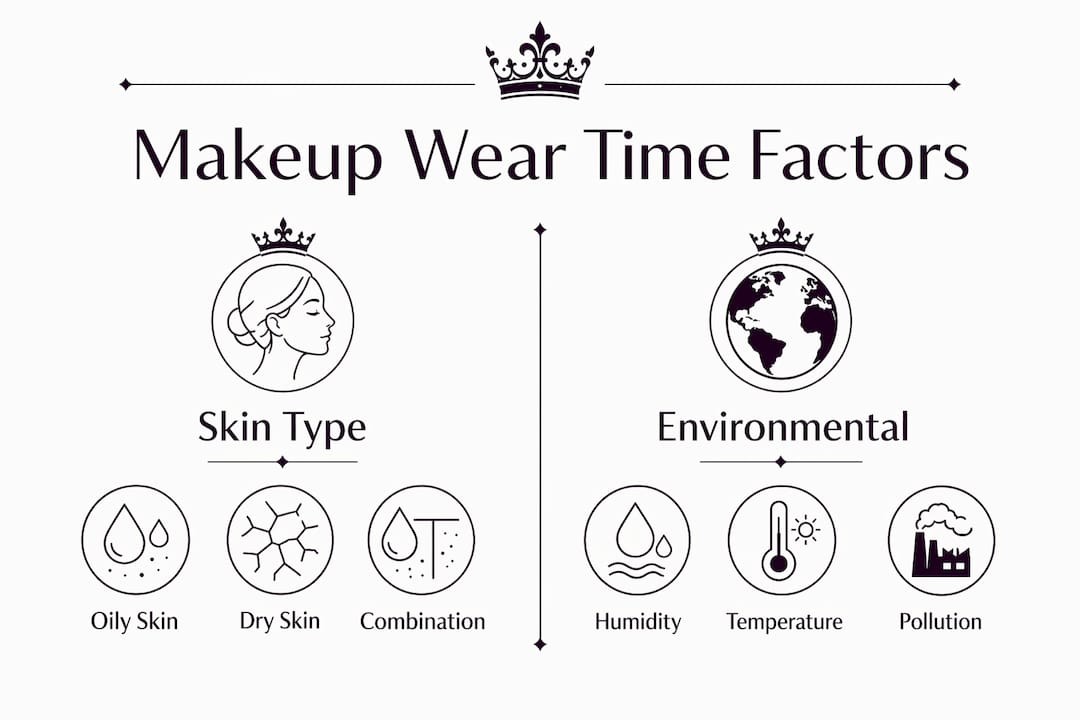
Oily skin accelerates foundation breakdown because sebum acts as a solvent, causing pigment to slide and separate. Dry skin creates a different problem: it absorbs moisture from the makeup itself, leading to patchiness, flaking, and an uneven finish within a few hours. Combination skin deals with both issues simultaneously, requiring a targeted approach by zone.
Here is how to adapt your routine by skin type:
For oily skin:
-
Use a mattifying, silicone-based primer to control sebum at the surface.
-
Choose powder or matte-finish foundations over dewy formulas.
-
Set with a translucent or pressed powder immediately after foundation.
-
Carry blotting papers for midday touch-ups instead of adding more powder, which can cake.
For dry skin:
-
Apply a hydrating, water-based primer after moisturizer to prevent the foundation from absorbing into the skin.
-
Choose satin or luminous liquid foundations that flex with the skin rather than sitting on top.
-
Avoid heavy setting powders, which can emphasize dry patches and reduce wear quality.
-
Use a hydrating setting spray as the final step to bind layers without drying them out.
For combination skin:
-
Prime each zone differently: mattifying primer on the T-zone, hydrating primer on cheeks and dry areas.
-
Use a flexible foundation formula that performs across both skin conditions.
Pro Tip: Apply your primer at least five minutes before foundation. Letting it fully set on the skin creates a stronger adhesion surface, which directly extends how long your base lasts.
Estée Lauder specifically advises matching primer to skin type as the most reliable strategy for improving longevity. This is not a generic tip. It is the difference between a foundation that lasts four hours and one that lasts eight.
What role do environmental factors play in makeup longevity?
Climate and environment are the most underestimated factors affecting makeup wear time. Hot and humid conditions can cut wear time to as little as 3 hours, while cold and dry climates can extend it to 6 hours or more. That is a difference of half a day, driven entirely by where you are standing.
Heat accelerates sebum production and causes the skin to sweat, both of which break down the bond between makeup and skin. Humidity adds moisture to the air that softens product layers and causes pigment to migrate. Cold weather reduces oil production and slows the breakdown process, but it also dries the skin, which can cause flaking in dry-skin formulas.
Here is how to adjust your routine for different environments:
-
Hot and humid climates: Switch to waterproof or long-wear formulas across all categories. Use a setting spray with film-forming ingredients as the final step. Blot rather than powder for touch-ups to avoid buildup.
-
Cold and dry climates: Prioritize hydrating primers and moisturizers under your base. Avoid heavy matte formulas that can crack or flake on wind-dried skin. A light facial mist midday refreshes the look without disrupting the base.
-
High-altitude environments: UV exposure increases significantly at altitude, which degrades certain pigments faster. Use a tinted SPF as part of your base to protect both skin and color.
-
Air-conditioned offices: Recirculated air dehydrates skin throughout the day, pulling moisture from your makeup. A hydrating setting spray applied at midday extends the life of your base without requiring a full touch-up.
Environmental conditions and skin oiliness interact to shape wear time in ways that fixed product claims cannot predict. Adjusting your routine seasonally is not optional if you want consistent results.
How do setting products and application techniques extend wear?
Setting products and application order are the two most controllable variables in makeup wear performance. Getting these right adds hours to your look without requiring you to buy a single new product.
The mechanism works in layers. Primer creates the adhesion base. Foundation bonds to that surface. Setting powder absorbs excess oil and locks the foundation in place. Setting spray then forms a lightweight film over everything, protecting the layers from humidity, friction, and sebum.
Follow this application order for maximum wear:
-
Moisturizer: Apply and let it absorb fully. Rushing this step means your primer sits on top of wet skin rather than bonding to it.
-
Primer: Choose based on skin type (see above). Wait at least five minutes before the next step.
-
Foundation: Apply in thin layers rather than one heavy coat. Thin layers bond more effectively and last longer.
-
Concealer: Apply after foundation so it has a prepped surface to adhere to.
-
Setting powder: Press (do not swipe) into the skin using a damp beauty sponge or powder puff. Pressing packs the powder into the foundation rather than sitting on top.
-
Setting spray: Hold the bottle 8 to 10 inches from your face and mist in an X and T pattern to cover the full face evenly.
Here is the recommended products per sequence for a full face:
-
Primer: Applied first to smooth skin texture and create a base for adhesion
Recommended:
-
Foundation: Liquid or cream formula applied in thin passes, not one heavy coat
Recommended:
-
Clarins Double Serum Foundation - (best overall)
-
RMS Beauty Un Cover-up Cream Foundation (best clean beauty choice)
-
-
Concealer: Placed after foundation so you only cover what the foundation did not
Recommended:
-
Cream blush, bronzer, or contour: Applied while the skin is still slightly tacky for better grip
-
Setting powder: Pressed, not swept, to lock everything in place
Laura Mercier’s setting sprays use Hydrolyzed Corn Starch as a film-former to lock pigment and resist transfer. This is not just a finishing touch. Setting spray functions through cosmetic chemistry to form a durable film that resists environmental challenges and physical contact.
Reapplication needs vary by product area. Lips and eyes often degrade faster than face base, so touch-up schedules should be product-specific rather than uniform. Carry a lip product and a small concealer for targeted fixes rather than redoing your entire face.
Pro Tip: Mist your beauty sponge with setting spray before pressing foundation into the skin. This technique, sometimes called “baking,” presses pigment deeper into the skin surface and measurably extends wear.
A scientific study published in Nature Scientific Reports tracked liquid foundation color changes using objective color measures over 8 hours, confirming that wear quality degrades in measurable stages rather than all at once. This means strategic touch-ups at the right intervals preserve the look far better than waiting until full breakdown occurs.
Key takeaways
Makeup wear time depends on skin prep, product type, and environment working together. No single product delivers all-day wear without the right foundation of primer, application technique, and setting products.
| Point | Details |
|---|---|
| Wear time by product | Liquid foundation lasts 8–12 hours with primer; lipstick lasts 4–6 hours under the same conditions. |
| Skin type matters most | Matching primer to your skin type extends wear more reliably than upgrading your foundation. |
| Climate cuts wear time | Hot and humid conditions can reduce wear to 3 hours; adjust formulas and setting products seasonally. |
| Application order is critical | Skipping primer or rushing layers can reduce longevity by up to 50%. |
| Setting spray is chemistry | Film-forming ingredients in setting sprays physically protect makeup from humidity, friction, and sebum. |
What I’ve learned about wear time that most articles get wrong
After spending years comparing products and reading ingredient labels, the pattern I keep seeing is this: people spend money on premium foundations and then skip the steps that actually make them last. A $15 drugstore foundation applied over a good primer and set correctly will outlast a $60 foundation applied to bare skin every single time.
The other misconception worth addressing is the idea that wearing heavy makeup longer than 6 to 8 hours is harmless as long as it still looks good. Skin renewal and respiration happen continuously, and heavy occlusive layers interfere with that process. The 8 to 12 hour wear window is not just a performance benchmark. It is also roughly the safe daily wear limit for most skin types.
What I find genuinely useful is thinking about wear time as a system rather than a product feature. Your skin condition that day, the weather, how much you touched your face, whether you ate oily food at lunch. All of these shift the outcome. The best approach is building a routine that accounts for variability: a solid primer, a setting spray, and a targeted touch-up kit for lips and eyes. That system beats any single “24-hour” product claim I have ever tested.
— Magdalena Kapuscinska - Queencompares.com Founder
Find your perfect long-wear match with Queencompares
Knowing what affects makeup wear time is only half the equation. Finding the right products for your specific skin type and lifestyle is where Queencompares comes in.

Queencompares gives you:
-
side-by-side product comparisons across foundations, primers, and setting sprays, so you can see real wear time claims, ingredient profiles, and community reviews in one place. Not sure whether your skin is oily, dry, or combination?
-
Take the skin type quiz to get personalized product recommendations matched to your skin profile. You can also use the Ingredient Checker to verify whether a formula contains film-forming or sebum-absorbing ingredients that genuinely support longer wear. Our community of beauty enthusiasts shares honest wear experiences every day, and your next long-wear staple is probably already in their reviews.
-
Check your makeup ingredients thoroughly with our Ingredient Checker, a comprehensive tool designed to help you identify potentially harmful substances, allergens, and ensure product safety before application.
-
Cross-check the detailed list of ingredients in our Ingredient Library, which provides comprehensive information on each component, including potential allergens, sourcing details, and nutritional facts to help you make informed choices.
-
Want to determine which makeup products contain genuinely clean and safe ingredients? Visit our Clean Beauty page, where we provide comprehensive, unbiased AI-powered Ingredient Safety Analysis to help you make informed choices about your cosmetics and skincare products.
FAQ
What is makeup wear time?
Makeup wear time is the period a cosmetic product stays visibly intact on the skin before fading, smudging, or creasing. On well-prepped skin, most long-wear foundations last 8 to 12 hours.
Which makeup product lasts the longest?
Waterproof mascara and matte liquid lipstick consistently deliver the longest wear among their respective categories, with waterproof mascara lasting up to 12 hours and matte liquid lipstick lasting up to 8 hours with proper application.
How does primer affect how long makeup lasts?
Primer creates a grippy adhesion surface that bonds foundation to the skin and absorbs sebum. Skipping it can reduce wear time by up to 50%, cutting an 8-hour foundation down to roughly 4 hours.
How long should you wear makeup in a day?
Makeup should ideally be removed within 8 to 12 hours of application. Wearing heavy makeup beyond that window can interfere with skin renewal and increase the risk of irritation.
Does climate change how long makeup lasts?
Yes. Hot and humid conditions can reduce wear time to as little as 3 hours, while cold climates can extend it to 6 hours or more. Adjusting your formula and setting products by season is the most practical fix.