TL;DR:
- A minimal travel skincare routine comprises four essential products: cleanser, moisturizer, broad-spectrum SPF, and targeted treatments, ensuring consistency and simplicity. Packaging in solid formats and decanting into TSA-compliant containers optimize space, while routine adjustments address different climates and environments. Following a straightforward four-step sequence and avoiding new actives prevents irritation, making skin protection reliable during travel and commuting.
A skincare routine for travel and commuting is a streamlined set of essential steps and products designed for portability, quick application, and protection against dryness, UV exposure, and pollution in transit. Whether you’re catching a 6 a.m. flight or grinding through a 90-minute subway commute, your skin faces the same core threats: dry recirculated air, unfiltered UV rays, and environmental grime. The good news is that dermatology-aligned guidance consistently values consistency over complexity. A four-step routine built around cleansing, moisturizing, sun protection, and one or two targeted treatments is all you need to keep your skin healthy and comfortable on the go.
What are the essential products for a travel skincare kit?
A travel-ready routine that includes essential skincare products such as a gentle cleanser, a lightweight moisturizer, broad-spectrum sunscreen, and a hydrating mist. For example, packing travel-sized bottles of your favorite cleanser and moisturizer can help maintain your skin’s health on the go. Don’t forget to include a small tube of SPF to protect your skin from UV rays during outdoor activities, and a hydrating spray to refresh your face throughout the day. These simple, effective items ensure your skin stays clean, protected, and moisturized without taking up too much space in your luggage. covers four non-negotiables: a gentle cleanser, a moisturizer that supports your skin barrier, a broad-spectrum sunscreen, and one or two targeted products you already use at home. That last point matters. Travel days are not the time to experiment with new actives or test a product you picked up at the airport. Stick to what your skin already knows.
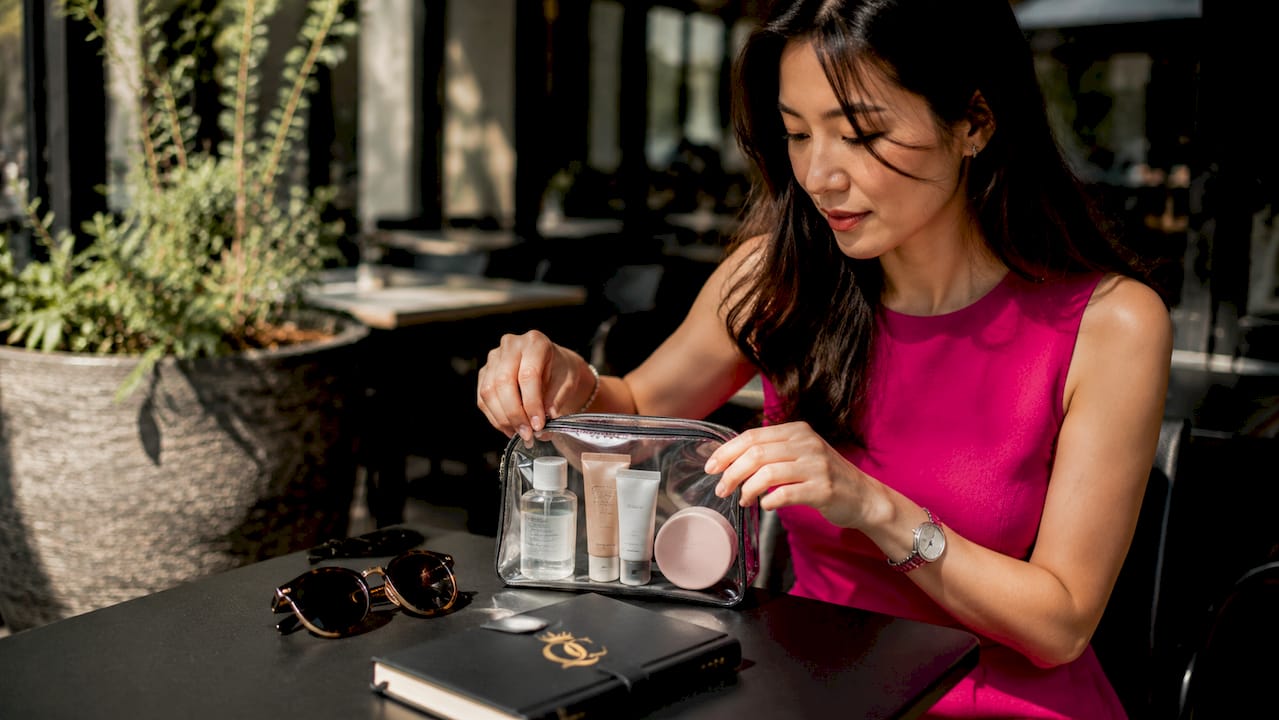
Packaging is where most people lose time and bag space. The TSA 3-1-1 liquid rule limits carry-on liquids to containers of 3.4 oz (100 mL) or less, all fitting into one clear quart-size bag. That rule applies to every liquid, gel, and cream in your kit. One way around it: solid formats. Solid cleansing bars, balm moisturizers, and SPF sticks are not classified as liquids, so they skip the quart bag entirely and free up space for other products.
Multipurpose products cut your kit in half. A tinted moisturizer with SPF 30 or higher replaces both your daytime moisturizer and sunscreen in one step. A lip balm with SPF covers both hydration and sun protection for your lips. The table below breaks down the most practical formats for travel and commuting.
| Product | Best format for travel | Why it works |
|---|---|---|
| Cleanser | Solid bar or micellar water | No liquid restrictions; micellar water needs no rinsing |
| Moisturizer | Balm or travel tube (under 3.4 oz) | Easy application; balms double as spot sealers |
| Sunscreen | SPF stick or mini bottle | Portable reapplication without mess |
| Targeted treatment | Original prescription in travel size | Maintains routine continuity |
Pro Tip: Decant your full-size products into reusable silicone travel bottles labeled with a marker. You save money, reduce waste, and always know exactly what’s inside.
For organization, a clear zip pouch keeps your kit visible and TSA-ready. Place the products you reach for first (sunscreen, lip balm) at the top. Quick access matters when you’re applying SPF on a moving train or in an airport bathroom with a line behind you.
How to adapt your routine for different travel environments
Dry airplane cabin air is the most aggressive skin stressor most travelers face. Cabin humidity typically drops well below what your skin is used to at home, which accelerates moisture loss from the surface layer. Emollients work by forming a protective layer that traps existing moisture and slows water loss rather than simply adding water to the skin. On flight days, reach for a richer, emollient-heavy moisturizer than your usual formula and apply it generously before boarding.
Climate at your destination changes the texture and quantity of products you need. In humid tropical climates, a lightweight gel moisturizer prevents that heavy, congested feeling. In cold or dry destinations, switch to a richer cream and consider a night moisturizer upgrade for extended trips. The principle is simple: match your moisturizer weight to the moisture level of the air around you.
Sun protection for commuters is not just an outdoor concern. UV exposure through windows is real, and daily sunscreen use matters even when you spend most of your day inside a car, train, or office. UVA rays penetrate glass and contribute to premature aging and pigmentation. Applying SPF 30 or higher every morning, regardless of weather or destination, is the single most protective habit you can build into your routine.
Here are the key adjustments to make based on your travel environment:
-
Airplane or long train ride: Apply a generous layer of moisturizer before boarding and carry a facial mist or balm for mid-journey touch-ups.
-
Hot and humid destination: Swap cream moisturizer for a gel formula and use a mattifying or lightweight SPF.
-
Cold or dry destination: Use a richer cream, apply moisturizer while skin is still slightly damp, and add a barrier balm to dry patches.
-
Daily car or subway commute: Apply SPF every morning without exception, even on overcast days or short trips.
Pro Tip: A small facial mist like Avène Thermal Spring Water or Mario Badescu Facial Spray fits in any bag pocket and gives your skin a hydration boost mid-flight without disturbing your SPF.
What is the step-by-step routine for busy travelers and commuters?
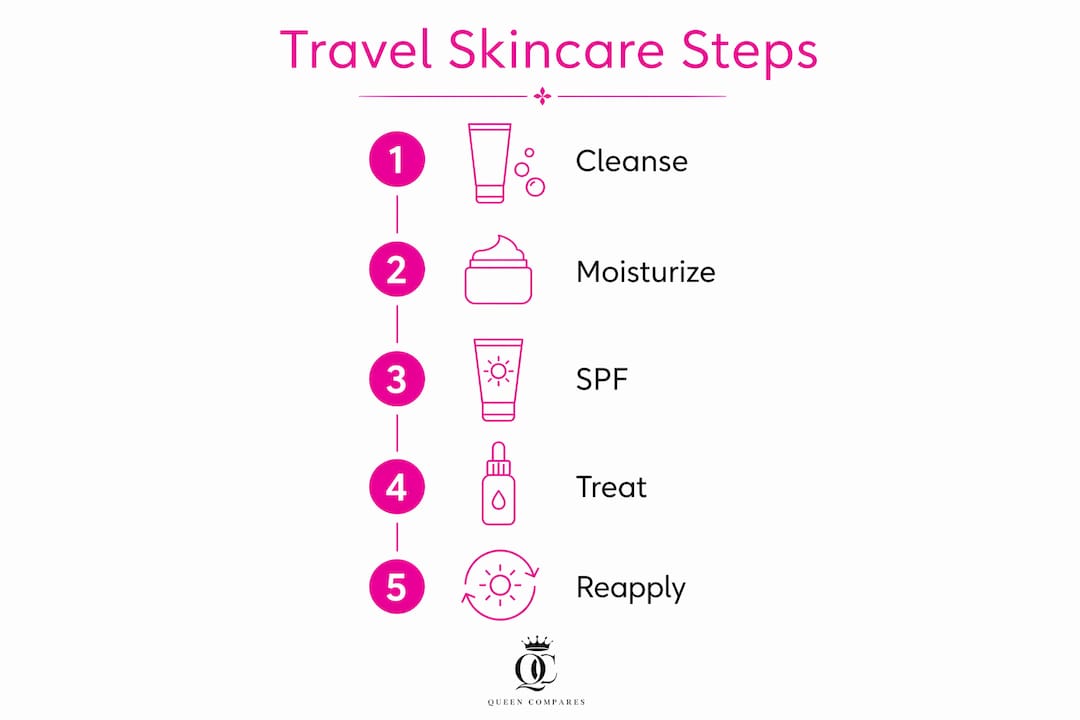
The most effective skincare for on-the-go lifestyles follows a four-step sequence that takes under five minutes. Airport and travel day guidance from dermatologists consistently points to one cleanser, one moisturizer applied generously, and a quick-apply sunscreen as the core trio that saves time and reduces skin stress.
-
Cleanse (morning and evening, 60 seconds). Use a gentle, sulfate-free cleanser or micellar water to remove sweat, sunscreen residue, and pollution from the day. On travel days, micellar water on a cotton pad works without a sink and is ideal for mid-trip refreshes.
-
Moisturize (immediately after cleansing, 30 seconds). Apply moisturizer within 3 minutes of cleansing to lock in hydration before the skin surface dries. Use enough product to cover your face and neck evenly. On flight days, apply a second layer mid-flight if your skin feels tight.
-
Apply sunscreen (morning only, 30 seconds). Use a broad-spectrum SPF 30 or higher as the final step in your morning routine. Reapply every 2 hours when in direct sun, and after sweating or swimming. An SPF stick makes reapplication fast and clean without needing a mirror.
-
Add targeted treatments (as needed, 30 seconds). Lip balm with SPF, a prescription retinoid at night, or a spot treatment for breakouts. Bring your regular prescribed actives for acne, pigmentation, or rosacea to maintain routine continuity and avoid flare-ups triggered by schedule and environment changes.
Pro Tip: On layover days or long commutes, a balm-based product like Aquaphor or CeraVe Healing Ointment applied to dry patches around the nose and lips acts as a spot seal that holds up for hours without reapplication.
The entire routine fits in under five minutes. That’s the point. Complexity is the enemy of consistency, and consistency is what actually protects your skin over time.
What common mistakes should you avoid with travel skincare?
The two most common failures in travel skincare are under-applying sunscreen and skipping mid-day reapplication. Most people underestimate how much sunscreen is needed for full SPF coverage, and the habit of applying once in the morning and forgetting it for the rest of the day is nearly universal. An SPF stick or a pocket-sized bottle solves the reapplication problem without requiring a full bathroom stop.
Avoid introducing new active ingredients right before or during a trip. Retinoids, exfoliating acids like glycolic or salicylic, and vitamin C serums can cause sensitivity, peeling, or irritation, especially when your skin is already stressed by dry air and schedule disruption. The travel-safe rule is to maintain your standard routine rather than increasing strength or adding new products while traveling.
Here are the most common pitfalls and how to fix them:
-
Skipping SPF on cloudy or indoor days. UVA rays penetrate clouds and glass. Apply SPF every morning, full stop.
-
Forgetting hands and lips. Both are exposed to UV constantly and are often ignored. Use an SPF lip balm and apply hand cream with SPF when possible.
-
Overpacking products. More products mean more weight, more TSA hassle, and more decisions. A four-product kit outperforms a ten-product kit you abandon by day two.
-
Using harsh cleansers while traveling. Foaming cleansers with sulfates strip the barrier when it’s already under stress. Stick to gentle, pH-balanced formulas. You can learn more about maintaining skin pH to understand why this matters.
“Simplicity is not a compromise. It’s the strategy that actually gets followed every day, in every time zone.”
If your skin feels irritated or unusually dry mid-trip, scale back to just moisturizer and SPF for a day or two. Removing actives temporarily gives your barrier time to recover without abandoning protection entirely.
Key takeaways
A travel skincare routine works best when it is built around four products, applied consistently, and adapted to your environment rather than expanded with new ingredients.
| Point | Details |
|---|---|
| Four products are enough | Cleanser, moisturizer, SPF, and one targeted treatment cover every skin need in transit. |
| TSA compliance shapes your kit | Keep all liquids at 3.4 oz or under; use solid formats to bypass the quart bag rule. |
| Reapply sunscreen every 2 hours | Under-application and skipping mid-day reapplication are the two most common SPF failures. |
| Match moisturizer to climate | Use richer formulas in dry or cold environments and lighter gels in humid destinations. |
| Never introduce new actives while traveling | Stick to your existing prescription and treatment products to avoid irritation and flare-ups. |
Why simplicity is the real secret to great travel skincare
I’ve reviewed hundreds of travel skincare guides, and the pattern is always the same: the most effective routines are the ones people actually follow. I’ve seen travelers pack 15-step routines into their carry-ons and abandon them by day three because the process felt like a chore. The minimalist approach, four products, consistent application, and smart packaging, wins every time.
What I find genuinely underappreciated is the role of the moisturizer on flight days. Most people treat it as optional. It’s not. Cabin air is aggressively drying, and a generous application of an emollient-rich formula before boarding is one of the highest-impact things you can do for your skin. I’d prioritize that over any serum or treatment product in your bag.
The other thing I’d push back on is the idea that commuting skincare is less demanding than travel skincare. A daily 45-minute car commute exposes your left side to cumulative UVA radiation through the driver’s window. That’s a real, documented concern, and it’s why daily SPF is non-negotiable regardless of whether you’re boarding a plane or just driving to the office.
If you want to track how your routine holds up across different environments and seasons, keeping a simple log of what you used and how your skin responded is genuinely useful. It removes the guesswork when you’re adjusting for a new climate or a longer trip.
— Magdalena Kapuscinska QueenCompares.com Founder
Find your perfect travel skincare kit at QueenCompares
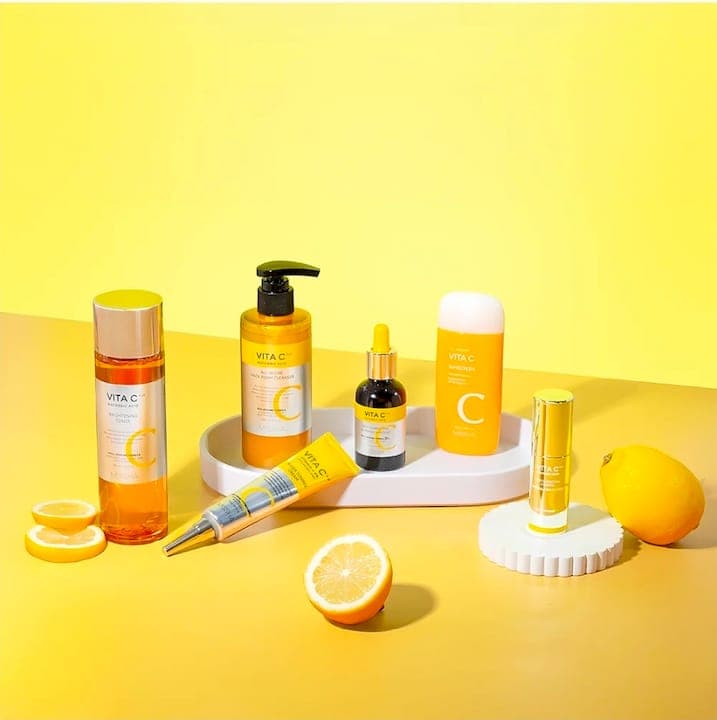
Building a travel skincare kit that actually works starts with choosing the right products for your skin type and travel habits. Missha Vita C Skincare Kit is a perfect travel companion.

QueenCompares makes that process straightforward. You can compare travel-friendly skincare products side by side, check ingredient safety ratings, and read community reviews from people who’ve tested these products in real commuting and travel conditions. Whether you’re looking for the best SPF stick, a gentle cleanser that fits TSA rules, or a multipurpose moisturizer that works in both humid and dry climates, the QueenCompares beauty category has curated options to match. Our Ingredient Checker tool helps you confirm that every product in your kit aligns with your skin’s needs before you pack it.
FAQ
What is the best skincare routine for travel and commuting?
The best routine covers four steps: gentle cleansing, moisturizer application, broad-spectrum SPF 30 or higher, and one targeted treatment you already use. Dermatologist-aligned guidance consistently recommends this minimal approach for consistency and skin health on the go.
How do I pack skincare for trips without breaking TSA rules?
Keep all liquid and cream products in containers of 3.4 oz (100 mL) or less, placed in one clear quart-size bag. Use solid bars, SPF sticks, and balm formats to bypass liquid restrictions entirely.
Should I wear sunscreen on my daily commute?
Yes. UV exposure through car and train windows contributes to skin aging and pigmentation even on short indoor commutes. Apply SPF 30 or higher every morning regardless of weather or trip length.
Can I use the same skincare products in different climates?
You can use the same core products, but adjust the texture and quantity of your moisturizer based on climate. Switch to a richer formula in cold or dry destinations and a lighter gel in humid environments for best results.
Is it safe to try new skincare products while traveling?
No. The travel-safe rule is to maintain your existing routine without introducing new actives or increasing product strength, which reduces the risk of irritation and flare-ups during trips.