
Finding trustworthy ingredient breakdowns for mineral sunscreens can take hours when comparison tools ignore label detail and skip real-life feedback. Many websites only match formulas by ingredient similarity and do not offer skin profile matching or community reviews beyond star ratings. This guide lays out three ingredient analysis sites so beauty consumers can choose the best platform for their sunscreen search.
Table of Contents
Queen compares
At a Glance
The Ingredient Checker and Label Scanner analyze formulas and barcode labels to surface ingredient safety signals. Community reviews then add real-world experience and ratings for each product entry. Quick side by side comparisons let you weigh formulas, reviews, and safety scores at a glance.
Core Features
QueenCompares combines community-based and editorial reviews with a searchable ingredient library and safety scores, which helps you judge a product beyond marketing claims. The platform offers side by side product comparison tools and barcode label scanning to pull ingredient lists into a unified view. Personalized skincare recommendations match products to skin type and preferences using those ingredient and review signals.
Key Differentiator
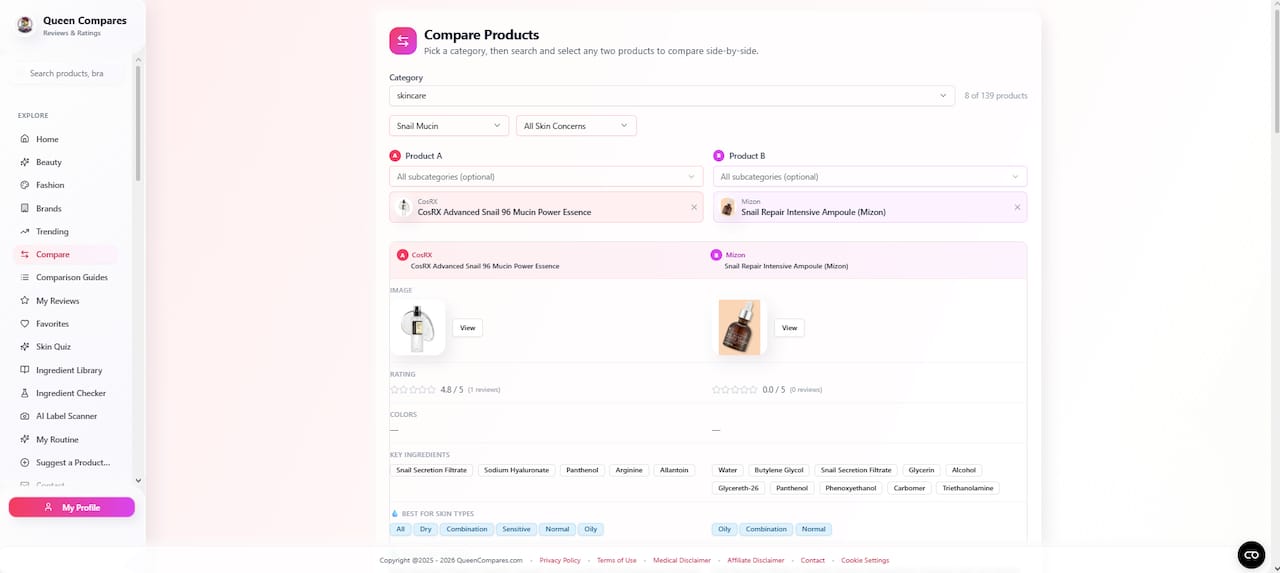
An independent, community-driven approach anchors the site, but the distinguishing capability is the depth of ingredient analysis tied directly into the comparison workflow. That pairing makes it simple to compare formulas by safety score, not just price or marketing. The community layer adds context to raw ingredient data through lived experience and product notes.
What’s more, thanks to the comparison tool, you can compare two beauty products side by side to see detailed information about each one. This includes a comprehensive breakdown by Key Ingredients, Beneficial Actives, Emollients, and Texture Agents, allowing you to understand what makes each product unique. Additionally, the tool highlights the Pros and Cons of each item, helping you make more informed decisions based on your specific skincare or beauty needs. For example, you might compare a moisturizer and a serum to see which contains more hydrating ingredients or which has fewer potential irritants.
Then you can move a step further and get a full AI Analysis Report that unveils similarities, differences, and dupe detection. This report uses advanced algorithms to identify products with similar formulations or effects, making it easier to find affordable alternatives or dupes for high-end products. For instance, if you’re interested in a luxury anti-aging cream, the AI report can suggest comparable products at lower prices, saving you money while still achieving your desired results. This feature is especially useful for beauty enthusiasts who want to explore options without compromising on quality or effectiveness.
Benefits
The platform surfaces both formula data and community feedback in one place, which speeds decision making when you vet sunscreens or serums. Ingredient Checker and Label Scanner pull ingredients into the comparison view so you can spot irritants or actives without switching tabs. The site also aggregates reviews across categories, giving you cross-product context for brands you already trust.
In Comparison Guides , you can find detailed features with comprehensive analysis about various products that might be potential duplicates or similar beauty alternatives. These guides help you understand the main differences and similarities between products, including their ingredients breakdown, texture, scent, and performance. For example, you can compare two moisturizers to see which one contains more natural ingredients or which one offers better hydration. Additionally, the guides often include user reviews and expert opinions to help you make more informed shopping decisions, ensuring you select the best product suited to your needs and preferences.
Who It’s For
-
Beauty consumers who prioritize ingredient transparency and want hands-on tools to compare products.
-
Skincare enthusiasts who read labels and care about safety scores when choosing sunscreens and moisturizers.
-
People who prefer community perspective tied directly to ingredient data rather than retailer ratings alone.
Unique Value Proposition
The Ingredient Checker and Label Scanner turn product labels into searchable, comparable data points you can filter by safety and skin type. That capability reduces time spent opening multiple product pages and reading long ingredient lists. For shoppers who filter by a few banned or preferred ingredients, the tools convert preference into fast, repeatable comparisons.
Real World Use Case
A shopper preparing for summer lists sensitive skin and zinc oxide preference in the recommendation settings. They scan three candidate sunscreens, view safety scores, and run a side by side comparison that highlights irritants and redundant actives. With community reviews visible, the shopper selects the formula that matches their skin type and lifestyle.
Website: https://queencompares.com
Skinskool Beauty

At a Glance
Skinskool Beauty reports over 63,216 ingredient lists, 5,202 brands, and more than 10 million searches on the site. That scale powers side by side comparisons that surface ingredient matched alternatives and dupes across price points. The site highlights trending and budget friendly options and provides direct shop links so you can buy a match quickly.
Core Features
Ingredient list comparison sits at the center of the experience. The site centralizes raw ingredient lists and lets you compare them side by side to spot overlaps and near matches. You can filter by category, view curated trending subsets, and follow purchase links when a match appears.
Key Differentiator
The primary distinction is the size of its ingredient library. Using that database, Skinskool Beauty prioritizes ingredient similarity to surface dupes rather than full formulation analysis. That narrow focus speeds discovery for shoppers seeking cost conscious alternatives but reduces depth around product performance.
Pros
The catalog breadth helps you find lower cost alternatives for a specific ingredient profile quickly. Data driven ingredient comparisons expose obvious overlap between high end and drugstore formulas. Search and trending lists are simple to use, which suits people who want a fast match rather than a deep read on formulation details.
Cons
-
Comparison relies only on ingredient list similarity and does not assess formulation or efficacy.
-
The site does not provide detailed formulation analysis or comprehensive user reviews to judge real world performance.
-
Product performance data is limited, so you cannot rely on the site for verified results.
-
Accuracy depends on brands’ ingredient disclosures, and listing errors will affect matches.
When It May Not Fit
If you want clinical testing, dermatologist commentary, or verified performance metrics this will feel incomplete. The service does not deliver deep formulation breakdowns or expert recommendations. Also avoid it if you need curated product picks based on trial results rather than ingredient similarity.
Who It’s For
-
Beauty consumers who focus on ingredients and price will get the most value here.
-
The site suits shoppers hunting for drugstore alternatives to expensive serums or those comparing formulas before buying.
-
It also fits enthusiasts who enjoy scanning ingredient lists to learn what goes into a product.
Real World Use Case
A shopper compares Luxury Serum A with Drugstore Brand B to check ingredient overlap and cost differences. They spot several matching actives, follow the shop link, and choose the lower cost option for a trial. The tool saved time by showing comparable formulas without reading dozens of product pages.
SkinSort

At a Glance
According to the company, SkinSort assigns personalized skincare scores by combining a user skin profile with ingredient analysis. The app pairs ingredient explanations and community reviews with tools for building and tracking routines. That mix helps people who want objective details and a place to compare products quickly.
Core Features
SkinSort offers detailed ingredient explanations and a searchable database that highlights functions and potential irritants. It generates personalized scores from your skin profile, and it lets you compare products side-by-side while filtering for conditions like rosacea or fungal acne. The app also includes routine building and tracking so you can log products, note reactions, and monitor progress over time.
Key Differentiator
The vendor advertises a blend of in-depth ingredient notes with user-specific scoring that aims to translate chemistry into practical buying guidance. That feature links ingredient function to how a product might perform for your profile rather than giving generic ratings. The result reads as a targeted decision aid for people who want both science and community input.
Pros
SkinSort delivers rich ingredient context that explains why an ingredient behaves a certain way and which skin types should avoid it. The personalized scoring and routine suggestions make it easier to prioritize products for an individual profile. Community reviews come from people with similar concerns, which helps when you want anecdotal confirmation alongside the technical notes. The comparison and filtering tools speed up finding safer options for sensitive skin.
Cons
-
Specific third-party reviews indicating limitations were not provided. This makes independent validation harder.
-
The app can present a lot of technical detail, which may overwhelm skincare newcomers. New users may need time to parse ingredient science.
-
It may not have in-depth features for advanced dermatological routines. Professionals who need clinical tools might find the app limited.
-
Limited to mobile app; no desktop version is available. That restricts users who prefer a larger screen for research.
When It May Not Fit
If you prefer a minimalist, product-first shopping experience, the volume of ingredient data can feel excessive. Professionals requiring clinical testing logs or formal treatment plans will find the app missing those features. People who cannot provide accurate or consistent profile input will get weaker personalization from that system.
Who It’s For
-
This app suits skincare enthusiasts who want to learn why ingredients behave the way they do and how formulas compare.
-
It also fits people with sensitive or condition-specific skin who need filters and community experiences to vet products. Routine builders who want to track reactions and product performance will get the most value.
Real World Use Case
A person with sensitive skin uses SkinSort to filter for moisturizers that avoid known irritants and to compare three candidate products side-by-side. They log the chosen routine, note any redness, and adjust the routine based on product performance and scoring. Over several weeks the user refines choices and documents what works for their profile.
Comparison of alternatives
QueenCompares, Skinskool Beauty, and SkinSort each offer distinct innovations in the realm of skincare ingredient analysis, catering to diverse user priorities. Evaluating their approaches reveals unique strengths, which can guide skin-conscious consumers to the platform aligning best with their needs.
Ingredient analysis accuracy and utility
When emphasizing ingredient safety and transparency, QueenCompares excels. It integrates community reviews with safety scoring capabilities, enabling nuanced evaluations personalized to specific skin concerns. SkinSort also provides in-depth ingredient insights, further supported by routine tracking. However, it emphasizes correlating user profiles with ingredient functions, which may overwhelm novices. Skinskool Beauty prioritizes speed over depth by focusing on ingredient similarity to surface cost-effective product alternatives, useful for budget-conscious buyers but less so for those requiring in-depth evaluations.
Personalized recommendations and functionality
QueenCompares stands out for balancing broad ingredient analysis with user input to amplify its recommendations’ relevance. SkinSort offers personalization by connecting user profiles with ranked ingredient performance, suitable for managing condition-specific routines. Skinskool Beauty, streamlined for affordability, lacks comparable adaptability but offers trending and curated lists, making it suitable for quick decisions.
Best fit
-
For skincare enthusiasts focused on ingredient safety and user insights, QueenCompares creates a streamlined platform for evaluating options based on preferences and health considerations.
-
Shoppers seeking affordable dupes to expensive formulas with an emphasis on price-effectiveness will appreciate Skinskool Beauty’s efficient ingredient-matching capabilities.
-
Individuals requiring tailored skincare routines built around personal conditions and tracked progress will find value in SkinSort’s personalized tools.
Our pick
For shoppers prioritizing ingredient safety analysis alongside informed user evaluations, QueenCompares delivers a distinctive balance of community feedback and analytical depth. While Skinskool Beauty and SkinSort offer unique advantages, their limited versatility in blending transparency with practical application presents specific trade-offs. When affordability or focused routine tracking prevails, these alternatives may suit other priorities.
This table presents a comparison of leading skincare ingredient analysis platforms, emphasizing their core strengths and limitations to guide your selection.
| Platform | Core Feature | Key Differentiator | Best For | Notable Limitation |
|---|---|---|---|---|
| QueenCompares | Ingredient analysis with community reviews | Community-driven and beauty editor context for comprehensive analysis | Consumers valuing ingredient transparency and savvy shoppers | Heavily relies on community reviews and beauty editor reviews |
| Skinskool Beauty | Extensive ingredient list database for comparisons | Emphasis on identifying ingredient dupes | Shoppers seeking cost-effective alternatives | Focuses on ingredients only, lacking performance insights |
| SkinSort | Combines ingredient analysis with personalized scoring | Targeted matching of ingredients to skin profiles | Skincare enthusiasts needing routine optimization | App interface limits use to mobile devices only |
How to Choose the Safest Mineral Sunscreens for Your Skin
Finding the right mineral sunscreen can feel confusing with so many options. The key is understanding ingredient safety and how formulas fit your unique skin needs. QueenCompares helps beauty consumers who prioritize ingredient transparency by combining community reviews with ingredient safety scores and personalized skincare recommendations.
QueenCompares offers tools like the Ingredient Checker and Label Scanner to compare mineral sunscreens side-by-side. These features reveal irritants and active ingredients quickly, reducing time spent reading long labels. Join the Queen community and confidently pick products that match your skin profile and lifestyle.
Visit QueenCompares to compare top mineral sunscreens and find the best fit for your sensitive or sun-care focused skin today.
Top Clean Beauty Mineral sunscreen picks:
FAQ
How does QueenCompares help with ingredient safety in mineral sunscreens?
QueenCompares analyzes formulas using its Ingredient Checker and Label Scanner, focusing on ingredient safety signals. These features allow users to spot irritants and actives quickly, facilitating informed decisions about mineral sunscreens. Users seeking a thorough understanding of product ingredients can rely on this tool to enhance their shopping experience.
What is the difference between QueenCompares and Skinskool Beauty?
Skinskool Beauty excels in its large database, reporting over 63,216 ingredient lists which helps in spotting ingredient-matched alternatives quickly. QueenCompares stands out for its community-driven reviews and personalized skincare recommendations, providing a more contextual understanding when evaluating mineral sunscreens. This makes QueenCompares suitable for those who value community feedback alongside ingredient analysis.
Can I use QueenCompares to compare different mineral sunscreen options?
QueenCompares allows for easy side-by-side comparisons of products based on safety scores, reviews, and ingredient analysis. This feature equips users to make better choices by evaluating different mineral sunscreens effectively and quickly. Shoppers should expect a streamlined process that reduces confusion while comparing products.
Which platform offers deeper ingredient analysis for mineral sunscreens?
QueenCompares provides in-depth ingredient analysis tied into its comparison workflow, which is beneficial for discerning consumers. Users wanting extensive insights into skincare ingredients will appreciate the detailed reports available on QueenCompares. The site focuses on safety scores and community experiences for a well-rounded view.
How can I find mineral sunscreens that suit sensitive skin on QueenCompares?
QueenCompares generates personalized skincare recommendations based on user preferences and skin type, which helps in finding suitable mineral sunscreens. By entering specific needs like sensitive skin or ingredient preferences, users can filter down to products that align with their requirements. This ensures a tailored experience for individual skin concerns.