
Yes, anti-aging face massage genuinely works — just not in the way most people expect. Regular massage improves circulation, supports lymphatic drainage, and helps maintain muscle tone, and it can soften the look of fine lines over time. It won't erase deep wrinkles or replace structural procedures, but as a consistent at-home practice it's one of the most accessible tools in any anti-aging skincare routine. One safety note before you start: if you've had Botox or dermal fillers in the last two weeks, or if your skin is actively inflamed or broken out, hold off until those conditions resolve. For everyone else, start with 5–10 minutes per session, three to five times a week, and give it six to eight weeks to assess real change. If you're dealing with significant sagging or deep folds, massage is a great maintenance tool but a conversation with a board-certified dermatologist or plastic surgeon will tell you whether a more structural approach makes sense.
Key Takeaways
Consistent anti-aging face massage produces measurable improvements in skin elasticity and facial contour when practiced five times a week for at least eight weeks, but it works best as part of a broader skincare strategy that includes safe product choices and professional care for structural concerns.
| Point | Details |
|---|---|
| Evidence is real but modest | An 8-week RCT showed roller improved skin elasticity and gua sha produced measurable contour changes in 34 women. |
| Frequency and timing | Aim for 5–10 minutes per session, three to five times a week; assess results after six to eight weeks. |
| Safety red flags | Skip massage over active inflammation, recent injectables (wait at least two weeks), open wounds, or post-surgical skin without provider clearance. |
| Tool and product choice | Use high-slip, non-comedogenic, fragrance-free oils; clean tools after every use; check ingredients before buying. |
| QueenCompares for product safety | Use the QueenCompares Ingredient Library and product comparison tools to verify massage oils and serums before use. |
Table of Contents
- Does anti-aging face massage actually work? What the research says
- What are the main types of facial massage techniques?
- How to do a step-by-step at-home facial massage routine
- How to choose and use facial massage tools and products safely
- When should you skip facial massage? Risks and red flags
- When massage isn't enough: in-office options and how to choose a provider
- What are the next steps after reading this?
- The case for massage as a daily practice, not a trend
- QueenCompares helps you choose safer massage products
- Sources
- FAQ
Does anti-aging face massage actually work? What the research says
The evidence is real, but it's worth knowing its limits before you commit to a routine.
The most rigorous data comes from an 8-week randomized controlled trial of 34 women who used either a facial roller or gua sha for 10 minutes a day, five times a week. Both techniques produced statistically significant improvements in facial contour measurements. Those are modest but measurable numbers from a controlled setting, and they matter because they confirm that technique choice shapes the outcome.
A separate pilot 3D-CT imaging study found that twice-daily self-massage over two weeks produced small but detectable tissue changes: cheek thickness decreased slightly and SMAS height increased slightly. The sample was small and the timeline short, so treat this as preliminary evidence of tissue-level shifts rather than a proven protocol.
The mechanisms behind these changes are fairly well understood. Massage increases microcirculation, bringing fresh oxygen and nutrients to skin cells. It stimulates lymphatic flow, which reduces puffiness and helps clear metabolic waste from tissue. Manual pressure may also activate collagen-synthesis pathways in the dermis, according to skincare experts at Byrdie. And regular muscle manipulation can shift resting tone in the superficial facial muscles, which is why gua sha and roller techniques produce different outcomes.

What massage won't do is reverse structural volume loss, reposition descended fat pads, or smooth deep static wrinkles. Healthline's clinical overview frames it well: treat facial massage as a skin-health maintenance tool, not a wrinkle eraser. Visible de-puffing and a radiance boost can appear after a single session; contour and elasticity changes take weeks to months of consistent practice.
Professional sessions go deeper. Estheticians and massage therapists use techniques and pressure levels that are harder to replicate at home, and monthly professional treatments can accelerate results. But consistent at-home work is what maintains those gains between appointments.
| Study | Design | Key Outcome |
|---|---|---|
| Roller vs. gua sha RCT | 34 women, 8 weeks, 5×/week | Roller: improves skin elasticity; gua sha: produces measurable contour changes |
| 3D-CT self-massage pilot | Small sample, 2 weeks, 2×/day | Cheek thickness −0.8%; SMAS height +2.6% (preliminary) |
| Lymphatic massage review | Literature review + pilot data | Reduced edema, improved contour; supports nourishment pathways |
What are the main types of facial massage techniques?
Different techniques target different problems. Here's how to match the method to your goal.
Manual lymphatic drainage
Light, rhythmic strokes that follow lymph-node pathways, typically starting at the neck and moving outward across the face. The pressure is feather-light, almost no heavier than the weight of a finger resting on skin. Best for morning puffiness, post-travel bloating, and anyone with fluid retention around the eyes or jawline. Pair with a lightweight facial oil or skip product entirely for dry work.
- Best for: De-puffing, post-travel recovery, general skin nourishment
- Pressure: Very light (lymphatic vessels sit just below the skin surface)
- Safety note: Avoid if you have active infection, recent surgery, or a clotting disorder
Gua sha
A flat tool, traditionally jade or rose quartz, scraped along the face in long, upward strokes. The RCT data shows gua sha produces measurable contour changes and muscle-tone shifts, making it the better choice when sculpting and definition are the goal. Use with a generous layer of facial oil to prevent friction damage. Frequency: four to five times a week for active results, two to three times for maintenance.
- Best for: Jawline definition, muscle-tone changes, contouring
- Pressure: Moderate, always with oil; never drag on dry skin
- Safety note: Skip over active breakouts, inflamed areas, or recent filler sites
Facial roller (jade, rose quartz, or metal)
A rolling tool that glides across the face with less directional pressure than gua sha. The RCT found rollers specifically improve skin elasticity, making them a solid choice for anyone focused on firmness and texture rather than sculpting. Metal rollers can be chilled for an added de-puffing effect. Use with a serum or oil.
- Best for: Skin elasticity, product absorption, relaxation
- Pressure: Light to moderate; let the weight of the tool do the work
- Safety note: Clean after every use; bacteria transfer from tool to skin is a real concern
Facial exercises (face yoga)
Targeted muscle contractions and resistance movements designed to strengthen and lift facial muscles. The Cleveland Clinic notes that consistent facial exercises may help maintain muscle tone, though evidence is still emerging. No tools or products needed, which makes this the most portable option.
- Best for: Muscle tone, natural face lifting, anyone who travels frequently
- Pressure: Isometric resistance, not surface pressure
- Safety note: Avoid exaggerated movements around recent injectable sites
Kansa wand
A small dome-shaped tool made from a traditional Indian copper-tin alloy. It's used in Ayurvedic practice for facial massage and is thought to help balance skin pH and reduce inflammation. Less studied than rollers or gua sha, but popular for relaxation and gentle contouring. Use with a light oil.
- Best for: Relaxation, gentle contouring, Ayurvedic-style routines
- Pressure: Light to moderate
- Safety note: Patch-test if you have metal sensitivities
How to do a step-by-step at-home facial massage routine
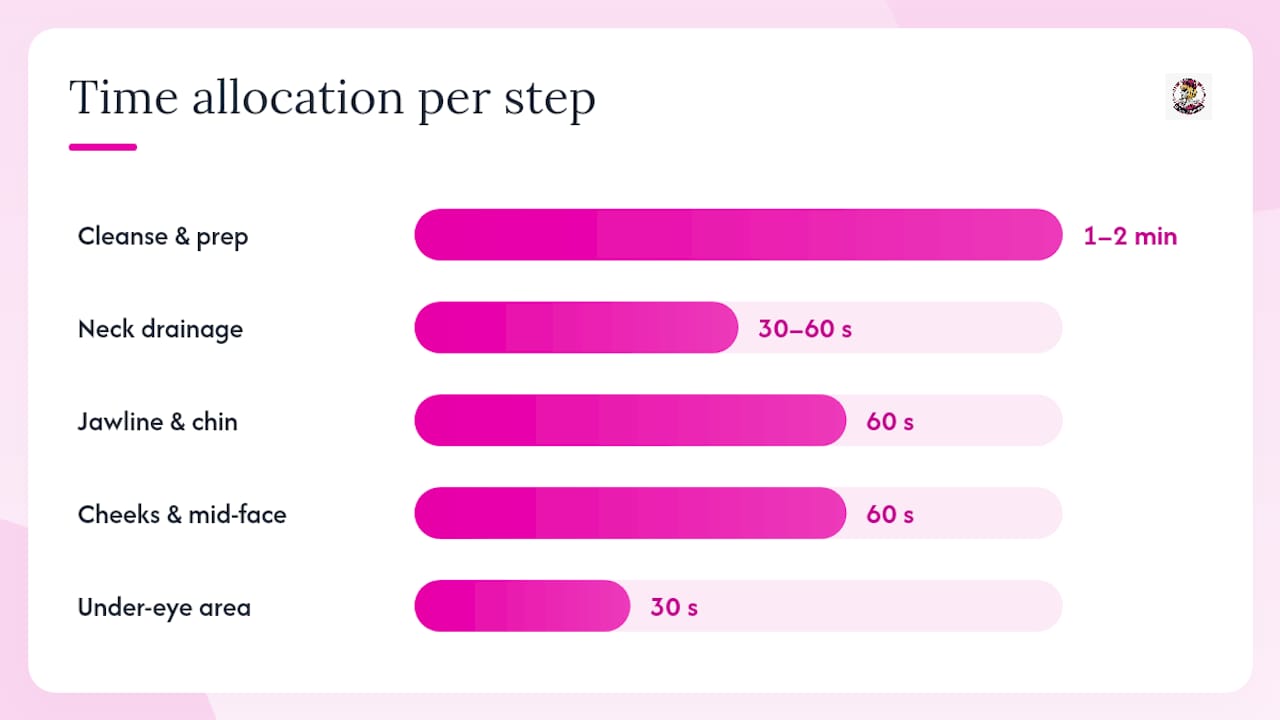
This routine takes 5–10 minutes total and works for most skin types. Do it on clean skin with a facial oil or serum for slip.
-
Cleanse and prep (1–2 min). Wash your face and pat it mostly dry. Apply 3–5 drops of a facial oil or a pea-sized amount of serum to your fingertips and press it gently across your face and neck. You need enough slip that your fingers or tool glide without dragging.
-
Neck drainage (30–60 sec). Before touching your face, open the lymphatic pathways in your neck. Place both hands flat on either side of your neck and use light downward strokes from jaw to collarbone, five to six repetitions. This creates a "drain" for the fluid you'll move from your face.
-
Jawline and chin (60 sec). Using your knuckles or a gua sha tool, work from the center of your chin outward along the jawline to the ear. Three repetitions per side, moderate pressure. This is where most people carry tension and where contour changes are most visible.
-
Cheeks and mid-face (60 sec). Sweep upward and outward from the nose toward the temples, following the cheekbone. Use a roller or flat fingers. Three repetitions per side, light to moderate pressure.
-
Under-eye area (30 sec). Switch to your ring finger (the weakest, least likely to over-press). Tap lightly from the inner corner outward along the orbital bone. Never press directly on the eye socket. Three repetitions per side.
-
Forehead (30–60 sec). Smooth upward from the brow to the hairline, alternating hands. This relaxes the frontalis muscle and can soften horizontal lines with consistent practice. Three repetitions.
-
Temple and scalp release (30 sec). Finish with small circular motions at the temples, then move fingers into the hairline. This releases tension that contributes to forehead lines and brow furrow.
-
Final neck drain (30 sec). Repeat the neck drainage strokes from step 2 to clear the fluid you've moved. This is the step most people skip, and it's the one that makes the biggest difference in de-puffing results.
Frequency: A quick 5-minute version of this routine works well daily. The full 10-minute version is ideal three to five times a week. Give yourself six to eight weeks of consistency before evaluating results.
Modifications by skin type:
- Sensitive skin: Use the lightest possible pressure, skip gua sha until your barrier is strong, and choose fragrance-free oils like squalane.
- Acne-prone skin: Avoid massaging over active breakouts. Use non-comedogenic oils (squalane, hemp seed) and clean your tools after every single use.
- Mature or dehydrated skin: Increase oil volume for more slip, reduce pressure slightly, and focus on lymphatic strokes rather than deep sculpting.
Age-based adjustments: In your 30s, moderate pressure and sculpting strokes are well-tolerated and great for prevention. By your 50s, skin is thinner and more fragile, so lighter pressure and more lymphatic-style work tends to serve the skin better. Check out how age affects skincare needs for a fuller breakdown by decade.
Pro Tip: Combine your neck drainage with a one-handed technique: use your non-dominant hand to gently hold the skin taut at the collarbone while your dominant hand performs the downward neck sweep. This keeps the drainage pathway open and prevents the skin from bunching, which makes the lymphatic strokes noticeably more effective.
How to choose and use facial massage tools and products safely
The product you use under your hands or tool matters as much as the technique itself.
What to look for in a massage product:
- High slip (the product should let your fingers or tool glide without resistance)
- Non-comedogenic rating, especially for acne-prone skin
- Fragrance-free formulas for sensitive or reactive skin
- Carrier oils with a stable fatty acid profile: squalane, rosehip, marula, and jojoba are popular choices that absorb well and don't clog pores for most skin types
- Avoid heavy occlusives like petrolatum or thick balms as your primary massage medium; they create too much drag for tool-based techniques
Tool selection and hygiene:
- Gua sha: Jade and rose quartz are the most common materials. Both work well; the difference is largely aesthetic. Look for smooth, polished edges with no chips or rough spots that could scratch skin.
- Facial rollers: Jade and rose quartz rollers are gentle and widely available. Metal rollers (often stainless steel) can be refrigerated for a cooling, de-puffing effect. Check that the roller head spins smoothly and doesn't snag.
- Kansa wand: Verify the alloy composition if you have metal sensitivities.
- Clean your tools after every use. Wipe with a gentle soap and warm water, then dry completely before storing. Bacteria and oil residue on tools transfer directly to your skin.
When not to use a massage product or tool:
- Immediately after chemical exfoliation (AHAs, BHAs) or active retinoid use: your skin barrier is compromised and friction can cause irritation or micro-tears
- Over open lesions, active eczema, or rosacea flares
- Within two weeks of Botox or dermal filler injections (see the next section for full guidance)
Before you commit to a new oil or serum for your massage routine, run it through the QueenCompares Ingredient Library to check for comedogenicity ratings, allergen flags, and ingredient safety data. It takes about 30 seconds and can save you from a breakout or reaction.
When should you skip facial massage? Risks and red flags
Massage is low-risk for most people, but there are clear situations where it can cause harm.
Contraindications: stop or skip entirely if you have:
- Active skin infection, open wounds, or cold sores in the massage area
- Eczema or dermatitis in a flare (friction worsens barrier damage)
- Active rosacea flare (increased blood flow can intensify redness and flushing)
- Recent chemical peel: wait at least one full week, longer for medium or deep peels
- Recent Botox: most practitioners recommend waiting a minimum of two weeks before massaging the treated area; ask your injector for personalized timing
- Recent dermal fillers: wait a recommended period after injections before massaging; massage may affect recent filler integration
- Recent cosmetic surgery: get clearance from your surgeon before resuming any facial massage
Red flags: stop immediately and seek medical advice if you notice:
- Severe or sharp pain during massage
- Spreading redness, warmth, or swelling that wasn't there before
- Visible bruising or skin breakdown
- Sudden vision changes after working near the orbital area
Lymphatic massage and surgery: If you've had recent facial surgery or have a known clotting disorder, lymphatic-style massage should only be performed under the guidance of a qualified therapist or medical provider. The lymphatic massage literature review notes that while lymphatic drainage supports healing in appropriate candidates, timing and technique matter significantly in post-surgical contexts.
The less-is-more principle applies here too: if your skin feels irritated after a session, dial back the pressure and frequency before adding more steps.
When massage isn't enough: in-office options and how to choose a provider
Massage is a strong maintenance tool, but structural facial aging involves bone resorption, fat pad descent, ligament laxity, and dermal thinning. No amount of at-home massage addresses those layers. A multimodal approach is what most board-certified providers now recommend, combining treatments that work at different tissue depths.
Main in-office options:
- Botox (botulinum toxin): Relaxes dynamic wrinkle-causing muscles. Works well for forehead lines, crow's feet, and brow furrow. Results typically last three to four months.
- Dermal fillers (hyaluronic acid): Restore volume in areas like the cheeks, under-eyes, and lips. HA fillers are reversible with hyaluronidase. Duration varies by product and placement.
- Collagen stimulators (CaHA, PLLA): Biostimulators like Sculptra (PLLA) and Radiesse (CaHA) trigger the body's own collagen production over months. Results develop gradually and last longer than HA fillers.
- HIFU (high-intensity focused ultrasound): Targets the SMAS layer to produce a lifting effect. Minimal downtime; results build over two to three months.
- RF microneedling: Combines radiofrequency energy with microneedling to stimulate collagen and tighten skin. Typically requires a series of treatments.
- Lasers and light devices: Address surface texture, pigmentation, and mild laxity. Recovery varies widely by device intensity.
- Surgical options (rhytidectomy/facelift): For marked ptosis and deep rhytides, surgery remains the definitive structural solution. Deep-plane and SMAS techniques address multiple tissue layers simultaneously.
When to consider in-office treatment over massage alone:
Significant volume loss, jowling, deep nasolabial folds, or skin laxity that doesn't respond to six to eight weeks of consistent massage are reasonable triggers for a professional consultation.
Provider checklist for your consultation:
- Verify board certification (dermatology, plastic surgery, or facial plastic surgery for surgical options)
- Ask to see before-and-after portfolios specific to your concern
- Ask about treatment sequencing: which modality first, and why
- Confirm aftercare restrictions, including when massage is safe to resume post-procedure
- Ask about realistic timelines and what "maintenance" looks like long-term
What are the next steps after reading this?
Here's where to start, right now.
- Begin a 5–10 minute routine this week. Use the step-by-step sequence above, starting with neck drainage and ending with a final lymphatic sweep. Three to five sessions a week is the sweet spot for most people.
- Scan your products before you use them. Check your massage oil or serum for comedogenic ingredients, allergens, and safety flags before it goes on your skin.
- Consult a provider if red flags appear or if you're post-procedure. Don't massage over recent injectables, active inflammation, or healing skin without professional clearance.
- Give it six to eight weeks. Contour and elasticity changes take time. De-puffing and radiance improvements are often visible sooner, but the structural benefits of consistent practice build gradually.
Realistic expectations matter. Massage is not a substitute for sunscreen, topical retinoids, or professional care when those are warranted. Pair it with evidence-backed beauty habits and you'll get more from both.
The case for massage as a daily practice, not a trend
Facial massage gets dismissed in two directions: oversold as a "natural facelift" on one side, and written off as pseudoscience on the other. Neither is accurate, and both miss the point.
The RCT data is clear that consistent technique produces measurable changes in elasticity and contour. The CT imaging data shows tissue shifts are real, even if modest. What the evidence doesn't support is the idea that massage alone can address the structural changes that come with significant aging. Bone resorption, fat pad descent, and deep dermal thinning require interventions that work at those tissue depths.
Where massage genuinely earns its place is in the middle ground: maintaining what you have, supporting circulation and lymphatic health, and keeping muscle tone from declining faster than it needs to. That's not a small thing. Most people who commit to a consistent routine notice real differences in puffiness, skin texture, and overall radiance within a few weeks. Those are quality-of-life improvements that compound over time.
The product you use matters more than most guides acknowledge. A massage oil with high comedogenic ingredients, undisclosed allergens, or irritating fragrance compounds can undo the benefits of even a perfect technique. Checking ingredient safety before you commit to a product is a step most people skip, and it's one of the easiest ways to protect your results.
QueenCompares helps you choose safer massage products
Picking the right oil or serum for your massage routine shouldn't require a chemistry degree. QueenCompares' Ingredient Checker and product comparison tools let you scan any facial oil, serum, or massage cream and instantly see comedogenicity ratings, allergen flags, and safety data side by side. You can compare two products head-to-head, check a brand's full ingredient philosophy, or browse curated beauty categories to find tool-safe options that match your skin type.

Whether you're choosing between a rosehip oil and a squalane serum, or trying to figure out which gua sha-friendly product won't break you out, the platform gives you the ingredient-level clarity to decide with confidence. Head to QueenCompares Beauty to explore facial massage products, compare formulas, and find options that work with your routine, not against it.
Sources
- Does Facial Massage Really Work? We Asked the Experts
- Facial massage benefits and how to do it
- Comparative Effects of Facial Roller and Gua Sha Massage on Facial Contour, Muscle Tone, and Skin Elasticity: Randomized Controlled Trial
- A Multimodal Approach to Facial Rejuvenation—Integrating HA Fillers, Collagen Stimulators, Botulinum Toxin and Energy-Based Devices for Optimal Patient Outcomes
- Pilot imaging study of self-massage-induced changes in facial soft tissue (CT study)
FAQ
Is face massage good for anti-aging?
Yes, with realistic expectations. Regular facial massage improves circulation, supports lymphatic drainage, and can improve skin elasticity and contour over weeks of consistent practice, but it won't reverse deep wrinkles or structural volume loss.
How do you massage your face for anti-aging?
Start with neck drainage strokes, then work upward and outward across the jawline, cheeks, under-eyes, and forehead using light to moderate pressure with a facial oil. Aim for 5–10 minutes per session, three to five times a week, and finish with a second round of neck drainage to clear moved fluid.
What is the best face massage for a sagging face?
Gua sha and facial roller techniques both show measurable contour improvements in clinical trials. Gua sha tends to produce more pronounced muscle-tone and contour changes, while rollers improve skin elasticity; combining both across a weekly routine targets sagging from multiple angles.
How can you lift a sagging face naturally?
Consistent gua sha and facial roller massage, paired with facial exercises targeting the cheeks and jawline, can help maintain muscle tone and improve skin firmness over time. For significant sagging, these tools work best alongside professional treatments like HIFU, RF microneedling, or a consultation about injectable options.
How often should you do anti-aging face massage?
Three to five sessions per week is the frequency used in the most rigorous clinical trial, with each session lasting 10 minutes. A shorter daily routine of five minutes also supports maintenance; give any new routine at least six to eight weeks before evaluating visible results.