
TL;DR:
- A minimalist skincare routine emphasizes using only a gentle cleanser, a barrier-supporting moisturizer, and SPF 30+ sunscreen to promote skin health. Adding targeted actives should be done one at a time to avoid irritation and preserve the skin barrier. Fewer products improve adherence, simplify troubleshooting, and support long-term skin maintenance.
The "less is more" skincare principle is defined as using the smallest number of carefully chosen products to maintain skin health, prevent irritation, and protect the skin barrier. Dermatologists consistently point to three essential skincare steps as the non-negotiable foundation: a gentle cleanser, a barrier-supporting moisturizer, and a broad-spectrum SPF 30+ sunscreen. This approach, sometimes called "skinimalism" in clinical and beauty circles, is not about doing less care. It is about doing the right care. Every product you add beyond the essentials introduces a new variable, a new potential irritant, and a new chance for ingredient conflict.
What are the core benefits of a minimalist skincare routine?
A minimalist skincare routine reduces the risk of irritation by limiting the number of active ingredients your skin processes at once. When you layer five or more products, the chance of a negative reaction multiplies. Fewer products mean fewer ingredients competing for absorption and fewer opportunities for pH imbalances to disrupt your skin's natural environment.
Skin barrier integrity is the central argument for simplicity. Overloading your routine with actives, toners, and serums can strip the barrier faster than it can repair itself. A simplified routine keeps the barrier intact by avoiding the ingredient fatigue that comes from constant chemical exposure.
Troubleshooting becomes dramatically easier with fewer products. If your skin breaks out or turns red, a three-step routine tells you exactly where to look. A ten-step routine leaves you guessing for weeks.
The psychological benefit is real too. Fewer products improve adherence because a simple routine is easier to repeat every single day. Consistency, not complexity, drives long-term skin health.
- Reduced irritation: Fewer ingredients mean fewer chances for sensitization or allergic reactions.
- Barrier protection: Simple routines prevent the micro-damage caused by over-exfoliation and product layering.
- Easier troubleshooting: One new product at a time makes reactions easy to identify.
- Better consistency: Short routines are easier to maintain morning and night.
- Cost savings: Fewer products mean a lower monthly spend without sacrificing results.
Pro Tip: If your skin feels tight, red, or flaky after your routine, that is a sign of barrier stress. Strip back to cleanser, moisturizer, and sunscreen for two weeks before adding anything else.
Which skincare products and ingredients are truly essential?
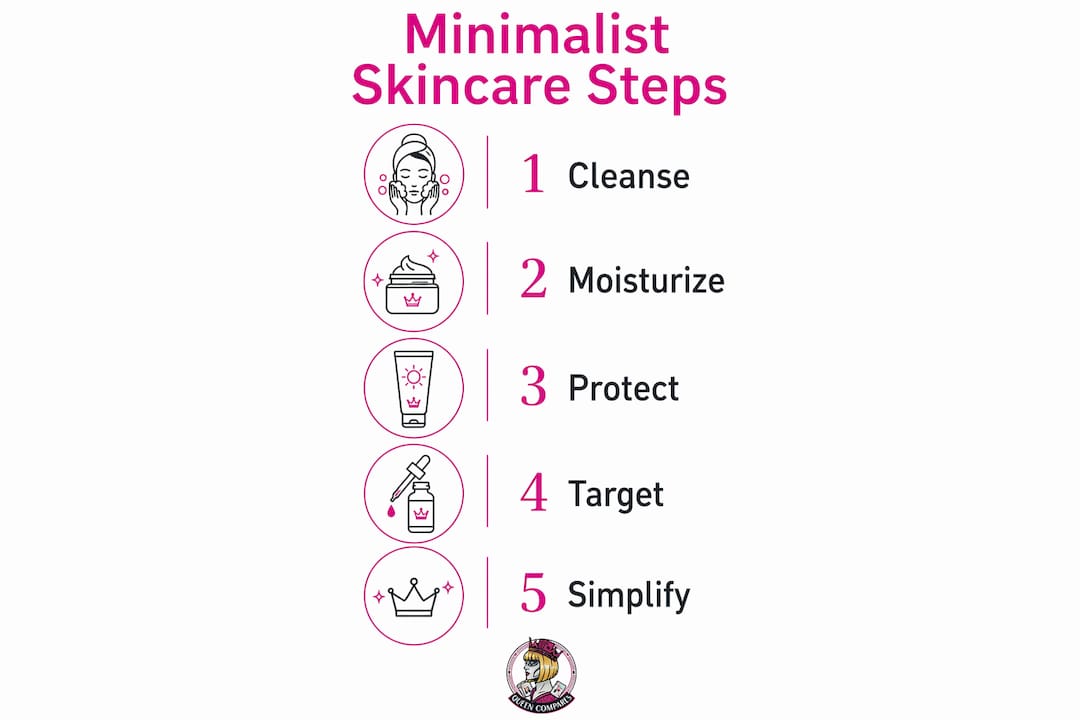
The three products every dermatologist agrees on are a gentle cleanser, a moisturizer with barrier-supporting ingredients, and a broad-spectrum SPF 30+ sunscreen applied daily. These three steps address the core needs of every skin type: cleansing removes debris without stripping, moisturizing replenishes and seals the barrier, and sunscreen prevents the UV damage that causes premature aging and skin cancer.
Beyond the baseline, targeted actives serve specific goals. Retinoids address aging and acne by accelerating cell turnover. Benzoyl peroxide targets acne-causing bacteria directly. The AAD's 2026 acne guidelines recommend benzoyl peroxide and topical retinoids as the core of a multimodal acne approach. The key word is "targeted." You choose one active for one goal, not five actives for five overlapping goals.
The best moisturizing ingredients for barrier support are ceramides, niacinamide, and hyaluronic acid. Ceramides rebuild the lipid layer. Niacinamide reduces redness and strengthens the barrier. Hyaluronic acid draws water into the skin. Products from brands like CeraVe and La Roche-Posay are built around these ingredients and are widely recommended by dermatologists for minimalist routines.
| Product | Purpose | Key Ingredients |
|---|---|---|
| Gentle cleanser | Remove debris without stripping | Glycerin, mild surfactants |
| Barrier moisturizer | Seal and replenish the skin barrier | Ceramides, niacinamide, hyaluronic acid |
| SPF 30+ sunscreen | Prevent UV damage daily | Zinc oxide, titanium dioxide, or chemical filters |
| Retinoid (optional) | Address aging or acne | Retinol, tretinoin, adapalene |
| Benzoyl peroxide (optional) | Target acne bacteria | 2.5%–5% benzoyl peroxide |
Sunscreen is the one product with no optional status. Skipping it daily undoes the work of every other step in your routine. Reapplication every two hours during sun exposure is the standard recommendation.
How can a minimalist approach prevent skin barrier damage?
Overuse of actives is the leading cause of self-inflicted skin barrier damage. Chemical exfoliants like AHAs and BHAs, retinoids, and vitamin C serums all work by disrupting the skin surface to some degree. Using them together, or too frequently, causes micro-tears, persistent redness, and a compromised barrier that lets irritants in more easily.
Ingredient fatigue is a real clinical pattern. The skin stops responding to actives when it is constantly under chemical stress. The result is a routine that costs more, takes longer, and delivers worse results than a simple three-step approach.
Dermatologists recommend a specific recovery protocol for damaged barriers:
- Stop all actives immediately. Remove retinoids, exfoliants, and vitamin C from your routine.
- Use only the baseline three. Cleanser, moisturizer, and sunscreen for a minimum of two weeks.
- Monitor skin signals. Watch for reduced redness, less tightness, and restored softness before adding anything back.
- Reintroduce one active at a time. Start with the lowest concentration and use it twice a week before increasing frequency.
- Wait two to four weeks between additions. This gives your skin time to show a clear response to each new product.
This protocol, backed by dermatologist-recommended workflows, applies especially to people with sensitive skin. The goal is to identify the true treatment effect of each product without the noise of simultaneous reactions.
Pro Tip: Retinoids already exfoliate at the cellular level. Combining retinoids with chemical exfoliants adds irritation without adding benefit. Pick one or the other.
How to personalize a minimalist skincare routine effectively?
Skinimalism is not a single formula. Dr. Teresa Song frames skinimalism as a tailored approach where the right ingredients depend entirely on your skin type, goals, and lifestyle. A person managing oily, acne-prone skin needs different targeted actives than someone focused on anti-aging or managing rosacea.
The foundation stays the same for everyone: cleanser, moisturizer, sunscreen. What changes is the one or two targeted additions you layer on top. Here is how personalization works across common skin concerns:
- Acne-prone skin: Add benzoyl peroxide or a low-strength retinoid. Use them on alternate nights to reduce irritation risk.
- Aging concerns: A retinoid used consistently three to four nights per week delivers the most evidence-backed results. Pair with a ceramide-rich moisturizer.
- Sensitive or reactive skin: Skip all actives until the barrier is fully repaired. Fragrance-free formulas from brands like Vanicream or Avène are the safest starting point.
- Hyperpigmentation: Niacinamide in your moisturizer and consistent SPF use address discoloration without adding extra products.
- Dry skin: A richer moisturizer with ceramides and shea butter replaces the need for a separate facial oil or serum.
The single most important rule in personalizing a minimalist routine is changing one variable at a time. Adding two new products in the same week makes it impossible to know which one caused a reaction or which one improved your skin. Patience here is not optional. It is the method.
You can also build a beginner skincare routine around your specific skin type without needing to buy ten products at once. Start with the baseline, observe for four weeks, then add one targeted active if needed.
Key Takeaways
The "less is more" skincare principle works because a three-step routine of cleanser, moisturizer, and SPF 30+ sunscreen protects the barrier, prevents irritation, and builds the consistency that delivers real long-term results.
| Point | Details |
|---|---|
| Three-step baseline | Cleanser, moisturizer, and SPF 30+ sunscreen cover the core needs of every skin type. |
| Barrier protection first | Stripping back to basics repairs the barrier faster than adding more products. |
| One change at a time | Introducing one new product at a time is the only reliable way to track skin response. |
| Targeted actives only | Retinoids and benzoyl peroxide serve specific goals and should not overlap with other exfoliants. |
| Personalization matters | Skinimalism is individualized. The right minimal routine depends on your skin type and goals. |
Why simplicity is the smartest skincare mindset right now
I have watched the skincare conversation shift dramatically over the past decade. The industry spent years convincing people that more steps meant better skin. Ten-step routines became aspirational. Shelfies filled with 30 products became a status symbol. And then the skin barrier damage reports started rolling in.
What I find most interesting is that the clinical evidence was never on the side of complexity. Dermatologists have recommended cleanser, moisturizer, and sunscreen as the core for decades. The multi-step trend was a marketing phenomenon, not a medical one. The "less is more" beauty philosophy is not new. It just got drowned out.
The misconception I hear most often is that minimalism means neglect. It does not. A three-step routine done consistently every single day outperforms a ten-step routine done three times a week. Adherence is the variable that actually moves the needle on skin health. Simple routines win on adherence every time.
What I also appreciate about skinimalism is the sustainability angle. Fewer products mean less packaging, less waste, and a smaller environmental footprint. That alignment between skin health and mindful consumption feels right for where beauty is heading. Quality over quantity is not just a skincare principle. It is a better way to shop for everything.
— Magdalena Kapuscinska
QueenCompares makes minimal skincare choices easier
Choosing the right three products sounds simple until you are standing in front of 200 moisturizers with overlapping ingredient lists. That is where QueenCompares comes in.

QueenCompares gives you side-by-side product comparisons so you can see exactly which moisturizer has ceramides, which cleanser is truly fragrance-free, and which sunscreen fits your skin type without guessing. The Ingredient Library breaks down what each ingredient actually does, so you can build your minimal routine with confidence. You can also check out our skincare simplification checklist to map out your baseline routine step by step. Our community reviews add real-world context to every ingredient and formula. Fewer products, better choices, and a community that has your back.
FAQ
What is the "less is more" skincare principle?
The "less is more" skincare principle means using a small number of high-priority products, specifically a cleanser, moisturizer, and SPF 30+ sunscreen, to maintain skin health without causing irritation or barrier damage. It prioritizes consistency and ingredient quality over product quantity.
How many products does a minimalist skincare routine need?
A minimalist skincare routine needs three products: a gentle cleanser, a barrier-supporting moisturizer, and a broad-spectrum SPF 30+ sunscreen. Targeted actives like retinoids or benzoyl peroxide can be added one at a time for specific concerns.
Can a simple skincare routine actually improve skin health?
Yes. Simplified routines improve adherence, reduce irritation, and support barrier repair more effectively than complex layered routines. Consistent use of the right three products outperforms inconsistent use of ten.
Why do dermatologists recommend fewer skincare products?
Dermatologists recommend fewer products because overlapping actives increase irritation risk without adding clinical benefit. Fewer products also make it easier to identify what is helping or harming your skin.
Is sunscreen really necessary in a minimal routine?
Sunscreen is the one non-negotiable step in any minimal routine. Daily SPF 30+ use prevents UV-driven aging, hyperpigmentation, and skin cancer, making it the highest-return product in any routine regardless of skin type.