Choose a cleansing balm for heavy, waterproof makeup or dry, sensitive skin that needs comfort more than speed. Choose a cleansing oil for a fast, everyday first step or when you're covering larger areas like your neck and chest. Either way, the format matters less than the technique: massage it in dry, emulsify with water until it turns milky, then follow with a gentle second cleanser. If you want to check whether a specific formula fits your skin before you buy it, QueenCompares' ingredient tools can help.
TL;DR:
- Using a cleansing balm provides superior control for removing stubborn waterproof makeup and heavy sunscreen, especially when properly emulsified.
- Cleansing oils are faster and more convenient for covering larger areas like the neck and chest and rinse away more quickly.
- The effectiveness against waterproof and long-wear products depends on emulsification, not format, with balm’s thicker texture offering an advantage for heavy formulas.
- Skin type influences choice: balms suit dry or sensitive skin, while non-comedogenic oils work for oily or acne-prone skin, with formulation quality being critical.
- Proper technique requires applying to dry skin, massaging for 60 seconds, emulsifying with water, then following with a gentle second cleanser to prevent breakouts and residue.
Table of Contents
- Cleansing Balm vs Oil: The Quick Comparison
- Why Texture Decides How a Cleanser Behaves
- Which Format Wins on Sunscreen and Long-Wear Makeup?
- Cleansing Balm and Oil by Skin Type
- How to Use a Cleansing Balm or Oil the Right Way
- Common Cleansing Mistakes That Cause Breakouts
- What Dermatologists and Formulators Actually Agree On
- Your Decision Checklist Before You Buy
- Why We Treat This as a Skin-Type Question, Not a Trend
- Check Any Formula Before It Reaches Your Skin
- Where This Advice Comes From
- Sources
- FAQ
Cleansing Balm vs Oil: The Quick Comparison
The two formats start from the same idea (oil dissolves oil) but feel completely different on your skin.
- Texture: Balms are semi-solid at room temperature and melt into oil the moment they hit warm skin; oils are already liquid and spread instantly.
- Packaging: Balms usually come in jars or tins you scoop with fingers or a spatula; oils are typically bottled with a pump or dropper.
- Rinse behavior: Both need water and massaging to turn milky before rinsing, but oils tend to rinse away a beat faster since there's no solid structure to melt first.
- Best use: Balms shine on full-glam days and stubborn sunscreen; oils are the better grab-and-go option for a quick daily reset, according to Byrdie's breakdown of the two formats.
Neither one is objectively "better." Cushiony balms and oil cleanser benefits often come down to what your hands prefer touching every night.
Why Texture Decides How a Cleanser Behaves
A balm's solid state isn't just a marketing gimmick. It gives you control. Because it doesn't liquefy until it meets the heat of your palms, you can work it precisely around the eyes or nose without it running everywhere, which matters if you're removing spotty concealer or waterproof mascara.
Oils skip that step entirely, which is exactly why they move faster across the skin and cover a jawline or chest in seconds.
The real engine in both formats is the emulsifier. This ingredient allows oil to bind with water instead of just sitting on top of it, which is what lets the product rinse clean instead of leaving a greasy film. Emulsification is the step most people skip, and it's the single biggest factor in whether a formula feels rinsable or leaves you second-guessing your skin the next morning.
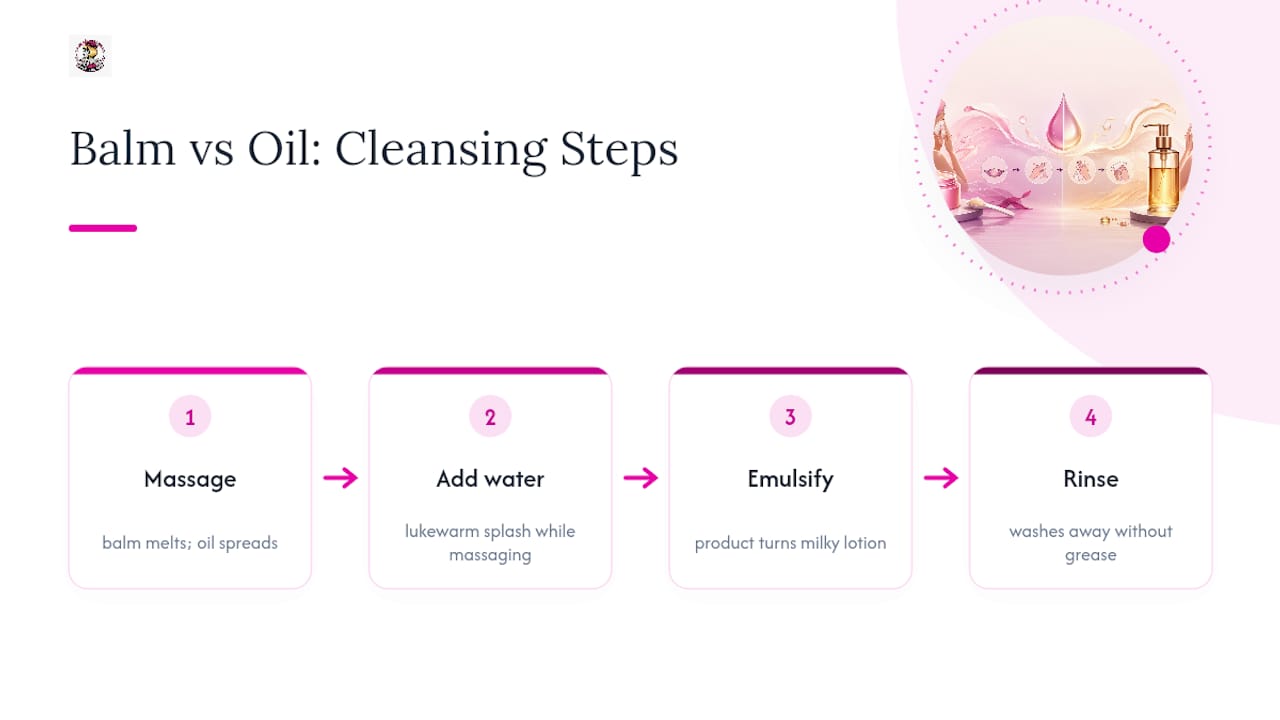
Pro Tip: Add a splash of lukewarm water while your hands are still massaging, not after. That's the moment the product should visibly turn from oil to a milky lotion.
Which Format Wins on Sunscreen and Long-Wear Makeup?
Chemistry has a simple rule here: like dissolves like. Both oils and balms break down sunscreen filters, silicones, and sebum on contact, which is why they outperform water-based cleansers on anything labeled "waterproof" or "long-wear."
- Balms have the edge on heavy coverage. Their thicker consistency clings to stubborn waterproof mascara and full-face sunscreen without needing a second swipe.
- Oils have the edge on speed and coverage area. If you're rinsing off SPF from your arms, neck, and face after a beach day, an oil moves through that territory faster.
- Sunscreen removal is where format matters most. Balms are especially effective at dissolving heavy sunscreen and waterproof makeup when you actually emulsify instead of just wiping.
- Micellar water falls short here. It's convenient for a no-rinse touch-up, but it's noticeably weaker against modern, long-wear sunscreen formulas.
If you wear SPF under your makeup daily, this is the exact scenario a proper first cleanse was built for.
Cleansing Balm and Oil by Skin Type
Your skin type should drive this decision more than trend cycles do.
- Dry or sensitive skin: Balms tend to feel more cushioned and less stripping, since their heavier oil blends leave a light film that dry skin usually welcomes.
- Oily or acne-prone skin: Oils can absolutely work here, but the specific oil matters more than the category. Look for non-comedogenic options like jojoba, squalane, or sunflower oil rather than heavier, pore-clogging blends.
- Combination skin: Many people switch by season, reaching for an oil in summer heat and a richer balm once the air turns dry in winter.
- Mature skin: The extra glide and slower melt of a balm can double as a light massage, which some people find genuinely relaxing at the end of a long day.
- Any skin type, one caution: Watch out for heavy coconut oil, strong fragrance, and added essential oils. Formulation matters more than format when it comes to breakout risk, so a "clean" label doesn't guarantee it's clean for your face.
If you're not sure which ingredients belong in that caution list, running a formula through an ingredient checker before you buy takes the guesswork out of it.
How to Use a Cleansing Balm or Oil the Right Way
Technique makes or breaks both formats, and it's simpler than most routines make it look.
- Apply to completely dry skin, dry hands, dry face. Water at this stage blocks the oil from binding to makeup and sunscreen.
- Massage for 60 seconds. Work in circular motions, giving the product time to break down whatever's sitting on your skin.
- Emulsify with water. Add small splashes while continuing to massage until the texture turns milky and slightly foamy.
- Rinse thoroughly, then follow with a mild, water-based cleanser to lift any remaining residue without over-stripping your barrier.
For the eye area, use a light touch and consider a clean spatula for balms rather than dipping fingers repeatedly into the jar. Dermatologists generally advise this exact two-step sequence: an oil or balm first, followed by a gentle cleanser, so you dissolve without drying out.
Pro Tip: If your cleanser never turns milky, you're not adding enough water. Keep massaging with wet fingertips until the color and texture visibly shift.
Common Cleansing Mistakes That Cause Breakouts
Most "this broke me out" stories trace back to technique, not the product itself.
- Wiping instead of emulsifying leaves behind an oily film that traps debris overnight, which is the most common cause of both residue and perceived clogged pores.
- Skipping the second cleanse means sunscreen and product residue never fully lift, even when the first step felt thorough.
- Blaming the format instead of the formula overlooks that a heavy, occlusive oil can clog pores regardless of whether it's packaged as a balm or a liquid.
Emulsification mistakes are the most common practical cause of that greasy, unrinsed feeling people mistake for comedogenicity. If a new formula causes irritation within a few uses, stop and patch test elsewhere before assuming the entire category is wrong for you.
What Dermatologists and Formulators Actually Agree On
Ask ten skincare experts whether a balm or oil is "better," and you'll mostly get the same answer: it depends on what's on your skin that day, not brand loyalty to one format.
"The choice really depends on what's on your skin. All three formats can be effective, but balms are cushiony and great for heavier makeup, while oils are faster and rinse more easily." That consensus runs consistently through dermatology-focused coverage of cleansing balm and oil performance.
Formulators echo the same point from a different angle. A balm's semi-solid structure gives you control around the eyes and on spotty waterproof makeup, which is why many professionals reach for a balm specifically on heavier makeup days rather than as a daily default.
Your Decision Checklist Before You Buy
Answer these questions honestly, and the right format becomes obvious fast.
- How much makeup or sunscreen do I wear most days? Heavy and waterproof leans balm; light and daily leans oil.
- Is my skin dry, sensitive, or acne-prone? Match the answer to the ingredient flags below before falling for packaging.
- Do I travel often? Balms in jars survive a suitcase better than pumps that can leak in transit.
- Am I willing to actually emulsify every time? If the answer is no, pick whichever format you'll use correctly, not the one that sounds trendier.
| Your Priority | Better Starting Point | Watch For |
|---|---|---|
| Heavy or waterproof makeup | Cleansing balm | Full 60-second massage before rinsing |
| Fast daily routine | Cleansing oil | Non-comedogenic oils like squalane or jojoba |
| Dry or sensitive skin | Cleansing balm | Fragrance-free, minimal essential oils |
| Oily or acne-prone skin | Lightweight cleansing oil | Avoid heavy coconut oil |
| Travel or gym bag | Cleansing balm (jar, no leaks) | Use clean fingers or a spatula |
Sample a small size before committing to a full jar or bottle, and patch test on your jawline for a few nights if you have reactive skin.
Why We Treat This as a Skin-Type Question, Not a Trend
Most "balm vs oil" content online treats this like a beauty rivalry, as if one format is destined to replace the other. It won't, and it shouldn't. The honest answer is that your skin type, your makeup habits, and your patience for a 60-second massage decide the winner far more than any ranking ever will.
What we'd push back on is the idea that comedogenicity lives in the format at all. A cheap, fragrance-loaded balm can break you out just as easily as a heavy, occlusive oil. The ingredient list underneath the marketing claim is where the real risk sits, which is exactly why QueenCompares built ingredient-checking tools instead of just another "top 10" list. If you're genuinely unsure whether a formula fits your skin, checking the ingredient deck yourself, or reading through community reviews from people with your skin type, tells you more than any single glowing review ever will.
— Magdalena Kapuscinska
Check Any Formula Before It Reaches Your Skin
Picking between a balm and an oil is only half the decision. The other half is knowing what's actually inside the one you're eyeing. QueenCompares' Ingredient Checker lets you scan a product's full ingredient list and flag potential irritants, heavy comedogenic oils, or fragrance levels before you commit your money or your skin.

The tool is especially useful if you're acne-prone and trying to confirm whether a cleansing oil leans on jojoba and squalane or something heavier like coconut oil. Pair it with the Ingredient Library if you want to look up a specific ingredient on its own before comparing it against a full formula. Run your next cleansing balm or oil through the checker before it hits your bathroom shelf, so you're deciding with the label in hand instead of guessing.
Where This Advice Comes From
The comparisons in this guide draw on dermatology and formulation coverage that consistently tests these formats against real makeup and sunscreen wear.
- Byrdie's cleansing balm, oil, and micellar water comparison covers dermatologist-backed removal performance.
- Banila USA's texture and use-case guide details travel and everyday handling differences.
- Skin Sense's expert roundup gathers formulator opinions on ingredient safety.
Sources
- Cleansing balm vs cleansing oil vs micellar water: which to use and when
- Cleansing Balm vs. Cleansing Oil | Which One Is Better?
- Cleansing Balm vs Oil: 10 Skincare Experts Share Their Verdict - Skin Sense
FAQ
Do Dermatologists Recommend Cleansing Balms?
Yes, many dermatologists recommend them for heavier makeup and drier skin types, though they consistently stress that proper emulsification matters more than the format itself.
Do Cleansing Balms Clog Pores?
Not inherently. Pore-clogging risk comes down to the specific ingredients in the formula, such as heavy coconut oil, rather than the balm texture itself.
Does Cleansing Balm Count as an Oil Cleanser?
Functionally, yes. A balm is a solid-to-oil formula that behaves like an oil cleanser once it melts on your skin, just packaged in a firmer state.
Can I Use a Cleansing Balm as My Only Cleanser?
You can on low-makeup days, but dermatologists generally recommend following it with a gentle second cleanser to fully remove residue without over-stripping your skin.
Can You Use a Cleansing Balm Daily?
Yes, daily use is fine for most skin types as long as you emulsify thoroughly and follow with a mild second cleanse to avoid buildup.