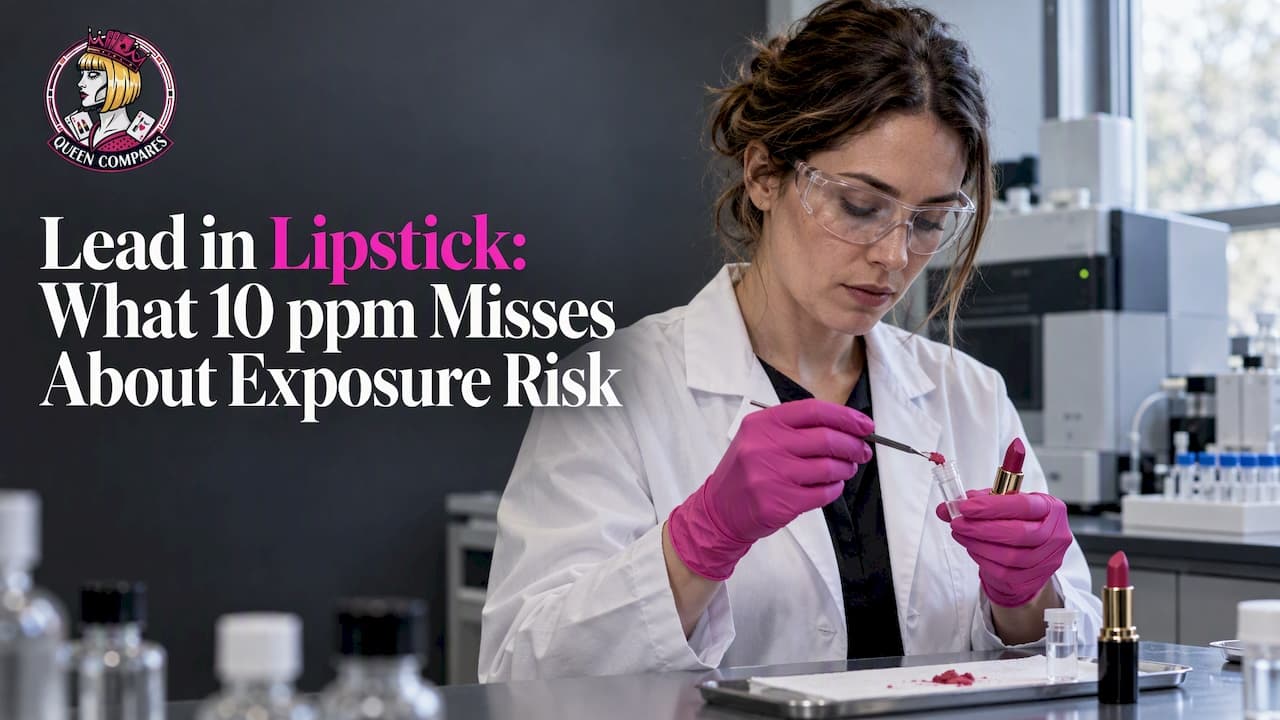
Yes, trace lead can show up in many commercial lipsticks, typically at low parts-per-million levels found by regulators, but public-health authorities maintain that no amount of lead exposure is completely without risk. Most lip products tested by the FDA fall below a low parts-per-million level, with many samples far lower. The WHO flags children and pregnant people as most vulnerable. Your best moves: choose regulated brands, run suspect products through an ingredient checker, and consider lab testing if you’re still concerned.
Key Takeaways
Most lipsticks contain trace lead levels below regulatory guidance, but repeated exposure still poses health risks, especially for children and pregnant individuals.
| Point | Details |
|---|---|
| Lead in pigments | Lead enters lipstick mostly as a trace impurity from mineral pigments and fillers, not as an added ingredient. |
| Regulatory limits | Public health guidelines recommend keeping lead levels in lip products below 10 ppm to minimize health risks. |
| Health risks of lead | No level of lead exposure is considered completely safe, with vulnerable groups like children and pregnant people most at risk. |
| Testing methods | Laboratories use ICP-MS to detect trace metals like lead, with results depending on sampling, methods, and sourcing. |
| Consumer measures | Use ingredient checkers, choose regulated brands, and consider lab testing for added safety concerns. |
Table of Contents
What Labs and Regulators Have Found in Lipstick Samples
When the FDA tested hundreds of lipsticks for trace metals, it found lead levels ranging from below detection to low ppm levels, with most tested cosmetics landing under the recommended 10 ppm limit. A separate peer-reviewed 2024 study measured a mean lead concentration around 1.68 mg/kg (roughly 1.68 ppm) across sampled lipsticks, within levels generally regarded as low by regulatory standards.
Results vary by lab method, sample selection, and which pigments a brand sources, which is why NGO campaign reports sometimes report different numbers than government testing. A few things to keep in mind when you see conflicting figures:
-
FDA surveys and the 2024 peer-reviewed study both point to typical levels well under 10 ppm, with means closer to 1 to 2 ppm.
-
Both regulators and independent researchers agree lead is a contaminant, never an intentional ingredient.
-
The same study found a measurable difference in lead content between higher-priced and lower-priced lipsticks, suggesting raw-material sourcing plays a role.
What Lead Exposure Means for Your Body, Especially at Higher Risk
Lead doesn’t have a dose that’s considered risk-free. The WHO’s 2025 guidance states there is no known safe level of lead exposure, and blood lead concentrations as low as 3.5 micrograms per deciliter have been linked to adverse outcomes in children, including effects on cognitive development and behavior.
No blood lead level is considered fully safe, and levels at or above 5 µg/dL should prompt identification and removal of the exposure source, according to the WHO. That standard matters here because lipstick exposure happens repeatedly, through swallowing residue, licking your lips, or transferring product hand to mouth.
A few points worth understanding about who faces the most risk:
-
Children absorb and retain lead more efficiently than adults, which is part of why pediatric exposure gets more attention.
-
Pregnant people can mobilize lead stored in bone, passing it to a developing fetus even from exposures that happened years earlier.
-
For most adults, lipstick likely contributes a small fraction of total lead intake, but repeated use adds up and matters more for anyone already managing other sources of exposure.
Why Lead Shows Up in Lipstick in the First Place
Lead isn’t an ingredient any brand adds on purpose. It enters lipstick as a trace impurity carried in mineral pigments, mica, and filler clays, the same raw materials that give lipstick its color and texture. The FDA’s explanation of lead contamination confirms that fully eliminating trace lead from these naturally occurring minerals is difficult, which is why impurity limits exist instead of a zero-tolerance standard.
A few supply-chain factors shape how much ends up in your lipstick:
-
Where a brand sources its mineral pigments and how closely suppliers screen for contamination.
-
Whether a manufacturer runs its own quality-assurance testing before a product ships.
-
Traditional or imported cosmetics from less-regulated markets, which have historically tested higher in some surveys and deserve extra caution, particularly for children.
If you’re curious how pigment sourcing works in adjacent categories like semi-permanent lip treatments, this overview of lip pigment types walks through how raw materials get selected and processed.
How Labs Measure Lead and What the Numbers Actually Mean
Laboratories rely on inductively coupled plasma mass spectrometry, or ICP-MS, as the standard method for detecting trace metals like lead in cosmetics. It’s sensitive enough to catch impurities at the parts-per-million and even parts-per-billion level, which is why the FDA and CDC both treat it as the dependable approach for cosmetic testing.

A ppm reading on a lab report tells you the concentration in the product itself, not your resulting blood lead level. Translating one into the other requires exposure modeling that accounts for how much product you apply, how often, and how much gets ingested versus absorbed through skin.
If you’re evaluating a lab report or a brand’s safety claim, work through it this way:
-
Confirm the lab is accredited and uses ICP-MS or an equally validated method.
-
Check the reported detection limit. A result of “nondetect” only means the lead level fell below what the method could measure.
-
Look at how the sample was prepared. Digestion method affects accuracy for trace-metal testing.
-
Weigh the ppm figure against known benchmarks, like the FDA’s 10 ppm guidance, rather than reacting to the number in isolation.
Pro Tip: A “lead-free” claim on a label means little without a lab report behind it. The CDC notes that marketing claims can’t substitute for accredited testing.
How Regulators Set Limits and Weigh the Risk
The FDA has recommended limiting lead as an impurity in lip products to a maximum of about 10 ppm, based on its own testing program across hundreds of samples. That figure is guidance rather than a binding rule, which is part of why messaging from different health bodies can feel inconsistent.
Public-health organizations like the WHO take a different starting point: since no blood lead level is considered fully safe, their goal is minimizing exposure from every source, cosmetics included, rather than setting a single acceptable ceiling.
Risk assessments typically combine a few pieces of information:
-
The measured ppm in the product itself.
-
Realistic ingestion estimates based on how lipstick is actually used day to day.
-
Lifetime exposure modeling that accounts for cumulative contact rather than a single application.
The 2024 peer-reviewed study mentioned earlier applied this kind of modeling and concluded that exposures from its sampled lipsticks fell below the thresholds it used, while still recommending routine monitoring going forward. For more on how manufacturers are expected to comply with these standards, our breakdown of FDA cosmetic regulations covers the compliance side in more depth.
Practical Steps for Choosing Safer Lipstick
You don’t need a home lab to shop smarter. A few habits go a long way:
-
Favor brands manufactured under regulated frameworks that publish testing data or third-party lab results.
-
Skip unregulated traditional or imported cosmetics for children, since these have tested higher in some surveys.
-
Look for brands that disclose pigment sourcing rather than relying on vague “clean” labeling.
-
Cross-check suspect products before buying rather than after you’re already wearing them daily.
Our Ingredient Checker and Label Scanner tools are built for exactly this kind of screening: you can flag pigments and additives associated with contamination risk before a product lands in your routine, rather than digging through lab reports yourself. For a broader rundown of what to watch for, our guide on ingredients to avoid in makeup pairs well with these tools.
Balancing the Data With a Little Common Sense
Regulators are right that measured lead levels in most lipsticks are low. Public-health bodies are also right that low isn’t the same as zero, and that repeated exposure deserves attention, especially for kids and anyone pregnant. Neither fact cancels the other out. The useful response is evidence over alarm: check what you can, use tools that make ingredient screening fast, and save lab testing for when you have a specific reason for concern. If you want a quick read on a product you already own, running it through our Ingredient Checker takes less time than scrolling through conflicting headlines.
— Magdalena Kapuscinska
Let Us Help You Screen Lipstick Before You Buy
You shouldn’t have to read a toxicology paper every time you want new lipstick. Our AI Ingredient Analysis flags pigments and additives linked to contamination risk, and our Label Scanner reads a product label in seconds so you can compare options before checkout instead of after.

-
Use the Ingredient Checker when you want a fast screen of a specific product’s formula.
-
Reach for accredited lab testing when you need a precise ppm figure for a particular concern.
-
Talk to a clinician if you suspect actual exposure symptoms rather than relying on product labels alone.
| Situation | Best next step |
|---|---|
| Curious about a new lipstick before buying | Run it through our Ingredient Checker |
| Want to compare pigment-related ingredients across brands | Browse Products by Ingredient, Ingredient Checker and AI label Scanner |
| Need a precise lead measurement | Request accredited lab testing |
Start with our Ingredient Checker the next time a new lipstick catches your eye.
This article is general information, not a substitute for advice from a qualified doctor. Consult a qualified healthcare professional about your own circumstances before acting on anything here.
FAQ
Do Maybelline lipsticks contain lead?
Published FDA testing has found trace lead in many commercial lipsticks across brands and price points, generally at low levels under the agency’s 10 ppm guidance. We don’t have brand-specific published figures to confirm an exact number for any single product line, so checking current lab results or using an ingredient screening tool is the most reliable way to get a formula-specific answer.
Is lead harmful for skin?
Lead itself is a toxic metal with no known safe exposure level, according to the WHO, though the main concern with lipstick comes from ingestion through lip-licking or hand-to-mouth contact rather than skin absorption alone. Repeated low-level exposure is what public-health bodies flag as worth minimizing, especially for children and pregnant people.
What are the risks of arsenic in cosmetics?
Arsenic is tested alongside lead, cadmium, and other heavy metals in the FDA’s cosmetic contaminant program, since it can enter products the same way, as a trace impurity in mineral raw materials. As with lead, the practical approach is checking for products from regulated manufacturers and looking at available lab data rather than assuming any single ingredient list guarantees safety.
Which lipsticks have lead?
Nearly any lipstick made with mineral pigments carries some chance of trace lead, since it enters through raw materials rather than as an added ingredient, per the FDA. Levels vary by brand, sourcing, and manufacturing quality control, which is why running a product through an ingredient checker or looking for published lab results gives you a more specific answer than relying on brand reputation alone.
Sources
-
World Health Organization — No safe level: act now to end lead exposure
-
FDA — Testing of cosmetics for arsenic, cadmium, chromium, cobalt, lead, mercury, and nickel content
-
Peer-reviewed study measuring lead in lipsticks and modeling exposure (PMC)
Recommended
General Entertainment & Information Purposes Only At QueenCompares.com we share content for general entertainment and information. It’s not medical, dermatological, nutritional, or fitness advice and shouldn’t replace guidance from a licensed professional. If you’re making health-related decisions, please check with a qualified expert — and know that using this site and its information is at your own discretion.