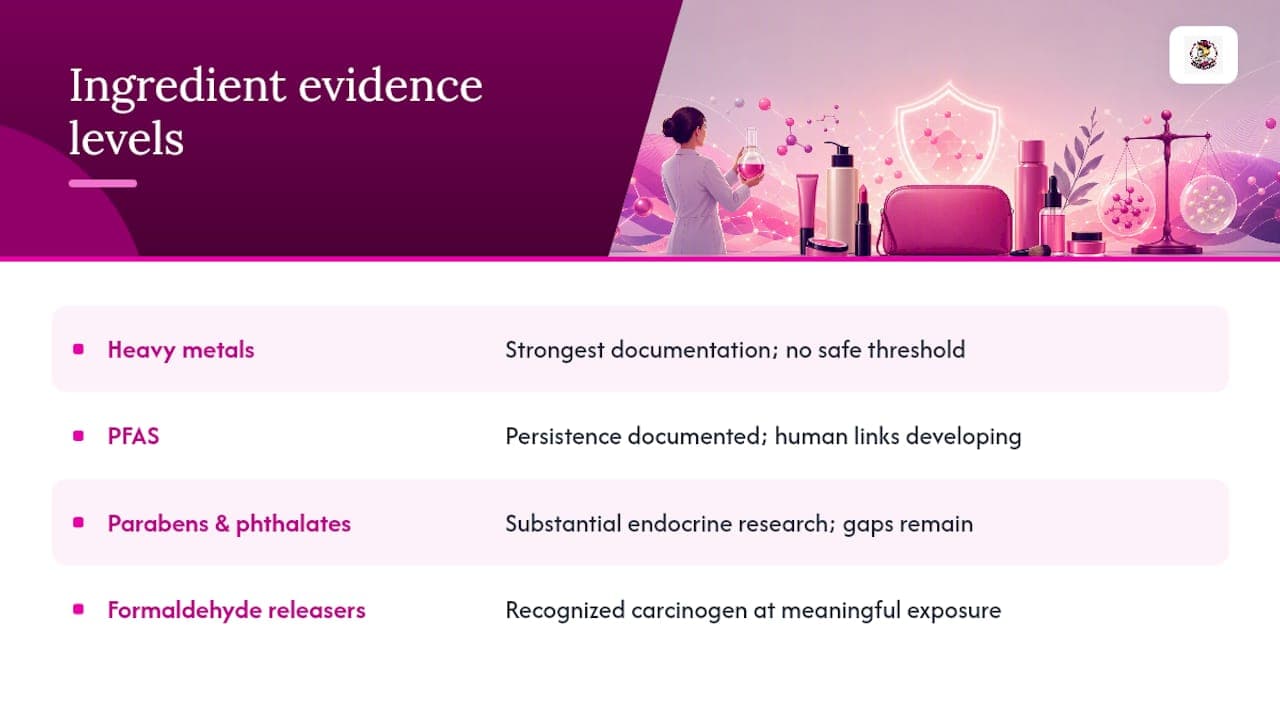
Formaldehyde releasers, certain parabens (isobutyl and isopropyl), phthalates, PFAS, talc with asbestos contamination risk, lead and other heavy metals, and vague “fragrance” listings top the list of what to avoid in makeup right now. If you touch nothing else today, check your lip products, mascara, eyeliner, and long-wear foundation first. These sit on your skin longest and, in the case of lipstick and gloss, get ingested in small amounts every time you eat, drink, or lick your lips.
Here’s what to do in the next 24 to 72 hours:
-
Pull your daily lip and eye products and run them through an ingredient checker or label scanner before you use them again.
-
Patch-test one replacement on your inner arm for 24 hours before it touches your face.
-
Check our Clean Beauty page where we feature skincare and makeup products whose AI ingredient safety analysis scored 80/100 or higher — cleaner formulations, fewer concerns
Start your inspection with this order, from highest exposure risk to lowest:
-
Lip color and lip liner (ingestion risk)
-
Mascara and eyeliner (proximity to eyes and mucous membranes)
-
Long-wear or “transfer-proof” foundation (all-day skin contact)
-
Pressed and loose powders (inhalation risk from fine particles)
Key Takeaways
The safest approach to makeup shopping combines a short list of priority ingredients to avoid with a slow, one-product-at-a-time swap plan verified by trusted ingredient databases.
| Point | Details |
|---|---|
| Priority ingredients to avoid | Watch for formaldehyde releasers, certain parabens, phthalates, PFAS, talc contamination, heavy metals, and vague “fragrance” listings. |
| Highest-risk product types | Lip products, mascara, eyeliner, and long-wear foundation carry the greatest cumulative exposure risk. |
| Swap one item at a time | Replace your highest-frequency product first, then monitor your skin for two weeks before the next swap. |
| Verify with trusted databases | Cross-check unfamiliar ingredients against EWG Skin Deep and Consumer Reports before buying or discarding a product. |
| Use QueenCompares to speed the process | The QueenCompares Ingredient Library and label scanner flag risky ingredients and suggest safer alternatives in seconds. |
Table of Contents
What To Avoid in Makeup: The Ingredient Rundown
The Environmental Working Group’s Toxic Twelve list names the chemicals showing up most often in safety complaints, and it’s a solid starting map for anyone building a mental checklist before they shop. Here’s what each one actually is, where it hides, and why it earns a spot on your avoid list.
-
Formaldehyde and formaldehyde releasers (Quaternium-15, DMDM hydantoin, imidazolidinyl urea): These preservatives slowly release small amounts of formaldehyde to kill bacteria in a product. Formaldehyde is a known human carcinogen at certain exposure levels, and it’s also a common cause of skin sensitization. You’ll find releasers most often in liquid foundations, mascaras, and nail products.
-
Certain parabens (isobutylparaben, isopropylparaben): These preservatives extend shelf life but mimic estrogen in lab studies, raising endocrine disruption concerns. They show up in foundations, concealers, and cream blushes.
-
Phthalates (DBP, DEHP): Often hidden inside “fragrance” rather than listed by name, phthalates help nail polish resist chipping and help fragrance last longer on skin. They’re linked to endocrine disruption and reproductive health concerns in animal and observational human research.
-
PFAS (“forever chemicals”): Used in some long-wear and waterproof formulas for their slick, water-resistant feel. PFAS persist in the body and environment for years and are under growing scrutiny for links to hormone disruption and other health effects.
-
Talc with asbestos contamination risk: Talc itself isn’t automatically dangerous, but it’s mined near asbestos deposits, and contamination has turned up in loose powders, blush, and eyeshadow. Asbestos is a confirmed carcinogen, which is why sourcing and third-party testing matter here.
-
Heavy metals (lead, mercury, cadmium, arsenic): These typically enter products as contaminants in raw pigments and talc rather than intentional additives. A peer-reviewed review in PMC documents arsenic, cadmium, lead, and mercury turning up in tested cosmetic samples, with concerns ranging from neurotoxicity to carcinogenicity depending on the metal and dose.
-
Synthetic musks and select preservatives (methylisothiazolinone, DMDM hydantoin): Common sensitizers linked to allergic contact dermatitis, especially with repeated use on the same skin area.
-
Triclosan: An antibacterial agent found in some lip products and antiperspirant-adjacent cosmetics, flagged for potential hormone disruption and antibiotic resistance concerns.
-
Oxybenzone and octinoxate: Chemical sunscreen filters sometimes blended into tinted makeup with SPF. Both are linked to hormone disruption signals in research and coral reef damage, which is why some reef-safe travel destinations restrict them.
The BCPP Red List organizes many of these same chemicals by product category, which makes it a useful cross-check if you want a second source before tossing something in your bathroom cabinet.
How Do These Ingredients Actually Affect Your Health?
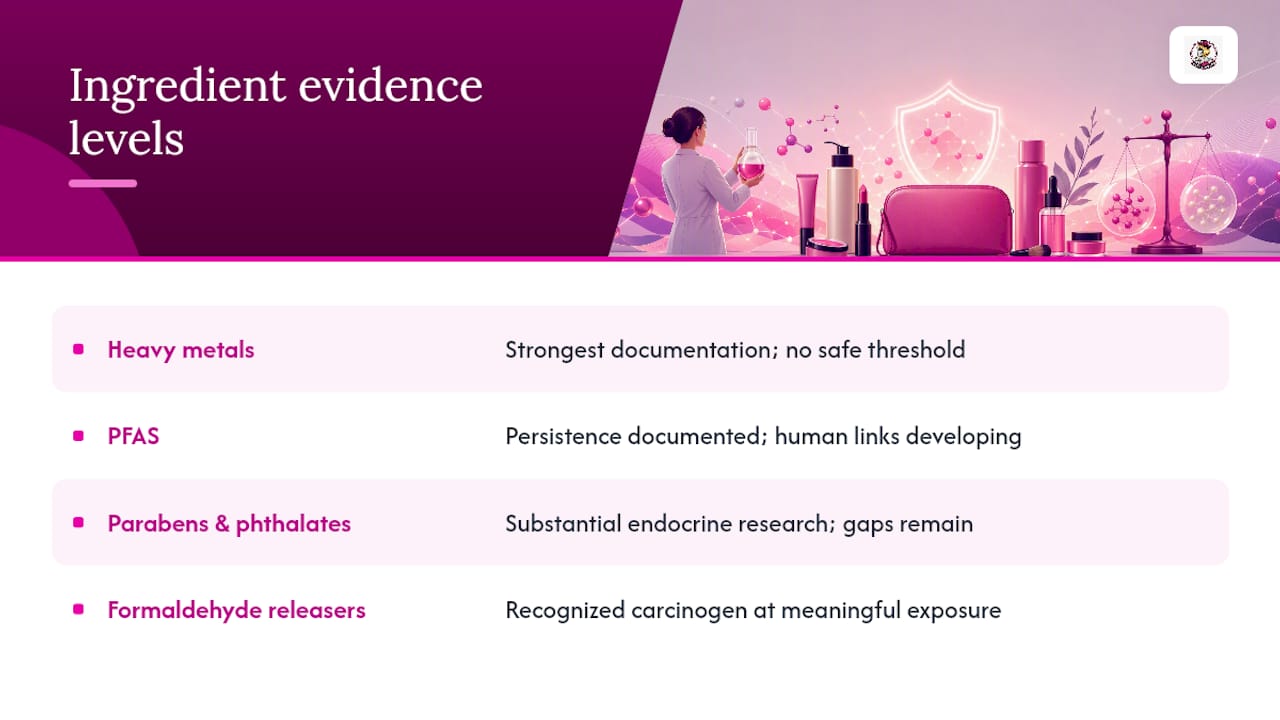
These chemicals reach your body through four routes: absorption through skin, ingestion from lip products, inhalation of fine powders, and slow accumulation from daily repeated use. Not every ingredient carries the same weight of evidence, and knowing the difference helps you prioritize instead of panicking over every unfamiliar word on a label.
Heavy metal contamination has the strongest documentation. Toxicology studies and the National Toxicology Program’s classifications confirm lead, mercury, cadmium, and arsenic as established hazards with no safe threshold for some exposure types, especially in children and pregnant women. PFAS sits in a newer but fast-growing evidence category: persistence in the body is well documented, while human epidemiology linking specific cosmetic-level exposure to disease outcomes is still developing. Parabens and phthalates have a substantial body of endocrine disruption research, mostly from animal studies and human observational data, though findings on long-term low-dose exposure still leave some gaps researchers are working to close. Formaldehyde has the clearest regulatory classification: it’s recognized as a human carcinogen at meaningful exposure levels, which is why the releaser chemicals matter even though they aren’t formaldehyde itself.
A 2023 review in PMC documenting cosmetic contamination found detectable levels of arsenic, cadmium, lead, and mercury across tested product samples, reinforcing why heavy metals deserve a permanent spot on any avoid list.
Short-term, occasional use of a product containing a lower-tier concern (say, a synthetic musk in a special-occasion perfume) carries relatively low individual risk. The real concern builds with cumulative exposure: a lip product applied five times a day, every day, for years, or a foundation worn eight hours a day at a job that also involves airborne dust exposure. That’s why lip and leave-on products get first priority in any swap plan, and why occupational makeup artists and estheticians should be extra vigilant about inhalation from loose powders.
How Can You Spot Hidden Ingredient Names on a Label?
You can catch most risky ingredients without a chemistry background by scanning for a handful of suffixes and umbrella terms: “-paraben,” “phthalate,” “PEG,” and the catch-all “fragrance” or “parfum.” Manufacturers aren’t required to disclose the dozens of chemicals that can hide inside a single fragrance blend, which is why that one word deserves more suspicion than almost anything else on a label.
| What You’ll See on the Label | What It Often Means |
|---|---|
| Fragrance, parfum, aroma | Umbrella term that can legally conceal dozens of undisclosed chemicals, including phthalates |
| DMDM hydantoin, Quaternium-15, imidazolidinyl urea | Formaldehyde-releasing preservatives |
| Isobutylparaben, isopropylparaben | Parabens flagged for endocrine disruption concerns |
| Dibutyl phthalate (DBP), diethylhexyl phthalate (DEHP) | Phthalates used for flexibility and fragrance retention |
| PTFE, perfluorooctanoic acid, “fluoro” prefix ingredients | PFAS compounds used for water resistance |
| Methylisothiazolinone, MIT | Preservative linked to skin sensitization |
Run through a bottle or compact in under two minutes with this quick scan:
-
Read the first five ingredients closely. Cosmetic labels list ingredients by concentration, so the biggest concerns near the top matter more than a trace amount buried at position 25.
-
Treat “fragrance” or “parfum” anywhere on the list as a flag worth investigating rather than skipping past.
-
Look up any long, unfamiliar chemical name in EWG’s Skin Deep database before assuming it’s harmless just because you can’t pronounce it.
-
Cross-check questionable products against Consumer Reports’ cosmetics coverage for recall history or safety alerts.
QueenCompares built its Ingredient Library specifically to speed up this kind of scan, translating chemical names into plain language so you’re not stuck googling synonyms mid-shopping-trip. For a deeper walkthrough of decoding labels line by line, our guide on how to read skincare ingredient labels like a pro applies the same logic to makeup formulas.
Which Products Should You Replace First?
Replace lip and eye products first, then leave-on face products like foundation and concealer, and save rinse-off or occasional-use items like special-occasion glitter for last. This order follows exposure logic: what touches your body most often and stays longest carries the highest cumulative risk, regardless of how “natural” or “clean” the packaging claims to be.
Consumer Reports built its entire recommendation around this same logic, calling it a slow-swap approach rather than an overnight overhaul. Here’s how to execute it without wrecking your routine or your budget:
-
List every product you use daily, then flag the ones that touch your lips, eyes, or stay on your skin more than four hours.
-
Run each flagged product through an ingredient checker to confirm what it actually contains, not just what the front label promises.
-
Patch-test any replacement on your inner forearm for 24 hours before applying it to your face.
-
Phase out one product at a time, finishing or discarding the old one before introducing the next swap.
-
Track how your skin responds for at least two weeks before judging whether a new product is a keeper.
Pro Tip: Buy travel or sample sizes of replacement products first. You’ll spend less testing whether a new mascara formula agrees with your eyes, and multiuse products, like a cream blush that doubles as lip color, cut your total swap list without cutting corners on safety.
Keep an eye on manufacturer recalls through the FDA’s cosmetics enforcement pages and Consumer Reports’ safety coverage, since recalls for heavy metal contamination in powders and eyeshadow palettes happen more often than most shoppers realize. If a new product triggers redness, swelling, itching, or hives, stop using it immediately and rinse the area with cool water. Persistent irritation, swelling near the eyes, or any breathing difficulty after using a powder product warrants a call to your doctor or a dermatologist rather than waiting it out.
How Do You Choose Safer Makeup Alternatives?
Prioritize products with short, legible ingredient lists, real third-party testing, and formulas that skip the high-priority chemicals covered earlier. Marketing words like “natural” and “clean” carry no legal definition in the United States, so they tell you almost nothing about what’s actually in the jar.
Some certifications carry real weight. EWG Verified screens both ingredients and manufacturer transparency before granting its badge. Made Safe runs an independent human-health and environmental-impact screening process that goes beyond a simple ingredient checklist. NSF’s cosmetic-adjacent standards can add another layer of assurance for specific product categories, though they’re less common on mainstream drugstore shelves. Treat unverified claims on packaging, like “chemical-free” (a scientifically meaningless phrase since even water is a chemical), as marketing rather than fact.
On the ingredient side, look for simple, well-studied preservatives like potassium sorbate instead of formaldehyde releasers, and mineral-based sunscreen filters like zinc oxide if you want SPF in your foundation without the oxybenzone question mark. Expect trade-offs: naturally preserved formulas often have shorter shelf lives and may need refrigeration, and mineral SPF can leave more of a cast on deeper skin tones than chemical filters. A pressed powder reformulated without talc contamination risk, for instance, might run slightly heavier in texture, and that’s a fair trade for lower inhalation risk if you wear powder daily.
A Simple Workflow for Prioritizing Your Swaps
Rank each product by four factors: how often you use it, how risky its application site is, how easy it is to replace, and how it fits your budget. That four-part filter keeps you from either ignoring real risk or trying to replace your entire makeup bag in one overwhelming weekend.
| Exposure Frequency | Application Site Risk | Ease of Swap | Recommended Action |
|---|---|---|---|
| Daily | High (lips, eyes) | Moderate | Swap first, within the next two weeks |
| Daily | Moderate (full face, leave-on) | Moderate | Swap second, once budget allows |
| Weekly | Low to moderate (occasional powder) | Easy | Swap when current product runs out |
| Rare or special-occasion | Low | Easy | Deprioritize, replace only if flagged as high-risk |
Turn that table into action with a repeatable weekly habit:
-
Inspect one category of your makeup bag (lips, then eyes, then face) using an ingredient checker.
-
Rank each item using the frequency and risk factors above.
-
Swap the single highest-priority item and start using its replacement exclusively.
-
Monitor your skin and reaction for two full weeks before moving to the next swap.
-
Repeat the cycle until your daily-use items are fully transitioned.
Pro Tip: Keep a simple running note, whether that’s a spreadsheet or a saved list in a QueenCompares account, tracking which products you’ve swapped, how your skin reacted, and which brands you’d repurchase. Six months from now, you won’t remember which foundation caused that breakout without it.
Perfect Safety Isn’t the Goal, Consistent Reduction Is
Chasing a zero-risk makeup bag will burn you out faster than any single ingredient will hurt you, so the smarter goal is steady exposure reduction on the products you actually use every day. Health-conscious shoppers often feel pressure to overhaul everything overnight, and that pressure is exactly what leads people to give up on safer swaps within a month.
Cost and enjoyment matter as much as chemistry here. A favorite lipstick shade you’ve worn for a decade doesn’t need to go in the trash the moment you learn it contains a preservative worth watching. It needs a fair evaluation against what you now know, and maybe a search for a comparably pigmented replacement using tools built for exactly that comparison. That’s the entire premise behind pairing an ingredient checker with a patient, one-product-at-a-time approach: it turns an anxiety-inducing task into a manageable habit.
Start with what you touch most: your lips, your eyes, your daily foundation. Keep what works once you’ve confirmed it’s genuinely low-risk, and don’t feel obligated to replace a rinse-off product you use twice a year just because it appeared on a list somewhere.
Ready to Scan Your Makeup Bag?
Use an ingredient checker and label scanner to cut your research time from an hour of tab-switching down to a few seconds per product. QueenCompares built its scanner specifically for the slow-swap workflow above, so you can flag risky ingredients, get suggested safer alternatives, and save notes on products you’ve already vetted, all in one place instead of scattered across bookmarks and screenshots.
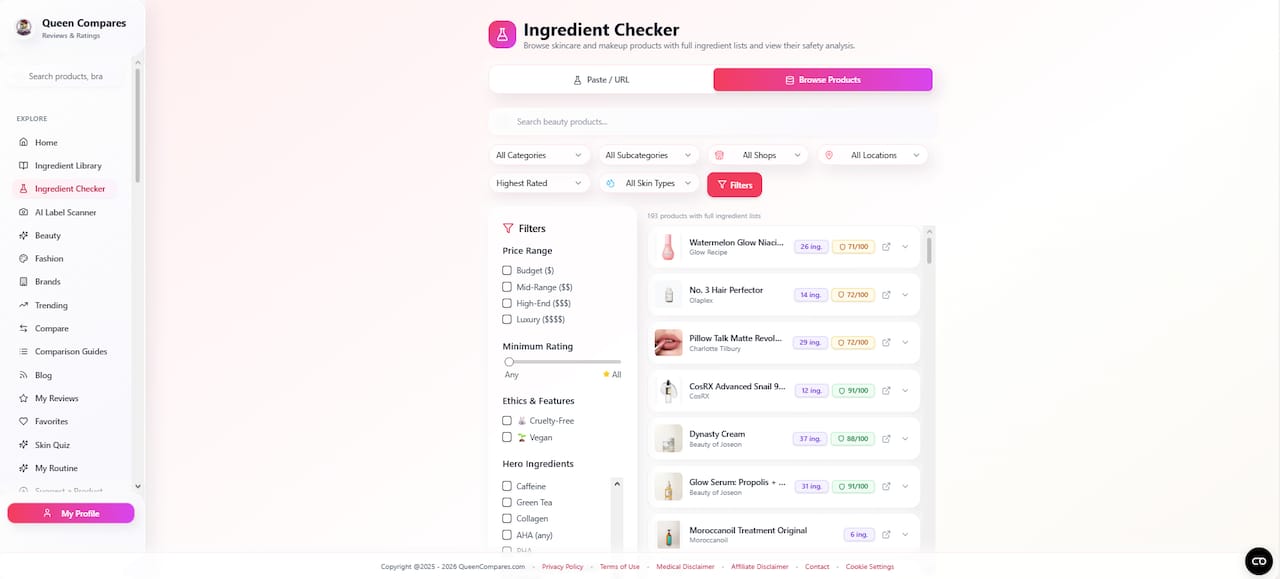
Here’s what the tool actually does for you: it scans a product’s label or ingredient list, flags anything from the priority-avoid categories covered in this guide, and points you toward comparable products that skip those ingredients. You can also save notes on how your skin responded to a swap, which turns your phone into the tracking system this whole approach depends on. Start by visiting the Ingredient Library to look up a product you’re already unsure about, or head to the Ingredient Checker and AI Label Scanner to run your first side-by-side scan today.
Trusted Resources for Ongoing Ingredient Checks
-
EWG Skin Deep database: Search individual products or ingredients for safety ratings and formula breakdowns before you buy.
-
BCPP Red List / SafeCosmetics.org: A category-organized reference for chemicals of concern and where they typically show up.
-
Consumer Reports cosmetics safety coverage: Ongoing reporting on concerning ingredients, recalls, and practical swap advice.
-
PMC review on cosmetic contamination: Peer-reviewed documentation of heavy metal contamination and carcinogen concerns in tested products.
-
FDA prohibited and restricted ingredients list: The official federal list of ingredients banned or limited in U.S. cosmetics, useful for confirming regulatory status.
This article is general information, not a substitute for advice from a qualified doctor. Consult a qualified healthcare professional about your own circumstances before acting on anything here.
Sources
FAQ
Which makeup brand is the least toxic?
No single brand is universally “the least toxic,” since formulas vary product by product even within the same brand. Check individual products against EWG Skin Deep or a similar database rather than trusting brand reputation alone.
What is the 3:1:1 rule for makeup?
This isn’t an established safety or regulatory standard, and definitions of it vary widely online, so treat any specific claim about it with caution. Focus instead on the ingredient-priority and slow-swap approach covered in this guide, which does have research backing.
What is the healthiest makeup to wear?
The healthiest choice is a product with a short, transparent ingredient list, verified through a database or ingredient checker, that avoids formaldehyde releasers, certain parabens, phthalates, PFAS, and heavy metal contamination risk. No product is automatically “healthy” just because it’s labeled natural or clean.
Which makeup brands are safe to use?
Safety depends on formula, not brand name alone, and even reputable brands have had individual products flagged for heavy metal contamination or undisclosed phthalates. Use QueenCompares’ Ingredient Library or EWG Skin Deep to verify specific products before assuming a brand’s entire line is clean.