“Reef safe” generally means a sunscreen relies on non-nano zinc oxide or titanium dioxide instead of chemical filters like oxybenzone and octinoxate, which lab studies tie to coral stress. Here’s the catch: no government agency defines or verifies that phrase, so it’s a marketing claim, not a guarantee. The National Park Service estimates 6,000 tons of sunscreen reach reef areas every year, which is exactly why checking the actual ingredient list matters more than trusting a label.
TL;DR:
Most “reef safe” sunscreens rely on non-nano zinc oxide or titanium dioxide, but the label is unregulated and does not guarantee coral safety.
Chemical filters like oxybenzone and octinoxate have lab evidence of harming corals, leading to bans in some jurisdictions, yet many products still contain these chemicals.
Non-nano mineral sunscreens are generally less harmful to reefs, but formulations with preservatives or inadequate coverage can still pose environmental or skin risks.
Checking the active ingredients directly is the most reliable way to identify reef-friendly products, with non-nano mineral filters being the safest choice available.
Proper application, reapplication, and supplementary protective measures like UPF clothing and shade are essential to minimize sunscreen volume and environmental impact.
Table of Contents
What “Reef Safe” Really Means (and Why It’s So Slippery)
The phrase started showing up on bottles after Hawaii and Key West passed local bans on oxybenzone and octinoxate, reflecting concern over their environmental impact, and brands scrambled to signal they’d cleaned up their formulas. It stuck as shorthand for “coral-friendly,” but here’s what most shoppers don’t realize: any company can print “reef safe” on packaging with zero third-party verification. There’s no FDA seal, no legal standard, no enforcement body checking whether the claim holds up.

That gap matters because the science behind the phrase is real, even if the label policing isn’t. NOAA has documented how certain UV filters interact with coral tissue and disrupt reproductive cycles in lab settings. Groups like Surfrider and the National Park Service have pushed the term into public conversation precisely because sunscreen runoff at popular snorkeling and diving sites is measurable, not theoretical.
For QueenCompares readers, the practical takeaway breaks into three parts:
-
Marketing language and regulatory truth are two different things.
-
The active ingredient list is the only section of the label that means anything scientifically.
-
Reef-conscious buying is one piece of a bigger picture that includes how much sunscreen you use and how often you reapply it.
The Chemical Filters Under the Microscope
Three ingredients show up again and again in the research on coral impact, and they’re worth knowing by name.
Oxybenzone (benzophenone-3) has the most scrutiny behind it. PubChem’s data confirms it’s a widely used UV-absorbing compound, and a peer-reviewed review found laboratory evidence linking it to coral bleaching and toxicity in coral larvae. That evidence drove Hawaii, Key West, and several other jurisdictions to restrict its sale due to environmental concerns.
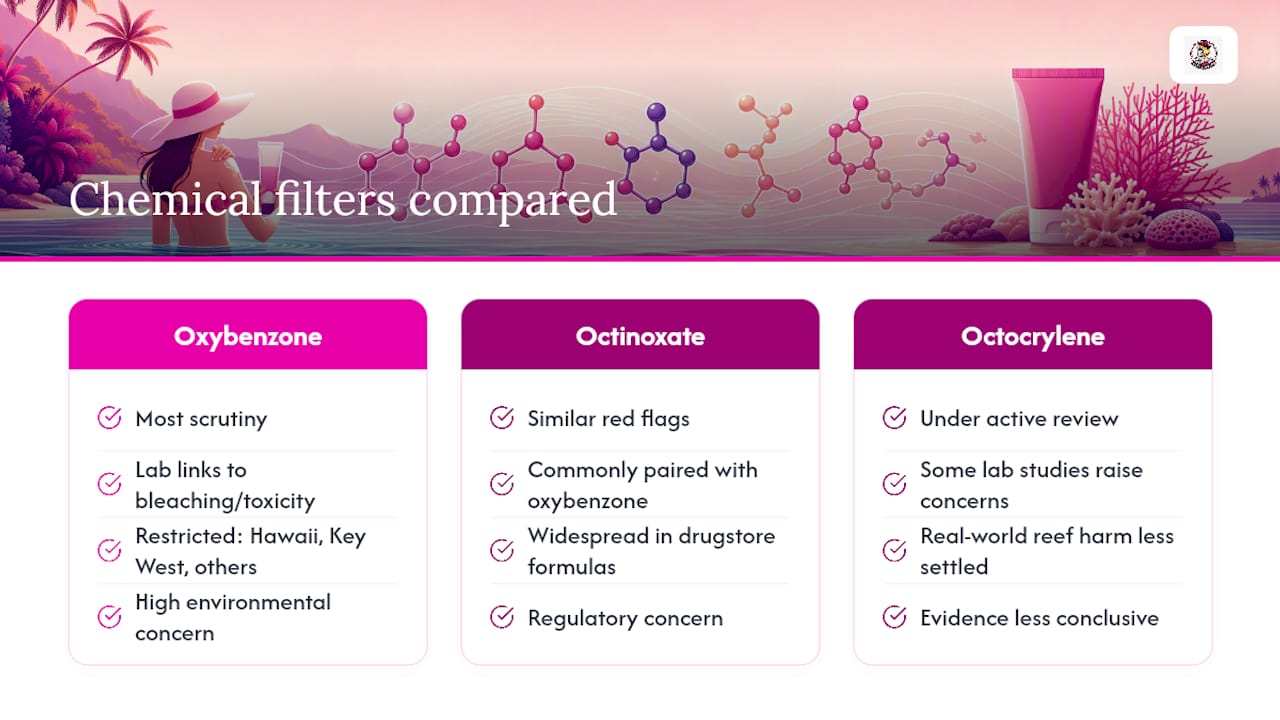
Octinoxate carries similar red flags and shows up in a comparable share of drugstore formulas, often paired with oxybenzone in the same bottle.
Octocrylene sits in a grayer zone. It’s under active review, and while some lab studies raise concerns, but the evidence linking typical beach-level exposure of octocrylene to real-world reef damage is less settled than that for oxybenzone.
An estimated 6,000 tons of sunscreen washes into reef areas annually, concentrated at high-traffic snorkeling and diving destinations.
That volume is exactly why chemical filter choice carries more environmental weight at a popular reef than it does, say, on a lake trip.
Why Mineral Sunscreens Get the Green Light
Zinc oxide and titanium dioxide work by sitting on top of skin and physically deflecting UV rays, while chemical filters absorb UV radiation and convert it to heat. That mechanical difference is part of why mineral formulas dominate the “reef safe” conversation. They don’t carry the same lab-documented coral toxicity concerns as oxybenzone or octinoxate.
Particle size is the detail most shoppers skip. “Non-nano” means the mineral particles are large enough that they’re less likely to be absorbed by coral tissue or inhaled as fine spray particles. Surfrider’s guidance specifically recommends non-nano zinc oxide or titanium dioxide over nano formulations for this reason.
A few things to watch for even with mineral products:
-
Some mineral sunscreens still include synthetic preservatives or fragrance additives worth flagging.
-
White cast and thicker texture are real trade-offs, though tinted mineral formulas have narrowed that gap.
-
Formulation stability varies brand to brand, so reapplication behavior still counts.
Pro Tip: Rub mineral sunscreen in fully before you leave the house. A visible white film usually means uneven coverage, not just a cosmetic issue.
How to Choose a Reef-Conscious Sunscreen
You don’t need a chemistry degree to shop smarter. Four steps get you most of the way there.
-
Flip the bottle and read the active ingredients first. If reef protection is your priority, zinc oxide and titanium dioxide should be the only actives listed. You can use our Ingredient Checker and past ingredient list there. Alternatively, if you have a product with label, you can scan it on our AI Label Scanner.
-
Look for “non-nano” on the label, and skip anything listing oxybenzone, octinoxate, or octocrylene.
-
Check for independent screening. Programs like Haereticus Environmental Laboratory’s Protect Land + Sea maintain a list of chemicals of concern, though even these programs have limits since they can’t test every real-world exposure scenario.
-
When you’re unsure, lean on physical coverage like UPF clothing instead of stacking on more sunscreen.
Our Ingredient Library breaks down exactly this kind of active ingredient list if you want a second opinion before you buy. For a deeper dive into which sunscreen ingredients are actually safe, that guide walks through the evidence ingredient by ingredient.
Smart Sunscreen Habits Matter as Much as the Formula
Product choice is half the equation. How you use it is the other half.
Dermatologists note that most people apply far too little sunscreen and skip reapplication, which undercuts protection regardless of formula. The standard guidance holds: a generous, visible layer, reapplied regularly and especially after swimming or heavy sweating.
-
UPF-rated swimwear and hats cut your total sunscreen need, which lowers what eventually washes off in the water.
-
Rinsing sunscreen off in the shower sends chemical residue into wastewater systems, so year-round choices matter, not just beach-day ones.
-
Shade during peak UV hours, roughly 10 a.m. to 4 p.m., reduces exposure without reducing protection.
None of this means skipping sunscreen to “save the reef.” Skin cancer prevention comes first. It means pairing smart product choices with less reliance on sunscreen volume overall.
How QueenCompares Helps You Verify the Claims
Ingredient libraries like ours can flag oxybenzone, octinoxate, and octocrylene when you search a product, helping avoid squinting at tiny ingredient panels in a drugstore aisle. Label scanning tools can read the active ingredients directly and surface similar flags instantly.
A typical path looks like this: scan the label on a sunscreen you’re considering, review any flagged chemical filters, then pull up side-by-side comparisons to find a non-nano mineral option with similar SPF and texture. User reviews on each product page often catch formulation quirks, like white cast or greasy finish, that ingredient lists alone won’t tell you.
What the Evidence Actually Supports
The coral research on chemical filters is real but incomplete. Lab studies show oxybenzone stresses coral larvae under controlled conditions, yet translating that into precise real-world risk at every beach is still being worked out. That uncertainty isn’t a reason to shrug. It’s a reason to lean precautionary: skip the chemicals with documented lab harm, favor non-nano minerals, and don’t treat any single ingredient swap as a complete fix.
The more durable habit is reducing total sunscreen load through clothing and shade, then using ingredient checkers to handle the label-reading you don’t have time for on vacation.
— Magdalena Kapuscinska
Check Your Sunscreen Before You Buy It
Resources exist that provide faster ways to confirm what’s actually in sunscreen bottles instead of trusting marketing stickers. Using label scanning tools, you can see active ingredients flagged within seconds, without squinting at fine print in a drugstore aisle.

Start with the Ingredient Library to search a product you’re already considering, or compare a few non-nano mineral options side by side before you check out anywhere else. These tools flag chemicals of concern based on current research, but since formulas change, it’s still worth reading the label yourself before buying. If a brand you love isn’t listed yet, you can suggest it and we’ll work on adding it.
Sources
FAQ
Is Hawaiian Tropic Actually Reef Safe?
It depends on the specific formula. Some Hawaiian Tropic products still list oxybenzone or octinoxate, so you need to check the active ingredients on the exact bottle rather than trusting the brand name alone.
Is Blue Lizard Actually Reef Safe?
Blue Lizard makes several mineral-based formulas using zinc oxide or titanium dioxide, which align with reef-conscious guidance, but not every product in their lineup is mineral only. Check the active ingredient panel on the specific product before assuming.
Which Sun Creams Are Reef Safe?
No sunscreen carries a legally regulated “reef safe” certification, but formulas using only non-nano zinc oxide or titanium dioxide as active ingredients align best with current environmental evidence. Tools like QueenCompares’ Ingredient Library can confirm the actives in a specific product.
What Sunscreens Are Not Reef Safe?
Sunscreens listing oxybenzone, octinoxate, or octocrylene as active ingredients raise the most concern, since lab studies have linked these chemicals to coral stress and bleaching. Chemical filter blends common in many drugstore SPF products often contain one or more of these.
Why Is the Term “Reef Safe” Unregulated?
No US or international regulatory body has established legal criteria for the phrase, so any manufacturer can apply it without third-party testing. That’s why reading the active ingredient list matters more than trusting the label claim itself.