TL;DR:
- A broad-spectrum SPF 30 sunscreen offers strong protection against UVB rays and some UVA rays. Proper protection depends on correct application, reapplication, and choosing the right filter type for your skin. Read labels carefully to ensure UVA and UVB coverage and reapply regularly for effective sun safety.
A good SPF sunscreen is defined as one that delivers broad-spectrum protection against both UVB and UVA rays, with a Sun Protection Factor of at least 30. The American Academy of Dermatology sets SPF 30 as the minimum for daily use because it filters approximately 97% of UVB rays. SPF alone does not tell the whole story. A truly effective sunscreen also needs the right filters, clear labeling, and consistent application to protect your skin from sunburn, premature aging, and long-term damage.
What are UV rays and why do they matter for your skin?
UV radiation from the sun reaches your skin in three forms: UVA, UVB, and UVC. Each behaves differently, and understanding the difference shapes every smart sunscreen decision you make.
UVC rays carry the highest energy but are almost entirely absorbed by the ozone layer. They never reach your skin under normal conditions, so sunscreen does not need to address them.
UVB rays are the primary cause of sunburn. They hit the outer layers of the skin and directly damage DNA in skin cells, which is why they are strongly linked to skin cancer. The SPF number on your sunscreen label measures protection specifically against UVB rays.
UVA rays are the ones most people underestimate. They penetrate deeper into the skin than UVB rays, reaching the dermis where collagen and elastin live. UVA exposure causes photoaging, including wrinkles, dark spots, and loss of firmness. UVA rays are present year-round, even on cloudy days, and they pass through glass. That makes UVA protection just as critical as UVB defense.
Here is a quick breakdown of the three UV types:
-
UVC: Blocked by the ozone layer. No sunscreen protection needed.
-
UVB: Causes sunburn and skin cancer. Measured by the SPF number.
-
UVA: Causes aging and deep skin damage. Requires broad-spectrum coverage.
-
Broad-spectrum: The label term that confirms a sunscreen protects against both UVA and UVB rays.
A sunscreen labeled “broad-spectrum” is the only type that addresses both threats. If a product only lists an SPF number without a broad-spectrum claim, it offers no verified UVA defense.
Chemical vs mineral SPF: which filter type is right for you?
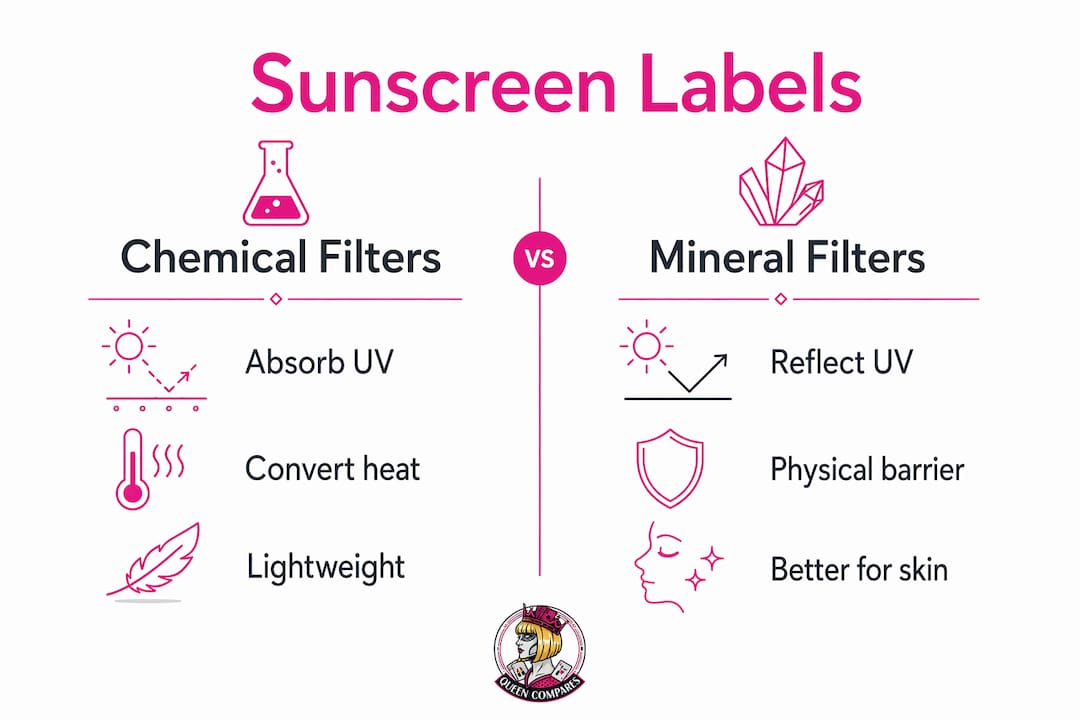
Sunscreen filters fall into two categories: chemical (also called organic filters) and mineral (also called inorganic filters). Both protect your skin, but they work in completely different ways.

Chemical filters such as avobenzone and oxybenzone absorb UV radiation and convert it into heat, which the skin then releases. These formulas tend to be lightweight, invisible on the skin, and easy to layer under makeup. Modern chemical sunscreens are formulated for broad-spectrum coverage and cosmetically elegant finishes. The trade-off is that some people with sensitive or reactive skin find certain chemical filters irritating.
Mineral filters, primarily zinc oxide and titanium dioxide, sit on top of the skin and physically reflect and scatter UV rays. Mineral sunscreens are less likely to clog pores or cause irritation, which makes them a strong choice for sensitive or acne-prone skin. Zinc oxide also has mild anti-inflammatory properties. The historical downside was a white cast, but many modern mineral formulas use micronized particles to reduce that effect significantly.
| Feature | Chemical filters | Mineral filters |
|---|---|---|
| How they work | Absorb UV and release as heat | Reflect and scatter UV rays |
| Key ingredients | Avobenzone, oxybenzone | Zinc oxide, titanium dioxide |
| Skin feel | Lightweight, invisible | Can leave a white cast |
| Best for | Normal to oily skin, daily wear | Sensitive, acne-prone, or children’s skin |
| Broad-spectrum | Yes, when formulated correctly | Yes, especially zinc oxide |
Mineral sunscreens typically contain active ingredients like zinc oxide or titanium dioxide, which sit on the skin's surface and reflect UV radiation, making them a good choice for sensitive skin or those prone to allergies. Chemical sunscreens, on the other hand, absorb UV rays through their chemical compounds like avobenzone, oxybenzone, or octocrylene, which are common chemical ingredients found in many sunscreens and skincare products. These compounds are not considered fully safe. However, some individuals may experience allergic reactions or skin sensitivities to these chemicals, and there is ongoing research into their environmental impact, especially concerning coral reefs and marine life. I prefer mineral sunscreen because it tends to be less irritating and offers broad-spectrum protection, but the best choice ultimately depends on your individual skin type, lifestyle, and personal preference regarding texture and formulation. It's important to choose a sunscreen that you will wear consistently every day for effective sun protection.
Pro Tip: If you find mineral sunscreens too heavy, look for formulas that combine zinc oxide with a lightweight serum base. These give you the gentleness of inorganic filters without the thick texture.
How to read a sunscreen label correctly
Sunscreen labels carry more information than most people realize. Knowing what each symbol and rating means puts you in control of your protection.
The SPF number
SPF 30 blocks about 97% of UVB rays. SPF 50 blocks about 98%, and SPF 100 blocks about 99%. The difference between SPF 50 and SPF 100 is less than 1% in UVB filtration. That is why SPF 50 is considered the sweet spot for most people, balancing strong protection with a formula that feels good to wear.
One critical point: SPF does not measure how many minutes you can safely stay in the sun. Protection depends on the UV index, your skin type, how much product you applied, and whether you reapplied. Treating SPF as a time calculator is one of the most common and costly mistakes.
PA rating and UVA protection
The PA rating system indicates UVA protection levels and is widely used on Asian and European market products. More plus signs mean stronger UVA defense:
-
PA+: Some UVA protection
-
PA++: Moderate UVA protection
-
PA+++: High UVA protection
-
PA++++: Very high UVA protection
The PA rating system gives you a direct read on UVA defense that the SPF number alone cannot provide. If you see PA++++ on a label, that product offers serious UVA coverage.
The UVA-in-a-circle symbol
The UVA circle symbol appears on products sold in Europe and indicates the product meets the EU standard for UVA protection, where UVA protection must be at least one-third of the SPF value. It is a quick visual confirmation of balanced broad-spectrum coverage.
Water resistance claims
Water resistance is not the same as waterproof. Labels specify either 40 minutes or 80 minutes of water resistance, meaning the SPF remains effective for that duration during water activity. After that window, or after towel drying, reapplication is required to maintain protection.
Pro Tip: Check the label for both a broad-spectrum claim and a PA rating if you want verified UVA and UVB coverage. A high SPF number with no UVA indicator is an incomplete shield.
How to choose a good SPF sunscreen for your skin
Choosing the right sunscreen comes down to four factors: SPF level, filter type, your skin’s needs, and how you will actually use it.
-
Start with SPF 30 as your minimum. For everyday activities like commuting or running errands, SPF 30 delivers strong UVB protection. If you spend extended time outdoors, work near windows, or have fair skin, move up to SPF 50.
-
Match the filter type to your skin. Sensitive or acne-prone skin benefits from mineral filters like zinc oxide. Normal to oily skin often tolerates chemical filters better because they feel lighter and leave no residue.
-
Look for broad-spectrum labeling. No broad-spectrum claim means no verified UVA protection. This is non-negotiable for complete effective sun protection.
-
Consider added skincare benefits. Modern sunscreens often include antioxidants, hyaluronic acid, and niacinamide. These ingredients merge sun protection with skin health benefits, making your morning routine more efficient.
-
Apply correctly and reapply consistently. Apply sunscreen liberally 15 minutes before sun exposure and reapply every 2 hours, or immediately after swimming, sweating, or towel drying. Proper application also means spreading it evenly without mixing it with other products, which can dilute the SPF.
-
Apply it as the last step in your skincare routine. Sunscreen applied last in your morning routine, before makeup, sits on top of your other products and maintains its protective integrity.
-
Choose a formula you enjoy wearing. The Skin Cancer Foundation states that the best sunscreen is the one a person will use consistently. A formula that feels heavy or leaves a white cast will get skipped. Comfort drives compliance.
For children or those with highly reactive skin, mineral formulas with zinc oxide are the most widely recommended starting point. For high UV exposure scenarios like beach days or mountain activities, SPF 50 or higher with water resistance is the practical choice.
Key Takeaways
A good SPF sunscreen requires broad-spectrum coverage, a minimum SPF 30 rating, the right filter type for your skin, and consistent daily reapplication to deliver real protection.
| Point | Details |
|---|---|
| Minimum SPF for daily use | SPF 30 filters about 97% of UVB rays and is the baseline recommended by dermatologists. |
| Broad-spectrum is non-negotiable | Only broad-spectrum sunscreens protect against both UVA and UVB rays. |
| PA rating reveals UVA strength | PA++++ indicates very high UVA protection; look for it alongside the SPF number. |
| Mineral vs chemical filters | Choose zinc oxide for sensitive skin; chemical filters suit normal to oily skin types. |
| Reapplication drives real protection | Reapply every 2 hours and after water or sweat exposure to maintain SPF efficacy. |
Why I think most people are using sunscreen wrong
People obsess over SPF numbers and ignore everything else. I have seen it constantly: someone buys an SPF 100 sunscreen, applies a thin layer once in the morning, and considers themselves protected for the entire day. That is not how it works, and the gap between the label and reality is where most sun damage actually happens.
The single biggest shift in my own routine came when I stopped treating sunscreen as a one-and-done step and started treating reapplication as mandatory. The formula matters too. I spent years avoiding sunscreen because heavy textures made my skin break out. When I switched to a lightweight mineral serum formula, I started wearing it every single day without thinking about it. That consistency did more for my skin than any high-SPF number ever could.
The other thing worth saying plainly: marketing language on sunscreen packaging is often misleading. “All-day protection” does not mean you skip reapplication. “Water-resistant” does not mean waterproof. Learning to read ingredient labels and understand what PA ratings and broad-spectrum claims actually mean is the real skill. Once you have it, you stop being swayed by packaging and start choosing products that genuinely work for your skin.
— Magdalena Kapuscinska
QueenCompares makes finding the right SPF sunscreen easier
Picking a sunscreen that matches your skin type, ingredient preferences, and protection needs takes more than reading one label. QueenCompares gives you the tools to compare sunscreen products side by side, check ingredient safety, and filter by formulation type.

The Ingredient Checker lets you verify whether a formula contains chemical or mineral filters, flag potential irritants, and confirm broad-spectrum claims before you buy. The Label Scanner takes the guesswork out of decoding PA ratings, water resistance claims, and SPF values. You can also browse the full sunscreen product catalog to find top-rated options matched to your skin’s needs. Our community of beauty enthusiasts is already using these tools to make smarter, safer sunscreen choices every day.
FAQ
What is a good SPF level for everyday use?
SPF 30 is the minimum recommended for daily use, filtering about 97% of UVB rays. SPF 50 offers marginally more protection and is considered the sweet spot for most skin types.
What does broad-spectrum mean on a sunscreen label?
Broad-spectrum means the sunscreen protects against both UVA and UVB rays. Without this label, a product offers no verified UVA protection.
What is the difference between mineral and chemical sunscreen?
Mineral sunscreens use zinc oxide or titanium dioxide to physically reflect UV rays and are better for sensitive skin. Chemical sunscreens absorb UV radiation and convert it to heat, offering a lighter feel for most skin types.
What does the PA rating on sunscreen mean?
The PA rating measures UVA protection. PA+ offers some protection, while PA++++ provides very high UVA defense. More plus signs equal stronger UVA coverage.
How often should you reapply sunscreen?
Sunscreen should be reapplied every 2 hours, and immediately after swimming, sweating, or towel drying, regardless of the SPF level on the label.