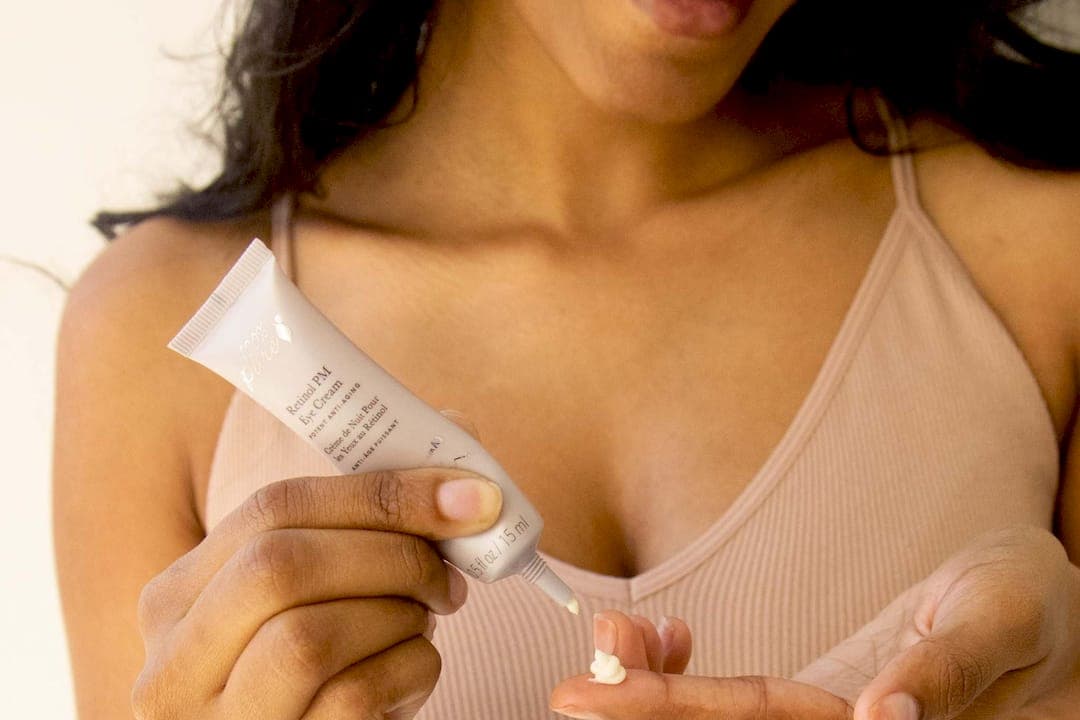
Avoid retinol and all prescription-strength retinoids during pregnancy, since oral retinoids are firmly contraindicated and topical versions carry enough theoretical concern that avoidance stays the standard advice. If you’re breastfeeding, consult with the licensed doctor if topical retinoids are generally considered low-risk as long as you skip applying them to your chest and wash your hands afterward.
TL;DR:
Topical retinol absorption is minimal and studies have not shown a clear increase in birth defects, but caution remains due to its chemical relation to known harmful oral retinoids.
The risk of harm increases with first-trimester use, high-potency formulations, or extensive application over large skin areas, especially with prescription retinoids like tretinoin or tazarotene.
During breastfeeding, topical retinoids are generally low-risk if applied only on the face and avoided on the chest, while oral retinoids are strictly contraindicated due to systemic absorption.
Accidental use before pregnancy recognition is unlikely to cause harm, but stopping immediately and informing your provider is recommended for reassurance.
Reintroduction of retinol after pregnancy depends on breastfeeding status; gentle, gradual use is acceptable during breastfeeding with precautions, but intensive treatments are best deferred until breastfeeding ends.
Table of Contents
-
Retinol vs. Pregnancy and Breastfeeding: Why Doctors Draw a Hard Line
-
Is Retinol Safe During Pregnancy? What the Research Actually Shows
-
Retinol and Breastfeeding: What InfantRisk and MotherToBaby Say
-
Safe Skincare Alternatives to Retinol While Pregnant or Nursing
-
What to Do If You Used Retinol Before Knowing You Were Pregnant
-
When Can You Restart Retinol After Pregnancy and Breastfeeding?
-
Check Your Products Before You Second-Guess Every Ingredient
Retinol vs. Pregnancy and Breastfeeding: Why Doctors Draw a Hard Line
Oral retinoids, like isotretinoin, reach the bloodstream in doses that have caused well-documented birth defects, which is exactly why they carry a black-box style warning and require strict pregnancy prevention protocols. Topical retinol works differently. It’s absorbed through the skin in far smaller amounts, and MotherToBaby’s fact sheet notes that studies haven’t shown a clear increase in birth defects from topical tretinoin specifically.
The caution comes from relatedness, not direct proof of harm. Because topical retinoids belong to the same chemical family as the oral drugs known to cause defects, clinicians tend to apply a “why risk it” standard rather than wait for more data.
Absorption also isn’t fixed. It climbs when:
-
The skin barrier is broken, irritated, or inflamed
-
You’re applying the product over a large surface area
-
You’re using a higher-potency prescription version like tretinoin or tazarotene rather than an over-the-counter retinol
The U.S. Pregnancy and Lactation Labeling Rule (PLLR) pushed manufacturers to describe actual risk data instead of vague warnings, but for retinoids, the honest answer is still “limited human data, known animal risk, avoid if possible.” That’s the regulatory posture behind most professional society guidance today.
Is Retinol Safe During Pregnancy? What the Research Actually Shows
A 2026 systematic review and meta-analysis pooling first-trimester topical retinoid exposures found no statistically significant link to major congenital malformations or spontaneous abortion. That’s a meaningfully reassuring finding for anyone who used a retinol serum before a positive pregnancy test.
The catch: the authors were clear that evidence gaps remain, and they recommended continued precautionary avoidance rather than treating the finding as a green light. Isolated case reports of birth defects following heavy topical tretinoin exposure still show up in the counseling literature, and those cases carry outsized influence on clinical advice even though they represent a tiny slice of exposed pregnancies.
Risk concern rises specifically with first-trimester use, since that’s when organ development is most sensitive, and with large-surface-area or high-potency application. Prescription tretinoin and tazarotene sit higher on the concern scale than over-the-counter retinol or retinaldehyde, since absorption and potency both run higher.
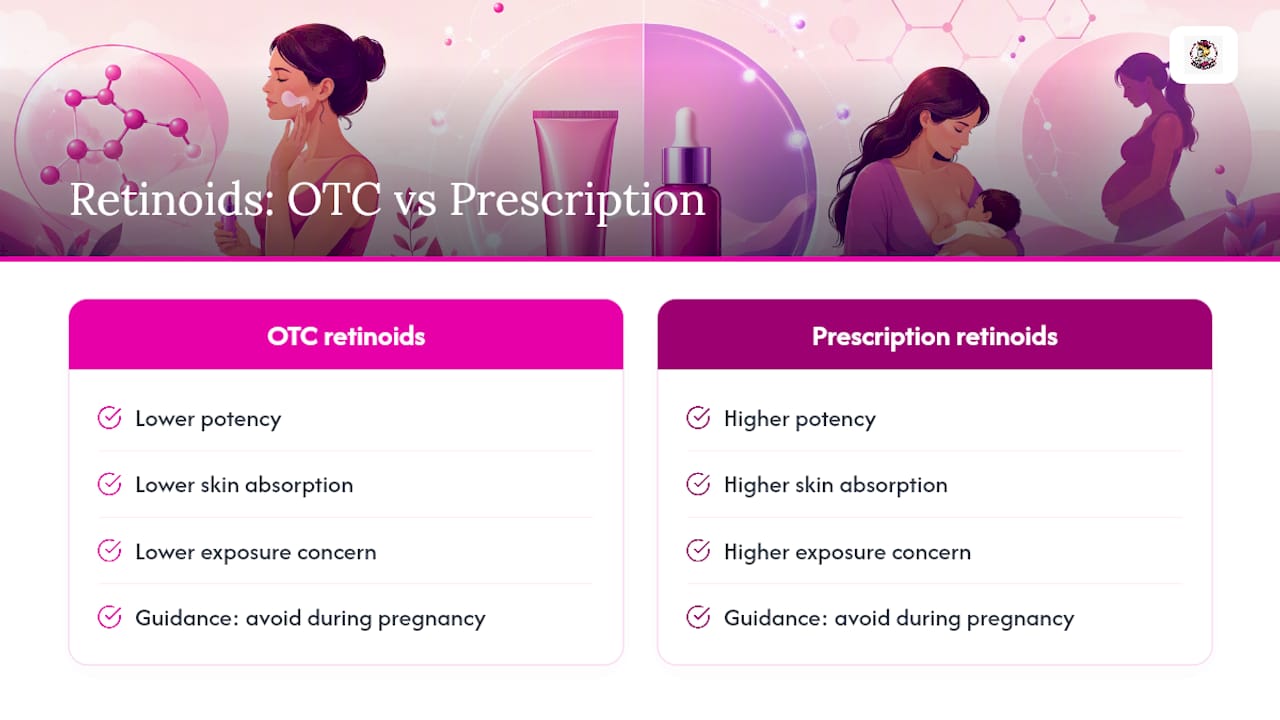
The practical translation: using retinol while pregnant isn’t proven to cause harm based on current data, but “not proven harmful” and “proven safe” are different things, and every major maternal-fetal guidance source still lands on avoidance.
Retinol and Breastfeeding: What InfantRisk and MotherToBaby Say
Breastfeeding is where the guidance genuinely diverges from pregnancy. The InfantRisk Center considers topical retinoids, prescription or over-the-counter, generally low-risk while nursing because minimal skin absorption makes meaningful transfer into breast milk unlikely.
Oral retinoids are a different story entirely. They’re not compatible with breastfeeding at all, since they reach systemic levels that likely pass into milk.
For topical use while nursing, InfantRisk and MotherToBaby both point to the same practical steps:
-
Skip applying retinol to your chest, nipples, or areola
-
Wash your hands thoroughly after application, before handling your baby
-
Don’t let your baby’s skin or mouth make contact with treated areas
-
Apply after a feeding session rather than right before one, giving the product time to absorb
Pro Tip: Keep your retinol routine confined to your face and apply it at night, after your baby’s last feed of the evening. That gives the product hours to fully absorb before any skin-to-skin contact in the morning.
Safe Skincare Alternatives to Retinol While Pregnant or Nursing
Most of what people use retinol for, texture, tone, acne, fine lines, has a workaround that doesn’t require the same caution.
-
Azelaic acid. Handles acne, redness, and pigmentation with a safety profile that makes it a go-to dermatologist recommendation during pregnancy.
-
Niacinamide. Calms inflammation, supports the skin barrier, and evens tone without any absorption concerns.
-
Vitamin C. A genuinely effective antioxidant for brightening and mild collagen support, safe throughout pregnancy and breastfeeding.
-
Hyaluronic acid. Pure hydration with no systemic exposure question at all.
-
Low-strength glycolic or lactic acid. Chemical exfoliants at conservative concentrations can substitute for retinol’s texture-smoothing effect, though check with your provider before layering multiple actives.
-
Benzoyl peroxide. Considered acceptable for acne in pregnancy by many board-certified dermatologists, typically at lower concentrations and used sparingly.
If your skin concern feels bigger than an over-the-counter swap can handle, a dermatology consult is worth the visit. Plenty of pregnancy-safe prescription options exist outside the retinoid family, and a professional can build a full routine around them rather than leaving you guessing.
What to Do If You Used Retinol Before Knowing You Were Pregnant
Stop using the product as soon as you find out. Then take a breath. This is a common situation, and one accidental exposure is not the same as ongoing use.
-
Write down which product you used, how much, and roughly how many weeks pregnant you were at the time.
-
Bring that information to your next prenatal appointment so your provider has the full picture.
-
Understand that a single, limited topical exposure is unlikely to cause harm based on current evidence, even though avoidance remains the standard advice going forward.
-
Seek prompt medical attention only if the exposure involved swallowing a retinoid product or heavy, prolonged use of a high-potency prescription version.
Your provider can walk through your specific timeline and reassure you directly, which usually helps more than searching for worst-case scenarios online.
Daily Habits to Minimize Exposure, and When You Can Restart
Beyond the chest-avoidance and handwashing basics, a few small habits add up. Let retinol fully absorb before getting dressed or holding your baby skin-to-skin. If you’re pumping, there’s no need to “pump and dump,” since topical use doesn’t create the kind of measurable milk transfer that oral medications do.
-
Apply retinol only to fully dry skin to reduce transfer to clothing or bedding
-
Cover treated areas loosely if you’ll be doing skin-to-skin contact soon after application
-
Keep other household members informed if they’re also handling the baby after touching your skincare free of microplastics
Pro Tip: If you’re weaning gradually, treat the transition as your natural cue to slowly reintroduce retinol rather than jumping back to your pre-pregnancy strength on day one.
On family planning: anyone prescribed oral isotretinoin is required to use strict pregnancy prevention measures, including monthly pregnancy tests and two forms of contraception, for the full duration of treatment. That protocol reflects how seriously the systemic risk is taken compared to topical products.
When Can You Restart Retinol After Pregnancy and Breastfeeding?
Timing depends on your feeding plan, not a fixed calendar date. If you’ve stopped breastfeeding entirely, you can generally reintroduce retinol once you feel ready, since the pregnancy-specific concern no longer applies. If you’re still nursing, many clinicians are comfortable with continued light topical use following the chest-avoidance and handwashing precautions covered above, rather than requiring you to wait until weaning is complete.
Where providers tend to draw a firmer line is around intensive retinoid therapy, higher-potency prescription formulas, or aggressive resurfacing regimens. Those are usually deferred until breastfeeding ends completely, simply because there’s less need to rush and more reason to be conservative with concentrated formulas.
If you’re restarting after a long break, ease back in rather than picking up where you left off. Skin that hasn’t seen retinol in nine months or more will react like beginner skin, regardless of how experienced you were before pregnancy. A gradual reintroduction schedule, starting low and building up over several weeks, reduces irritation and helps you gauge how your skin responds this time around.
It’s also worth revisiting whether retinol is still the right call at all. Some people find that understanding the full tradeoffs of retinol, including how it interacts with skin tone and sensitivity, changes what strength or frequency makes sense for a fresh start. Talk to your provider about timing if you’re still nursing part-time or transitioning off pumping, since that middle ground is where guidance varies most between individual clinicians.
An Editorial Perspective on Reading Retinol Warnings
The gap between “no proven harm” and “proven safe” is where most of the anxiety around this topic lives, and honestly, most skincare guidance doesn’t do a great job explaining the difference. A practical workflow helps more than another warning label: scan your product’s ingredient list, flag anything ending in “retinoid,” “retinal,” or “retinyl,” then cross-check it against pregnancy-safe alternatives in an ingredient library before you toss out a routine you actually like. Pair that with your provider’s advice rather than choosing one over the other. The data and the doctor are supposed to work together.
Check Your Products Before You Second-Guess Every Ingredient
You shouldn’t have to squint at a label or Google every unfamiliar ingredient name at 11 p.m. That’s exactly the gap QueenCompares’ Ingredient Checker is built to close: scan a product, and it flags retinoid derivatives along with other ingredients worth a second look during pregnancy or breastfeeding.
From there, you can browse pregnancy-friendly swaps directly in theIngredient Library, save the products you’re using to your scan reports for easy reference at prenatal visits, and keep a running list of what’s actually in your routine instead of relying on memory. This isn’t a replacement for your dermatologist or OB, it’s a way to walk into that appointment with real answers instead of a phone full of half-read blog posts. Scan your current shelf tonight and see what shows up.
Sources
For direct answers, MotherToBaby’s tretinoin fact sheet covers pregnancy-specific pharmacology, the InfantRisk Center covers breastfeeding, and the 2026 Frontiers meta-analysis covers the latest pooled evidence. Share any of these with your provider for personalized counseling.
This article is general information, not a substitute for advice from a qualified doctor. Consult a qualified healthcare professional about your own circumstances before acting on anything here.
FAQ
Can retinol pass through breast milk?
Topical retinol is absorbed through skin in very small amounts, and the InfantRisk Center considers meaningful transfer into breast milk unlikely as long as you avoid applying it directly to your chest.
What skincare should you avoid when breastfeeding?
Oral retinoids are the clearest thing to avoid entirely while breastfeeding, along with any high-dose vitamin A supplement beyond what’s found in a standard prenatal, since vitamin A in large amounts carries known risks.
What should you use instead of retinol while breastfeeding?
Azelaic acid, niacinamide, vitamin C, and hyaluronic acid all address common concerns like acne, tone, and hydration without the same caution around retinoids, and you can compare specific formulas using an ingredient checker before adding anything new.
Is it safe to use retinol before you knew you were pregnant?
A single, limited exposure before you knew you were pregnant is unlikely to have caused harm based on current evidence, though you should stop use immediately and mention it to your provider at your next appointment.
How long should you wait to restart retinol after breastfeeding?
There’s no universal waiting period. Light topical use may be fine while still nursing with proper precautions, while more intensive retinoid treatment is usually deferred until breastfeeding ends completely, so talk timing through with your provider.