Sunscreen is safe during pregnancy, and skipping it is the bigger risk. The single rule to follow: choose a broad-spectrum SPF 30+ formula with zinc oxide or titanium dioxide as the active ingredient. These mineral filters sit on the skin’s surface, reflect UV rays, and have minimal systemic absorption, making them the first-line recommendation from the American College of Obstetricians and Gynecologists (ACOG) and a 2025 peer-reviewed review in Frontiers in Medicine. Chemical sunscreens aren’t universally off-limits, but certain filters, especially oxybenzone and octinoxate, are worth avoiding when a mineral option is available. Check our Clean Beauty page where we feature skincare and makeup products whose AI ingredient safety analysis scored 80/100 or higher — cleaner formulations, fewer concerns
Two quick rules you can use right now:
-
Tinted mineral SPF 30+ with iron oxides is your best pick for the face. It protects against both UV and high-energy visible light (HEVL), which drives melasma, and the tint eliminates the white cast that makes many mineral formulas hard to wear daily.
-
Skip aerosol and spray sunscreens on the face during pregnancy. WHO guidance on topical product safety flags inhalation as a meaningful exposure route to reduce, and sprays make that harder to control.
Key Takeaways
Mineral sunscreen with zinc oxide or titanium dioxide, SPF 30+, applied daily and reapplied every 2 hours, is the safest and most effective photoprotection strategy during pregnancy.
| Point | Details |
|---|---|
| Mineral filters are first-line | Choose zinc oxide or titanium dioxide as the active ingredient; both have minimal systemic absorption. |
| Tinted mineral for melasma | Iron oxide in tinted formulas blocks HEVL, the primary driver of pregnancy melasma, and eliminates white cast. |
| Avoid oxybenzone and octinoxate | These chemical filters show measurable plasma detection in absorption studies; skip them when a mineral option is available. |
| Apply and reapply correctly | Use half a teaspoon on the face and a shot glass for the body; reapply every 2 hours or after swimming or sweating. |
| QueenCompares Ingredient Checker | Scan any sunscreen’s ingredient list for instant pregnancy-safety flags, mineral ratings, and HEVL-protection notes. |
Table of Contents
Why pregnancy makes sun protection more urgent
Pregnancy hormones, particularly estrogen and progesterone, ramp up melanin production. That’s why melasma, sometimes called the “mask of pregnancy,” appears on the forehead, cheeks, and upper lip in a significant share of pregnant people. UV exposure is the primary trigger that activates those already-primed melanocytes, so unprotected sun time during pregnancy can set off pigmentation that lingers for months postpartum.
Beyond cosmetic concerns, cumulative UV exposure raises lifetime risk of photoaging and skin cancer. Pregnancy is not a pause from that accumulation. The 2025 Frontiers in Medicine review on photoprotection in pregnancy recommends treating photoprotection as daily preventive care, not a seasonal habit, and advocates combining sunscreen with hats and UPF-rated clothing for full coverage.
Stat to know: Melasma affects a notable proportion of pregnant individuals, and UV exposure is the primary environmental trigger that worsens it, according to the Frontiers in Medicine 2025 review.
Skin sensitivity also increases during pregnancy. Hormonal shifts can make skin more reactive to fragrance, heat, and certain actives, which is one more reason to simplify your formula and lean on well-tolerated mineral filters.
Mineral vs. chemical sunscreens: what the safety evidence actually says
How each category works
Mineral sunscreens use zinc oxide, titanium dioxide, or both. These particles sit on the skin’s surface and physically scatter and reflect UV radiation. They don’t need to be absorbed to work. Chemical (organic) sunscreens use carbon-based compounds, such as avobenzone, oxybenzone, octinoxate, and homosalate, that absorb UV energy and convert it to heat. They require skin absorption to function.
What the absorption data shows
A dermatology review published in PMC found limited dermal or systemic absorption for many sunscreen filters and reported no adverse events when sunscreens were used in pregnancy to treat or prevent melasma. That’s reassuring across the board. The concern with specific chemical filters is more targeted: an Environmental Health Perspectives study detected measurable plasma levels of certain organic filters, including oxybenzone, after topical application in study settings. Causal harm in pregnancy has not been established, but the detection of these compounds in blood, and the theoretical concern about placental transfer and endocrine disruption, supports a precautionary preference for mineral filters when you have the choice.
Side-by-side comparison
| Feature | Mineral (zinc oxide / titanium dioxide) | Chemical filters (avobenzone, oxybenzone, etc.) |
|---|---|---|
| Active-ingredient type | Physical / inorganic | Organic / carbon-based |
| SPF and broad-spectrum | Broad-spectrum; zinc oxide alone covers UVA + UVB | Varies by filter; often blended for full coverage |
| White cast / cosmetic trade-off | Can leave white cast; tinted versions eliminate this | Typically invisible; lighter textures |
| Systemic absorption evidence | Minimal; largely stays on skin surface | Measurable plasma detection in some studies |
| Pregnancy suitability | First-line recommendation | Use cautiously; avoid oxybenzone and octinoxate when possible |
| Formulation notes | Tinted options available; water-resistant versions exist | Wide range of textures; sprays common |

The practical verdict: mineral is the first-line choice during pregnancy. If cosmetic acceptability is the barrier, a tinted mineral formula or a micronized mineral product resolves most white-cast complaints without switching to a chemical filter.
Ingredients to avoid or use cautiously during pregnancy
Not every ingredient concern is equal. Here’s a prioritized breakdown.
High-priority: avoid these
-
Topical retinoids (tretinoin, retinol, adapalene): Systemic retinoids are teratogenic, and while topical absorption is lower, ACOG guidance discourages topical retinoids during pregnancy because of systemic absorption concerns. Swap to azelaic acid for texture and tone.
-
Hydroquinone: Used for hyperpigmentation, but it has higher systemic absorption than most topical agents. The PMC safety review notes this explicitly. Avoid it during pregnancy.
Use cautiously, with clinician input
-
Benzoyl peroxide: ACOG and the American Academy of Dermatology both note that benzoyl peroxide is often considered acceptable in limited topical use during pregnancy after clinician discussion. Benzoyl peroxide while pregnant is not automatically off the table, but use the lowest effective concentration on small areas.
-
Salicylic acid (BHA): Topical salicylic acid while pregnant is generally considered low-risk at the concentrations found in most OTC cleansers and toners (0.5–2%). High-dose or leave-on salicylic acid preparations warrant more caution. Salicylic acid pregnancy safety is dose-dependent, so check with your provider if you’re using a high-concentration peel or treatment.
-
Strong chemical exfoliants at high concentrations: Glycolic acid at low concentrations is generally considered acceptable; high-concentration peels are not.
Safer replacements
-
Zinc oxide or titanium dioxide for sun protection
-
Iron oxides (in tinted mineral formulas) for HEVL and melasma protection
-
Azelaic acid for acne and pigmentation (generally well-tolerated in pregnancy)
-
Niacinamide for brightening and barrier support
Pro Tip: When scanning a label, oxybenzone may also appear as “benzophenone-3” and octinoxate as “octyl methoxycinnamate.” The QueenCompares Ingredient Library lists both names for flagged ingredients so you catch them even when the label uses the chemical synonym.
How to choose a pregnancy-safe sunscreen
The checklist below works whether you’re shopping in a store or scrolling a product page online.
Must-have criteria
-
SPF 30 or higher, broad-spectrum labeled. SPF 30 blocks a very high percentage of UVB rays. Broad-spectrum means UVA coverage is included.
-
Zinc oxide and/or titanium dioxide as the active ingredient. These are the mineral actives recommended as first-line by the 2025 Frontiers review.
-
No oxybenzone, octinoxate, or topical retinoids in the formula. Check the full ingredient list, not just the active section.
-
Water-resistant (40 or 80 minutes) if you’re swimming, exercising, or in a humid climate.
-
Lotion, cream, or stick format rather than aerosol spray. WHO guidance highlights inhalation as a risk to minimize.
Skin-type considerations
-
Acne-prone or hormonal skin: Look for “non-comedogenic” on the label. Lighter mineral milks and gel-cream textures work well. A routine guide for oily skin can help you layer sunscreen without clogging pores.
-
Dry skin: Hydrating mineral formulas with ceramides or hyaluronic acid give you SPF and moisture in one step.
-
Darker skin tones: An untinted mineral formula will leave a visible white cast. Choose a tinted mineral sunscreen with iron oxides. It protects against HEVL, reduces the white cast, and is more likely to become a daily habit.
-
Sensitive or reactive skin: Fragrance-free, minimal-ingredient formulas reduce the chance of irritation. Zinc oxide is generally the gentler of the two mineral actives.
Sunscreen recommendations from Ecco Verde:
For effective sun protection, Ecco Verde suggests choosing broad-spectrum sunscreens that protect against both UVA and UVB rays. Look for products with a high SPF rating, ideally SPF 30 or higher, especially if you have fair skin or plan to spend extended time outdoors. Some popular options include mineral sunscreens containing zinc oxide or titanium dioxide, which are gentle on the skin and provide reliable protection. For example, their mineral SPF 50 offers excellent coverage for sensitive skin types. Additionally, reapply sunscreen every two hours, or more frequently if swimming or sweating. For more detailed recommendations and product options, visit their website:
Ecco Verde Sun Protection Guide.
The adherence factor
A theoretically perfect sunscreen that you don’t wear is zero protection. Consumer testing consistently shows that texture, finish, and ease of reapplication determine whether people actually use their sunscreen every day. Pick something you genuinely like wearing. For the face, a tinted mineral formula that doubles as a primer dramatically improves daily compliance.
Use the QueenCompares Ingredient Checker to scan any product’s ingredient list and get instant pregnancy-safety flags before you buy.
How to apply sunscreen correctly during pregnancy
Getting the right product matters, but so does using it correctly.
How much to use
-
Face and neck: roughly half a teaspoon (about 2.5 mL)
-
Full body: roughly a shot glass worth (about 30 mL / 1 oz)
Apply 15 minutes before going outside so the formula has time to set. Reapply every 2 hours, or immediately after swimming or heavy sweating, regardless of whether the formula is water-resistant.
Face vs. body application notes
-
On the face, sticks and tinted cream formulas are easiest to reapply over makeup or on the go.
-
For the body, lotions spread more efficiently over large areas.
-
Avoid spraying aerosol sunscreen on or near the face. If a spray is the only option for body use, spray into your hands first and then apply, keeping the nozzle away from your face.
Layering with makeup
Sunscreen goes on after moisturizer and before makeup. A tinted mineral SPF can replace both primer and foundation-prep in one step, which simplifies the routine and makes reapplication more realistic. For tips on building a full safe skincare routine around your sunscreen, the QueenCompares blog has a step-by-step guide.
Reapplication routine for a day outdoors
-
Before leaving home: Apply a full dose of mineral SPF 30+ to face and all exposed skin. Wait 15 minutes before sun exposure.
-
At the 2-hour mark: Reapply to all exposed areas. Use a stick or powder mineral SPF on the face to avoid disturbing makeup.
-
After water or sweat: Reapply immediately, even if less than 2 hours have passed.
-
End of day: Cleanse thoroughly to remove sunscreen buildup, especially if you’re using a tinted formula with iron oxides.
Pro Tip: Keep a travel-size mineral stick in your bag for midday reapplication. It takes 30 seconds and means you’re actually protected all day, not just in the morning.
When to talk to your OB/GYN or dermatologist
General guidance covers most situations, but some circumstances call for a personalized conversation with your provider.
-
Known sunscreen allergies or contact dermatitis: If you’ve reacted to a sunscreen ingredient before, don’t trial-and-error during pregnancy. Your provider or a dermatologist can patch-test and recommend a safe alternative.
-
You’re using prescription topical medications: Combining sunscreen with prescription retinoids, strong corticosteroids, or other Rx topicals needs a clinician’s sign-off. Some combinations affect absorption or skin barrier function.
-
Severe or rapidly changing skin rashes: Pregnancy can trigger new skin conditions. A rash that spreads quickly or doesn’t respond to gentle care warrants a clinical evaluation, not a product swap.
-
Severe melasma needing professional management: Over-the-counter tinted mineral SPF helps prevent worsening, but established melasma often needs a dermatologist’s treatment plan, especially postpartum when more actives become available.
-
Breastfeeding considerations: Most mineral sunscreen guidance carries over to breastfeeding, but if you’re applying sunscreen to large body areas and have questions about specific filters, confirm with your provider.
-
Planned procedures: Chemical peels, laser treatments, and microdermabrasion are generally deferred during pregnancy. If you’re considering any procedure for melasma or pigmentation, discuss timing with your OB/GYN and dermatologist together.
What to bring to the appointment: the product label (or a photo of the ingredient list), a note on how often and where you apply it, and any other topical products in your routine. That context lets your provider give you a focused, specific answer rather than a generic one.
How to check sunscreen ingredients with QueenCompares
The fastest way to apply everything in this article at the shelf or on a product page is to run the ingredient list through the QueenCompares Ingredient Checker. Here’s the workflow:
-
Open the Ingredient Checker on QueenCompares and paste or scan the full ingredient list from the sunscreen you’re considering.
-
Review the safety flags. The tool highlights ingredients of concern, such as oxybenzone or octinoxate, with a caution note, and marks mineral actives like zinc oxide and titanium dioxide as preferred for pregnancy.
-
Check cosmetic attributes. Look for flags like “tinted / iron oxide present” (HEVL protection) or “non-comedogenic” to match the formula to your skin type.
-
Save the product to your QueenCompares list so you can compare it against other options or revisit it later.
Pro Tip: Use the QueenCompares Ingredient Library to look up contested ingredients like salicylic acid or benzoyl peroxide and read the pregnancy-specific notes. Salicylic acid pregnancy safety, for instance, is concentration-dependent, and the library breaks that down clearly so you don’t have to guess.
If your sunscreen isn’t in the database yet, you can suggest the product directly from the platform so the community benefits too.
What I’d tell every pregnant person about sunscreen
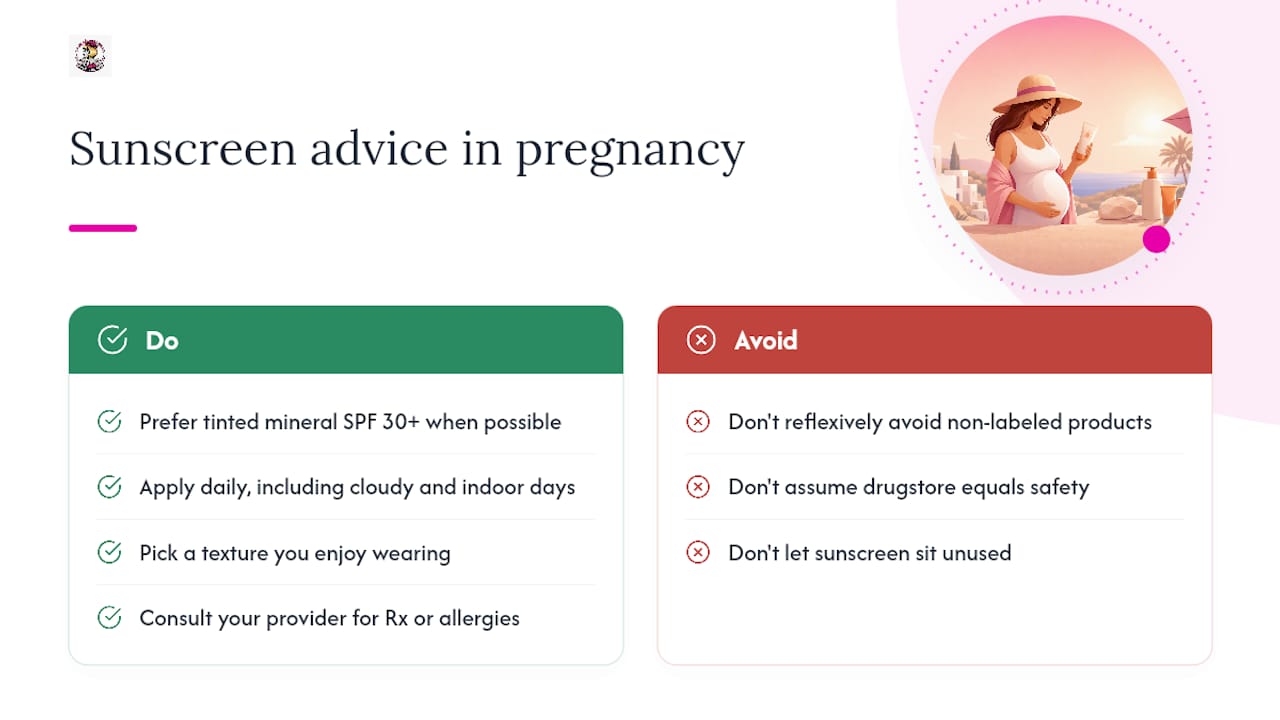
There’s a tendency in pregnancy to swing between two extremes: either avoid every product that isn’t explicitly labeled “pregnancy-safe” or assume that because something is sold in a drugstore it must be fine. Neither approach serves you well.
The evidence here is actually reassuring. Mineral sunscreens have a strong safety record, and the PMC review found no adverse events from sunscreen use in pregnancy across the studies it examined. The precaution around certain chemical filters is real but proportionate: it’s a “prefer mineral when you can” recommendation, not a “chemical sunscreen will harm your baby” warning.
What I find underappreciated is the melasma angle. Most people think of sunscreen as cancer prevention or anti-aging, and those are valid reasons. But during pregnancy, daily SPF is also your most effective tool for preventing a pigmentation change that can take a year or more to fade postpartum. A tinted mineral SPF 30+ worn every single day, including cloudy days and indoor days near windows, is doing real preventive work. The 2025 Frontiers review makes this case clearly, and it’s the recommendation I’d stand behind.
The QueenCompares community has flagged this too: when ingredient safety is clear and the texture is genuinely pleasant, people actually use their sunscreen consistently. That’s the whole game. A product you love wearing beats a technically superior one sitting in a drawer.
When in doubt, consult your provider. That’s not a hedge. It’s the right call for anything involving prescription topicals, known allergies, or significant skin changes.
QueenCompares makes pregnancy sunscreen selection simple
Choosing a pregnancy-safe sunscreen shouldn’t mean spending an hour cross-referencing ingredient lists with clinical studies. QueenCompares gives you the shortcut: paste any sunscreen’s ingredient list into the Ingredient Checker and get instant pregnancy-safety flags, mineral-preferred ratings, and HEVL-protection notes in seconds.
The Ingredient Library covers contested ingredients like salicylic acid and benzoyl peroxide with pregnancy-specific context, so you’re not guessing about concentration thresholds. Browse the full product directory to find tinted mineral formulas, compare them side by side, and save your shortlist. Community reviews from real users add the texture and finish feedback that ingredient lists alone can’t give you. Scan your next sunscreen on QueenCompares before you buy.
Sources
-
Photoprotection in pregnancy: addressing safety concerns and optimizing skin health
-
ACOG / NCBI guidance on topical medications during pregnancy
-
Safety profile of common topical agents during pregnancy (NCBI / PMC article)
-
American Academy of Dermatology: Acne treatment during pregnancy
-
WHO publication on topical product safety and public health considerations
This article is general information, not a substitute for advice from a qualified doctor. Consult a qualified healthcare professional about your own circumstances before acting on anything here.
FAQ
What sunscreen is safe to wear while pregnant?
Mineral sunscreens with zinc oxide or titanium dioxide as the active ingredient are the safest choice during pregnancy. Look for broad-spectrum SPF 30+, no oxybenzone or octinoxate, and a lotion, cream, or stick format rather than an aerosol spray.
What happens if I use a regular chemical sunscreen while pregnant?
Most chemical sunscreens are not proven to cause harm in pregnancy, but certain filters like oxybenzone have been detected in plasma in absorption studies, raising a precautionary concern. Switching to a mineral formula eliminates that uncertainty without reducing your protection.
What skincare ingredients should I avoid while pregnant?
The highest-priority avoids are topical retinoids, hydroquinone, and chemical sunscreen filters oxybenzone and octinoxate. Benzoyl peroxide and topical salicylic acid are generally considered acceptable in limited use per ACOG and AAD guidance, but check with your provider for your specific routine.
Is salicylic acid safe during pregnancy?
High-concentration leave-on treatments and peels warrant more caution, so confirm with your OB/GYN if you’re using anything beyond a standard face wash.
Which is better for pregnancy, mineral or chemical sunscreen?
Mineral sunscreen is the first-line recommendation for pregnancy because zinc oxide and titanium dioxide have minimal systemic absorption and a strong safety record. If cosmetic acceptability is a concern, a tinted mineral formula with iron oxides resolves the white-cast issue and adds HEVL protection that benefits melasma-prone skin.