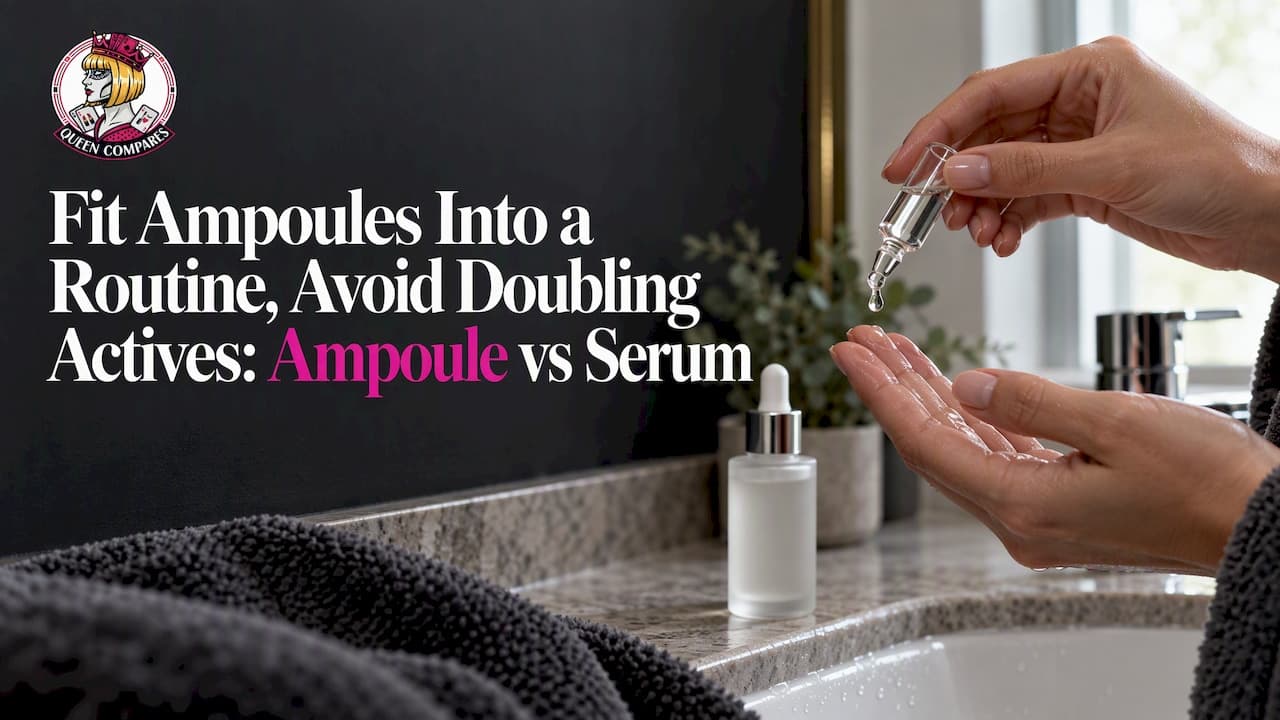
Ampoules are concentrated boosters meant for short-term, intensive use, while serums are the daily targeted treatments that carry your routine. The real difference comes down to the ingredient list, not the label on the bottle: a product called an “ampoule” can sometimes be a mildly concentrated serum in fancier packaging. If you use both, apply the thinner texture first and double-check that you’re not layering the same active twice.
Key Takeaways
Choosing between ampoules and serums depends on skin needs and product concentration, with formulation, not labeling, ultimately determining their efficacy.
| Point | Details |
|---|---|
| Labeling confusion | Terms like ampoule and serum are not regulated, so reading the ingredient list reveals true active levels and strengths. |
| Use for specific goals | Opt for ampoules for short-term, targeted boosts and serums for continuous, daily skin benefits. |
| Layer correctly | Apply the thinnest, most fluid product first, typically an ampoule or serum, to maximize absorption. |
| Patch test before use | Test new high-concentration products on skin to prevent irritation, especially when introducing potent formulas. |
| We prioritize formulation over branding | We recommend checking ingredient lists closely, as product benefits depend on ingredients, not marketing labels. |
Table of Contents
Formulation and packaging: why the names get confusing
The word “ampoule” came from pharmaceutical vials used to deliver a single, highly potent dose, and K-beauty borrowed that imagery to signal strength and seriousness. Traditionally, that meant small, single-use glass vials packed with a higher concentration of one or two hero ingredients, meant to be used for a limited stretch rather than forever.
Serum, on the other hand, is a much broader category. It covers almost any lightweight, fast-absorbing formula built around targeted actives like vitamin C, niacinamide, hyaluronic acid, or peptides, and it’s designed for daily, ongoing use as part of your core routine.
Here’s the catch: neither term is regulated.
-
A brand can call a product an “ampoule” even if its concentration barely differs from a standard serum.
-
Some “serums” are formulated at intensities that would traditionally belong in ampoule territory.
-
Packaging (glass vials, droppers, single-dose capsules) often drives the naming more than the formula does.
-
The only reliable way to know what you’re using is to read the ingredient list and check active percentages.
That inconsistency is exactly why we’d rather you judge a product by its formulation than its marketing.
Which one fits your skin goal?
Choosing between an ampoule and a serum comes down to how long you need the intensity and how your skin tends to react. A few decision rules make this easier:
-
Reach for an ampoule for short corrective courses, like reviving dull skin after travel, sun exposure, or a stretch of poor sleep.
-
Reach for an ampoule when you want a targeted boost before an event, since the higher concentration can deliver a visible, temporary lift.
-
Build your daily routine around a serum for ongoing needs like antioxidant protection, steady hydration, or long-term work on texture and pigmentation.
-
Check the ingredient concentration before adding either product, since stacking two formulas with the same active (two retinoids, two vitamin C products) raises irritation risk without adding benefit.
-
If you have sensitive skin, treat ampoules as occasional tools, not daily staples, and lean on fragrance-free, lower-concentration serums for everyday use.
The goal isn’t to own both categories. It’s to match the product’s intensity to how long your skin actually needs that level of support.
How to layer ampoules and serums without wasting them
Layering order follows one simple rule: thinnest texture first, thickest last, as explained in this guide on how to layer skincare products for maximum results. A typical sequence runs toner or essence, then your ampoule or serum, then moisturizer, then sunscreen in the morning.
-
When you’re using both an ampoule and a serum, apply whichever one has the lower viscosity first so it can absorb before a heavier formula seals it in.
-
Give each step roughly 30 to 60 seconds before moving on, longer for water-based actives like hyaluronic acid, which perform better with a brief pause to absorb.
-
Avoid pairing a strong vitamin C serum with multiple exfoliating acids in the same session unless the formula is specifically buffered for that combination.
-
Skip a step entirely if it duplicates an active you’ve already applied. Redundancy doesn’t double the benefit, it just raises the irritation odds.
A K-beauty multi-step routine typically places the ampoule right after the essence and before the heavier cream, which lines up with the thin-to-thick principle most routine guides recommend.
Pro Tip: Apply your most expensive, most active-dense product to slightly damp skin. It spreads further and absorbs faster than on fully dry skin.
Patch testing and how often to use a concentrated booster
Before introducing any new ampoule or serum, especially one with a high concentration of actives, patch-test it. Apply a small amount to your inner forearm or behind your ear and wait 24 to 48 hours before using it on your face, a step the American Academy of Dermatology recommends for any new skincare product.
-
Watch for redness, itching, or stinging during the waiting period before applying anywhere near your face.
-
Introduce known irritants like retinol or glycolic acid slowly, starting a few times a week rather than daily.
-
If irritation shows up and doesn’t resolve, a dermatologist can run a formal patch test to pinpoint the exact allergen.
-
If you get a severe reaction, wash the product off immediately, apply a cool compress, and see a dermatologist if symptoms persist.
Many skincare analysts caution against treating high-concentration ampoules as daily staples, since frequent use of a potent formula can sensitize skin over time rather than strengthen it. Short-term intensive courses, rather than constant rotation, are the safer approach.
Simple routines you can copy today
You don’t need a ten-step shelf to use either product well. A few structures cover most situations:
-
Serum-only routine (morning and evening): cleanser, toner, serum, moisturizer, sunscreen in the morning; swap sunscreen for a richer night cream in the evening.
-
Two-week ampoule course: use the ampoule once daily (or every other day if it’s strongly concentrated) for about two weeks, pausing any other strong actives like retinol or acids during that window.
-
Combined routine: cleanser, toner, ampoule, serum, moisturizer, sunscreen, skipping your usual vitamin C serum on ampoule days if the ampoule already contains it.
The combined version works best when the two products target different concerns, like a hydrating ampoule paired with a brightening serum, rather than two formulas chasing the same result.
Who’s behind this guidance and how to check your own products
This guide was written by Magdalena Kapuscinska, who covers skincare formulation and ingredient safety. You can find related breakdowns on hyaluronic acid layering and building a routine around your skin type.
Before combining a new ampoule and serum, it helps to see their ingredient lists side by side. Some ingredient analysis tools are designed to flag overlapping actives and potential irritants before they end up on your face, not after. Reading the full ingredient list and patch-testing still come first, every time.
Texture and absorption: what actually feels different
Ampoules tend to feel more viscous and concentrated, sometimes almost gel-like or syrupy, because they’re packing a higher dose of active ingredient into a small volume. Serums generally run lighter and more fluid, built to sink in quickly without leaving residue before the next step.
Absorption speed depends more on molecular weight and formulation than on the ampoule or serum label. A water-based, low-molecular-weight hyaluronic acid serum can absorb faster than a thick, oil-based ampoule, even though the ampoule is marketed as the more “intensive” product. Texture is a clue, not a guarantee, about how a formula will perform on your skin.
This is part of why K-beauty and routine guides emphasize checking texture and concentration over product category when deciding what goes where in a routine. A richer, heavier feel usually belongs later in your sequence, while anything that spreads thin and disappears quickly usually goes earlier, regardless of what the bottle calls itself.

Price range and value: are ampoules worth paying more for?
Ampoules are often priced higher per milliliter than comparable serums, partly because of smaller packaging formats and partly because of the perception of potency. That doesn’t always track with the actual concentration of actives inside, which brings us back to reading labels rather than assuming price reflects strength.
Value depends on how you use the product. An ampoule bought for a two-week course can be a reasonable one-time investment if it addresses a specific, short-term concern. A serum you’ll use daily for months needs to earn its price differently: through consistent performance and a formula gentle enough for repeated use without irritation.
Neither category is inherently the better deal. A well-formulated, moderately priced serum used consistently often does more for your skin over a year than an expensive ampoule used once and forgotten in a drawer.

Common misconceptions worth clearing up
The biggest myth is that “ampoule” automatically means stronger, better, or more effective than “serum.” In reality, the terms describe general categories, not guaranteed concentration levels, and plenty of serums outperform ampoules on paper.
Another common assumption is that more steps equal better skin. Piling on both an ampoule and multiple serums with overlapping actives doesn’t multiply results. It usually just multiplies irritation risk.
Marketing language like “clinical strength” or “intensive repair” on an ampoule label isn’t a regulated claim, it’s a positioning choice. The only numbers worth trusting are the ones in the ingredient list itself, like an actual percentage of niacinamide or vitamin C, rather than adjectives on the front of the bottle.
A brief history of how these categories evolved
Ampoules trace back to pharmaceutical packaging, where single-dose glass vials protected sensitive compounds from air and light exposure. K-beauty adopted that visual language decades later, using vial-style packaging and clinical framing to suggest a product was potent enough to need careful, limited dosing.
Serums evolved alongside the broader rise of multi-step skincare, becoming the catch-all term for any lightweight, active-focused treatment meant to sit between cleansing and moisturizing. As ingredient science advanced through the 2000s and 2010s, with wider access to stabilized vitamin C, retinoids, and peptides, serums became the default vehicle for delivering those actives daily.
The two categories have blurred over time as global skincare brands borrowed terminology from each other, which is part of why the distinction today rests more on formulation than on any fixed historical definition.
Our take: build the foundation before chasing boosters
A reliable serum does more for your skin over a year than a rotating cast of trendy ampoules ever will. Use boosters with intention, and trust the ingredient list over the label, that’s what the Ingredient Checker is for.
Comparing ingredient lists before you commit to either one
Some ingredient checker tools scan product formulas to flag actives that might clash or duplicate across the other steps already sitting in your routine. Some AI ingredient analysis tools go a layer deeper, reading full ingredient panels to surface concentration red flags and common irritants before you apply anything to your face.

If you’re weighing a specific ampoule against a serum you already use, compare both ingredient lists through our Ingredient Checker before adding either one to your shelf. It’s a faster way to catch overlap than reading two labels side by side in a store aisle.
FAQ
What comes first, serum or ampoule?
Apply whichever product has the thinner, more fluid texture first, since lighter formulas absorb faster and heavier ones can block penetration if applied too early. If both feel similar in weight, the general thin-to-thick layering rule still applies: lighter textures closer to clean skin.
Can I use both ampoule and serum?
Yes, as long as they target different concerns and don’t share the same concentrated active ingredient. Apply the thinner product first, wait briefly for absorption, then follow with the heavier one before moving on to moisturizer.
Can I use an ampoule every day?
Some lighter ampoules are formulated for daily use, but many concentrated ones are intended as short courses rather than everyday staples to limit the risk of sensitizing your skin. Check the product’s own instructions and patch-test first, since concentration varies widely between brands.
Can I use an ampoule as a serum?
You can, especially if its concentration is similar to a standard serum, but check the ingredient list first rather than assuming based on the name. If it contains a notably higher percentage of an active ingredient, treat it more cautiously and introduce it gradually instead of swapping it in daily right away.
Sources
-
Essence vs Ampoule vs Serum: What’s Actually the Difference? - Jane Yoo MD
-
How to test skin care products - American Academy of Dermatology
Recommended
General Entertainment & Information Purposes Only At QueenCompares.com we share content for general entertainment and information. It’s not medical, dermatological, nutritional, or fitness advice and shouldn’t replace guidance from a licensed professional. If you’re making health-related decisions, please check with a qualified expert — and know that using this site and its information is at your own discretion.