
The riskiest pairings are retinol with AHAs or BHAs, retinol with vitamin C, benzoyl peroxide with tretinoin, benzoyl peroxide with hydroquinone, and stacking more than one exfoliating acid at once. The fix isn’t banning ingredients from your shelf, it’s timing them apart. Use one strong active per session, alternate nights for the rest, layer barrier-supporting products around them, patch test anything new, and call in a dermatologist for prescription-strength retinoids or hydroquinone.
TL;DR:
Layer retinol and acids on alternate nights to prevent skin thinning, redness, and flaking, rather than trying to combine them in one session.
Separate benzoyl peroxide and tretinoin by morning and evening routines due to significant degradation of tretinoin when exposed to benzoyl peroxide.
Use vitamin C in the morning with sunscreen, and avoid pairing it with retinol or benzoyl peroxide in the same routine to prevent destabilization and oxidation.
Limit exfoliating acid use to one type at a time per week to avoid over-exfoliation and damage to the skin barrier.
Introduce new actives one at a time with patch testing and a waiting period of two to four weeks to determine tolerability and avoid reactions.
Table of Contents
What Not to Mix: Risky Pairings and Safer Swaps
Most “never combine” warnings you see floating around aren’t really about toxic chemistry. They’re about your skin barrier getting hit twice in one routine and tapping out. Here’s where that actually happens, and what to do instead.
Retinol plus AHAs or BHAs. Both increase cell turnover and thin the outer layer of skin, so stacking them in one session tends to spike redness, flaking, and stinging. Dermatologists routinely recommend alternating nights rather than layering these back to back.
Retinol plus vitamin C. This is less a chemical conflict and more a scheduling mismatch. Vitamin C works best at a low pH, and that acidic environment can destabilize retinol while also irritating skin that’s already adjusting to a retinoid. Vitamin C belongs in the morning under sunscreen. Retinol belongs at night.
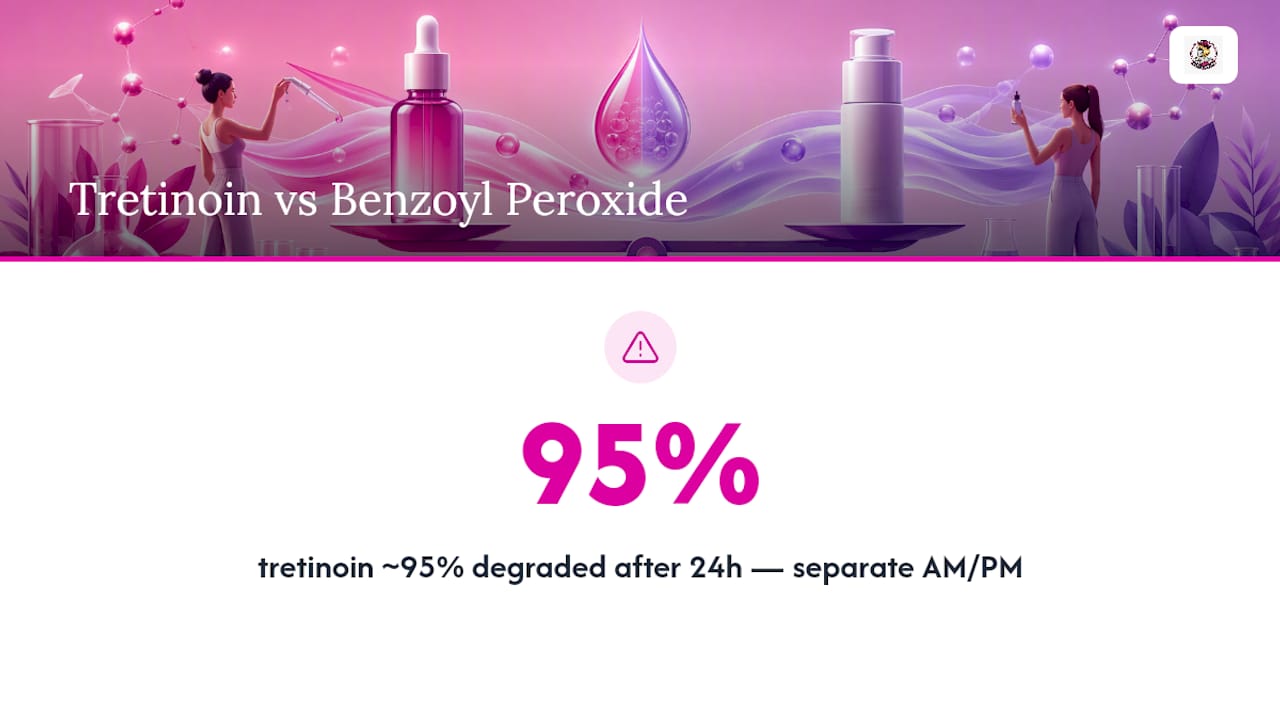
Benzoyl peroxide plus tretinoin. This is a real chemistry problem, not just an irritation issue. One stability study found tretinoin degraded by more than 50% within about two hours of contact with benzoyl peroxide, climbing to roughly 95% degradation after 24 hours, based on older formulation research cited in evidence reviews. Separate them by AM and PM, or switch to an adapalene-based retinoid, which holds up far better against benzoyl peroxide’s oxidative effect.
Benzoyl peroxide plus vitamin C. Benzoyl peroxide is an oxidizer, and it can break down vitamin C before it has a chance to work. Use vitamin C in the morning and save benzoyl peroxide treatments for night.
Hydroquinone plus benzoyl peroxide. Combining these two can cause temporary, unwanted skin staining, a reaction most people never see coming until it happens. Keep them on separate schedules entirely rather than trying to layer around it.
Stacking multiple exfoliating acids. Running an AHA, a BHA, and an exfoliating device in the same week is the fastest route to over-exfoliation. Overusing multiple acid types damages the barrier and raises transepidermal water loss, leaving skin more reactive to everything else in your routine. Pick one chemical exfoliant as your primary and rotate the rest in slowly.
The pattern across nearly every one of these: what looks like an ingredient conflict is usually a timing conflict. Separate the actives, and most of the risk disappears.
Ingredient Combinations That Actually Work Well Together
Not every pairing deserves side-eye. Some combinations are worth building a routine around because they genuinely make each other more effective.
-
Vitamin C, vitamin E, and ferulic acid. This trio is a classic for a reason: vitamin E and ferulic acid stabilize vitamin C and boost its antioxidant staying power, especially in a serum you’re already applying every morning.
-
Retinol with hyaluronic acid or glycerin. Retinol dries skin out as it works. Hydrators layered underneath or over it offset that dryness and keep the barrier intact while the retinol does its job.
-
Niacinamide with salicylic acid or benzoyl peroxide. Niacinamide calms inflammation while salicylic acid or benzoyl peroxide targets acne directly, making this a solid pairing for breakout-prone skin that still needs some redness control.
-
Niacinamide with vitamin C. This one gets flagged constantly, but modern formulations handle it fine. If you’re using an unstable, pure L-ascorbic acid formula, spacing them out is a reasonable precaution. Otherwise, this combination is largely a non-issue.
The common thread here is support, not competition. Antioxidants stabilize each other, hydrators offset actives that dry out skin, and niacinamide calms down ingredients that tend to provoke a reaction on their own.
How to mix skincare: a beginner’s guide to layering skincare
A simple AM/PM split resolves most conflicts before they start. Mornings are for protection, evenings are for repair, and strong actives get spread across the week instead of stacked into one night.
-
Morning routine: cleanser, antioxidant serum (vitamin C), moisturizer, sunscreen. This is when your skin needs defense against UV and environmental stress, not active ingredients working overtime.
-
Evening routine: cleanser, targeted treatment (retinoid, acid, or spot treatment), moisturizer. Save your strongest actives for night, when skin isn’t fighting sun exposure at the same time.
-
Weekly rotation for strong actives: retinol on Monday, Wednesday, and Friday; an AHA or BHA on Tuesday and Thursday; recovery nights with just moisturizer on the remaining days.
-
Same-day pairing rule: if you want to use a chemical exfoliant on a retinol night, choose a wash-off formula instead of a leave-on treatment to cut down on prolonged contact time and irritation.
-
Adjust as you go. Higher concentrations and more sensitive skin call for less frequency, not more. If redness or flaking shows up, pull back before adding anything else.
Pro Tip: Keep a simple note on your phone logging which actives you used each night for the first month. When irritation shows up, you’ll actually know what caused it instead of guessing.
This kind of scheduling is exactly what separates a routine that works from one that backfires. It’s the same logic behind building a full routine around frequency and rest days rather than piling on more products. If you want the AM/PM logic mapped out ingredient by ingredient, this daytime versus nighttime breakdown goes deeper.
How Do You Safely Introduce a New Active?
Adding one new ingredient at a time is the difference between a manageable adjustment period and a face full of confusing reactions you can’t trace back to a cause.
-
Patch test first. Apply the product to your inner forearm or just behind your ear, then wait 24 to 72 hours before using it on your face.
-
Introduce one active at a time. Give it two to four weeks before adding anything else new, and keep notes on texture, redness, and breakouts.
-
Know the difference between purging and an allergic reaction. Purging from a retinoid typically shows up in the first six to eight weeks as small breakouts in areas you normally break out. Hives, swelling, or intense burning are not purging; that’s a reaction, and it means stop immediately.
-
Buffer or back off if needed. Applying moisturizer before an active, cutting frequency in half, or pausing entirely are all valid moves. If irritation doesn’t calm down within a week or two, a dermatologist visit beats guessing.
Common Myths About Mixing Skincare Ingredients
A lot of the “never mix” advice circulating online traces back to lab conditions that don’t reflect how your actual products are formulated.
-
Niacinamide and vitamin C “cancel each other out.” This myth comes from decades-old lab experiments involving raw ingredients at high heat, not the stabilized, finished formulas sitting on your shelf. Current evidence treats this combination as a non-issue for most people.
-
All vitamin C needs to be avoided near other actives. pH sensitivity is mostly a concern with pure, unbuffered L-ascorbic acid. Stable derivatives like sodium ascorbyl phosphate don’t carry the same restrictions.
-
Copper peptides can never touch antioxidants. The honest answer is more nuanced: spacing them out is a reasonable caution, but it’s not a hard rule that demands separate routines entirely.
Verifying Pairings With QueenCompares’ Tools
Reading two ingredient lists side by side and guessing whether they’ll play nice is exactly the kind of guesswork QueenCompares was built to cut out.
-
Run a product pairing through the Ingredient Checker before you combine two new purchases, especially when one contains a retinoid or an acid.
-
Use the Label Scanner to confirm what’s actually in a formula when the packaging is vague about concentration or form.
-
Cross-reference unfamiliar ingredients in the Ingredient Library to understand pH range and known interactions before adding something new to your shelf.
-
When you’re dealing with prescription-strength tretinoin, hydroquinone, or a compounded formula with no listed concentration, no tool replaces an actual conversation with a dermatologist.
Keep Your Routine Simple and Evidence-First
Most skin trouble doesn’t come from one bad ingredient. It comes from three good ingredients used the same night. Stack fewer actives, rotate the strong ones, and let hydrators do quiet repair work in between.
When you’re unsure about a pairing, check it instead of guessing, and save the prescription-strength decisions for a dermatologist.
— Magdalena Kapuscinska - Queencompares.com Founder
Skip the Guesswork With QueenCompares’ Ingredient Checker
QueenCompares gives you a faster way to answer the question every reader of this guide is really asking: will this specific product clash with what’s already in my routine? Instead of cross-referencing ingredient lists by hand or hoping a brand’s marketing copy tells the whole story, you scan a label and get a straight read on what’s inside.

The Ingredient Checker flags known conflicts before you apply anything, the Label Scanner pulls the real ingredient list off a product you’re considering, and the Ingredient Library gives you a plain-language reference for anything unfamiliar. If you’re building out a routine from scratch or replacing something that’s not working, browse comparable formulations in Beauty Products to find options that pair well with what you already own, and check side-by-side comparisons before you commit to a new active.
Sources
-
Dermatologists reveal skincare ingredient combos you should never mix
-
Which skincare actives you should (and shouldn’t) mix: evidence-based guide
FAQ
Which Skincare Ingredients Should Not Be Mixed?
Avoid layering retinol with AHAs or BHAs, retinol with vitamin C, benzoyl peroxide with tretinoin, benzoyl peroxide with hydroquinone, and multiple exfoliating acids in the same routine. Separating these by time of day or alternating nights resolves most of the risk.
What Skincare Ingredients Can Be Mixed Together?
Vitamin C pairs well with vitamin E and ferulic acid, retinol pairs well with hyaluronic acid or glycerin, and niacinamide works alongside salicylic acid, benzoyl peroxide, or vitamin C in most modern formulations.
What Is the 4-2-4 Rule in Skincare?
Definitions of this rule vary across sources and it isn’t a standardized dermatology guideline, so treat any specific version you encounter with caution. The safer, evidence-backed approach is the timing and rotation framework covered above: separate strong actives by AM/PM or alternate days rather than following a fixed numeric formula.
Which Two Serums Cannot Be Used Together?
A vitamin C serum and a benzoyl peroxide treatment shouldn’t be applied together, since benzoyl peroxide oxidizes and weakens vitamin C. Use vitamin C in the morning and save benzoyl peroxide for your evening routine.
Recommended
General Entertainment & Information Purposes Only At QueenCompares.com we share content for general entertainment and information. It’s not medical, dermatological, nutritional, or fitness advice and shouldn’t replace guidance from a licensed professional. If you’re making health-related decisions, please check with a qualified expert — and know that using this site and its information is at your own discretion.