Start with the QueenCompares Ingredient Library and Ingredient Checker if you want a fast, practical answer to “is this safe for me?” It combines a searchable ingredient dictionary with an AI label scanner, so you can paste an ingredient list or snap a photo of a product and get safety flags, allergen alerts, and evidence links in under a minute.
Two things make it the right starting point among the best skincare ingredient databases: coverage that spans both individual ingredients and full product formulas, and a scanning tool that skips the tedious part where you manually retype a long INCI list. For edge cases, like a prescription-strength retinoid or a suspected allergy, pair it with a regulatory or clinical source.
Here’s what to do right now:
-
Scan a label: open the Ingredient Checker on your phone and photograph the back of a product.
-
Paste a list: copy the INCI ingredients from a product page and drop them into the checker for a breakdown.
-
Search one ingredient: type a name like “niacinamide” into the Ingredient Library to see its function, common concentration ranges, and flags.
-
Check our Clean Beauty page where we feature skincare and makeup products whose AI ingredient safety analysis scored 80/100 or higher — cleaner formulations, fewer concerns
If a database can’t tell you why an ingredient matters, or won’t show its sourcing, treat that as a gap, not a green light.
Use a regulatory database like CosIng when you need the official European inventory record for an ingredient. Use an NGO safety database when you want a second opinion on hazard scoring. Use dermatologist-reviewed literature when you’re trying to prioritize which actives are worth your money in the first place.
Key Takeaways
Start with a scanner-and-dictionary tool for speed, then escalate to regulatory or clinical sources only when a specific ingredient raises a real question.
| Point | Details |
|---|---|
| Start with a scanning tool | Use the QueenCompares Ingredient Checker to scan a label or paste an INCI list for instant flags. |
| Cross-check for edge cases | Escalate to CosIng or clinical primers for prescription actives or unresolved safety questions. |
| Watch for vague marketing terms | Avoid databases using words like “non-toxic” without citing methodology or evidence. |
| See a clinician when needed | Get professional input for severe reactions, prescription actives, or pregnancy-related concerns. |
| Presence isn’t the same as concentration | An ingredient appearing on a list doesn’t confirm its dose or guarantee results. |
Table of Contents
What Does a Skincare Ingredient Database Actually Do?
A skincare ingredient database is a searchable reference that defines what an ingredient is, what it does, and whether it carries known safety concerns. Some databases stop there, covering ingredients only. Others, like QueenCompares, pair ingredient data with full product formulas, so you can look up a moisturizer and see every ingredient it contains alongside individual safety context.

The distinction matters more than it sounds. An ingredient-only database tells you that retinol can cause irritation at high concentrations. A product+ingredient database tells you that the specific serum in your bathroom lists retinol fourth on the ingredient panel, which suggests a meaningful concentration, then lets you check that against known tolerability data.
Most solid databases share a common feature set:
-
INCI name lookup, so “tocopherol” and “vitamin E” resolve to the same entry.
-
Safety and allergen flags, often tied to known sensitizers or restricted-use ingredients.
-
Links to evidence, whether that’s a clinical trial, a regulatory opinion, or an industry standard.
-
Label or barcode scanning, which pulls a product’s full ingredient list automatically.
-
User reviews, offering a real-world layer on top of the technical data.
No database, however well built, can tell you the exact percentage of an active ingredient in a finished formula. Manufacturers rarely disclose concentrations, and INCI labeling rules under systems referenced by the Personal Care Products Council require listing order by concentration, not the number itself. A database also can’t predict how an ingredient behaves once it’s combined with a dozen others in a specific base, and it can’t substitute for a dermatologist’s judgment when your skin is already reacting to something. The European Commission’s CosIng database makes this limitation explicit: it’s an informational tool, not a legal authorization on its own, and the actual use conditions come from Regulation (EC) No 1223/2009.
What Types of Ingredient Databases Should You Know About?
Six general categories cover almost every tool you’ll encounter, and each one is built for a slightly different job.
Commercial ingredient checker platforms. These combine ingredient data with product lookups and consumer-facing tools like label scanners. QueenCompares fits here, alongside the strength of pairing an ingredient dictionary with an AI scanner and user reviews for real-world context.
NGO safety databases. Groups like the Environmental Working Group publish hazard scorecards that rate ingredients on a numeric scale. They’re useful for a quick gut check, but their scoring methodology has drawn criticism for weighting theoretical hazard heavily, sometimes more heavily than real-world exposure levels would justify.
Regulatory inventories. CosIng is the reference example. It carries genuine legal weight because it reflects actual government-reviewed inventory records and Scientific Committee opinions, but it’s dense, technical, and not built for quick consumer decisions.
Academic and clinical literature aggregators. These are primers, like the Cleveland Clinic’s ingredient guide, that explain how ingredients like AHAs, retinol, and niacinamide actually function and what tolerability issues show up in practice.
Brand transparency portals. Some brands publish full formulas and sourcing details directly. They’re only as good as the brand’s willingness to disclose, and that willingness varies enormously.
Crowd-sourced review databases. These lean on community reports rather than technical review. They’re valuable for real-world tolerance patterns but carry the bias of whoever bothers to leave a review.
| Database type | Best for | Watch out for |
|---|---|---|
| Commercial ingredient checkers | Quick label scans, product comparisons, allergen flags | Depth varies by platform |
| NGO safety databases | Second-opinion hazard screening | Scoring can skew toward theoretical risk |
| Regulatory inventories (CosIng) | Legal or compliance-grade ingredient facts | Dense, not built for fast decisions |
| Academic/clinical primers | Understanding how an active actually works | Not searchable by specific product |
| Brand transparency portals | Formula and sourcing detail | Only as honest as the brand |
| Crowd-sourced reviews | Real-world tolerance patterns | Selection bias, no technical vetting |
When you’re evaluating a product with a known irritant history, cross-checking a commercial checker against a regulatory source and a clinical primer gives you three angles on the same ingredient. That triangulation catches things a single source might miss.
How Do You Choose the Right Ingredient Database?
Run any candidate database through a short checklist before you trust it.
-
Does it cite primary sources? Look for links to actual regulatory filings, clinical studies, or standards bodies, not just a vague “backed by science” claim.
-
When was it last updated? A date stamp on ingredient entries tells you whether the data reflects current regulatory status.
-
Who reviews the content? Dermatologist or cosmetic chemist review adds a credibility layer that generic editorial content doesn’t.
-
Does it cover ingredients, products, or both? Match the scope to your actual need.
-
Can it handle synonyms and INCI variants? A database that only recognizes “ascorbic acid” and not “vitamin C” will frustrate you fast.
-
Does it flag allergens specifically? General safety scoring isn’t the same as a targeted allergen alert.
-
Is the methodology visible, or hidden behind marketing language? If a site can’t explain how it scores an ingredient, that’s a real gap.
Red flags worth walking away from: databases that use loaded marketing terms like “toxin-free” or “chemical-free” without defining what that means, tools that hide their methodology behind a paywall, and sites that never link to a single regulatory or clinical source.
Pro Tip: If you have sensitive skin or a diagnosed condition like rosacea, prioritize databases with allergen-specific filters over general safety scores. A low overall hazard score doesn’t mean an ingredient is safe for your specific triggers.
Different users should weight these criteria differently. Someone managing acne cares most about comedogenic flags and evidence links for actives like salicylic acid. Someone focused on anti-aging wants deep evidence on retinoids and sunscreen filters. A professional, like an esthetician recommending products to clients, needs citation-heavy sources they can point back to if a client asks why.
How Do You Use an Ingredient Database Step by Step?
A repeatable five-step routine turns a database from a curiosity into an actual decision-making tool.
-
Locate the full ingredient list. Find the INCI panel, either on the physical package or through a scan. Watch for synonyms; “sodium hyaluronate” and “hyaluronic acid” aren’t identical, but they’re related enough to matter.
-
Separate actives from base ingredients. The first five to seven ingredients typically make up the bulk of the formula, and those are usually your base, water, emollients, and thickeners. Actives often sit further down the list, but a lower position doesn’t automatically mean a low dose; it just means it’s a smaller fraction of the total formula.
-
Check safety and allergen flags. Run the list through your database and note anything flagged for irritation, photosensitivity, or common allergy triggers.
-
Cross-reference ordering clues and known concentration ranges. If a database or clinical primer notes that an ingredient is typically effective above a certain percentage, and it appears near the bottom of a long list, that’s a signal worth weighing.
-
Make a decision. Trial the product on a small patch of skin for several days, or hold off and consult a clinician if you have a history of reactions to similar formulas.
Here’s a quick walkthrough: say you’re evaluating a hydrating serum. You scan the label and see water, glycerin, and butylene glycol up top (your hydrating base), then niacinamide fifth, then a handful of preservatives and fragrance components near the end. Your database confirms niacinamide is well-tolerated at common concentrations and flags fragrance as a possible sensitizer. That’s enough information to decide whether to try it or skip it.
Pro Tip: A single flagged ingredient isn’t automatically a dealbreaker. Read the evidence link behind the flag; often it applies to leave-on formulas at high concentrations, not the trace amount in a rinse-off cleanser.
Use your primary checker tool first, then escalate to a regulatory or academic source only when something looks genuinely ambiguous, like a prescription-strength active or an ingredient you’ve reacted to before.

What Can’t an Ingredient Database Tell You?
Databases are screening tools, not diagnostic ones, and knowing the difference protects you from false confidence.
They can’t tell you the exact concentration of an ingredient in a specific product, because manufacturers rarely publish that number. They can’t predict how ingredients interact once they’re combined in a real formula; two gentle ingredients can behave differently together than they do alone. They can’t account for your individual allergy history, and they don’t have access to clinical outcome data proving a specific product works for your specific skin.
-
No exact concentration data for most commercial products.
-
No visibility into formulation vehicle effects or ingredient interactions.
-
No personalized allergy risk assessment.
-
No clinical efficacy proof, only evidence that an ingredient category has shown results in studies.
A database can tell you an ingredient is generally well-tolerated. It cannot tell you that your skin, specifically, will tolerate it.
See a clinician or request a professional patch test if you’re dealing with a severe or persistent reaction, if you’re introducing a prescription-strength active like tretinoin, or if you’re pregnant or breastfeeding and need to avoid specific ingredient categories. Databases give you a strong starting filter, but they were never built to replace a dermatologist’s exam. If your skin is already compromised, rebuilding barrier function with ceramides and humectants before reintroducing high-potency actives tends to reduce the risk of a reaction in the first place.
Why We Recommend Queen Compares’ Ingredient Library and Ingredient Checker
The combination that makes this pairing stand out is straightforward: an ingredient dictionary that normalizes INCI names and synonyms, paired with an AI label scanner that reads a photo and returns flags in real time.
That matters because most people don’t want to manually retype a fifteen-ingredient list into a search bar. A few specific strengths back the recommendation:
-
AI label scanning that reads a photo and returns a full breakdown, cutting the manual work to almost nothing.
-
INCI normalization, so searching “vitamin C” and “ascorbic acid” pulls the same entry.
-
Safety and allergen flags built directly into ingredient and product pages.
-
Evidence links connecting flagged ingredients back to their sourcing.
-
Date-stamped entries, so you can see when an ingredient record was last reviewed.
The best tool is the one you’ll actually use before you buy, not after you’ve already had a reaction.
Getting started takes three moves: scan a product’s label with the Ingredient Checker, search a specific ingredient in the Ingredient Library, and read the safety flag explanation before deciding whether it applies to your situation. If you can’t find a product yet, you can suggest it be added to expand the database’s coverage.
QueenCompares earns revenue through affiliate and shop links when you click through to purchase a product; that relationship never changes how an ingredient is flagged or scored.
An Editor’s Note on Using Ingredient Databases
I’ve learned that the fastest way to waste an evening is to trust a single source completely. I once cross-checked a “clean” claim on a moisturizer against an actual ingredient breakdown and found the flagged preservative wasn’t even in a concentration range considered concerning, it was just on a list of ingredients some databases flag reflexively regardless of dose. That single cross-check saved me from avoiding a perfectly fine product for no real reason.
The habit that actually pays off is starting with a fast, well-sourced tool for the first pass, then escalating only when something looks genuinely unclear. That’s exactly why beginning with a database like QueenCompares’ Ingredient Checker makes sense: it gets you 90% of the way there in under a minute, and it tells you when the remaining 10% is worth a deeper look.
Try the Ingredient Checker Before Your Next Purchase
Reading a fourteen-ingredient panel and knowing what actually matters shouldn’t take a chemistry degree. QueenCompares’ Ingredient Checker turns that panel into a plain-language breakdown in the time it takes to snap a photo.
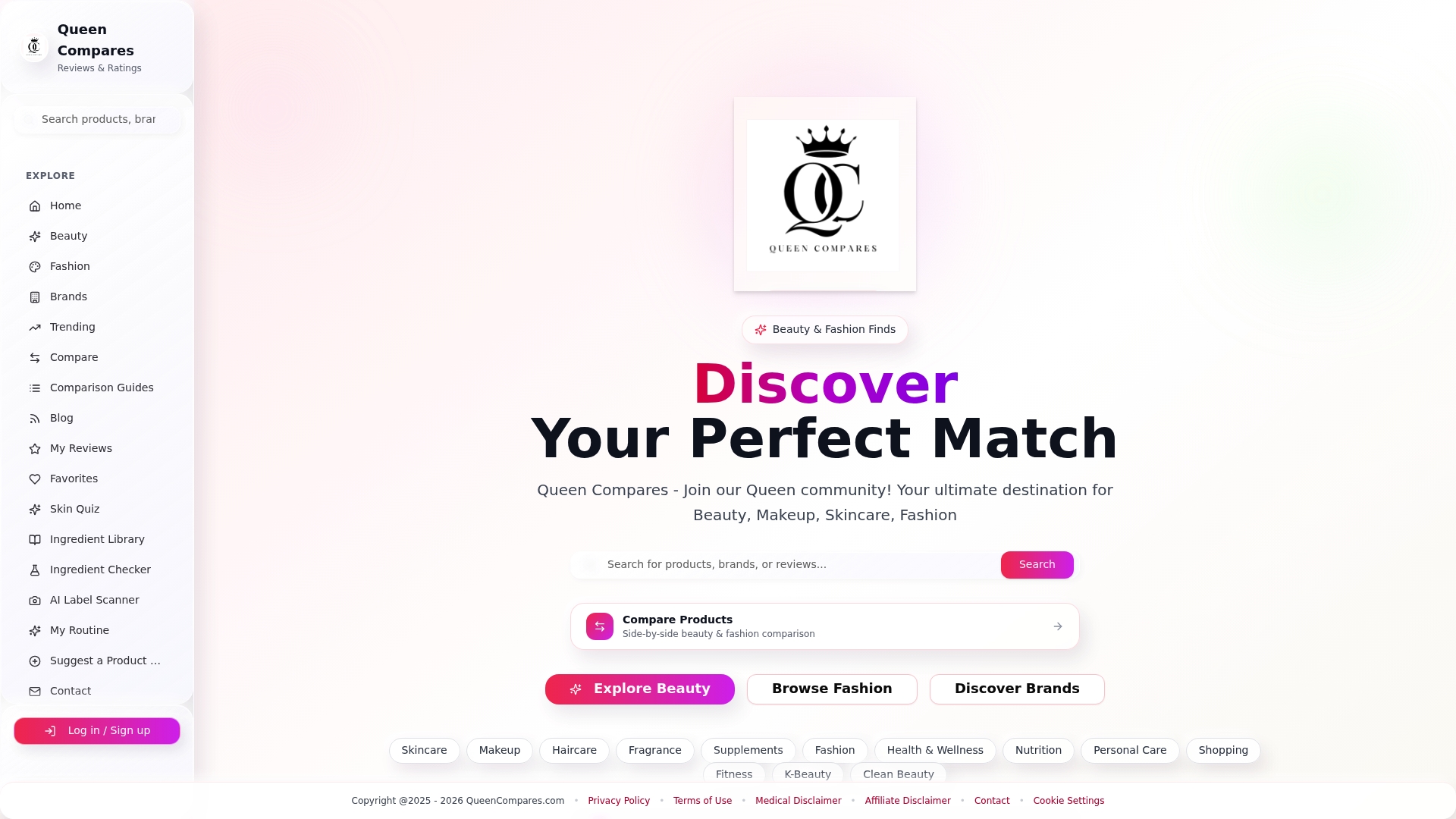
The tool scans a label or accepts a pasted ingredient list, normalizes INCI names so synonyms match automatically, flags known allergens and irritants, links each flag to its supporting evidence, and lets you save reports so you can compare products later through My Scan Reports. Core scanning and lookup features are free to use; saved report history and deeper comparison tools are part of the site’s expanded feature set. QueenCompares earns a commission on some shop links, which supports keeping the database free and current without changing how any ingredient is scored.
Open the Ingredient Library now, search the one ingredient you’ve been unsure about, and see what the evidence actually says.
Sources
A dermatologist consensus panel identified 23 ingredients with strong expert support, with mineral sunscreen and retinoids ranking highest, a useful starting list when you’re deciding which actives to research first.
-
Cosmetic ingredient database - Internal Market, Industry, Entrepreneurship and SMEs
-
Skincare Ingredients: What Actually Works And Why | The Naked Chemist
This article is general information, not a substitute for advice from a qualified doctor. Consult a qualified healthcare professional about your own circumstances before acting on anything here.
FAQ
What Is the Best Skincare Ingredient Checker?
The QueenCompares Ingredient Checker is a strong starting point because it combines an AI label scanner with allergen flags and evidence links in a single search or photo scan.
How Do I Find Skincare Products With Certain Ingredients?
Search an ingredient by name in a product+ingredient database like the QueenCompares Ingredient Library, which lets you filter products that contain or exclude specific ingredients.
Is There a Website That Compares Skincare Ingredients Side by Side?
Yes. QueenCompares lets you compare products and ingredients directly, pairing safety flags and evidence links with side-by-side product comparisons rather than isolated ingredient entries.
What Is the Highest-Rated Skincare Line?
There’s no single universally “highest-rated” line; ratings shift by skin type, concern, and which database’s methodology you trust. Checking a specific product’s ingredient list against dermatologist-recommended actives, like mineral sunscreen or retinoids, is more useful than chasing a single ranking.
Can an Ingredient Database Replace a Dermatologist?
No. A database screens ingredients and flags known concerns, but it can’t diagnose a reaction, assess your individual allergy history, or account for prescription-strength actives the way a clinician can.