
Wellness for your personal care routine means choosing products whose ingredients protect your skin and support your whole-person health — not just avoiding “bad” chemicals, but making intentional choices that align with your body, lifestyle, and goals. Before you buy or try anything new, do these three things: scan the INCI ingredient list, check key ingredients in a trusted database like the QueenCompares Ingredient Library, and patch test before full application.
-
Look up the product in QueenCompares to see ingredient flags and community reviews
-
Scan the label for “fragrance,” “parfum,” or formaldehyde-releasing preservatives
-
Patch test on your inner arm for a day or two before applying to your face
Table of Contents
-
Your step-by-step safety checklist before buying or applying
-
How to build a beauty routine that supports your whole-person wellness
-
When should you see a dermatologist instead of checking online?
What does wellness actually mean for your skincare?
The Global Wellness Institute defines wellness as the active pursuit of choices and lifestyles that lead to holistic health across eight interdependent dimensions: physical, intellectual, emotional, social, spiritual, vocational, financial, and environmental. For beauty consumers, four of those dimensions hit closest to home.
-
Physical: Ingredients that irritate, sensitize, or disrupt hormones affect your skin barrier and body directly
-
Emotional/mental: Stress and poor sleep visibly accelerate skin aging and trigger flare-ups
-
Environmental: Packaging, UV filters, and preservatives interact with your environment and microbiome
-
Lifestyle behaviors: Diet, hydration, and sleep quality shape how well any product actually performs
Wellness is not a destination you reach by buying the right serum. It is an ongoing, active process — and your product choices are one input among many, not the whole answer.
For personal care, wellness focuses on three things: ingredient safety, transparency about what is in the formula, and compatibility with your specific health conditions and sensitivities.
How to read a product label the right way
The INCI list and ingredient order are the two most reliable sources of truth on any cosmetics label. Everything else — the front-panel claims, the “clean” badge, the “dermatologist-tested” stamp — is marketing.
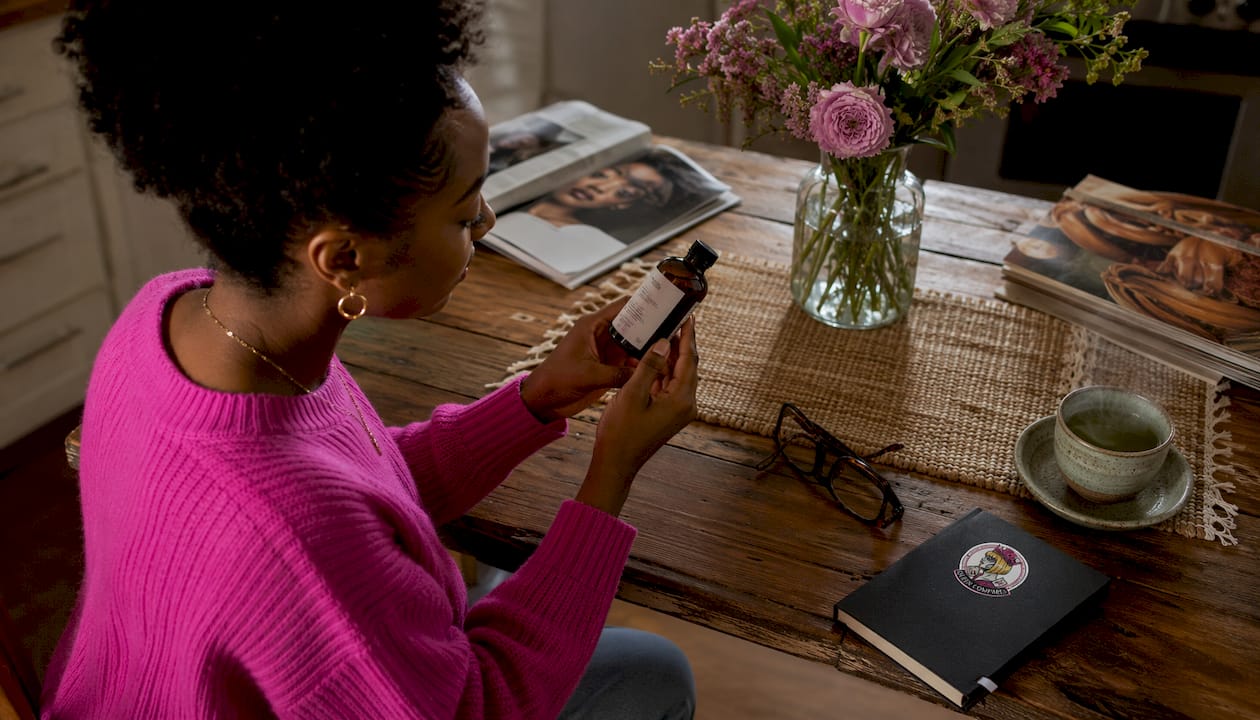
What INCI names are: The International Nomenclature of Cosmetic Ingredients (INCI) system gives every ingredient a standardized scientific name. “Tocopherol” is vitamin E. “Sodium lauryl sulfate” is a common surfactant. These names appear the same on every label worldwide, which makes database lookups fast and consistent.
Order by weight: Ingredients are listed from highest to lowest concentration. If water (aqua) is first and your “vitamin C serum” lists ascorbic acid tenth, the active level is likely low. Ingredients below 1% can appear in any order, so a long tail of actives near the bottom tells you little about their concentration.
Terms to watch:
-
“Fragrance” or “parfum”: A single word that can represent dozens of undisclosed chemicals, including known allergens like linalool, limonene, and eugenol
-
“Proprietary blend”: Often used to avoid disclosing specific preservative or fragrance combinations
-
“Fragrance oils”: Not the same as essential oils; may contain synthetic allergens
-
“Natural” or “organic”: Unregulated on U.S. cosmetics labels — these terms carry no legal standard from the FDA
A quick label breakdown example:
-
Aqua — base/solvent (first = highest concentration)
-
Glycerin — humectant
-
Niacinamide — active (check concentration; effective range is typically 2–10%)
-
Phenoxyethanol — preservative (common, generally well-tolerated at ≤1%)
-
Fragrance — flag this; look up the full product for allergen disclosure
Pro Tip: Use your phone’s camera and a label-scanning app to photograph the INCI list in-store. QueenCompares’s Label Scanner can read the photo and flag ingredients against its database in seconds — no manual searching required.
Why certain ingredients deserve a closer look
Some ingredients carry documented risks for irritation, allergic reaction, hormonal activity, or environmental harm. That does not mean every product containing them is dangerous — risk depends on concentration, formulation, and your individual biology. Understanding the nuance is what separates evidence-based choices from fear-based ones.
Common concerns and the safety context:
-
Fragrance allergens (linalool, limonene, cinnamal): Among the most frequent causes of contact dermatitis; the EU requires individual disclosure, but U.S. rules do not
-
Parabens (methylparaben, propylparaben): Preservatives with a long safety record; the Cosmetic Ingredient Review (CIR) has reviewed and found most safe at current use levels, though some longer-chain parabens remain under study
-
Formaldehyde releasers (DMDM hydantoin, quaternium-15, imidazolidinyl urea): Slowly release small amounts of formaldehyde to prevent microbial growth; a known sensitizer for some people
-
Oxybenzone (benzophenone-3): A UV filter with ongoing debate about hormonal activity at high doses; the FDA has asked for more safety data
-
Strong exfoliants (high-concentration AHAs/BHAs): Effective but can compromise the skin barrier if overused; always follow with SPF
-
Certain preservatives (methylisothiazolinone, MI/MCI): Potent sensitizers; the EU has restricted rinse-off use, but U.S. limits differ
The U.S. regulatory picture: The FDA regulates cosmetics under the Federal Food, Drug, and Cosmetic Act, but it does not pre-approve cosmetic formulas before they reach shelves. The CIR, an independent expert panel, reviews ingredient safety and publishes open-access conclusions. Neither body provides real-time consumer alerts for every ingredient of concern, which is why third-party tools matter.
The term “wellness” is itself unregulated on product labels — always verify credentials and evidence sources for any wellness claim you encounter.
Which resources help you check ingredients most reliably?
Use a mix of quick-scan tools and evidence-based databases. Each serves a different purpose.
| Resource | What is rated | Scope | Basis of rating | Best use-case |
|---|---|---|---|---|
| QueenCompares | Ingredients + whole products | Growing product and ingredient database | AI-assisted flags, community reviews, expert input | Quick personalized checks while shopping |
| EWG Skin Deep | Individual ingredients | — | Hazard scores from published studies and regulatory lists | Consumer-facing ingredient flags |
| FDA Cosmetics Guidance | Regulatory status | U.S. market | Federal law, enforcement actions | Regulatory and legal questions |
| Cosmetic Ingredient Review (CIR) | Individual ingredients | Hundreds of reviewed ingredients | Expert panel, peer-reviewed evidence | Deep evidence review for specific ingredients |
When to use each:
-
Shopping in-store or online: QueenCompares Label Scanner, Ingredient Checker or Ingredient Library for fast flags
-
Researching a specific ingredient in depth: CIR published reports for the full evidence picture
-
Checking if an ingredient is restricted or banned in the U.S.: FDA cosmetics guidance pages
-
Getting a broad consumer-facing hazard score: EWG Skin Deep
Pro Tip: For regulatory claims (“this ingredient is banned in the U.S.”), always verify against the FDA directly — consumer databases sometimes lag behind official updates or reflect rules from other markets.
The beauty-health connection runs deeper than most product labels suggest, which is why cross-referencing sources gives you a more complete picture than any single database alone.
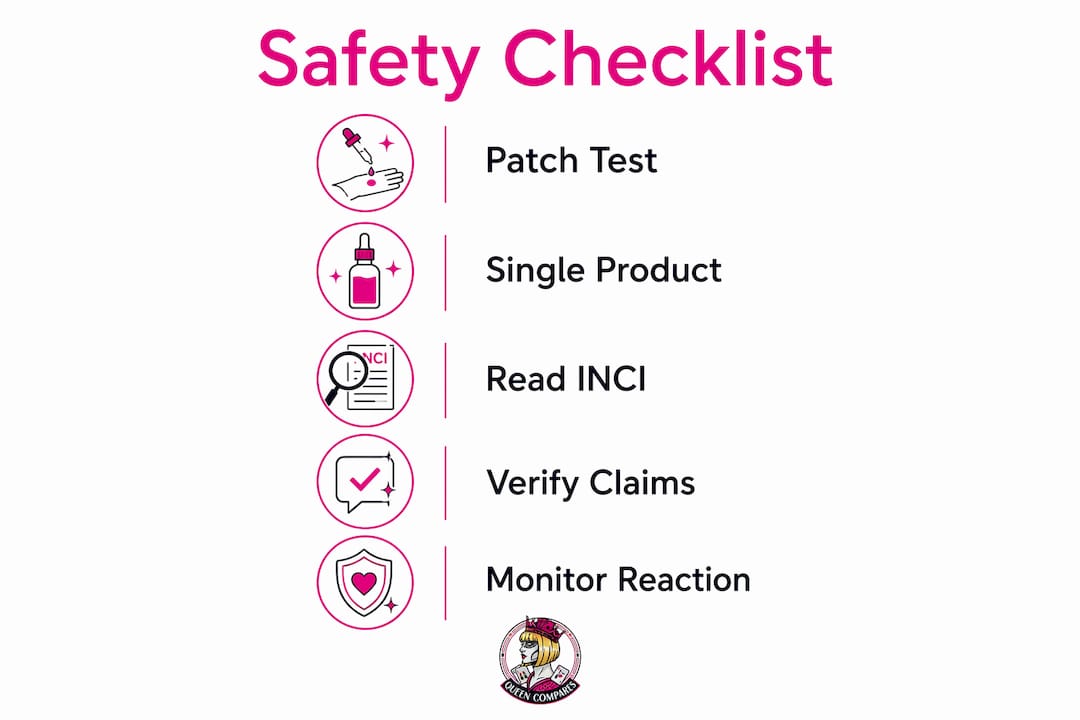
Your step-by-step safety checklist before buying or applying
Follow these checks in order — they take under five minutes and can save you from a reaction.
-
Read the INCI list — find it on the back panel or the brand’s website; if it is not disclosed, that is a red flag
-
Search key ingredients in the QueenCompares Ingredient Library or CIR for any flagged actives or preservatives
-
Check for your personal allergens — if you have known sensitivities to fragrance, nickel, or specific botanicals, scan for those first
-
Patch test — apply a small amount to your inner forearm, cover with a bandage, and leave for 24–48 hours; check for redness, itching, or swelling
-
Stop rules — if you develop a spreading rash, blistering, or any breathing difficulty, stop use immediately and seek medical attention
Patch test specifics: The inner arm is convenient, but the skin behind the ear more closely mimics facial sensitivity. Wait the full 48 hours; some delayed reactions appear only after 24 hours.
Pro Tip: Test one new product at a time, not several at once. If a reaction occurs, you will know exactly which product caused it.
How to build a beauty routine that supports your whole-person wellness
Fewer products with evidence-backed actives, combined with sleep, diet, and stress management, outperform a 12-step routine built on marketing claims. Lifestyle factors directly affect how well any product performs on your skin.
Core routine framework:
-
Cleanse: Gentle, low-pH surfactants (sodium cocoyl isethionate, glucosides) that do not strip the barrier
-
Protect (AM): Broad-spectrum SPF 30+ daily — the single most evidence-backed anti-aging step
-
Treat: One or two actives with real evidence: niacinamide, retinoids, vitamin C (ascorbic acid), or azelaic acid
-
Moisturize: Ceramides, hyaluronic acid, or glycerin to seal and hydrate
Sample minimalist routine:
-
Morning: Gentle cleanser → antioxidant serum (vitamin C) → moisturizer → SPF 30+
-
Evening: Gentle cleanser → retinoid or niacinamide → moisturizer
Layering rules: Apply water-based serums before oils. Do not combine retinoids and strong AHAs on the same night — alternate evenings. Exfoliate no more than 2–3 times per week. Habits drive roughly 40% of everyday behavior, and new ones average 66 days to form, so build your routine gradually rather than overhauling everything at once.
Sleep, stress management, and diet are not optional add-ons. Mental wellness directly supports physical health, and chronic stress shows up on your skin before it shows up anywhere else.
When should you see a dermatologist instead of checking online?
Online tools are a triage step, not a diagnosis. See a clinician when symptoms are persistent, severe, or worsening.
Red flags that require professional care:
-
Blistering or weeping rash
-
Reaction spreading beyond the application site
-
Breathing difficulty or throat tightness after product use
-
Symptoms lasting more than two weeks or interfering with daily life
-
Recurring reactions despite switching products
Online ingredient checks cannot replace supervised patch testing, diagnostic allergy testing (like a TRUE Test panel), or clinical management of conditions like eczema, rosacea, or contact dermatitis. Symptoms lasting for an extended period that impair daily functioning are a clear signal to move from self-directed care to clinical assessment.
If a reaction persists, spreads, or causes any systemic symptom, stop the product and consult a board-certified dermatologist or allergist. No database replaces a clinical exam.
This article is general information, not medical advice. Confirm any health concern with a qualified professional. See the QueenCompares Medical Disclaimer for full terms.
Key Takeaways
Wellness in personal care means making evidence-informed ingredient choices alongside lifestyle habits — sleep, diet, and stress management — that together support skin health and whole-person well-being.
| Point | Details |
|---|---|
| Read the INCI list first | Ingredient order reveals concentration; “fragrance” and “parfum” hide multiple undisclosed allergens. |
| Use layered resources | Combine QueenCompares for quick flags, CIR for deep evidence, and FDA guidance for regulatory facts. |
| Patch test every new product | Apply to the inner arm or behind the ear for 24–48 hours before full use. |
| Habits take time | New routines average 66 days to form — build gradually and favor fewer, proven actives. |
| QueenCompares speeds your checks | The Ingredient Library and Label Scanner let you flag concerns before you buy, not after. |
The wellness claims no one talks about honestly
The beauty industry has absorbed “wellness” as a marketing word faster than any regulatory body has defined it. Walk into any Sephora or scroll any brand’s Instagram and you will find “wellness-infused,” “holistic,” and “whole-person” applied to everything from a $12 body wash to a $300 facial oil. None of those terms mean anything legally on a U.S. cosmetics label.
What actually matters is ingredient transparency and evidence. The CIR has reviewed hundreds of cosmetic ingredients with genuine scientific rigor. The FDA, for all its limitations in pre-market cosmetics oversight, publishes clear guidance on restricted substances. EWG Skin Deep gives consumers a fast entry point. QueenCompares layers community reviews and AI-assisted flags on top of that foundation. None of these tools are perfect, but using them together is categorically better than trusting a front-panel claim.
The part most wellness content skips: your lifestyle inputs — sleep quality, chronic stress, diet — often have a larger effect on your skin than the difference between two well-formulated moisturizers. A retinoid applied on four hours of sleep and high cortisol levels will underperform the same retinoid applied with consistent rest and managed stress. Products are one variable. Treat them as one.
QueenCompares makes ingredient checks faster and clearer
Knowing which ingredients to flag is one thing. Finding that information quickly, in one place, before you spend money on a product is another. QueenCompares gives you an Ingredient Library and Label Scanner built specifically for beauty consumers who want evidence-based answers, not marketing copy.
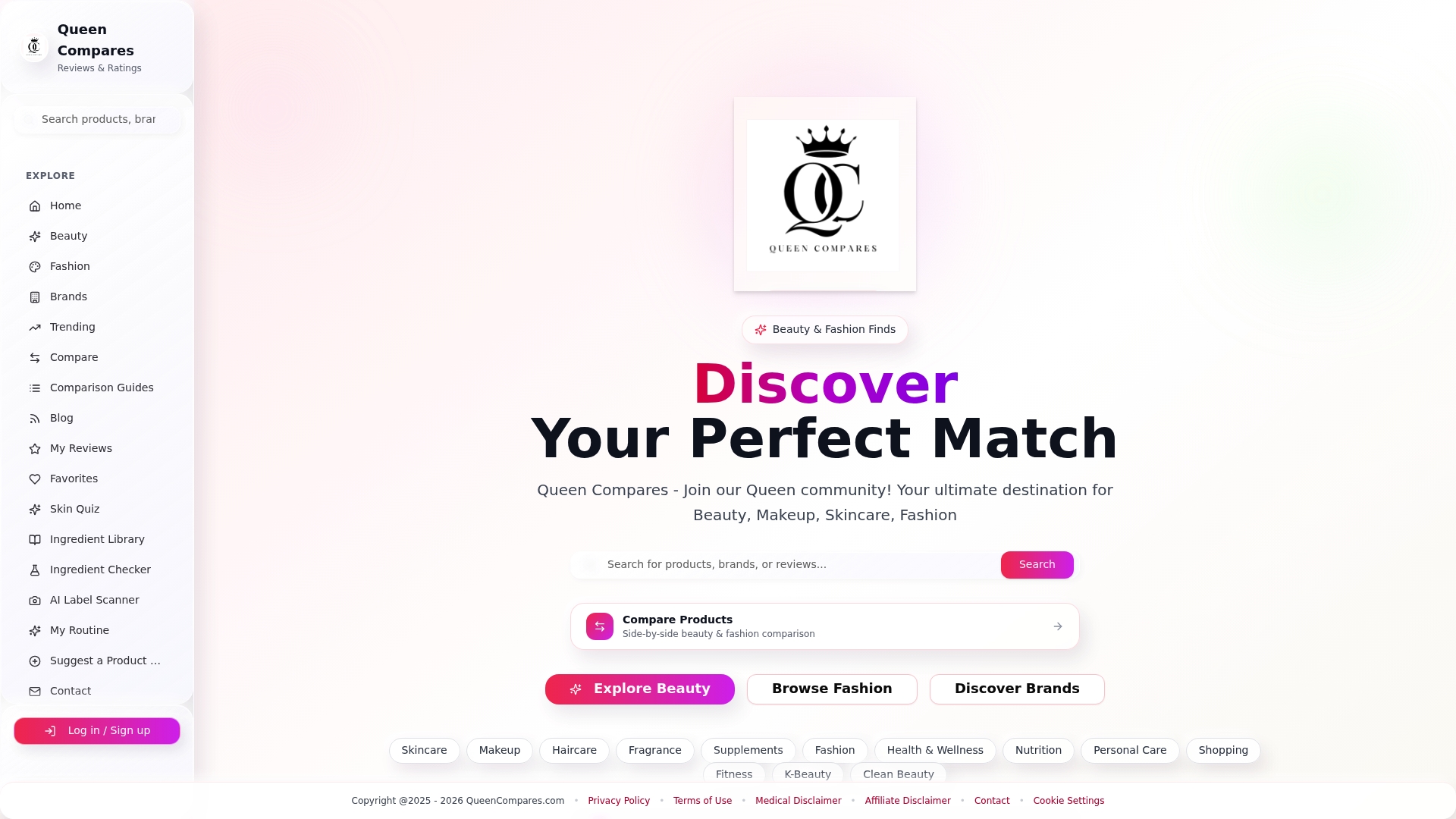
Here is how our community uses it:
-
Search any ingredient by INCI name and get a plain-language safety summary
-
Scan a product label with your phone and get instant flags on concerning ingredients
-
Save scan reports to your account to track what works and what does not
-
Read expert and community reviews on product pages to see real-world reactions
QueenCompares is not a substitute for medical advice, and our Medical Disclaimer makes that clear. What it is: the fastest way to go from “I have no idea what’s in this” to “I know exactly what I’m putting on my skin.” Check your next product before you buy it at QueenCompares.
Useful sources to read next
Start with these when you want to go deeper on any topic this article covers.
| Source | Best for |
|---|---|
| FDA Cosmetics Guidance | U.S. regulatory status, restricted ingredients, labeling rules |
| Cosmetic Ingredient Review (CIR) | Peer-reviewed safety assessments for specific cosmetic ingredients |
| EWG Skin Deep | Consumer-facing hazard scores and ingredient flags |
| QueenCompares Ingredient Library | Fast ingredient lookups with community and expert context |
| Global Wellness Institute | Definition and dimensions of wellness across whole-person health |
| NCCIH — Whole Person Health | Evidence on integrating lifestyle and conventional care |
| NHS — 5 Steps to Mental Wellbeing | Evidence-based behavioral steps linking mental and physical health |
| Harvard Health — Mental Wellness | How mental wellness supports physical health and skin outcomes |
| PMC — Dimensions of Wellness | Research on habit formation and wellness dimensions |
| NIMH — Caring for Your Mental Health | Red-flag timing for when to seek professional care |
| Health.com — Holistic Health | Guidance on evaluating wellness practitioners and credentials |
FAQ
What does “wellness” mean on a beauty product label?
Nothing legally specific. The FDA does not regulate “wellness” as a cosmetic claim, so any brand can use it without meeting a defined standard. Always read the INCI list instead of relying on front-panel language.
How do I know if an ingredient is safe for my skin?
Cross-reference the ingredient in the CIR published reports for peer-reviewed evidence, check the FDA’s restricted substances list for regulatory status, and use the QueenCompares Ingredient Library for a fast consumer-facing summary.
What is a patch test and how long should I wait?
Apply a small amount of the product to your inner forearm or behind your ear, cover it, and leave it for 24–48 hours. Check for redness, itching, or swelling before applying the product to your face.
When should I see a dermatologist instead of checking online?
See a clinician if a reaction spreads, blisters, causes breathing difficulty, or lasts more than two weeks. Online ingredient databases are a triage tool, not a substitute for a clinical exam or supervised allergy testing.
Are “natural” and “organic” labels regulated on U.S. cosmetics?
No. The FDA does not define or enforce “natural” or “organic” standards for cosmetics the way the USDA does for food. A product labeled “natural” may still contain synthetic preservatives, fragrance allergens, or other ingredients worth checking.