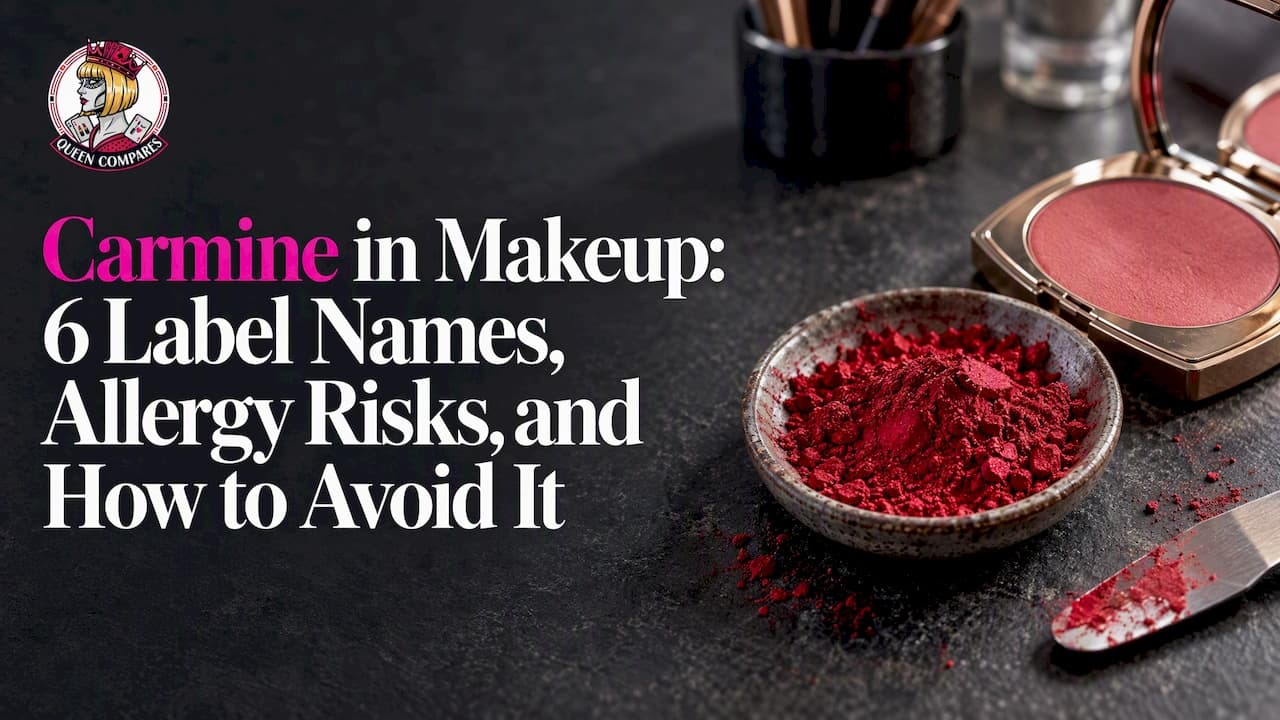
Carmine is a red pigment made from crushed cochineal insects, listed on ingredient panels as carmine, cochineal extract, CI 75470, or E120. If you wear red or pink makeup, two things matter most: it's a documented cause of allergic reactions in some people, and it's not vegan since it comes directly from an insect.
Key Takeaways
Carmine is a stable, pigment-rich ingredient in makeup derived from insects, but it poses allergy risks and ethical concerns, prompting consumers to check labels carefully.
| Point | Details |
|---|---|
| Carmine is insect-derived | It is made from crushed cochineal insects and is not vegan or cruelty-free. |
| Common in red and pink cosmetics | It appears in products like lipsticks, blushes, and eyeshadows at varying concentrations. |
| Allergy and safety risks | Carmine can cause allergic reactions, including skin irritation and systemic responses, especially from residual proteins. |
| How to identify it | Check ingredient lists for names like carmine, cochineal extract, CI 75470, Natural Red 4, or E120. |
| Vegan alternatives available | Synthetic iron oxides and plant-based pigments can replace carmine but may vary in stability and color quality. |
Table of Contents
- What Carmine Is: Chemistry, INCI Names, and How Much Is Used
- How Carmine Is Sourced and Manufactured
- Where Carmine Shows Up in Makeup and Why Formulators Choose It
- Safety and Allergy Evidence: What the Medical Literature Shows
- Regulation and Labeling: Finding Carmine on Ingredient Lists
- Vegan and Ethical Concerns, Plus Realistic Alternatives
- How to Avoid Carmine: A Practical Shopping Checklist
- How Our Ingredient Checker and Label Scanner Help You Avoid Carmine
- Our Take on Carmine's Place in Modern Makeup
- Scan Any Product Before You Buy With Our Ingredient Checker
- FAQ
- Sources
What Carmine Is: Chemistry, INCI Names, and How Much Is Used
Carmine gets its color from carminic acid, a compound the cochineal insect produces naturally. Commercial carmine is a carminic acid complex, typically containing at least 50% carminic acid once it's processed for use in cosmetics and food.
You won't always see the word "carmine" on a label. It shows up under several names, and recognizing them is the fastest way to check a product before you buy it:
- Carmine
- Cochineal extract
- CI 75470
- Natural Red 4
- E120
- Crimson lake
The amount used depends on the product. Finished cosmetics typically contain carmine at 0.02% to 2% in eyeshadows and up to around 10% in blushes, which explains why blush and bold eye pigments are the categories worth checking most closely.
How Carmine Is Sourced and Manufactured
Carmine comes from Dactylopius coccus, a scale insect that lives on prickly pear cacti and feeds on the plant's juices. Producers harvest the insects, dry them, and crush them to extract carminic acid, the molecule responsible for the red color.
From there, manufacturers typically convert the raw extract into a "lake," a more stable pigment form created through a chemical process:
- Carminic acid is chelated with aluminum or calcium salts to form an insoluble lake.
- The lake form resists fading from light, heat, and changes in pH better than the raw extract.
- Lakes disperse more evenly in oil-based and wax-based formulas, which matters for lipstick and cream products.
This lake-forming step is why carmine performs so reliably in makeup rather than in its raw, less stable state. It's also the reason some sensitization research looks closely at how processing affects the proteins that remain in the finished pigment.
Where Carmine Shows Up in Makeup and Why Formulators Choose It
Formulators reach for carmine because it does something synthetic dyes and plant pigments often struggle to match: it holds its color under heat, light, and shifting pH without fading or shifting tone.
You'll most commonly find it in:
- Lipsticks and lip stains
- Blushes and cream cheek products
- Eyeshadows, especially warm reds and berries
- Nail polishes
- Some lip liners and multi-use color sticks
Carmine's resilience makes it well suited to oil-based formulas, which is part of why it turns up so often in lipstick and cream blush rather than water-based products. That said, not every red or pink product relies on it. Some brands formulate with synthetic iron oxides or FD&C dyes instead, so seeing a red shade doesn't automatically mean carmine is inside. Checking the ingredient list is still the only reliable way to know.
Safety and Allergy Evidence: What the Medical Literature Shows
Carmine is one of the better-documented cosmetic allergens in clinical literature, and the evidence covers more than mild skin irritation. Case reports describe both immediate, IgE-mediated hypersensitivity reactions and delayed contact dermatitis linked to carmine exposure, sometimes progressing to more serious systemic responses.
Reported carmine concentrations in cosmetics vary widely by category, from about 0.01% to 4% in lipsticks and 0.05% to 10% in blushes, which helps explain why reaction severity differs so much from person to person and product to product.

The likely culprit isn't the carminic acid itself, but residual insect protein left over from processing. These protein impurities can make up a notable share of commercial carmine and are implicated in IgE-mediated reactions, yet neither the FDA nor EFSA currently sets a limit on how much protein impurity is allowed.
What makes carmine particularly worth watching is a pattern researchers call epicutaneous sensitization. A case report documented a patient who became sensitized through skin contact with carmine-containing cosmetics and later experienced a systemic reaction, including food-related anaphylaxis, after ingesting carmine in a different product. In laboratory testing from the same report, treating carmine with a chelating agent (EDTA) reduced the allergenic protein bands, suggesting that how a pigment is processed may influence how allergenic it becomes.
Epicutaneous exposure to carmine through cosmetics can sensitize the immune system, setting the stage for a systemic reaction when the same colorant is later ingested in food.
Source: case report on epicutaneous sensitization to carmine
Separately, dermatology literature has published patch-test case reports confirming allergic contact dermatitis from carmine, with reactions ranging from localized redness and swelling to more persistent irritation.
If you've reacted to red-tinted makeup before, or if you have known food allergies to shellfish or other insect-derived proteins, it's worth discussing carmine specifically with an allergist. Diagnostic options include skin prick testing, specific IgE blood tests, and in some cases supervised oral challenges, all of which a qualified professional can help you interpret.
Regulation and Labeling: Finding Carmine on Ingredient Lists
In the United States, you don't have to guess whether a product contains carmine. The FDA requires that cochineal extract and carmine be declared by name on the label of food and cosmetic products sold in the US, a rule that took effect in 2009 specifically because of documented allergic reactions.
In the EU and other markets that follow INCI naming conventions, the same pigment appears under its COSING-listed identifier, CI 75470, alongside its CAS and EC numbers.
To check a product with confidence:
- Flip to the ingredient list on the packaging or product page, not just the marketing copy.
- Scan for "carmine," "cochineal extract," "CI 75470," "Natural Red 4," "crimson lake," or "E120."
- If the list is hard to find or abbreviated, check the brand's website or contact customer service directly.
- Cross-reference with a tool built to parse INCI names if you want a faster read.
Vegan and Ethical Concerns, Plus Realistic Alternatives
For many shoppers, the issue isn't allergy risk at all, it's the insect origin itself. Carmine is produced by harvesting and processing live cochineal insects on an industrial scale, which puts it firmly outside vegan and some cruelty-free standards, regardless of how it performs on skin.
If you're looking to avoid it on ethical grounds, a few categories of alternatives exist:
- Plant-derived pigments like anthocyanins (from berries and red cabbage) and betalains (from beetroot)
- Synthetic iron oxides, which are stable and widely used in vegan formulations
- FD&C and D&C certified dyes, common in lip and cheek products
The trade-off is real: plant-based pigments often fade faster and shift color under heat or light in ways that carmine simply doesn't, which is part of why some brands still choose carmine even while expanding vegan lines elsewhere.
Pro Tip: If color match matters to you, test a vegan alternative on your hand in daylight before committing to a full-size lip or cheek product, since undertones can shift once a formula is carmine-free.
How to Avoid Carmine: A Practical Shopping Checklist
Avoiding carmine comes down to habit more than difficulty once you know what to look for.
- Read the full ingredient list and scan for carmine, cochineal extract, CI 75470, Natural Red 4, or E120.
- Look for a vegan certification logo, then verify it against the ingredient list rather than trusting the label alone.
- Use an ingredient-scanning tool to cross-check a product before you buy it.
- Contact the brand directly if the ingredient list is unclear or unavailable online.
- If you've had a reaction before, patch test any new red or pink product on your inner arm first and give it a few days before applying it to your face.
Keep in mind that switching away from carmine can change how a shade wears and lasts, so it's worth sampling before investing in a full-size product.
How Our Ingredient Checker and Label Scanner Help You Avoid Carmine
We have tools like an Ingredient Checker and Label Scanner to help identify various ingredient names. Scan a product's ingredient deck and we flag nonvegan ingredients and known allergens, including carmine under any of its listed names.
Beyond flagging, we let you compare products side by side by ingredient, so you can see at a glance which lipsticks, blushes, or eyeshadows skip carmine entirely:
- Scan a label or paste an ingredient list to check for carmine and its synonyms
- Flag nonvegan and allergen-linked ingredients automatically
- Compare carmine-containing and carmine-free products side by side
If you wear contacts or have sensitive skin more broadly, our piece on safe makeup practices for contact lens wearers covers related precautions worth knowing.
Our Take on Carmine's Place in Modern Makeup
Carmine earns its spot in red and pink makeup honestly: nothing else matches its color payoff and stability quite as reliably, which is exactly why so many formulators still reach for it even as vegan demand grows. The real problem isn't that carmine exists, it's that so many shoppers don't realize it's there until they react to it or look closely at a label. Our work is built around closing that gap: giving you the tools to see what's actually in a product before it's on your skin, so the choice to use carmine or avoid it is actually yours to make.
— Magdalena Kapuscinska
Scan Any Product Before You Buy With Our Ingredient Checker
Once you know what to look for, checking a product for carmine takes seconds instead of a squint at tiny print. Our Ingredient Checker scans a label or ingredient list and flags carmine, cochineal extract, and other animal-derived ingredients automatically, so you don't have to cross-reference synonyms yourself.

If you'd rather browse than scan, our Products By Ingredient pages let you filter by ingredient directly, which makes finding a carmine-free lipstick or blush a matter of a few clicks. You can try using a label scanner on your current makeup to see what ingredients are present.
This article is general information, not a substitute for advice from a qualified doctor. Consult a qualified healthcare professional about your own circumstances before acting on anything here.
FAQ
Is carmine the same as Red 40?
No. Carmine is a natural pigment derived from cochineal insects, while Red 40 is a synthetic dye made from petroleum-based compounds. They can produce similar red shades, but they come from entirely different sources and have different allergy profiles.
Do all lipsticks contain carmine?
No, not all lipsticks contain carmine. Reported concentrations in lipsticks that do use it range from about 0.01% to 4%, but many brands formulate reds and pinks with synthetic dyes or iron oxides instead, so checking the ingredient list is the only way to know for sure.
Which lipstick does not have carmine?
Carmine-free lipsticks are typically labeled vegan or formulated with synthetic dyes and iron oxides instead of insect-derived pigment. You can confirm this for any specific product by checking the full ingredient list for carmine, cochineal extract, or CI 75470, or by scanning it with our Ingredient Checker.
How can I tell if a product is likely to contain carmine?
Red, pink, and berry-toned blushes, eyeshadows, and lipsticks are the most likely categories, since carmine's stability makes it a common choice for those shades. The only reliable confirmation is checking the ingredient list for carmine or its synonyms, since shade alone doesn't tell you the pigment source.
Sources
- PMC article: carmine chemistry and usage
- FDA Small Entity Compliance Guide: Declaration by name of cochineal extract and carmine
- Case report: epicutaneous sensitization to carmine and the effect of chelation
- Allergic contact dermatitis from carmine (PubMed 2009 case report)
Recommended
- How to Avoid Harmful Ingredients in Your Makeup
- How to Read Ingredient INCI Names Like a Pro
- Ingredients to Avoid in Makeup for a Safer Beauty Bag
- What Does Clean Makeup Mean? Your 2026 Guide
General Entertainment & Information Purposes Only At QueenCompares.com we share content for general entertainment and information. It's not medical, dermatological, nutritional, or fitness advice and shouldn't replace guidance from a licensed professional. If you're making health-related decisions, please check with a qualified expert — and know that using this site and its information is at your own discretion.