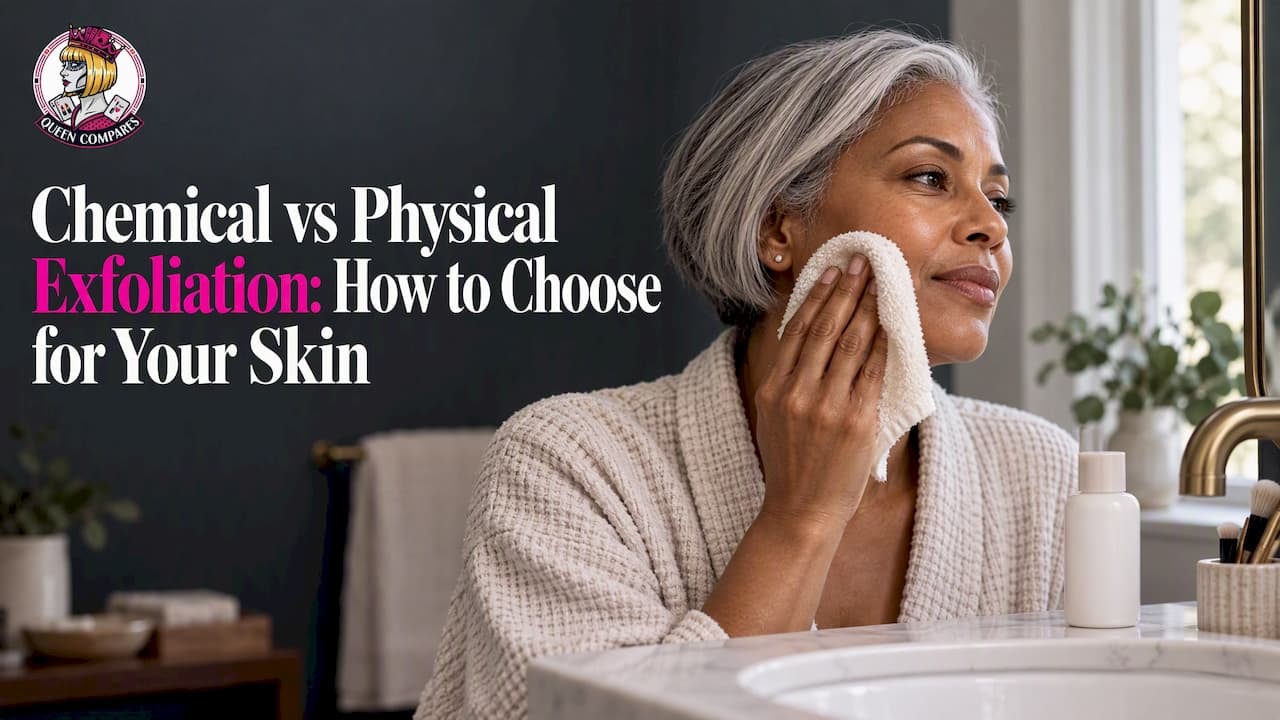
Physical exfoliation uses a tool or scrub to rub dead skin cells away. Chemical exfoliation uses acids to dissolve them. According to the American Academy of Dermatology, both remove dead cells from the surface of your skin. They do it in very different ways, and that changes who should use which. If your face is sensitive, acne-prone or on the deeper side of the skin tone range, the gentler route is usually chemical. If you have thick, rough skin on your body, a physical method can be a good fit. Below you will find how each works, how to pick, how often to use them, and what to put on afterward.
Key Takeaways
-
Physical exfoliation (scrubs, brushes, cloths) gives immediate smoothness. Chemical exfoliation (AHAs, BHAs) works more evenly and is generally the better first choice for faces.
-
Match the method to your skin: BHAs for oily or acne-prone skin, AHAs for dry skin, a soft washcloth or mild acid for sensitive skin.
-
Use one type of exfoliant at a time, once or twice a week on your face, and wear sunscreen every day.
-
Exfoliating is optional. It improves texture and glow, but skin stays healthy without it.
-
Always check the ingredient list of your exfoliant, especially if you have allergies or reactive skin.
Table of Contents
What exfoliation actually does
Your skin sheds dead cells on its own. Exfoliating simply speeds up the removal of the ones that linger on the surface. Harvard Health’s guidance describes the benefits as cosmetic, such as better texture and luster, rather than required for skin health. That is worth keeping in mind. If your skin is calm and comfortable, you are not behind on anything.
Where exfoliation helps is with dullness, rough patches, flaky makeup application and clogged-looking pores. The question is how aggressively you go after those concerns. That is where the two methods split.
Physical exfoliation: how it works
Physical, or mechanical, exfoliation means manually rubbing off dead cells. The Cleveland Clinic lists brushes, sponges, loofahs and granule-based scrubs as typical tools. Think of a sugar scrub, a konjac sponge, a cleansing brush, a washcloth or a body mitt.
What you get
-
Instant feedback. Skin feels smooth right after you rinse. A dermatologist quoted by Westlake Dermatology notes that physical exfoliation delivers immediate smoothness.
-
Simplicity. No acid percentages, no pH, no waiting.
-
Body-friendly. Harvard Health’s experts point out that physical exfoliation may be a good first choice for rough conditions like keratosis pilaris on the body, where skin is thicker than on the face.
What to watch
The Cleveland Clinic warns that rough physical exfoliation can cause irritation. Pressure is the variable you control, and it is easy to overdo. Hard scrubbing on a face that is already inflamed from breakouts is a common way to make things worse.
If you want to try a mild physical option on your face, the dermatologist quoted by Harvard Health suggests starting with a simple washcloth and watching how your skin responds. That is a low-risk test before you buy a gritty scrub.
Chemical exfoliation: how it works
Chemical exfoliants contain acids that loosen the bonds between dead skin cells so they shed on their own. The AAD names alpha hydroxy acids (AHAs) and beta hydroxy acids (BHAs) as the main types. The Cleveland Clinic explains that these work over hours or days rather than in the moment, and that they can cover more surface area than a scrub.

AHAs
Glycolic and lactic acid are the best known. According to Westlake Dermatology, AHAs are water-soluble and tend to work best for dry skin rather than oily skin. Lactic acid is often considered the softer of the two, though your own reaction is what counts.
BHAs
Salicylic acid is the main BHA. Westlake Dermatology notes it has antibacterial and anti-inflammatory properties, which is why it is a go-to for oily or acne-prone skin. If you are choosing between acids for a specific concern, our guide to BHA vs AHA walks through which one fits which problem. For breakouts specifically, benzoyl peroxide vs salicylic acid breaks down lesion types.
What to watch
The Cleveland Clinic notes that exfoliants can dry skin. Strength, frequency and layering with other actives matter more than the acid’s name. Our piece on mixing skincare ingredients by pH helps you avoid stacking products that fight each other.
Side-by-side comparison
| Physical exfoliation | Chemical exfoliation | |
|---|---|---|
| How it works | Manual rubbing with grains, brushes, cloths | Acids dissolve bonds between dead cells |
| Speed of results | Immediate smoothness | Gradual, over hours to days |
| Evenness | Depends on your technique and pressure | Easier to get uniform results |
| Main risk | Irritation from rough scrubbing | Dryness and irritation if too strong or too frequent |
| Good for | Thicker body skin, rough patches | Faces, oily or acne-prone skin, dull texture |
| Typical products | Scrubs, brushes, sponges, mitts | Toners, serums, pads, leave-on liquids, peels |
Which one is right for your skin?
The AAD, Harvard Health and Westlake Dermatology all point the same way: your skin type and concern decide the method.
Sensitive or dry skin
Gentle chemical exfoliants are often the better fit. Harvard Health’s dermatologist recommends chemical exfoliants over physical versions for the face. If you prefer to start physical, use a soft washcloth with light pressure and see how your skin reacts.
Oily or acne-prone skin
A BHA is the logical start because of its anti-inflammatory profile. A dermatologist quoted by Vogue says she leans toward chemical exfoliation for acne-prone clients because it is less irritating on inflamed skin. Avoid scrubbing over active breakouts.
If oiliness is your main issue, our quick routine for oily skin shows where an exfoliant fits among your other steps.
Combination skin
You may want different treatment by zone: a BHA on the T-zone and nothing, or a gentle lactic acid, on drier cheeks. See our zone-based combination skin routine for how to space it out.
Darker skin tones
The AAD, Harvard Health and Westlake Dermatology all advise people with darker skin tones to proceed with caution, because irritation can lead to pigment changes. In practice, that means starting low and slow, skipping aggressive scrubs, and patch testing. If you already deal with dark marks, a skin brightening peptide guide can give you background on one ingredient people explore for tone, and our comparison of alpha arbutin vs hydroquinone covers other dark spot options. Whatever you choose, calm skin tends to fade marks better than irritated skin.
Body skin
Body skin is thicker, and the Cleveland Clinic and Harvard Health both note it can generally tolerate exfoliating more often than the face. Physical tools like mitts and dry brushes are reasonable here, particularly for bumpy, rough areas such as the backs of the arms.
Can you use both?
You can include both in your routine, but not at the same time. The Cleveland Clinic’s advice is to use one exfoliant at a time rather than combining physical and chemical methods, to prevent irritation. Some brands and aestheticians suggest alternating days. If you try it, keep each gap generous. A sensible pattern for a face looks like this:
-
Pick one method as your main exfoliant.
-
Use it once a week for the first two weeks.
-
Move to twice a week only if your skin stays comfortable.
-
If you add the other method, put it on a separate day and consider cutting the first back.
Retinoids and other strong actives count as well. If you use retinol, our pros and cons of retinol plan includes tips for skin of color, and it is a good place to check before adding an acid on top.
How often to exfoliate
The AAD says frequency depends on your skin type and your method. The Cleveland Clinic and Harvard Health both suggest limiting facial exfoliation to once or twice a week. Your body can usually take more.
Signs you are overdoing it
-
Redness that lingers after exfoliating
-
Stinging when you apply products that never stung before
-
Tight, shiny or flaky skin
-
New irritation or breakouts
The AAD notes that over-exfoliation can leave skin red and irritated. If you notice these signs, stop exfoliating, keep your routine to a gentle cleanser and moisturizer, and see a board-certified dermatologist if it does not settle.
After you exfoliate: moisturize and protect
The Cleveland Clinic’s rule is short: moisturize, and use sunscreen every day. Harvard Health adds that exfoliating can make you more prone to sunburn. So the follow-up step matters as much as the exfoliant.
This is where tinted base products earn their place, especially if you want one fewer step in the morning:
-
Tinted moisturizer with SPF. Sheer coverage that sits well on skin that is smooth but a little sensitive. Look for one with a broad-spectrum SPF listed on the label.
-
BB cream. A step up in coverage, often with skincare-style ingredients. Handy on exfoliation days when you want an even look without a heavy base.
-
CC cream. Aimed at redness and uneven tone, which can be useful while skin recovers.
-
Foundation. A liquid or serum-style formula tends to glide over freshly exfoliated skin better than a very matte, dry-finish one. Powder foundations can cling to any dry patches.
An SPF in your tinted product is a bonus, not a replacement for proper sunscreen amounts. If you are not sure whether a tinted product suits reactive or allergy-prone skin, check its ingredient list before you buy.
Our perspective

We built Queen Compares around a simple idea: you should be able to see what is in a product before you decide whether it belongs on your face. Exfoliation is a perfect example. The bottle may say “gentle” or “resurfacing”, but the ingredient list tells you whether you are getting a mild lactic acid, a salicylic acid, a stack of several acids, or a scrub with added fragrance.
Our view is that most beginners do better starting chemical on the face and physical on the body, patch testing every new product, and changing one thing at a time. We also think the best exfoliant is the one your skin tolerates twice a week for months, not the strongest one you can find. That is why we focus on ingredient-level comparisons, side-by-side product views and allergen alerts rather than marketing claims.
— Magdalena
Check your exfoliant before you buy
If you are standing in front of two exfoliants and cannot decide, we can help you read them.
Check our Premium Access with just 7 EUR/month.

Our Ingredient Checker analyzes up to beauty products with full ingredient analysis
If you are building a cleaner routine, you van find catalogue with Clean Beauty Makeup and Skincare analyzed and tested with our Ingredient checker and AI label scanner, including tinted moisturizers, BB and CC creams and foundations. You can also browse the Products By Ingredient page to find items that contain, or avoid, a specific ingredient. Our Label Scanner and Ingredient Analysis tools are there to speed up the same checks.

For a wider look at what we do, visit Queen Compares.
FAQ
Do dermatologists recommend physical exfoliation?
Many prefer chemical exfoliants for the face. A dermatologist quoted by Harvard Health recommends chemical over physical versions, and suggests testing mild physical exfoliation with a washcloth first. Physical methods are more commonly suggested for thicker body skin.
Can I physically exfoliate my face?
Yes, if you keep it gentle and infrequent. Use light pressure, avoid inflamed or broken skin, and limit it to once or twice a week. If your face turns red or stings, switch to a mild chemical exfoliant or pause entirely.
Can you do both physical and chemical exfoliation?
The Cleveland Clinic advises using one exfoliant at a time rather than combining them in the same session. If you want both in your routine, space them on different days and watch for dryness or redness.
Which exfoliation method is best?
There is no single winner. Chemical exfoliation tends to be more even and gentler on faces, oily and acne-prone skin, while physical exfoliation gives instant smoothness and suits thicker body skin. Your skin type, sensitivity and tolerance decide.
Do I have to exfoliate at all?
No. Harvard Health describes the benefits as cosmetic. If your skin looks and feels good, you can skip it.
Sources
Recommended
General Entertainment & Information Purposes Only At QueenCompares.com we share content for general entertainment and information. It’s not medical, dermatological, nutritional, or fitness advice and shouldn’t replace guidance from a licensed professional. If you’re making health-related decisions, please check with a qualified expert — and know that using this site and its information is at your own discretion.