Yes, essential oils can earn a place in your skincare routine, but only when they're diluted, patch tested, and matched to your skin's actual needs. Undiluted or careless use is where things go wrong. A systematic review of essential oils in skincare found real evidence for tea tree oil in acne care and anti-inflammatory effects from lavender and rosemary, so the benefits are real, just not unlimited. Here's what QueenCompares wants you to lock in before you add a single drop to your routine:
- Dilute conservatively: a 1% concentration is the standard ceiling for leave-on facial products.
- Patch test every new oil on your inner arm for 24 to 48 hours before facial use.
- Skip citrus oils like bergamot and lemon on skin that will see the sun.
Quick stat: clinical-quality evidence backs tea tree, lavender, and rosemary, though researchers still call for larger, longer trials before treating any essential oil as a cure.
Key Takeaways
Essential oils can support acne care and calm inflammation, but only in diluted, patch-tested, and properly formulated applications, never neat and never on sun-exposed skin with phototoxic citrus oils.
| Point | Details |
|---|---|
| Dilute before applying | Keep leave-on facial products at roughly 1% concentration or lower to avoid irritation. |
| Patch test every oil | Wait 24 to 48 hours on your inner arm before trying any new oil on your face. |
| Skip citrus before sun | Bergamot, lemon, lime, and grapefruit can cause burns or dark spots under UV light. |
| Tea tree leads for acne | Clinical evidence backs diluted tea tree oil as comparable to some conventional acne treatments. |
| Store oils properly | Dark glass, cool storage, and airtight caps slow oxidation and reduce irritation risk. |
Table of Contents
- Essential Oils In Skincare vs. Carrier and Fragrance Oils
- What The Research Actually Shows About Essential Oils
- The Safety Rules: Dilution, Patch Testing, and Sun Exposure
- The Best Essential Oils For Skin, Sorted By Concern
- How To Add Essential Oils To Your Routine, Step By Step
- Storage, Shelf Life, and Why Oxidation Matters
- When To Skip Essential Oils Entirely
- How QueenCompares Helps You Vet Essential-Oil Products
- Why This Category Needs More Skepticism, Not Less
- Sources
- FAQ
Essential Oils In Skincare vs. Carrier and Fragrance Oils
An essential oil is a concentrated plant extract, usually pulled out through steam distillation, cold expression (common for citrus peels), or CO2 extraction. What comes out is a cocktail of dozens, sometimes hundreds, of aromatic compounds like terpenes and phenols, and that complexity is exactly why one oil can calm skin while another irritates it.
That complexity matters for a bigger reason: it's the whole story behind fragrance vs essential oils, a distinction most shoppers never get explained.
- Essential oils are naturally derived, chemically variable, and can carry genuine bioactive effects, good and bad.
- Carrier oils (jojoba, squalane, sweet almond) are the diluting base. They rarely cause irritation on their own and don't carry aromatic potency.
- Fragrance oils are synthetic or partly synthetic scent compounds built for smell, not skin benefit, and shouldn't be confused with therapeutic essential oils.
The takeaway: essential oils bring both the benefits and the risk. Fragrance oils bring only scent, and carrier oils bring the safety net that makes essential oils usable at all.
What The Research Actually Shows About Essential Oils
The evidence is more solid than skincare marketing usually lets on, but it's not a blank check either. A 2025 systematic review covering 70 studies found genuine therapeutic potential for essential oils across acne, atopic dermatitis, and psoriasis. Tea tree oil stood out specifically for acne, while lavender and rosemary showed measurable anti-inflammatory and anti-aging signals.
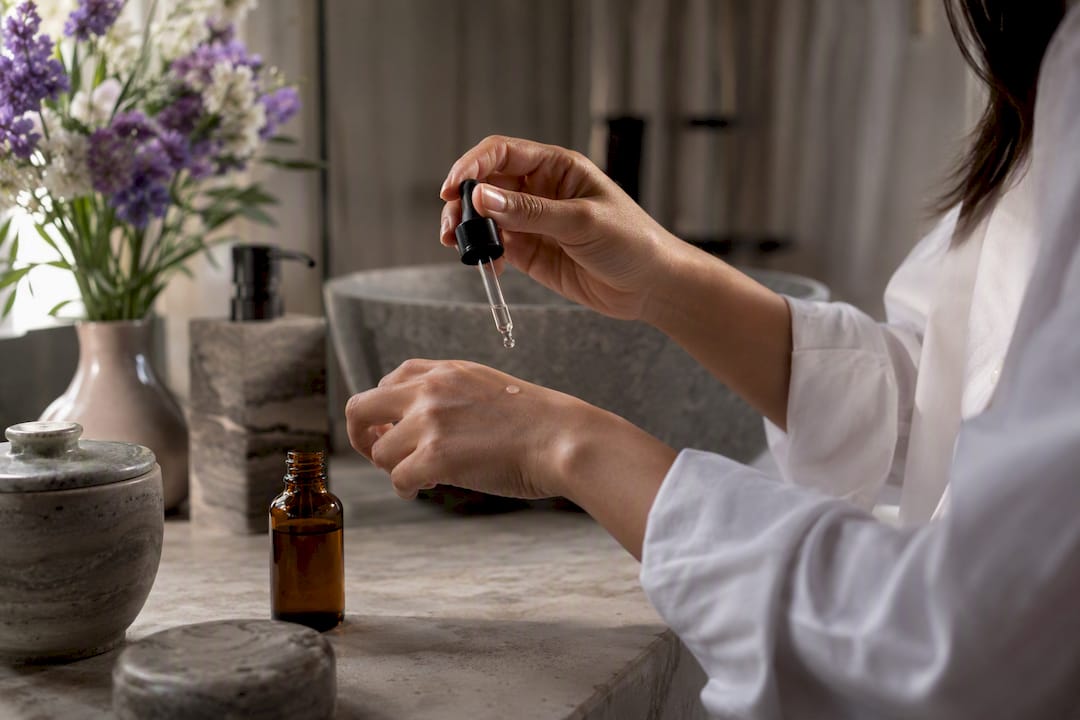
The number that matters: researchers pooled data from 70 separate studies, spanning in vitro work and small clinical trials, and still called for larger, longer-term research before drawing firm conclusions.
Here's where the nuance lives:
- Some randomized trials found tea tree oil performed comparably to conventional topical acne treatments, with fewer reported side effects in small samples.
- Most of the strongest results came from oils tested inside formulated gels, creams, or serums, not applied neat.
- In vitro results (petri dish studies) don't always translate to real skin, and sample sizes in human trials tend to be small.
The practical bottom line: essential oils can function as a helpful adjunct to a real skincare routine. They are not a replacement for prescription-strength acne treatment or dermatologist-guided anti-aging care, and no study claims otherwise.
The Safety Rules: Dilution, Patch Testing, and Sun Exposure
This is the section that actually keeps your skin barrier intact, so read it before you open a bottle.
- Dilute before every application. A 0.5% dilution suits sensitive facial skin, 1% is the standard ceiling for daily leave-on products, and 2% is reserved for targeted spot treatments on tougher skin, like body use, not the face.
- Patch test every time. Mix your diluted oil, apply a dime-sized amount to your inner forearm, and wait 24 to 48 hours. Redness, itching, or bumps mean stop, don't proceed to your face.
- Avoid phototoxic oils before sun exposure. Bergamot, lemon, lime, and grapefruit contain furocoumarins that react with UV light and can cause burns or dark patches. If you use them, apply at night and stay out of direct sun for at least 12 hours.
- Watch for allergic reaction signs. Swelling, hives, blistering, or breathing difficulty after topical use warrants stopping immediately and seeking medical care, not waiting it out.
Pro Tip: Keep a small notebook or phone note logging which oil, what dilution, and how your skin reacted. Patterns show up faster than memory does.
Sensitive skin, broken skin, or active eczema flares are all reasons to skip essential oils entirely until skin has calmed down.
The Best Essential Oils For Skin, Sorted By Concern
Matching the oil to the problem is where most people go wrong. Here's what the evidence actually supports for each concern:
- Acne: Tea tree oil (Melaleuca alternifolia) has the strongest backing of any essential oil for breakouts. Use it as a diluted spot treatment, never neat, since undiluted tea tree is a common cause of contact dermatitis.
- Inflammation and sensitive skin: Chamomile (Matricaria chamomilla) and lavender (Lavandula angustifolia) show anti-inflammatory effects at low concentrations, ideally blended into a gentle carrier like squalane rather than applied directly.
- Aging and antioxidant support: Rosemary (Rosmarinus officinalis) and lavender both show anti-aging signals in review data, though "anti-aging" here means supporting skin's antioxidant response, not erasing wrinkles overnight.
- Oily or congested skin: Peppermint (Mentha piperita) and eucalyptus (Eucalyptus globulus) bring cooling, antimicrobial properties, but both are potent enough to sting or sensitize skin that's already compromised, so keep concentrations low.
Every one of these needs the same caveat: dilution first, patch test always, and stop at the first sign of irritation. None of them are meant for eyes, mucous membranes, or broken skin.
How To Add Essential Oils To Your Routine, Step By Step
Building this into a real routine is simpler than most DIY tutorials make it sound.
- Pick your carrier first. Jojoba oil mimics skin's natural sebum, squalane suits nearly every skin type, and cream-based matrices work if you prefer a lotion feel over an oil.
- Do the dilution math before you mix anything. For a 30 mL bottle, a 1% concentration works out to roughly a handful of drops using standard 20 drops per mL essential oil droppers. For a 10 mL roller bottle, that same 1% target uses far fewer drops, since the total volume is a third of the size.
- Choose your method. Adding a drop or two of a compatible essential oil to an existing moisturizer is one option. Buying a product already formulated with essential oils at stable, tested concentrations is usually the safer route, since formulated vehicles change how oils behave on skin compared to DIY neat application.
- Start slow. Use once daily, or every other day at first, and give your skin two weeks before judging results.
Pro Tip: If math isn't your strength, buy a pre-diluted roller or serum rather than mixing your own; a slightly wrong ratio on a DIY blend is how irritation happens.
Storage, Shelf Life, and Why Oxidation Matters
Essential oils degrade, and oxidized oils are more likely to irritate skin than fresh ones. Watch for a sharper, sour, or "off" smell and any color shift as your cue to toss a bottle.
- Store oils in dark glass, capped tightly, away from heat and direct light.
- Shelf life typically runs one to three years depending on the oil's volatility, with citrus oils oxidizing fastest.
- Newer nanolipidic formulations, like nanostructured lipid carriers and solid lipid nanoparticles, can slow that degradation while improving how well the oil absorbs and reducing irritation risk.
When To Skip Essential Oils Entirely
Some situations call for skipping essential oils altogether, not just diluting harder.
- Pregnancy, infants, and young children need extra caution since several essential oils aren't studied for safety in these groups.
- Broken, actively inflamed, or eczema-flaring skin shouldn't get essential oils until it's calmer.
- Known fragrance allergies are a strong signal to avoid essential oils too, since the same sensitizing compounds often overlap.
If any of those apply, look for essential oil free skincare built around fragrance-free formulas, single-ingredient botanical extracts, or dermatologist-prescribed actives instead. Check labels closely: "unscented" doesn't always mean fragrance-free, and "natural fragrance" can still mean essential oil content.
How QueenCompares Helps You Vet Essential-Oil Products
You don't have to decode ingredient lists alone. QueenCompares' Ingredient Checker flags furocoumarins, high-phenol oils, and undisclosed fragrance blends hiding behind vague label terms.
- Scan a product label and get flagged ingredients highlighted instantly.
- See which flagged oils warrant a patch test versus outright avoidance.
- Cross-reference results against our ingredient library for deeper context on any compound.
Pro Tip: Run any leave-on product through the checker before your first patch test, since a flagged phototoxic oil changes whether daytime use is even safe.
Ready to see how your current products stack up? Browse QueenCompares' product comparisons to find essential oil formulations that other Queens have already vetted, or suggest a product you'd love our community to review next.
Real transparency in this space means brands publishing their actual composition data, not just a pretty ingredient list.
Why This Category Needs More Skepticism, Not Less
The conventional advice on essential oils splits into two unhelpful camps: breathless promotion claiming oils cure everything, or blanket dismissal treating them as dangerous fragrance dressed up in wellness branding. Both miss what the actual research supports.
Tea tree oil has real, if modest, clinical backing for acne. Lavender and rosemary show measurable anti-inflammatory signals. That's worth something, but it's a far cry from "natural miracle" marketing copy. The bigger problem is that most consumer guidance skips the math entirely.
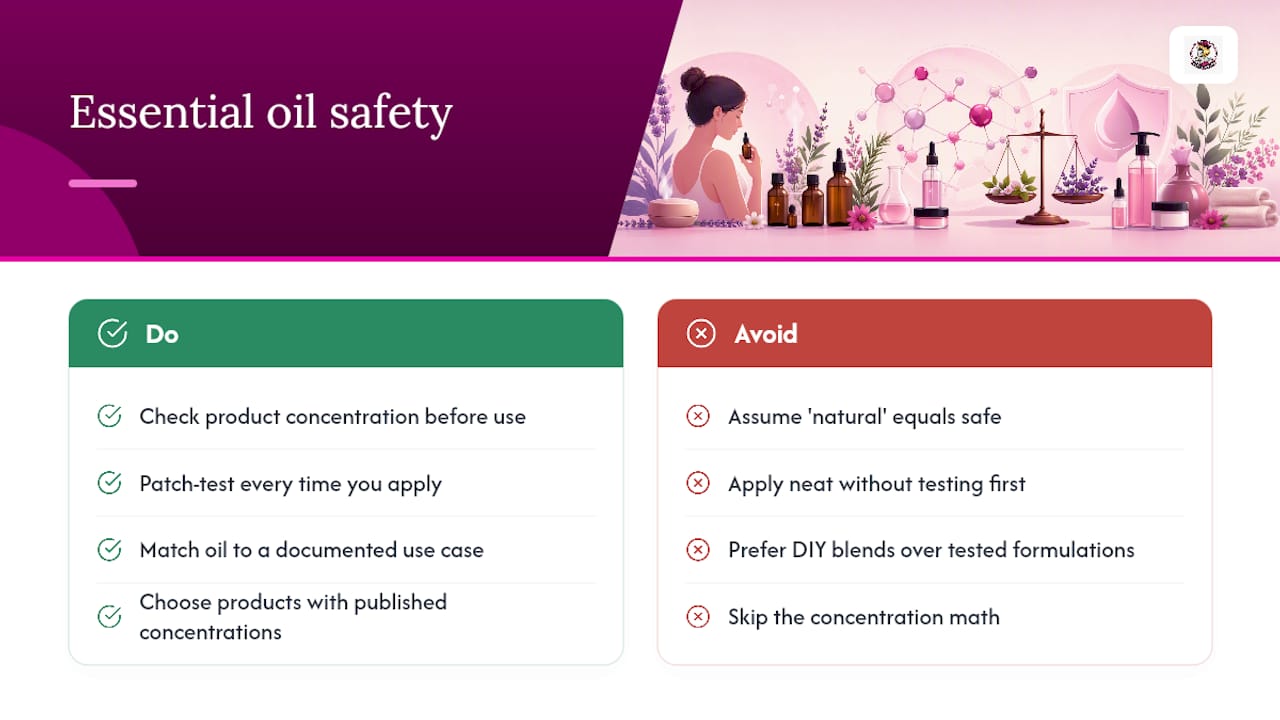
What actually matters is treating essential oils the way you'd treat any active ingredient: check the concentration, patch test without exception, and match the oil to a documented use case rather than a vibe. Readers should prioritize formulated products with published concentrations over DIY blending, since the research backing these oils largely comes from tested formulations, not neat application. That's the gap between what the label promises and what the evidence actually measured.
This article is general information, not a substitute for advice from a qualified doctor. Consult a qualified healthcare professional about your own circumstances before acting on anything here.
Sources
- Evaluating efficacy, safety, and innovation in skin care applications of essential oils: a systematic review - PMC
- Evaluating efficacy, safety, and innovation in skin care applications of essential oils: a systematic review - Frontiers (2025)
- Essential oils as dermocosmetic agents, their mechanism of action and nanolipidic formulations for maximized skincare
FAQ
What Is The Safest Essential Oil Dilution For Facial Skin?
Can Essential Oils Help With Acne?
Tea tree oil has clinical-quality evidence supporting its use for acne when properly diluted, though it works best alongside a full routine rather than as a standalone cure.
Which Essential Oils Should I Avoid Before Sun Exposure?
Bergamot, lemon, lime, and grapefruit contain furocoumarins that cause phototoxic reactions in sunlight, so apply them at night and avoid direct sun for at least 12 hours after.
How Do I Patch Test An Essential Oil?
Apply a small amount of the diluted oil to your inner forearm and wait 24 to 48 hours, watching for redness, itching, or bumps before using it on your face.
Are Essential Oils The Same As Fragrance Oils?
No, essential oils are naturally extracted plant compounds with potential bioactive effects, while fragrance oils are synthetic scent compounds built purely for smell.
How Long Do Essential Oils Last Before They Go Bad?
Most essential oils last one to three years depending on volatility, with citrus oils oxidizing fastest and needing earlier replacement.