
TL;DR:
- Face mapping divides the face into zones linked to internal or lifestyle triggers for skin issues. It helps identify patterns in breakouts over several weeks, guiding targeted skincare and lifestyle changes. Combining face mapping with barrier health awareness improves understanding and treatment of skin reactions.
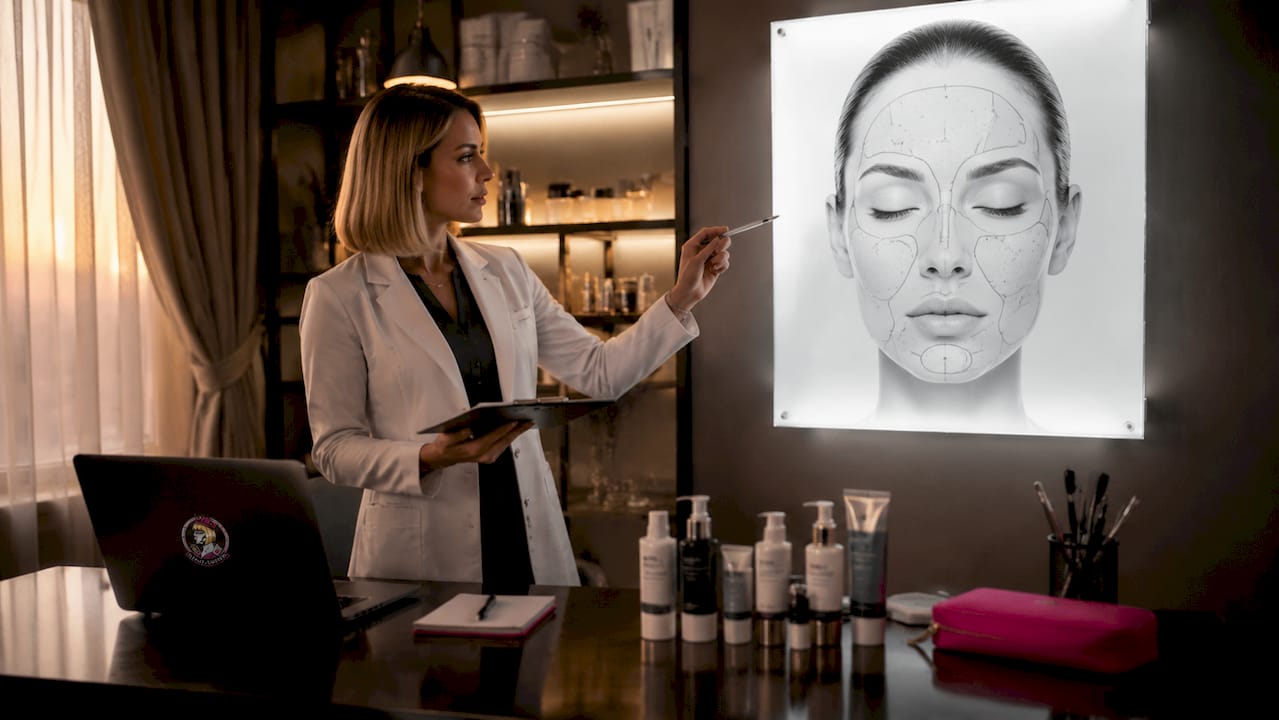
Face mapping is defined as a skincare practice that divides the face into distinct zones, each linked to potential internal triggers or lifestyle habits that may explain recurring skin concerns. The technique draws on ancient Chinese and Ayurvedic medicine and has been adapted by modern skincare professionals as a pattern recognition tool. Understanding what does face mapping mean in skincare helps you move beyond guessing why breakouts keep appearing in the same spots. It does not diagnose medical conditions. Instead, it points you toward patterns worth investigating.
What does face mapping mean in skincare history?
Face mapping is over 3,000 years old. Its earliest roots sit in traditional Chinese medicine and Ayurvedic practice, both of which linked specific facial regions to internal organ health. A blemish on the forehead, for example, was traditionally associated with the digestive system. Chin breakouts were connected to reproductive organs. These correlations were not random guesses. They reflected centuries of observational medicine in cultures that treated the body as an interconnected system.
Modern dermatology has moved away from strict organ-to-face correlations. Traditional organ mapping has been largely replaced by an understanding of external and environmental factors that affect skin zones differently. The shift matters because it makes face mapping more practical and less speculative.
Here is how the evolution breaks down:
-
Ancient Chinese medicine: Linked forehead to the bladder and small intestine, cheeks to the lungs, and chin to the kidneys and reproductive system.
-
Ayurvedic tradition: Organized the face by doshas (Vata, Pitta, Kapha) and connected skin imbalances to internal energy disruptions.
-
Early 20th-century Western adoption: Naturopathic practitioners began using facial observation as part of broader health assessments.
-
Modern skincare adaptation: Professionals now use face mapping to observe breakout patterns over time, focusing on sebaceous gland density, product contact, and lifestyle habits rather than organ links.
The practical result is a tool that has shed its more speculative elements while keeping its most useful feature: the idea that where you break out repeatedly is worth paying attention to.
How does face mapping work and what do facial zones indicate?
Face mapping works by identifying breakout patterns across specific facial zones and connecting those patterns to common triggers like hormones, oil production, or environmental contact. The key word is “patterns.” A single pimple on your chin tells you very little. Three months of consistent chin breakouts tells you something worth acting on.
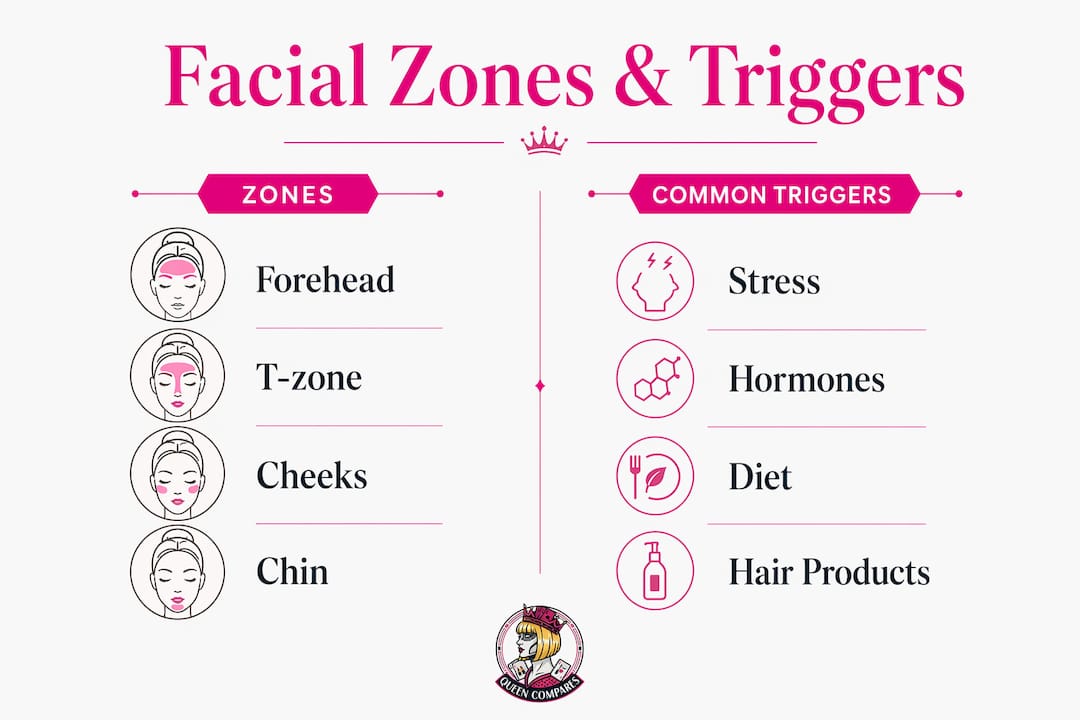
The most commonly mapped zones and their associated triggers are:
| Facial Zone | Common Triggers |
|---|---|
| Forehead | Stress, poor sleep, digestive habits, hair products |
| T-zone (nose and center panel) | High sebaceous gland density, excess oil production |
| Cheeks | Phone contact, pillowcase bacteria, allergens, air quality |
| Chin and jawline | Hormonal fluctuations, particularly around menstruation |
| Hairline and edges | Sweat, hair products, occlusive styling agents |
| Nose | Pore density, blackheads, oil buildup |
The chin and jawline zone is the most well-documented. Hormonal shifts drive sebaceous gland activity in this area, which is why many people notice flares tied to their menstrual cycle. The T-zone behaves differently. The nose and center forehead carry a higher concentration of oil glands, making them prone to congestion regardless of hormonal status. Cheeks are the most reactive to external contact. Your phone screen, pillowcase, and even the air quality in your home all affect this zone.
Pro Tip: Take a photo of your face every two weeks under consistent lighting. After two months, you will see zone patterns that are impossible to track from memory alone.
The role of sebaceous glands is central to understanding face mapping. Gland density varies across the face, which explains why some zones break out more than others even when your overall skin health is stable. Face mapping gives that variation a framework you can actually use.
What are the scientific support and limitations of face mapping?
Face mapping is a guide for understanding patterns, not a foolproof diagnostic tool. Breakouts are influenced by hormones, genetics, stress, diet, environment, and skincare products. No single zone-based system can account for all of those variables simultaneously.
Dermatologists see face mapping as one tool among many. It must be combined with genetics, hormones, lifestyle, and professional evaluation to produce genuinely useful insights. That combination is where face mapping earns its place in a skincare routine. Used alone, it risks oversimplification.
“Face mapping should be viewed as a guide for understanding patterns, not an absolute diagnostic system. Breakouts are influenced by hormones, genetics, stress, diet, environment, and skincare. Individualized patterns vary widely, and face mapping works best alongside professional assessment.” — Acne and skin expert Holly Mason, as cited by Cosmopolitan UK
The limitations worth knowing:
-
Oversimplification risk: Assigning a single cause to a zone ignores the multifactorial nature of acne and skin sensitivity.
-
Barrier neglect: Focusing too narrowly on individual zones can lead to overtreatment in some areas while the overall skin barrier health is ignored.
-
Inconsistent correlations: The nose has more oil glands and breaks out frequently, but that does not mean the liver is struggling. Scientific perspective favors pore density and product use over internal organ links.
-
No substitute for medical advice: Face mapping encourages awareness of habits and lifestyle but cannot diagnose internal health conditions.
The bottom line is that face mapping works best as a starting point, not a conclusion. It raises the right questions. A dermatologist helps you answer them.
How can you apply face mapping to improve your skincare routine?
The most effective way to use face mapping is to track breakout locations over at least several weeks before drawing any conclusions. Single incidents are often environmental or random. Patterns are where the real information lives.
Here is a practical approach to applying face mapping insights:
-
Document your skin for four to six weeks. Use photos, a journal, or a skincare tracking app. Note where breakouts appear, their size, and any lifestyle events around the same time. QueenCompares readers who use skincare routine tracking tools find this step dramatically improves their ability to spot real patterns.
-
Match your products to your mapped zones. If your T-zone consistently congests, use a non-comedogenic, oil-controlling formula there. If your cheeks react, check your pillowcase hygiene and phone cleaning habits before adding new products.
-
Adjust lifestyle factors linked to your active zones. Chin and jawline patterns often respond to stress reduction and sleep consistency. Forehead patterns sometimes improve with dietary changes or switching to a lighter hair product.
-
Treat your whole skin barrier, not just the problem zones. Overloading a specific area with active ingredients like salicylic acid or benzoyl peroxide can strip the barrier and worsen breakouts over time.
-
Consult a dermatologist for persistent patterns. Consistent, gentle skincare targeting mapped zones is a solid foundation, but complex or painful breakouts need professional evaluation.
Pro Tip: Before changing your entire routine, change one variable at a time. If you suspect your cheek breakouts come from your pillowcase, switch to a clean silk or cotton case for four weeks before adding any new products. Isolating variables gives you real answers.
Face mapping and acne management work best together when you treat the practice as an ongoing experiment rather than a one-time diagnosis. Your skin changes with seasons, stress levels, and age. Your map should update accordingly.
How does face mapping differ from barrier mapping?
Face mapping answers the question “where does my skin react?” Barrier mapping answers the question “why does my skin react?” The distinction is significant for anyone dealing with chronic breakouts, sensitivity, or pigmentation that does not respond to zone-based treatments.
Barrier mapping focuses on the skin’s protective outer layer and its function across facial zones. A compromised barrier allows irritants, bacteria, and allergens to penetrate more easily, which explains why some face mapping correlations lack consistency across different people.
| Feature | Face Mapping | Barrier Mapping |
|---|---|---|
| Primary focus | Location of skin concerns | Function of the skin’s protective layer |
| Core question | Where do breakouts occur? | Why does the skin react? |
| Rooted in | Traditional medicine, pattern observation | Skin biology, transepidermal water loss |
| Best used for | Identifying lifestyle and hormonal triggers | Treating chronic sensitivity, acne, pigmentation |
| Scientific backing | Moderate, strongest for hormonal zones | Strong, grounded in dermatological research |
The two methods complement each other well. Face mapping tells you which zones to pay attention to. Barrier mapping tells you what is happening biologically in those zones. Together, they give you a fuller picture than either method provides alone.
Key differences to keep in mind:
-
Barrier dysfunction underlies many skin issues, which is why some face mapping correlations do not hold up across all skin types.
-
Barrier mapping is particularly useful for people whose skin reacts unpredictably to products, since it identifies where the protective layer is weakest.
-
Face mapping is more accessible as a starting point. Barrier mapping often requires professional assessment or specialized tools.
The role of the skin barrier is central to controlling chronic breakouts. Treating zones without addressing barrier health is like patching a leak without fixing the pipe.
Key Takeaways
Face mapping is a pattern recognition tool that links facial zones to potential triggers, and it works best when combined with barrier awareness, lifestyle tracking, and professional skincare guidance.
| Point | Details |
|---|---|
| Face mapping defined | It divides the face into zones linked to hormonal, lifestyle, and environmental triggers. |
| Zone accuracy varies | Hormonal zones like chin and jawline have the strongest scientific support. |
| Patterns over incidents | Track breakouts for at least four to six weeks before drawing conclusions. |
| Barrier mapping complements | Barrier mapping explains why skin reacts; face mapping shows where it reacts. |
| Professional input matters | Persistent patterns need dermatologist evaluation, not just zone-based product swaps. |
Face mapping as a starting point, not a final answer
By Magdalena Kapuscinska
Face mapping gave me a framework when I had none. Before I understood that my jawline breakouts were tied to hormonal cycles rather than my cleanser, I cycled through products constantly and made things worse. The map helped me stop blaming the wrong variables.
That said, I have seen people take face mapping too literally, and it backfires. Treating your T-zone with three different acids because a chart told you your liver is stressed is not skincare. It is overtreatment. The skin barrier pays the price, and the breakouts often get worse before anyone realizes the map was not the problem. The application was.
What I have found actually works is using face mapping as a conversation starter with your own skin. Document what you see. Notice the timing. Then bring that information to a professional or use it to make one targeted change at a time. The ancient wisdom behind face mapping is real. The mistake is treating a 3,000-year-old observational tool as a substitute for modern skin science. They work together. Neither one works alone.
The future of face mapping sits at the intersection of traditional pattern recognition and AI-driven skincare analysis, where technology can track zone patterns over time with far more precision than memory or even photos allow. That combination is worth watching.
— Magdalena Kapuscinska
QueenCompares helps you act on your face mapping insights
Knowing which facial zones need attention is only half the work. Choosing the right products for those zones is where most people get stuck.

QueenCompares makes that step easier. The platform lets you compare skincare products side by side, check ingredient safety with the Ingredient Checker tool, and filter by skin concern so you are not guessing which formula suits your mapped zones. If your chin and jawline need a hormonal-friendly, non-comedogenic option, you can find and compare those products directly. If your T-zone needs oil control without barrier disruption, the skincare product comparison pages give you the ingredient-level detail to make a confident call. Join our Queen community and let your face mapping insights lead you to products that actually fit your skin.
FAQ
What does face mapping mean in skincare?
Face mapping is a practice that divides the face into zones, each linked to potential internal or lifestyle triggers for skin concerns. It is a pattern recognition tool, not a medical diagnostic method.
Is face mapping scientifically proven?
Face mapping has partial scientific support. Hormonal zones like the chin and jawline are well-documented, but strict organ-to-face correlations from traditional medicine are not supported by modern dermatology.
How does face mapping help with acne?
Face mapping helps identify where acne consistently appears, which points to likely triggers such as hormones, oil production, or external contact. Tracking patterns over several weeks makes the insights more reliable.
What is the difference between face mapping and barrier mapping?
Face mapping identifies where skin concerns occur. Barrier mapping analyzes why the skin reacts by examining the health of its protective outer layer. Both methods work best when used together.
How long should I track my skin before using face mapping?
Track your breakout locations for at least four to six weeks. Single incidents are often random. Consistent patterns across multiple weeks are what face mapping is designed to interpret.