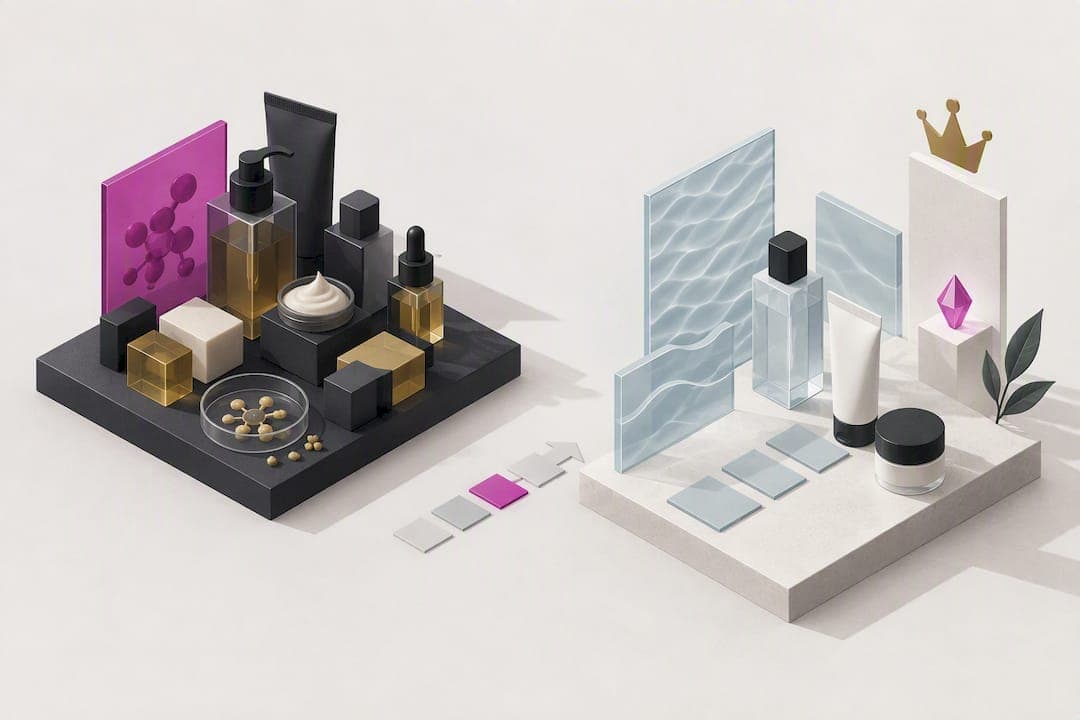
If your bumps are fungal acne, or Malassezia folliculitis, stop feeding the yeast causing it. Use an antifungal wash while breakouts are active, then switch daily care to water-based, C11 to C24 free products, meaning gel textures, humectants like glycerin, and a mineral sunscreen. That combination starves the yeast and calms the skin at the same time.
TL;DR:
Products containing fatty acids in the C11 to C24 range, such as coconut oil, shea butter, and certain esters, can actively feed Malassezia yeast and worsen fungal acne.
Active fungal acne cases respond best to antifungal washes with ketoconazole, zinc pyrithione, or selenium sulfide, used regularly for two to three weeks.
Avoid using topical products with coconut oil, oleic acid, or isopropyl esters in the first few ingredients, especially during active flare-ups.
Hydrating ingredients like glycerin, hyaluronic acid, and squalane are safe for fungal acne-prone skin and help support the skin barrier without feeding yeast.
Checking ingredient lists with specialized tools or quick reference guides can prevent using products that may trigger or worsen fungal acne.
Table of Contents
-
What Is Fungal Acne Safe Skincare and How Does It Differ From Regular Acne Care?
-
Why Do C11 to C24 Fatty Acids Matter in Fungal Acne Safe Skincare?
What Is Fungal Acne Safe Skincare and How Does It Differ From Regular Acne Care?
Fungal acne isn’t acne at all in the traditional sense. It’s Malassezia folliculitis, a yeast overgrowth inside hair follicles that mimics bacterial acne closely enough to fool most people, including some who’ve been treating it wrong for months. Dermatology reviews describe it as a yeast-driven follicular infection that typically responds to antifungal therapy rather than the benzoyl peroxide and antibiotics that treat bacterial breakouts.
The visual tell is uniformity. Bacterial acne shows up as a mix of blackheads, whiteheads, and inflamed cysts in different sizes. Fungal acne looks almost stamped out, small, same-sized papules clustered together, often itchy in a way bacterial acne rarely is.
You’ll usually spot it in specific zones:
-
The forehead and hairline, where oil and occlusion meet
-
The chest and upper back, especially after sweating
-
The shoulders, particularly under backpack straps or tight bra bands
Here’s the part that trips people up: if you’ve been fighting “acne” for months with salicylic acid or benzoyl peroxide and seeing zero improvement, or it’s getting worse, that’s a real clue you’re dealing with yeast, not bacteria. The two organisms don’t respond to the same weapons.
Self-diagnosis has limits, though. A dermatologist confirms Malassezia folliculitis through visual exam, sometimes paired with a skin scraping or culture under a microscope. If your bumps aren’t budging after a few weeks of a fungal-acne-safe routine, that’s your cue to get a professional look rather than keep guessing.
What Triggers Fungal Acne Flares?
Malassezia yeast lives on everyone’s skin already. It only becomes a problem when conditions tip in its favor, and those conditions are almost always things you can control.
Heat and humidity top the list. Malassezia thrives in warm, moist environments, which is why flares spike in summer, after workouts, or in humid climates year-round. Occlusion makes it worse: tight leggings, sports bras, bike helmets, and even N95 masks trap sweat against skin and create a greenhouse effect for yeast.
Recent antibiotic use is another major driver. Antibiotics wipe out competing bacteria on your skin, giving Malassezia room to overgrow unchecked. Topical or oral steroids do something similar by suppressing the immune response that normally keeps yeast populations in check.
Common flare triggers worth watching:
-
Heavy sweating without a prompt shower afterward
-
Tight, non-breathable synthetic fabrics worn for hours
-
A course of antibiotics for an unrelated infection
-
Long-term topical steroid use on the face or body
-
Naturally oily skin, which gives yeast more lipids to feed on
-
Skipping laundry changes between gym sessions
The fix is often boringly simple. Shower and change out of sweaty clothes within thirty minutes of a workout. Wash gym clothes after every single wear, not every third wear, since Malassezia spores survive in damp fabric. Choose looser, breathable materials when you know you’ll be sweating for hours. None of this requires new products, just different habits.
Why Do C11 to C24 Fatty Acids Matter in Fungal Acne Safe Skincare?
This is the single most useful thing to understand if you’re building a fungal-acne-safe routine: Malassezia yeast needs fatty acids to survive, and it can’t make its own. It pulls them straight from your skincare.
Laboratory research has documented Malassezia’s ability to metabolize fatty acids in the C11 to C24 carbon-chain range, which covers a huge swath of oils and esters common in cosmetic formulas. Anything in that range acts as fuel. Anything outside it generally doesn’t. That’s the whole rule.
Statistic Callout: Community-consolidated ingredient databases built from lab growth studies have flagged dozens of common cosmetic oils and esters as Malassezia food sources, which is why so many “clean” or “natural” products still trigger flares. Natural doesn’t mean fungal-acne-safe.
Ingredients to watch for on a label:
-
Lauric acid, myristic acid, palmitic acid, and stearic acid
-
Isopropyl palmitate and isopropyl myristate (common texture agents)
-
Coconut oil, coconut alkanes, and coconut-derived esters
-
Shea butter, olive oil, and jojoba oil
-
Certain polysorbates (polysorbate 60 and 80 show up most often)
-
Oleic acid, a frequent ingredient in “nourishing” facial oils
Rinse-off products carry less risk than leave-on ones, simply because contact time is shorter. A shampoo with coconut oil sitting on your scalp for ninety seconds is a different exposure than a body lotion with the same oil left on all day. That said, finished-formula behavior isn’t always predictable from the ingredient list alone. A product loaded with a “safe” oil at 0.1% behaves differently than one where it’s the second ingredient, which is exactly why checking full ingredient order matters more than skimming for a single scary word.
Which Ingredients Are Genuinely Fungal Acne Safe?
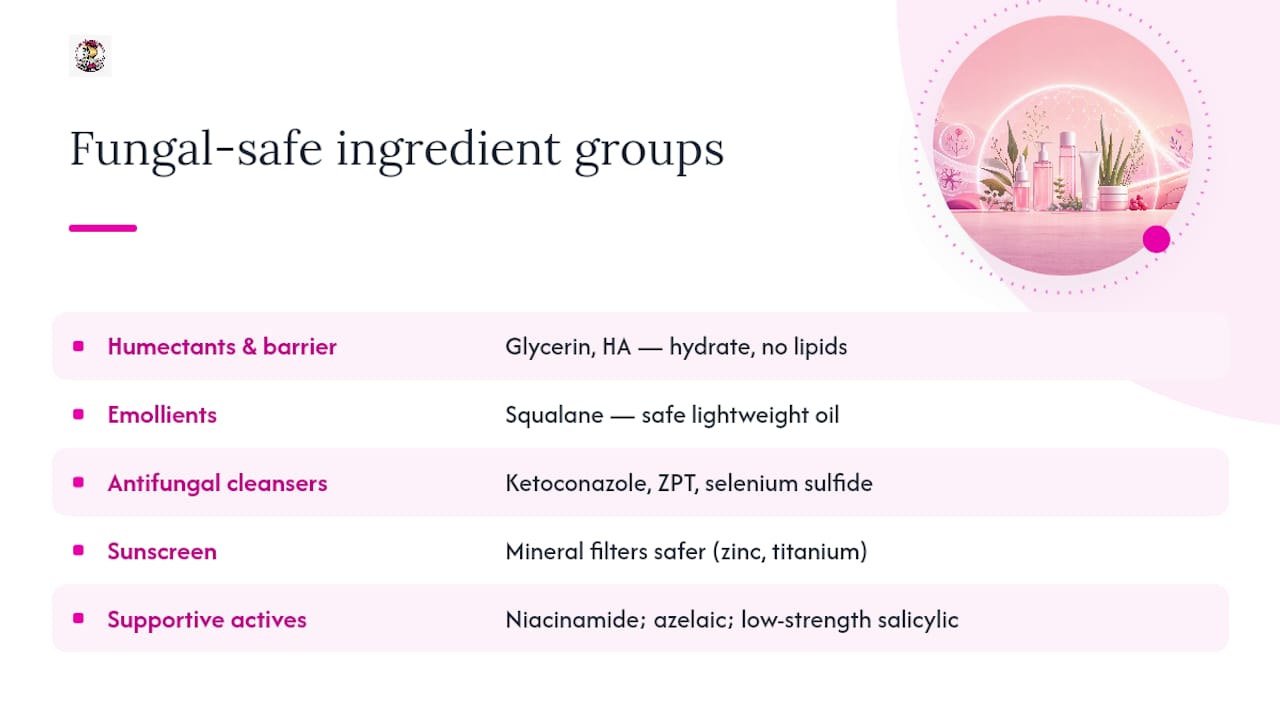
Once you know what to avoid, the safe list is refreshingly short and effective. These categories give your skin what it needs, hydration, barrier support, sun protection, without handing Malassezia anything to eat.
Humectants pull water into skin without supplying lipids. Glycerin, hyaluronic acid, and propanediol are the workhorses here, and they show up in the vast majority of gel moisturizers and lightweight serums. Barrier-supporting ingredients like ceramides, glycerin, and hyaluronic acid help restore hydration and skin structure without feeding the yeast that causes flares.
Emollients are trickier since most emollients are oils, but squalane is the standout exception. It’s a saturated hydrocarbon, chemically distinct from the fatty acids Malassezia metabolizes, which is why it’s repeatedly recommended as the go-to lightweight moisturizing oil for fungal-acne-prone skin.
Antifungal and antiseborrheic cleansers do double duty as both treatment and prevention. Ketoconazole, zinc pyrithione, and selenium sulfide washes are the three most studied options, and they show real antifungal activity against Malassezia when used consistently. A 1% zinc pyrithione bar or a ketoconazole shampoo used as a face and body wash a few times a week is one of the most cost-effective moves in this entire routine.
Sunscreen deserves its own callout because it trips up more people than any other category. Mineral filters (zinc oxide, titanium dioxide) in water- or silicone-based vehicles tend to be safer than many chemical sunscreens, whose oil-heavy bases often carry problematic esters. It’s not the UV filter itself causing flares, usually. It’s what the filter is suspended in.
Supportive actives round out a routine without adding fungal fuel. Niacinamide calms redness and supports the barrier. Azelaic acid has mild antimicrobial and anti-inflammatory properties. Salicylic acid, being oil-soluble, can help clear congested follicles as a low-strength adjunct.
How Do You Build a Fungal Acne Safe Routine?
Structure beats improvisation here. A predictable, repeatable routine gives you a clean signal when something works, and an obvious culprit when something doesn’t.
-
Morning: Start with a gentle micellar water or low-foam gel cleanser, nothing stripping. Follow with a water-based humectant serum (glycerin or hyaluronic acid), then a lightweight gel moisturizer built around squalane. Finish with a mineral sunscreen in a gel or fluid base rather than a heavy cream.
-
Evening, active flare: Use an antifungal wash, ketoconazole or zinc pyrithione, as a two-to-three minute mask on affected areas before rinsing. Follow with the same gel moisturizer once skin is dry. Skip actives like retinoids during the first week of antifungal treatment to avoid compounding irritation.
-
Evening, maintenance: Cleanse, apply any supportive actives (niacinamide or azelaic acid), then moisturize. Drop the antifungal wash to two or three times weekly once bumps have cleared.
-
Body care: Use a ketoconazole or zinc pyrithione wash on the chest and back once or twice weekly as prevention, more often during active breakouts. Change into dry clothes immediately after sweating, and always launder workout gear after a single wear.
-
Introducing new products: Add one product at a time, wait seven to ten days, and watch for new bumps before adding the next. This is slower than most people want, but it’s the only way to know which product is actually helping or hurting.
Pro Tip: Keep a simplified routine for two to three weeks minimum before judging results. Malassezia folliculitis reacts to consistency, not variety, so resist the urge to add “just one more” serum while you’re still assessing.
For a broader framework on building routines that don’t overwhelm your skin barrier, this guide on building a safe skincare routine walks through the same layering logic in more general terms.
How Long Does Fungal Acne Treatment Take to Work?
Topical antifungals are the frontline treatment, and they work faster than most people expect. Ketoconazole or clotrimazole applied as a wash or short-contact mask typically shows visible improvement within two to three weeks when used consistently. Some clinical guidance recommends daily use for the first one to two weeks, then dropping to twice-weekly maintenance once symptoms clear.
Oral antifungals like fluconazole or itraconazole are reserved for severe or treatment-resistant cases, and they require a prescriber’s oversight. These aren’t over-the-counter decisions. Oral antifungals carry interaction risks with other medications and need liver function monitoring in some cases, so unsupervised long-term use is a genuine safety concern, not just an inconvenience.
Signs it’s time to see a dermatologist rather than keep self-treating:
-
No improvement after three to four weeks of consistent topical antifungal use
-
Spreading beyond the original area or worsening itch
-
Uncertainty about diagnosis, especially if bacterial acne treatments already failed
-
Recurrent flares that come back within weeks of clearing
-
Any signs of secondary infection (increased pain, warmth, pus)
A short-course topical antifungal followed by lighter, barrier-focused maintenance care is the approach most clinical guidance converges on, largely because aggressive daily antifungal washing long-term can disrupt the skin barrier on its own.
How Do You Screen a Product Label for Fungal Acne Safety?
Reading an ingredient list takes ten seconds once you know what you’re scanning for. Ingredients are listed in descending order by concentration, so the first five to seven matter most.
Start there. Scan for the usual suspects, coconut oil, oleic acid, isopropyl palmitate, any of the fatty acids in the C11 to C24 range, near the top of the list. If one shows up in the first few ingredients, that product is a higher risk, even if the rest of the formula looks clean. If it’s buried near the bottom at trace amounts, the risk drops considerably.
Then confirm the safe stuff is doing the heavy lifting: glycerin, hyaluronic acid, squalane, niacinamide, or a mineral UV filter should appear early if the brand built the product with sensitive or fungal-acne-prone skin in mind.
Quick label-check habits worth memorizing:
-
Red flag: coconut, shea, or olive derivatives in the first five ingredients
-
Red flag: isopropyl myristate or palmitate anywhere on the list
-
Safe tick: glycerin, hyaluronic acid, or propanediol near the top
-
Safe tick: squalane listed as the primary emollient
-
Always patch test, since non-comedogenic labeling isn’t regulated and doesn’t guarantee fungal-acne safety
| Label check | What to look for | Why it matters |
|---|---|---|
| First 5 ingredients | Absence of C11 to C24 oils/esters | Highest concentration = highest exposure risk |
| Humectant presence | Glycerin, hyaluronic acid, propanediol | Hydrates without feeding yeast |
| Emollient type | Squalane over plant oils | Chemically distinct from Malassezia’s fuel source |
| SPF vehicle | Water or silicone gel base | Reduces hidden ester exposure |
Scanning labels by eye works, but it’s slow when you’re standing in a store deciding between five products. QueenCompares’ Ingredient Checker does this exact C11 to C24 screening in seconds, flagging problem ingredients before you buy instead of after you break out.
Why “Fungal Acne Safe” Lists Aren’t Gospel
Here’s what most guides won’t tell you plainly: the fungal-acne-safe ingredient lists circulating online are community-built heuristics, not regulated certifications. They come from a mix of lab growth studies on isolated Malassezia strains and crowdsourced trial-and-error, and the limits of ingredient-only screening are real. A fatty acid that feeds yeast in a Petra dish doesn’t always behave the same way inside a finished formula with a dozen other ingredients interacting.
That gap matters for how strict you need to be. If you’re mid-flare with visible, spreading bumps, be conservative. Cut every C11 to C24 ingredient without exception and lean on antifungal washes until things calm down. But if your skin is mostly clear and you’re maintaining, rigid ingredient policing can backfire, stripping too aggressively and wrecking your barrier does more damage than a trace amount of a “risky” oil buried at the bottom of an ingredient list.
I’d rather see readers build tolerance for nuance than treat every list as a strict rulebook. Check ingredients, patch test new products, and use tools like QueenCompares’ checkers to move faster, but let your skin’s actual response be the final word, not a spreadsheet.
— Magdalena Kapuscinska - Queencompares.com Founder
Screen Every Product Before It Touches Your Skin
Guessing which products are safe from a label alone is slow and, honestly, easy to get wrong when isopropyl palmitate is hiding fifteen ingredients deep. QueenCompares built its Ingredient Checker and Label Scanner specifically to catch C11 to C24 fatty acids and esters before you buy, so you’re not decoding chemistry names in a store aisle.
Beyond the scanner, QueenCompares’ curated Beauty collection groups products by ingredient safety profile, so you can browse fungal-acne-friendly picks without re-checking every single label from scratch. Pair that with the Ingredient Library when you want to understand exactly why a specific ester made the avoid list. Start with the Ingredient Checker on your current products this week, then build your replacement routine from the Beauty category’s vetted picks.
Sources
This article is general information, not a substitute for advice from a qualified doctor. Consult a qualified healthcare professional about your own circumstances before acting on anything here.
FAQ
What Skincare Should I Use if I Have Fungal Acne?
Stick to water-based gels and humectants like glycerin and hyaluronic acid, a squalane-based moisturizer, and a mineral sunscreen in a gel or fluid vehicle. During active flares, add an antifungal wash such as ketoconazole or zinc pyrithione a few times a week, which clinical sources support as effective against Malassezia.
What Skincare Should I Avoid With Fungal Acne?
Avoid products where coconut oil, shea butter, olive oil, oleic acid, or isopropyl palmitate/myristate appear in the first several ingredients. These fall within the C11 to C24 fatty acid range Malassezia metabolizes, so they can actively fuel a flare rather than calm it.
What Kills Fungal Acne Naturally?
There’s no reliably “natural” cure backed by strong evidence. Antifungal washes containing ketoconazole, zinc pyrithione, or selenium sulfide remain the most consistently effective option, alongside reducing heat, sweat, and occlusion that let Malassezia overgrow in the first place.
What Kills Malassezia on the Face?
Topical antifungals like ketoconazole and clotrimazole, along with zinc pyrithione and selenium sulfide washes, are the treatments with the clearest support for reducing Malassezia populations on facial skin. Most people see improvement within two to three weeks of consistent use, and severe or resistant cases may need an oral antifungal prescribed by a dermatologist.
Can Skincare Cause Fungal Acne?
Yes, certain skincare formulas can trigger or worsen flares by supplying fatty acids and esters Malassezia feeds on, even when the product is marketed as “natural” or “nourishing.” Checking ingredient lists with a tool like QueenCompares’ Ingredient Checker before buying helps catch these triggers before they cause a breakout.
Recommended
General Entertainment & Information Purposes Only At QueenCompares.com we share content for general entertainment and information. It’s not medical, dermatological, nutritional, or fitness advice and shouldn’t replace guidance from a licensed professional. If you’re making health-related decisions, please check with a qualified expert — and know that using this site and its information is at your own discretion.