Azelaic acid is the stronger corrective choice for inflammatory acne, active rosacea, and stubborn post-inflammatory hyperpigmentation (PIH); niacinamide is the gentler, multi-tasking option for pore appearance, oil control, and barrier repair. That's the short answer for the azelaic acid vs niacinamide debate. For most people, the real question isn't which one to pick — it's whether to use one or both.
Quick verdict by concern:
- Acne (inflammatory, cystic): Azelaic acid, with niacinamide as a supportive add-on
- Rosacea and redness: Azelaic acid first; niacinamide can calm alongside it
- PIH and dark spots: Azelaic acid for active correction; niacinamide for maintenance and mild brightening
- Pores, oiliness, and shine: Niacinamide is your go-to
- Sensitive or reactive skin: Start with niacinamide, then introduce azelaic acid slowly
One-line action plan: If you're dealing with one primary concern, start with the ingredient mapped to it above. If you have two or more overlapping concerns, split them AM (niacinamide) and PM (azelaic acid), or layer niacinamide first and azelaic acid second in the same session once your skin has adjusted.
Key Takeaways
Azelaic acid corrects; niacinamide stabilizes — and using both in a split AM/PM routine covers the widest range of skin concerns with minimal irritation risk.
| Point | Details |
|---|---|
| Azelaic acid for correction | Best for inflammatory acne, rosacea, and PIH; works via antimicrobial and tyrosinase-inhibiting action. |
| Niacinamide for balance | Best for pore control, oil regulation, and barrier repair; well-tolerated at 2–10% concentrations. |
| They're compatible | Layer niacinamide first, then azelaic acid; or use niacinamide AM and azelaic acid PM. |
| OTC vs prescription | Azelaic acid at 10% OTC suits mild concerns; 15% Rx is standard for rosacea and moderate acne. |
| QueenCompares Ingredient Checker | Scan product labels to verify concentrations and flag allergens before you buy. |
Table of Contents
- How does azelaic acid work, and who benefits most from it?
- How does niacinamide work, and who benefits most from it?
- Which ingredient wins for your specific skin concern?
- Can you use azelaic acid and niacinamide together?
- How to build a routine with one or both ingredients
- OTC vs prescription options in the U.S.: what concentration do you actually need?
- Side effects, patch testing, pregnancy, and when to see a dermatologist
- What does the clinical evidence actually say?
- A practical take on choosing between these two actives
- Find products with azelaic acid and niacinamide using QueenCompares
- Sources
- FAQ
How does azelaic acid work, and who benefits most from it?
Azelaic acid is a naturally occurring dicarboxylic acid found in grains like wheat, rye, and barley. Its four-way action is what makes it genuinely useful: it's anti-inflammatory, antimicrobial, comedolytic, and a tyrosinase inhibitor, meaning it interrupts the enzyme pathway that produces excess melanin. A peer-reviewed PMC review confirms these mechanisms and supports its clinical use for acne, rosacea, and hyperpigmentation.
Concentrations and formulations
In the U.S., you'll find azelaic acid in two tiers.
Gels tend to suit oilier skin better because they're lighter and absorb faster. Creams and lotions work well for drier or more sensitive skin types, since the richer vehicle helps offset any transient dryness that azelaic acid can cause.
What it treats best
The benefits of azelaic acid are clearest in three areas:
- Inflammatory acne: It kills Cutibacterium acnes and reduces the inflammatory response around blocked follicles
- Rosacea: Prescription 15% formulations are commonly used as a first-line treatment for papulopustular rosacea
- PIH and melasma: Tyrosinase inhibition slows melanin overproduction at the site of inflammation or sun damage
Results for acne typically appear within several weeks; pigment correction and rosacea improvement usually require longer periods of consistent use.
Side effects and tolerability
The most common side effect is a brief tingling or stinging sensation on application, especially at higher concentrations. Transient dryness and mild peeling can occur in the first few weeks. Serious reactions are rare, and azelaic acid is generally considered one of the more tolerable prescription-grade actives.
This lets your skin adjust to the tingling before you increase frequency or move to a higher concentration.*
How does niacinamide work, and who benefits most from it?
Niacinamide, also called nicotinamide or vitamin B3, is one of the most versatile actives in skincare. Unlike azelaic acid, it doesn't target a single pathway — it works across several simultaneously. A PMC review on nicotinamide's topical benefits details how it supports barrier function, reduces sebum production, and calms inflammation, all of which translate into real, visible improvements for a wide range of skin types.
The NIH Office of Dietary Supplements confirms niacin (vitamin B3) has a well-established safety profile, and topical niacinamide carries that same reassuring track record into skincare.
Concentrations and what to expect
- 2–4%: Barrier support, mild anti-inflammatory effects, good for sensitive or compromised skin
- 5%: The most common serum concentration; addresses pore appearance, oiliness, and early pigment concerns
- 10%: Stronger sebum regulation and brightening; occasionally causes flushing or mild irritation in very reactive skin
Most people see changes in pore appearance and oil control within some weeks. Brightening effects tend to take longer periods of consistent use.
Primary benefits at a glance
- Reduces sebum production and visible pore size
- Strengthens the skin barrier by boosting ceramide synthesis
- Calms redness and mild inflammatory acne
- Provides mild brightening by inhibiting melanosome transfer to skin cells
- Pairs well with nearly every other active in a routine
Niacinamide is water-soluble and works well in serum form, which makes it easy to layer. It's compatible with retinoids, vitamin C, AHAs, BHAs, and azelaic acid — a flexibility that most actives simply don't have. For a deeper look at everything it can do, the niacinamide benefits guide on QueenCompares covers concentrations and routine uses in detail.
Which ingredient wins for your specific skin concern?
Here's a concern-by-concern breakdown so you can match the right active to your top priority.
| Skin Concern | Best Pick | Why | Typical Onset |
|---|---|---|---|
| Inflammatory acne | Azelaic acid | Antimicrobial + anti-inflammatory; kills acne bacteria directly | 4–8 weeks |
| Rosacea / persistent redness | Azelaic acid | Reduces papules and erythema; 15% Rx is a standard first-line option | 8–12 weeks |
| PIH / post-acne dark spots | Azelaic acid (primary) + niacinamide (support) | Tyrosinase inhibition + melanosome transfer reduction | 8–12 weeks |
| Enlarged pores / oiliness | Niacinamide | Sebum regulation and pore-tightening effect | 4–8 weeks |
| Barrier repair / sensitivity | Niacinamide | Ceramide support and anti-inflammatory action | 4–6 weeks |
| Mild brightening / uneven tone | Both | Complementary mechanisms for a more even result | 8–12 weeks |
| Aging / fine lines | Niacinamide | Barrier strengthening and collagen support | 8–12 weeks |
When to see a dermatologist:
- Severe or widespread rosacea that doesn't respond to OTC options within 8 weeks
- Melasma covering large areas of the face (prescription-strength treatment is usually more effective)
- Persistent cystic acne that isn't improving with topical actives alone
A recent clinical review on PMC reinforces that timelines and outcomes vary significantly by individual, and that more severe presentations benefit from professional oversight.
Can you use azelaic acid and niacinamide together?
Yes, and they work well as a pair. These two actives don't compete or cancel each other out. Niacinamide calms and strengthens the barrier while azelaic acid corrects and clears, so combining them often produces better results than either alone, particularly for PIH and rosacea. Practical guides consistently recommend layering niacinamide before azelaic acid or splitting them across AM and PM sessions for the best tolerance.
How to layer them in the same routine
- Cleanse and pat skin dry
- Apply niacinamide serum first (it's typically water-based and lighter)
- Wait 1–2 minutes for it to absorb
- Apply azelaic acid on top (gel or cream formulation)
- Follow with a moisturizer to seal everything in
- Apply SPF in the morning — non-negotiable when treating pigment
For AM/PM ingredient placement, niacinamide works well in both sessions. Azelaic acid can be used morning or night, but many people find PM use more comfortable since it avoids any brief tingling under makeup.
What not to mix with azelaic acid
- Strong exfoliating acids (high-concentration AHAs/BHAs or peels): Using these in the same session can push irritation higher than either would cause alone. Use on alternate nights instead.
- Prescription retinoids: Not incompatible, but combining them in one session can be drying. A dermatologist can advise on sequencing.
- Vitamin C (L-ascorbic acid at low pH): Both are acidic; layering them together can cause unnecessary irritation. Use vitamin C in the AM and azelaic acid in the PM.
Pro Tip: If you notice stinging that lasts more than a few minutes after layering, split the two actives into AM and PM sessions for a week or two. Most people can return to same-session layering once their skin has adjusted.
How to build a routine with one or both ingredients
Azelaic acid only
PM: Gentle cleanser → azelaic acid → moisturizer
Niacinamide only
PM: Gentle cleanser → niacinamide serum → moisturizer
Combined routine
AM: Gentle cleanser → niacinamide serum → moisturizer → SPF 30+ PM: Gentle cleanser → niacinamide serum → azelaic acid → moisturizer
How to introduce a new active safely
- Start 2–3 times per week for the first two weeks
- Increase to every other night in weeks 3–4 if no irritation appears
- Move to nightly use only once your skin is comfortable
- Always patch test on the inner arm or jawline for 24–48 hours before full-face use
The skincare routine simplification checklist on QueenCompares walks through this process step by step for beginners.
Troubleshooting:
- Persistent stinging: Drop frequency and add a barrier-supporting moisturizer before the active
- New breakouts in week 1–2: Often a purging response; give it 4 weeks before reassessing
- Flaking or peeling: Reduce frequency and layer a richer moisturizer on top
OTC vs prescription options in the U.S.: what concentration do you actually need?
| Ingredient | Concentration Range | Format | Typical Use Case |
|---|---|---|---|
| Niacinamide | 2–4% | Serums, toners, moisturizers | Barrier repair, sensitivity, mild anti-inflammatory |
| Niacinamide | 5% | Serums | Pore control, oil regulation, mild brightening |
| Niacinamide | 10% | Serums, treatments | Stronger sebum control, more visible brightening |
| Azelaic acid | Up to 10% | OTC serums, creams | Mild acne, early PIH, general brightening |
| Azelaic acid | 15% | Rx foam or gel (dermatologist) | Papulopustular rosacea, moderate acne, melasma |
| Azelaic acid | Up to ~20% | Compounded (dermatologist) | Resistant PIH, melasma, severe rosacea |
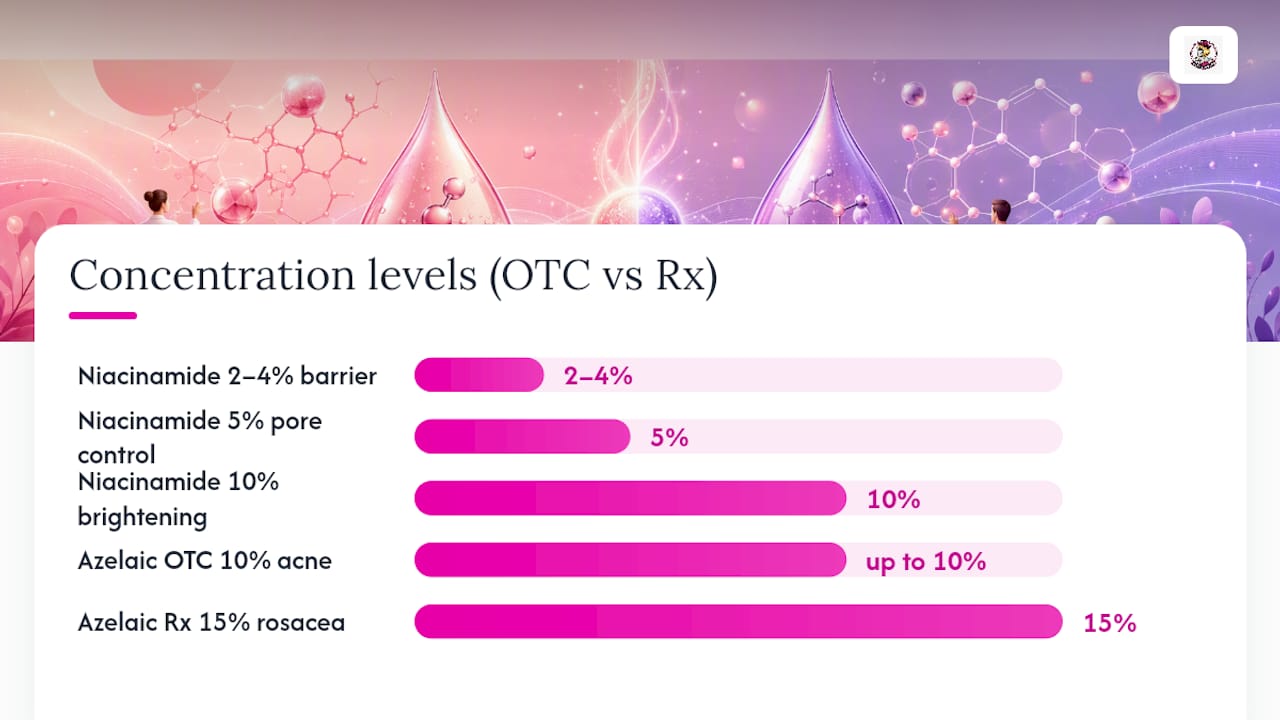
Compounded formulations are typically reserved for cases where standard concentrations haven't worked.
Formulation vehicle matters more than most people realize. A gel delivers the active faster and feels lighter, which suits oily or combination skin. A cream or lotion slows absorption slightly but reduces the chance of dryness, making it a better fit for dry or sensitive skin types. The skincare pH balance guide on QueenCompares explains how pH affects how well acidic actives like azelaic acid perform in different formulations.
Side effects, patch testing, pregnancy, and when to see a dermatologist
Both ingredients have strong safety records, but they're not identical in their risk profiles.
Azelaic acid side effects:
- Transient tingling or burning on application (most common, usually fades within minutes)
- Mild dryness or peeling in the first 2–4 weeks
- Rare: contact dermatitis or prolonged irritation
Niacinamide side effects:
- Generally very well tolerated across all skin types
- Rare flushing or redness at concentrations above 10%
- Occasional mild irritation in highly reactive skin
Patch test steps
- Apply a small amount to the inner arm or behind the ear
- Leave it on for 24 hours without washing
- Check for redness, itching, or swelling at 24 and 48 hours
- If no reaction appears, introduce the product to your face at low frequency
Pregnancy and nursing
Both azelaic acid and niacinamide are commonly cited as safer alternatives to restricted actives like retinoids and hydroquinone during pregnancy and nursing. A PubMed-indexed clinical article supports azelaic acid's suitability in pregnancy-safe regimens. That said, always confirm any new active with your OB or dermatologist before using it during pregnancy.
Red flags — see a dermatologist if you experience:
- Severe burning that doesn't subside within 10–15 minutes of application
- A spreading rash, hives, or facial swelling after use
- Rapid worsening of acne or rosacea rather than gradual improvement
- No visible change after 12 consistent weeks at OTC concentrations
This article provides general skincare information and is not a substitute for professional medical advice. Confirm any treatment plan with a qualified dermatologist, especially for prescription-strength products or use during pregnancy.
What does the clinical evidence actually say?
The evidence base for these two ingredients is solid but not uniform. Azelaic acid has more robust clinical trial data across multiple concerns; niacinamide's evidence is strong for barrier function and sebum regulation but thinner for some other claims.
A Cochrane systematic review found that azelaic acid showed moderate-quality evidence in comparisons with some other acne treatments, while evidence for nicotinamide was limited or low quality for several outcomes. That doesn't mean niacinamide doesn't work — it means the trials are smaller and less consistent, not that the ingredient fails.
Key clinical finding: Azelaic acid's anti-inflammatory, antimicrobial, and tyrosinase-inhibiting mechanisms are well-documented in peer-reviewed literature, with clinical support for acne, rosacea, and hyperpigmentation. Niacinamide's barrier-supporting and sebum-regulating effects are backed by multiple controlled trials, though evidence strength varies by outcome and concentration studied.
For azelaic acid, the strongest evidence sits with inflammatory acne and rosacea. For niacinamide, the clearest signals come from barrier function and sebum regulation studies, with brightening evidence described as promising but more variable across trials.
A published clinical review on PMC emphasizes that trial quality for topical acne agents varies considerably, which is why dermatologist guidance remains valuable for moderate-to-severe presentations. When you read a claim that one ingredient "definitely outperforms" another, check whether the supporting trial was large, randomized, and well-controlled — or a small open-label study with 20 participants.
A practical take on choosing between these two actives
The conventional framing of azelaic acid vs niacinamide as a binary choice misses the point for most people. These aren't competitors. They address overlapping but distinct problems, and the skin rarely has just one.
My honest recommendation: if your primary concern is something inflammatory — active breakouts, visible rosacea, or dark spots left behind by acne — start with azelaic acid. It has the mechanism to actually correct those issues, not just calm them. Niacinamide alone won't clear a papule or fade a stubborn PIH mark as efficiently.
But if your skin is reactive, compromised, or you're brand new to actives, niacinamide first is the smarter move. It builds the barrier tolerance you'll need to handle azelaic acid without unnecessary irritation. Think of it as preparing the skin before asking it to do harder work.
When to use both: once your skin is stable on one, adding the other is almost always worth it. Niacinamide in the morning, azelaic acid at night is a pairing that covers correction, maintenance, and barrier support in one routine without stacking irritation risk. The antioxidants in skincare guide on QueenCompares is worth reading alongside this if you're also thinking about adding a vitamin C serum to the mix.
Monitor your skin every two weeks. If you're not seeing any change after 8 weeks, that's the signal to either increase concentration or get a professional opinion — not to add more products.
*— Magdalena Kapuscinska
Find products with azelaic acid and niacinamide using QueenCompares
Knowing which ingredient you need is step one. Finding a product that actually contains the right concentration, in the right formulation, without allergens or ingredients you want to avoid — that's where things get complicated.

QueenCompares' Ingredient Checker scans product labels, flags concentration ranges, and shows you exactly what's in a formula before you buy. You can search the Ingredient Library to find products containing azelaic acid or niacinamide, filter by formulation type, and check for common allergens including lanolin — useful if you're navigating lanolin allergy skincare or looking for lanolin free moisturizers that still deliver on actives. Head to QueenCompares and run your first ingredient scan today.
Sources
FAQ
Do you need niacinamide if you already use azelaic acid?
Not strictly, but they complement each other well. Azelaic acid corrects specific concerns like acne and PIH, while niacinamide strengthens the barrier and regulates oil — adding niacinamide often improves overall tolerance and results.
What should you never mix with azelaic acid?
Avoid combining azelaic acid with high-concentration exfoliating acids or peels in the same session, as this can cause significant irritation. Vitamin C (L-ascorbic acid) is best used at a different time of day rather than layered directly on top.
What's better for PIE, niacinamide or azelaic acid?
Azelaic acid is generally more effective for post-inflammatory erythema (PIE) because of its direct anti-inflammatory action on redness. Niacinamide can support the process by calming the skin and reducing further inflammation, making the two a useful combination.
Which comes first, niacinamide or azelaic acid?
Apply niacinamide first. It's typically lighter and water-based, so it absorbs quickly and prepares the skin before the thicker azelaic acid formula goes on. Wait 1–2 minutes between applications.