TL;DR:
- Human trials show that oral NMN increases blood NAD+ levels and can improve physical function and sleep in older adults. However, there is no peer-reviewed evidence confirming that NMN supplementation directly improves skin appearance or provides anti-aging benefits. Verification of product quality through third-party testing and clear labeling remains essential for consumers.
NMN (nicotinamide mononucleotide) is a natural NAD+ precursor that can raise blood NAD+ levels in humans, but clinical proof that it reliably improves visible skin aging is still limited. Here’s what the evidence actually says before you add it to your routine:
-
Human trials confirm oral NMN raises blood NAD+ at doses from 250–900 mg/day, with functional benefits like improved walking speed and sleep quality in older adults.
-
Direct, replicated evidence for visible skin improvements (texture, elasticity, wrinkle reduction) from NMN supplementation does not yet exist in peer-reviewed human trials.
-
Topical NMN faces real formulation hurdles: stability, skin penetration, and delivery are all open challenges.
-
When shopping, prioritize products with a certificate of analysis (COA) from a third-party lab, a declared dose or concentration, and clear good manufacturing practices (GMP) certification.
Table of Contents
What is NMN and how does it connect to NAD+ and skin aging?
Nicotinamide mononucleotide is a nucleotide your body produces naturally and uses as a direct building block for NAD+ (nicotinamide adenine dinucleotide). NAD+ is not a niche biochemistry term — it is the molecule your skin cells rely on for mitochondrial energy production, DNA repair after UV damage, and activating sirtuins, a family of proteins linked to cellular longevity.
The problem is that NAD+ levels decline with age in multiple tissues, and dietary sources of NMN are nowhere near therapeutic doses. Edamame, broccoli, and avocado each contain roughly 1 mg of NMN per 100 g — far too little to move the needle. That gap is why supplements exist.
Once absorbed orally, NMN converts to NAD+ through enzymatic pathways involving NMNAT enzymes in cells. One complication worth knowing: an enzyme called CD38 can degrade NMN extracellularly before it reaches target tissues, which partly explains why higher doses don’t always produce proportionally higher tissue NAD+. For skin specifically, the question of whether a systemic NAD+ rise translates to meaningful changes in skin cell behavior remains unanswered by current human data. The mechanism is plausible; the clinical proof for beauty endpoints is not there yet.

What does the research actually show about NMN?
The strongest human evidence comes from randomized, controlled trials, and the results are genuinely encouraging for general health — with important caveats for beauty shoppers.
| Trial | Dose | Duration | Key Outcomes | Significance |
|---|---|---|---|---|
| Multicenter RCT (healthy middle-aged adults) | 300, 600, 900 mg/day | 60 days | Blood NAD+ increased dose-dependently; walking distance and SF-36 scores improved | significant p-value for NAD+ |
| Double-blind RCT (older adults) | 250 mg/day | 12 weeks | Shorter 4-m walking time; improved PSQI sleep scores; higher blood NAD+ | Statistically significant vs. placebo |
| Placebo-controlled RCT (older men) | 250 mg/day | 12 weeks | Elevated whole-blood NAD+; nominally improved gait speed and left grip strength | Significant for NAD+ and gait |
What’s replicated across trials: blood NAD+ increases, some physical function measures, and sleep quality in older adults. What’s not replicated: any direct, peer-reviewed measure of skin appearance.
Key limitations to keep in mind:
-
Sample sizes are small (most trials enroll under 100 participants).
-
Trial durations run 8–12 weeks, too short to assess long-term skin remodeling.
-
NAD+ measurement methods vary widely across studies (colorimetric assays vs. LC-MS/MS, whole blood vs. serum), making cross-trial comparisons tricky.
-
No trial has used validated skin-appearance endpoints as a primary outcome.
A 2024 comprehensive review in Frontiers in Pharmacology concluded that while NMN’s mechanism is well-characterized, clinical proof for cosmetic endpoints remains preliminary. Animal models show robust anti-aging effects; human data are smaller and shorter.
Topical NMN vs. oral NMN: which one actually makes sense for skin?
| Feature | Topical NMN serum | Oral NMN supplement |
|---|---|---|
| Typical dose/concentration | Not standardized; often undisclosed | 250–900 mg/day in trials |
| Evidence level | No human clinical trials; in vitro only | Multiple small human RCTs |
| Regulatory status (U.S.) | Cosmetic ingredient; FDA does not pre-approve | Dietary supplement; FDA does not pre-approve |
| Bioavailability route | Skin penetration (challenged by molecule size and stability) | Systemic absorption; raises blood NAD+ |
| Realistic consumer outcome | Antioxidant support possible; skin-specific NAD+ boost unproven | NAD+ increase confirmed; skin appearance benefit unproven |
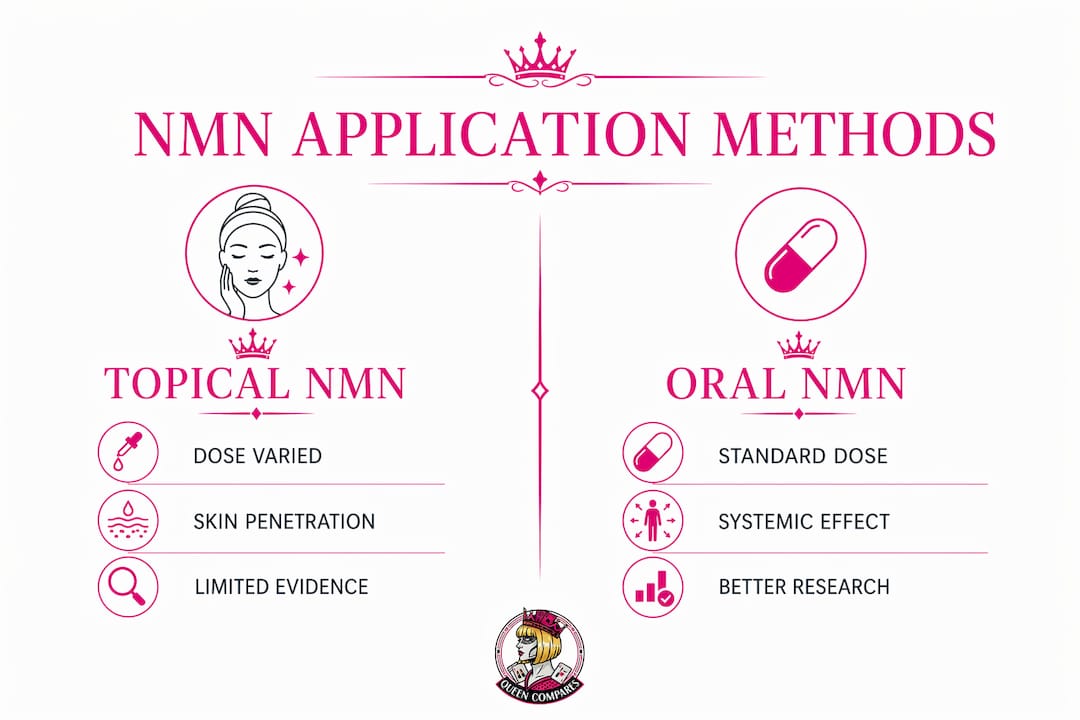
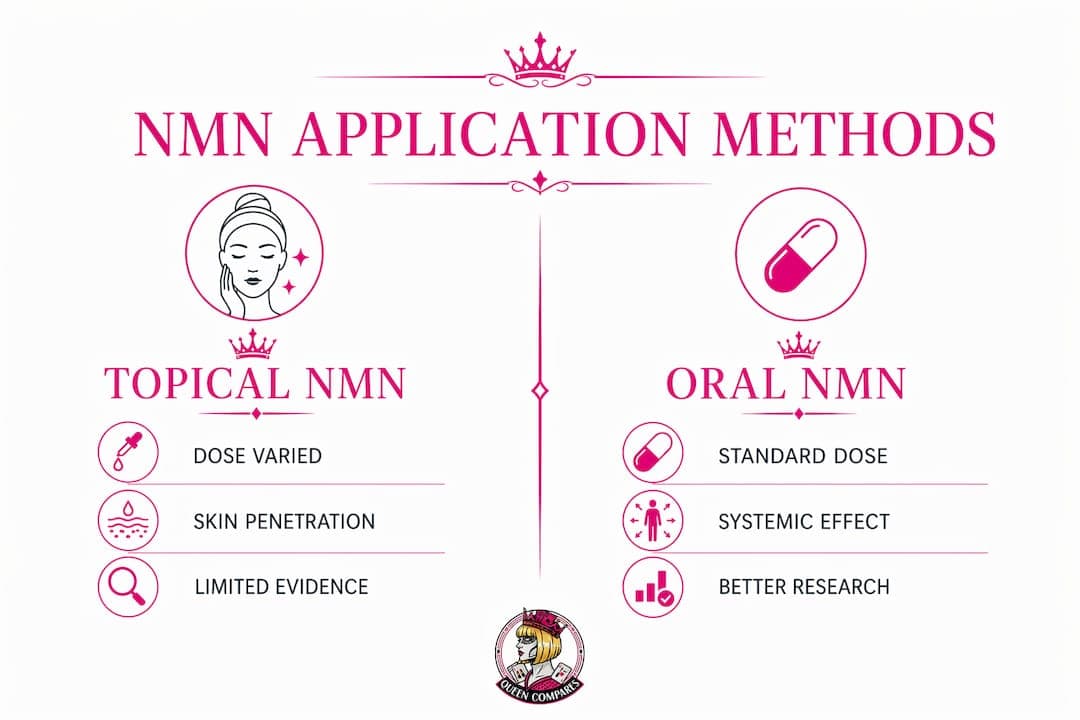
Oral NMN has the stronger evidence base, but even that evidence doesn’t extend to skin appearance. Topical NMN faces challenges: it is a relatively large, charged molecule with limited skin penetration and is sensitive to pH and oxidation, so formulation quality is critical. Encapsulation technologies like liposomes or nanoparticles are used to improve delivery, but no peer-reviewed human trial has validated a topical NMN formulation for skin outcomes.
For readers curious about how nucleotide-based ingredients interact with skin biology, the science behind PDRN skin treatments offers useful comparative context. NMN also shares a biochemical neighborhood with niacinamide — a well-studied nicotinamide derivative with stronger topical evidence for skin tone and barrier function.
Is NMN safe, and what does the FDA say?
The safety profile from human trials is reassuring within the studied ranges. The multicenter dose-dependent trial found NMN well tolerated up to 900 mg/day over 60 days with no significant adverse events. The 250 mg/day trials in older adults similarly reported no treatment-related side effects.
That said, long-term safety data beyond 12 weeks is limited. Common reported experiences include mild gastrointestinal discomfort at higher doses, though these are not consistently documented across trials.
On the regulatory side: NMN in the U.S. is sold as a dietary supplement, which means it does not require FDA pre-market approval. The FDA has previously signaled interest in NMN’s regulatory classification, and the landscape can shift. As a cosmetic ingredient, topical NMN is also not pre-approved. This is why third-party testing matters so much — there is no federal gatekeeping at the product level.
Specific populations should consult a clinician before starting NMN: those who are pregnant or breastfeeding, anyone with active serious health conditions, and people on medications where NAD+ pathway modulation could interact (certain cancer therapies, for example, where NAD+ plays a role in cell survival signaling). If you’re exploring peptide therapies or other biologically active anti-aging approaches alongside NMN, a clinical conversation is worth having.
This article is general information, not medical advice. Confirm current regulations and your personal suitability with a qualified healthcare professional.
Pro Tip: Check QueenCompares’ Medical Disclaimer page for the platform’s full disclosure on health-related content.
How to evaluate an NMN product label before you buy
-
Verify the ingredient name. Look for “NMN,” “nicotinamide mononucleotide,” or “β-nicotinamide mononucleotide” — all three are the same compound. Vague terms like “NAD+ booster blend” without naming NMN specifically are a red flag.
-
Check the declared dose. Human trials used 250–900 mg/day for oral supplements, with efficacy and safety strongest at 250–600 mg/day according to trial data. Products listing doses far below 250 mg or above 900 mg without clinical rationale deserve scrutiny.
-
Demand a COA. A credible certificate of analysis comes from an accredited third-party lab, includes a lot number matching your product, and shows purity, potency, and contaminant testing. No lot number or a COA from the manufacturer’s own lab is a warning sign.
-
Evaluate packaging for stability. NMN degrades with heat, light, and moisture. Amber glass or opaque packaging with a desiccant is a good sign; clear plastic bottles are not.
-
Confirm GMP certification. Look for NSF, USP, or Informed Sport certification, or a statement that the product is manufactured in an FDA-registered, GMP-compliant facility.
-
Look for clear dosing guidance. Reputable products state when and how to take NMN. Some consumer health reporting notes that afternoon dosing may align with perceived benefits for muscle responsiveness, though this is not yet confirmed in controlled trials.
Pro Tip: A trustworthy supplement label shows the exact NMN dose per serving (in milligrams), the lot number, an expiration date, and a QR code or URL linking to the third-party COA. If any of those four elements are missing, treat the product as unverified. Learning to evaluate formula transparency applies equally to supplements and serums.
How QueenCompares tools help you vet NMN products
QueenCompares gives you two tools that make this checklist faster and more reliable:
-
Ingredient Checker: Paste or type “nicotinamide mononucleotide” into the Ingredient Checker to pull up safety notes, known synonyms, and community flags from the Ingredient Library. This is especially useful for spotting mislabeled NMN or undisclosed forms.
-
Label Scanner: Use the Label Scanner to photograph a product label. The tool extracts ingredient names, lot numbers, and any COA links the brand has published, saving your scan to My Scan Reports for side-by-side comparison.
-
Community reviews: Cross-reference your findings with real user experiences on My Reviews. Crowd-sourced scan reports from other shoppers add another layer of confidence, especially for newer NMN brands.
Together, these signals map directly to the checklist above: the Ingredient Checker covers steps 1 and 5, the Label Scanner covers steps 2, 3, and 4, and community reviews fill in real-world experience gaps.
Key Takeaways
Oral NMN reliably raises blood NAD+ in humans, but no peer-reviewed trial has proven it visibly improves skin aging — making product quality verification the most important step for beauty shoppers.
| Point | Details |
|---|---|
| NMN raises NAD+ in humans | Multiple RCTs confirm blood NAD+ increases at 250–900 mg/day; functional benefits include walking speed and sleep quality. |
| Skin appearance evidence is limited | No human trial has used validated skin endpoints; visible anti-aging benefits remain plausible but unproven. |
| Topical vs. oral trade-offs | Oral supplements have stronger evidence; topical NMN faces stability and penetration challenges with no clinical validation. |
| Dosing plateau around 600 mg | The multicenter trial found efficacy plateaued near 600 mg/day; going higher didn’t proportionally increase benefits. |
| Verify with QueenCompares | Use the Ingredient Checker and Label Scanner to confirm NMN identity, dose, COA, and packaging integrity before buying. |
The honest truth about NMN for skin
NMN sits in an interesting position: the biochemistry is genuinely compelling, the safety record from short-term trials is solid, and the functional health benefits in older adults are real. What’s missing is the direct line from “blood NAD+ went up” to “my skin looks better.” That connection exists in cell culture and mouse models, but human skin trials haven’t been run yet.
My practical stance: if you’re drawn to NMN for general wellness and longevity, the evidence supports cautious optimism at doses in the 250–600 mg range, with verified product quality as a non-negotiable starting point. Human trials up to 900 mg/day showed good tolerability, but efficacy for blood NAD+ plateaued near 600 mg/day. For skin specifically, I’d layer it alongside proven actives — retinoids for cell turnover, broad-spectrum sunscreen for UV protection, and antioxidant-rich formulas that address oxidative stress through established pathways. NMN is a reasonable addition to that stack, not a replacement for it.
For topical NMN serums, the burden of proof is higher and largely unmet. I’d want to see a peer-reviewed human trial with skin-specific endpoints before spending premium prices on a topical formulation. Until then, niacinamide remains the better-evidenced nicotinamide derivative for topical use.
QueenCompares makes NMN verification simple
Sorting through NMN label claims shouldn’t take an hour of research. QueenCompares’ Ingredient Checker and Label Scanner put COA verification, ingredient synonyms, and community scan reports in one place — so you spend less time second-guessing and more time shopping with confidence.

Check the full Brands directory to compare transparency ratings side by side. Can’t find your product? Suggest it and our community will get it added.
Useful sources
-
Multicenter dose-dependent NMN RCT (300–900 mg/day) — the strongest human efficacy and safety data available.
-
Older adults double-blind RCT (250 mg/day, 12 weeks) — walking speed and sleep quality outcomes.
-
Frontiers in Pharmacology 2024 comprehensive review — covers pharmacology, clinical trials, and limitations.
-
PMC multicenter trial full text — useful for assay methodology details.
-
Healthline NMN consumer summary — accessible overview with dosing and timing notes.
When reading any NMN source, check the publication date, whether the study used human participants or animal models, and which NAD+ assay method was used. Primary sources (PubMed, Springer) carry more weight than secondary summaries.
FAQ
Does NMN actually improve skin appearance?
No peer-reviewed human trial has tested NMN with validated skin-appearance endpoints as a primary outcome. The mechanism is plausible, but visible skin benefits are not yet proven.
What NMN dose do human trials use?
Human trials have employed doses between 250 and 900 mg/day, with a multicenter randomized trial showing efficacy for blood NAD+ and functional measures plateaued around 600 mg/day.
Is NMN safe to take daily?
Short-term trials up to 12 weeks found NMN well tolerated at doses up to 900 mg/day with no significant adverse events. Long-term safety data beyond 12 weeks is limited; consult a clinician if you have health conditions or take medications.
How is NMN different from NR (nicotinamide riboside)?
Both NMN and NR (nicotinamide riboside) are NAD+ precursors, but NMN is one metabolic step closer to NAD+. Human trials exist for both; neither has proven skin-specific benefits in controlled studies.
How can I verify an NMN supplement is legitimate?
Use QueenCompares’ Label Scanner to check lot numbers and COA links, and the Ingredient Checker to confirm the ingredient is correctly identified. A credible product lists the exact milligram dose, an expiration date, and a third-party COA from an accredited lab.