Nutrition products can genuinely support skin, hair, and nails — but only when you choose evidence-backed ingredients at clinically studied doses, and only when a real dietary gap exists. The food-first principle from the American Heart Association and the 2020–2025 Dietary Guidelines is clear: meet your nutrient needs through whole foods first, and use supplements to fill confirmed gaps, not as a daily insurance policy.
Before you spend anything, run through these three checks:
- Verify third-party certification — look for NSF Certified for Sport, USP Verified, or Informed-Sport seals on the label.
- Confirm clinical dosage — the dose on the label should match the range used in published studies, not a token amount.
- Avoid high-dose antioxidant stacks unless a clinician specifically recommends them.
Pro Tip: Before buying any supplement, check whether the FDA has issued any alerts on that product category at fda.gov/food/dietary-supplements — it takes under two minutes and can save you from a risky purchase.
Table of Contents
- What counts as a "nutrition product" for beauty?
- When do you actually need a supplement?
- What does the evidence say ingredient by ingredient?
- What safety risks should you watch for?
- How do you read a supplement label correctly?
- Which certifications can you actually trust?
- How do you compare two products side by side?
- How does the FDA regulate nutrition products?
- Why doesn't every person respond the same way?
- Should you talk to a clinician before starting supplements?
- Key Takeaways
- QueenCompares makes the ingredient check effortless
- Useful sources for further reading
- FAQ
What counts as a "nutrition product" for beauty?
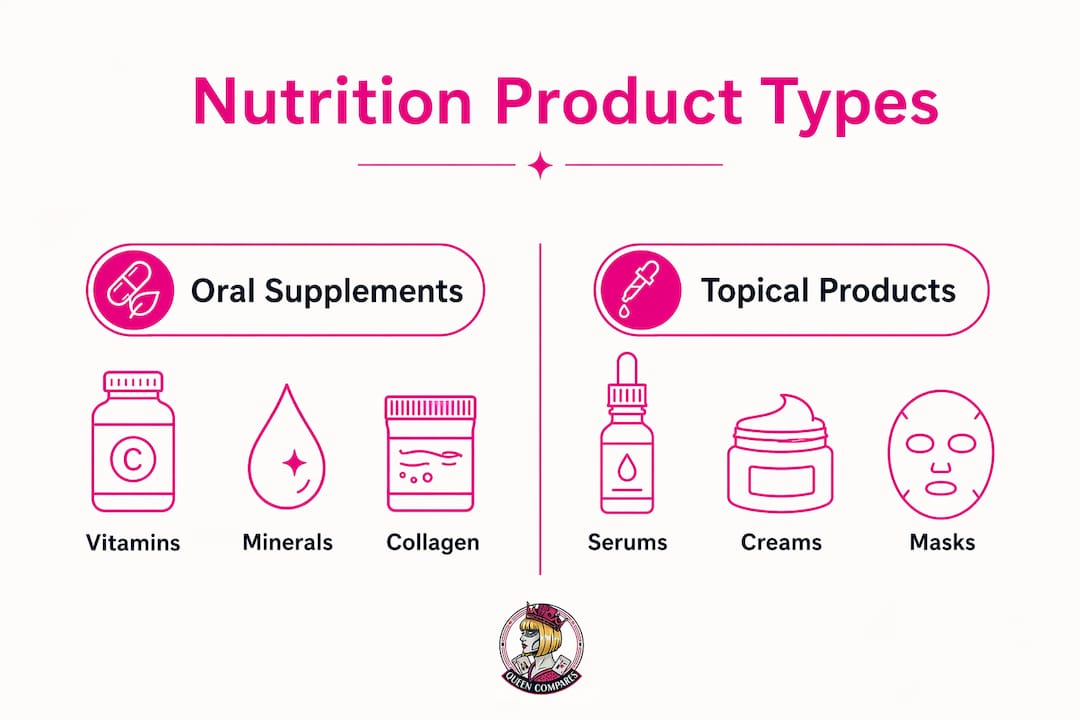
The term covers a wider range than most people expect. Here are the main categories you'll encounter:
- Single-ingredient supplements — biotin capsules, vitamin C tablets, zinc lozenges.
- Collagen powders — hydrolyzed collagen peptides, usually bovine or marine sourced.
- Omega-3 / fish oil capsules — targeting skin barrier and anti-inflammatory pathways.
- Multivitamins and beauty blends — combinations of vitamins A, C, E, B-complex, and minerals.
- Oral hyaluronic acid and silica — marketed for skin hydration and nail strength.
- Fortified foods and beauty drinks — beverages or bars with added vitamins and collagen.
- Complete meal replacements — products like Huel that combine macronutrients with a full micronutrient profile.
Form factor matters for absorption. Fat-soluble vitamins (A, D, E, K) absorb better when taken with a meal containing fat. Gummies often carry lower active doses than capsules and add sugar. Powders can offer flexible dosing but require label scrutiny for proprietary blends.
Watch for marketing language. Words like "supports" and "promotes" are legal structure-function claims under U.S. law. "Clinically backed" is not a regulated term — always ask: backed by what study, at what dose?
When do you actually need a supplement?
Use supplements mainly to correct a diagnosed deficiency, meet a life-stage need, or when clinical evidence supports a specific beauty outcome at a real dose. That's the short answer.
Scenarios where supplements are genuinely justified include confirmed vitamin D deficiency (common in northern climates and among people with limited sun exposure), pregnancy folic acid, clinically low B12 (especially in vegans and older adults), and iron deficiency confirmed by bloodwork. Registered dietitians consistently advise against stacking multiple generic supplements without first confirming a deficiency — many purchases are unnecessary and costly.
Most healthy adults eating a varied diet gain little measurable benefit from a daily multivitamin. Unneeded nutrients are largely excreted, making the purchase a waste rather than a safety net.
Pro Tip: Get a simple blood panel before committing to a long-term supplement purchase. Testing for vitamin D, B12, iron, and ferritin costs far less than months of supplements you may not need.
- Confirm deficiency with lab work before buying.
- Consult a registered dietitian or your physician for life-stage needs.
- Avoid "stacking" multiple products with overlapping nutrients.
What does the evidence say ingredient by ingredient?
Some ingredients have solid clinical support; others are mostly marketing. Here's a concise breakdown.
| Ingredient | Evidence level | Studied dose range | Safety note |
|---|---|---|---|
| Collagen peptides | Moderate (RCTs for skin elasticity/hydration) | 2.5–10 g/day | Generally well tolerated; source allergens vary |
| Biotin | Weak for beauty (unless deficient) | — | High doses skew lab test results |
| Vitamin C | Moderate (cofactor for collagen synthesis) | 500 mg/day | GI upset at high doses |
| Vitamin A (retinol) | Strong for deficiency; risky in excess | — | Teratogenic in high doses; avoid in pregnancy |
| Vitamin E | Weak for beauty outcomes | — | High-dose supplements discouraged by AHA |
| Omega-3 / fish oil | Moderate (skin barrier, inflammation) | 1–3 g EPA+DHA/day | Raises bleeding risk at high doses |
| Vitamin D | Strong for deficiency correction | — | Toxicity possible above typical supplement doses |
| B12 | Strong for deficiency | 2.4 mcg/day | Safe; excess excreted |
| Silica | Limited human RCT data | 10 mg/day | Generally low risk |
| Oral hyaluronic acid | Emerging (small RCTs) | — | Limited long-term data |
| Zinc | Moderate for acne/wound healing | 8 mg/day | Nausea and copper depletion at high doses |
| Probiotics/prebiotics | Emerging for skin microbiome | Strain-dependent | Generally safe; choose studied strains |
Collagen peptides have the strongest beauty-specific evidence among ingestible products, with several randomized controlled trials showing improvements in skin elasticity and hydration at doses of 2.5–10 g per day, as detailed in this effective anti-wrinkle formulation. Biotin is widely marketed for hair and nails, but clinical evidence supports benefit only in people with a confirmed deficiency. The American Heart Association specifically discourages high-dose antioxidant supplements (vitamins A, C, and E) as substitutes for whole-food intake.
Worth knowing: The U.S. supplement market is enormous, yet the NIH Office of Dietary Supplements notes that many consumers take supplements without any confirmed deficiency — making whole-food sources and targeted testing the smarter starting point.
What safety risks should you watch for?
High doses and overlapping sources are the most common routes to harm. If you take a multivitamin, a beauty blend, and a fortified food daily, your total vitamin A or iron intake can easily exceed safe limits without you realizing it.
- Vitamin A and pregnancy — excess preformed vitamin A (retinol) is teratogenic; avoid high-dose supplements if pregnant or trying to conceive.
- Iron overdose — iron supplements are a leading cause of accidental poisoning in children; store safely and don't supplement without confirmed deficiency.
- Omega-3 and blood thinners — fish oil at doses above 3 g/day can increase bleeding risk, especially combined with warfarin or aspirin.
- Pre-surgery risk — supplements can raise bleeding risk or affect anesthesia; always disclose everything you take to your surgical team.
Red flags on labels: proprietary blends that list ingredients without individual doses, disease-cure claims (illegal for supplements), and no batch testing information anywhere on the product or brand website.
Pro Tip: Keep a written list of every supplement and medication you take, including doses and timing. Share it with your doctor or pharmacist at every visit — interactions are easy to miss when products are reviewed in isolation.
How do you read a supplement label correctly?
The active dose is the only number that matters. Packaging claims are secondary.
- Supplement Facts vs. Nutrition Facts — supplements carry a "Supplement Facts" panel; fortified foods use "Nutrition Facts." Both list serving size first — check it carefully, as some products define a "serving" as two or three units.
- %DV — the Percent Daily Value shows how a nutrient's dose compares to the reference daily intake. Over 100% DV for fat-soluble vitamins warrants caution.
- Proprietary blends — a blend listed as "Beauty Complex 500 mg" tells you nothing about individual ingredient doses. Avoid products where key actives hide inside blends.
- Excipients and allergens — common fillers include magnesium stearate, silicon dioxide, and cellulose. Omega-3 capsules may contain shellfish-derived gelatin. Gummies often contain gelatin (not vegan) and added sugars.
For formula transparency, the gold standard is a label that lists every ingredient with its individual dose, a lot number, and a link to a certificate of analysis (COA).
| Label feature | What to look for | Pass / Fail |
|---|---|---|
| Serving size clarity | Single unit or clearly stated multi-unit | Pass if unambiguous |
| Individual ingredient doses | Each active listed separately in mg/mcg | Fail if hidden in a blend |
| Third-party seal | NSF, USP, or Informed-Sport logo | Pass if present and verifiable |
| Lot number / COA link | Printed lot number + URL or QR code | Fail if absent |
| Allergen statement | Explicit "contains" or "free from" statement | Pass if clearly stated |
Which certifications can you actually trust?
Prefer products with NSF Certified for Sport, USP Verified, or Informed-Sport seals and accessible batch COAs. These reduce the risk of contamination, mislabeled doses, and undisclosed ingredients.
- NSF Certified for Sport — tests for banned substances, label accuracy, and contaminants. Searchable at nsfsport.com.
- USP Verified — confirms ingredient identity, potency, and manufacturing quality. Searchable at usp.org.
- Informed-Sport / Informed-Choice — batch-level testing for prohibited substances; popular with sports nutrition brands.
- GMP compliance — the FDA requires supplement manufacturers to follow Good Manufacturing Practices, but this is a baseline floor, not a quality ceiling. Manufacturers bear responsibility for safety and label accuracy; the FDA does not pre-approve supplements before they reach shelves.
A "lab tested" claim without naming the lab or providing a COA link is essentially meaningless. Some brands, including those positioning themselves as complete nutrition products, publish batch COAs and carry NSF Certified for Sport status — use those as your benchmark when comparing options.
Pro Tip: Require a direct link to a batch COA before purchasing. If a brand's website has no COA lookup and customer service can't provide one, that's a clear signal to look elsewhere. Use the ingredient safety checker approach to cross-reference what you find.
How do you compare two products side by side?
Score each product across six dimensions. A product that passes four or more is generally worth considering; fewer than three is a signal to avoid.
| Dimension | What "pass" looks like | What "fail" looks like |
|---|---|---|
| Clinically tested dose | Dose ≥ lower bound of published RCT range | Token dose or hidden in a blend |
| Form factor / convenience | Matches your routine; fat-solubles with food | Gummy with low active dose |
| Third-party testing | NSF, USP, or Informed-Sport seal + COA | "Lab tested" with no named lab |
| Allergen / excipient profile | Clear allergen statement; no undisclosed fillers | Shellfish gelatin unlabeled |
| Price per serving | Competitive for the active dose delivered | High cost for a sub-clinical dose |
| Claim specificity | References a named study or dose range | Vague "supports beauty" language |
Apply the checklist in five steps:
- Look up the ingredient's clinical dose range (NIH ODS is a reliable starting point).
- Request or locate the batch COA on the brand's site.
- Calculate your total daily dose across all products you take.
- Verify allergens against your own sensitivities.
- Divide the product price by the number of servings to get a true cost-per-effective-dose.
Brands like Huel and Optimum Nutrition publish detailed ingredient sourcing and manufacturing standards. Garden of Life and Vital Proteins both carry third-party certifications that are verifiable online. Use those as your reference points when a newer or less-known brand makes similar claims.
How does the FDA regulate nutrition products?
The FDA does not pre-approve dietary supplements for safety or efficacy before they reach store shelves. Under the Dietary Supplement Health and Education Act (DSHEA), manufacturers are responsible for ensuring their products are safe and that labels are truthful. The FDA can act after the fact — removing products found to be unsafe or mislabeled — but the burden of pre-market proof sits with the brand, not the regulator.
This is a meaningful gap. It means a product can legally reach consumers before any independent body has verified its claims. GMP regulations set a manufacturing quality floor, but compliance varies. Third-party certification exists precisely because the regulatory baseline leaves room for error.
Why doesn't every person respond the same way?
Individual response to nutrition products varies more than most marketing suggests. Genetics, gut microbiome composition, baseline nutrient status, age, and concurrent medications all influence how well a supplement is absorbed and whether it produces a visible beauty outcome.
Placebo effects are also real and well-documented in supplement research. Participants in open-label trials often report improvements in skin texture or hair feel that don't appear in blinded studies. This doesn't mean supplements never work — it means you need blinded RCT evidence, not testimonials, to judge whether an ingredient is genuinely effective for your goal.
Should you talk to a clinician before starting supplements?
Yes, especially if you take prescription medications, are pregnant or nursing, have a chronic health condition, or plan to take more than one supplement at a time. Supplements can interact with medicines and affect surgical outcomes — disclosing everything you take is a basic safety step, not an overreaction.
A registered dietitian can review your diet, identify real gaps, and recommend targeted products at evidence-based doses. That conversation is worth more than any "best nutrition brands" list, because your gaps are specific to you.
Key Takeaways
Evidence-backed nutrition products for beauty require a confirmed need, a clinically studied dose, and third-party certification — without all three, you're likely spending money on benefits you won't see.
| Point | Details |
|---|---|
| Food first, always | Meet nutrient needs through whole foods before adding any supplement. |
| Test before you buy | A blood panel for vitamin D, B12, and iron costs less than months of unneeded supplements. |
| Dose must match clinical evidence | Compare the label dose to published RCT ranges; sub-clinical doses don't deliver results. |
| Third-party seals matter | NSF Certified for Sport, USP Verified, and Informed-Sport are verifiable; "lab tested" alone is not. |
| QueenCompares simplifies the check | Use the Ingredient Checker and Label Scanner to score any product against these criteria in seconds. |
The evidence-first case for slowing down before you buy
The beauty supplement aisle has never been louder, and the claims have never been bigger. What gets lost in the noise is something simple: most of the ingredients with real evidence work only at specific doses, for people who actually lack them. Collagen peptides have decent RCT support — but at 2.5–10 g per day, not the 500 mg token dose tucked into a beauty gummy. Biotin is widely marketed, but clinical benefit appears only in confirmed deficiency, which is uncommon.
What I find most worth saying here is this: transparency is the only honest proxy for quality when the FDA doesn't pre-approve these products. A brand that publishes batch COAs, names its third-party certifier, and lists individual ingredient doses is telling you something real about how it operates. A brand hiding actives inside a proprietary blend and making vague "supports radiant skin" claims is telling you something real too.
The tools exist to check this quickly. QueenCompares's Ingredient Checker and Label Scanner map directly to the checklist in this guide. Use them the same way you'd use a skincare ingredient checker before putting something on your face — because what goes inside your body deserves at least as much scrutiny.
QueenCompares makes the ingredient check effortless
You now have the checklist. QueenCompares gives you the tools to run it in seconds, not hours. The Ingredient Checker flags safety concerns, dose gaps, and allergen conflicts across ingestible beauty products — the same six-dimension framework this guide walks through, built into one scan. The Ingredient Library lets you look up any active ingredient, see the evidence tier, and compare it against alternatives side by side.
Browse the full product comparison hub to put two products head to head on dose, certifications, and price per serving. If you've found a product worth adding to our database, suggest it here and our community will help vet it. Scan your next supplement before you buy it — your skin, hair, and wallet will thank you.
Useful sources for further reading
The sources below are worth bookmarking when you want to verify clinical doses, check batch COAs, or dig deeper into the regulatory picture.
- NIH Office of Dietary Supplements (ODS) — ods.od.nih.gov — the most authoritative U.S. source for ingredient-level evidence, tolerable upper intake levels, and consumer fact sheets.
- FDA Dietary Supplements page — fda.gov/food/dietary-supplements — official guidance on regulations, safety alerts, and GMP requirements.
- American Heart Association — heart.org — food-first guidance and antioxidant supplement cautions backed by cardiovascular research.
- UCHealth Today — uchealth.org — registered dietitian perspectives on supplement necessity and cost-effectiveness.
- Huel — huel.com — an example of a brand that publishes ingredient sourcing and manufacturing standards; useful as a transparency benchmark.
Stat to know: The NIH ODS notes that manufacturers are responsible for supplement safety and label accuracy before products reach shelves — making third-party COAs and certifications the consumer's primary verification tool, not the regulatory system itself.
FAQ
What nutrition products have the best evidence for skin health?
Collagen peptides (2.5–10 g/day) have the strongest RCT support for skin elasticity and hydration among ingestible beauty products. Vitamin C and omega-3 fatty acids have moderate supporting evidence when taken at clinically studied doses.
Are beauty supplements FDA-approved before they're sold?
No. The FDA does not pre-approve dietary supplements for safety or efficacy before market. Manufacturers are responsible for safety and truthful labeling under Good Manufacturing Practices.
How do I know if a supplement dose is clinically effective?
Compare the label dose to the range used in published randomized controlled trials for that ingredient. The NIH Office of Dietary Supplements publishes fact sheets with studied dose ranges for most common nutrients.
What third-party certifications should I look for?
NSF Certified for Sport, USP Verified, and Informed-Sport are the most credible U.S.-relevant seals. Each is independently verifiable on the certifying body's website using the product's lot number.
Can QueenCompares help me compare nutrition products for beauty?
Yes. The QueenCompares Ingredient Checker scans ingredient lists for safety flags, dose adequacy, and allergen conflicts, and the Ingredient Library provides evidence tiers for individual actives.