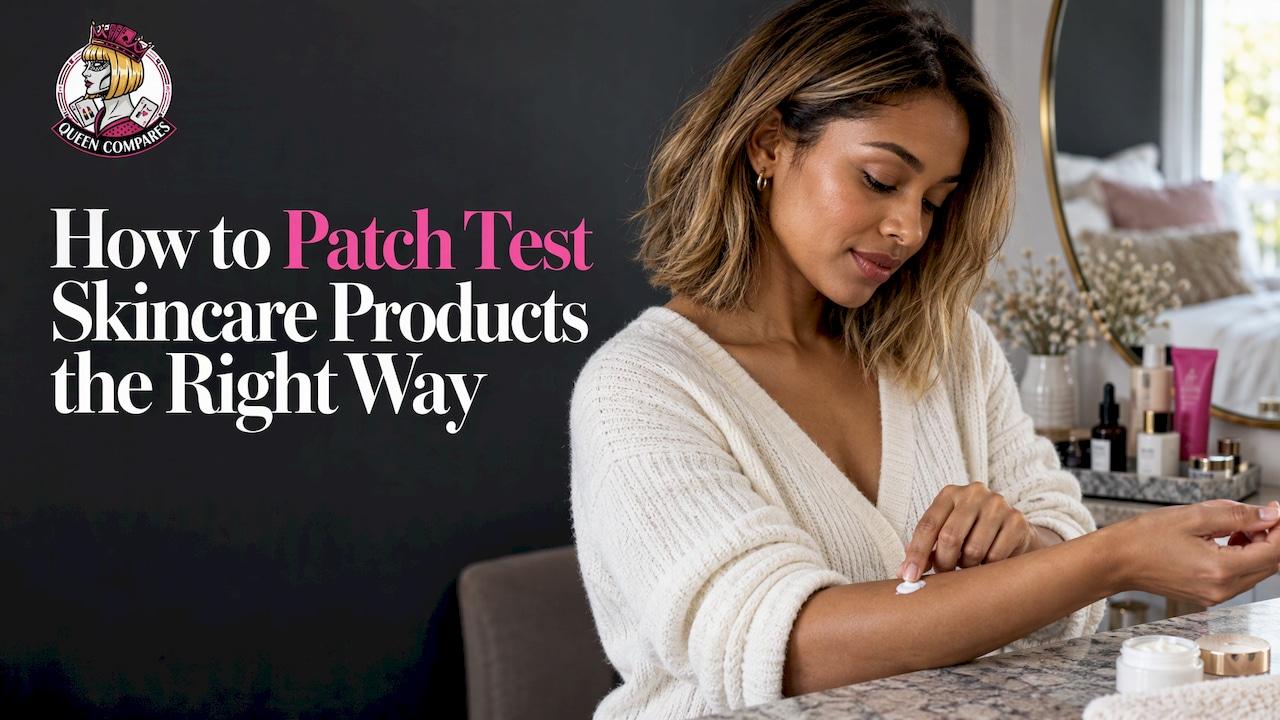
To patch test a skincare product at home, apply a small amount to a quarter-sized spot on the underside of your arm or the bend of your elbow. Do it twice a day for seven to 10 days. If your skin stays calm, with no redness, itching or swelling, the product is much more likely to be safe for your face. That is the method the American Academy of Dermatology describes, and this guide walks you through it step by step, including makeup, what a reaction looks like and when a home test is not enough.
Key Takeaways
-
Test one new product at a time on a quarter-sized spot, twice daily for seven to 10 days, before it goes on your face.
-
Burning or stinging right away often points to irritation. Allergic reactions can take several days to show up, so a one-night test can miss them.
-
If a reaction starts, wash the product off gently and stop using it. See a dermatologist if it is severe or does not settle.
-
A home test cannot replace clinical patch testing for stubborn, unexplained rashes.
-
Reading the ingredient list before you test helps you pick better candidates, but it will not tell you everything.
Table of Contents
What a Skincare Patch Test Actually Tells You
A patch test is a small, controlled trial of one product on a limited area of skin. You are checking whether your skin reacts before you commit to using it on a large area, especially your face and eyelids, which tend to be more reactive.
At home, this is really an “open application test”: you apply the product the way you normally would and leave it uncovered. The AAD notes that testing a few small areas first can help predict whether you will have a negative skin reaction. The word is predict, not guarantee. Skin can also become sensitized to an ingredient later, after weeks or months of use.
Two kinds of reaction matter here:
-
Irritant reactions usually show up quickly as burning, stinging or redness. DermNet NZ says an immediate burning or stinging response is usually more consistent with irritant contact dermatitis.
-
Allergic reactions are often delayed. The same source says allergic contact dermatitis is often delayed for several days, which is why a single overnight test is not enough.
That delay is the reason the recommended test runs for a week or more, not a few minutes.
How to Patch Test Skincare at Home, Step by Step
-
Start with clean, calm skin. Do not test on skin that is already inflamed, sunburned, or broken out in a rash. You will not be able to tell what caused what.
-
Test one product at a time. If you try a new serum, moisturizer and sunscreen together, you will not know which one caused the problem.
-
Choose the spot. The AAD suggests a quarter-sized area on the underside of your arm or the bend of your elbow. DermNet NZ recommends calm, hairless skin such as the forearm, elbow bend, behind the ear or the side of the neck, using an area of roughly 5 cm by 5 cm. Pick a place where the product will not be rubbed or washed away by clothing, a watch band or your shower.
-
Apply the normal amount. Use the same thickness you would use on your face. A smear so thin it disappears tells you little.
-
Repeat twice a day. The AAD recommends applying twice daily for seven to 10 days. DermNet NZ describes twice daily for one week to the same spot.
-
Match real use. Leave leave-on products on as you normally would. For a cleanser, the AAD says to leave it on for five minutes or as directed on the label, then rinse.
-
Check the spot each time. Look for redness, itching, swelling, bumps or blisters. Medical News Today also lists skin discoloration and stinging among possible signs.
-
Decide. If you see no reaction after seven to 10 days, the AAD says to go ahead and use the product.
A quick timeline you can copy
| Day | What to do | What to watch for |
|---|---|---|
| 1 | Apply a normal amount to your test spot, morning and evening | Immediate burning, stinging or redness |
| 2 to 4 | Keep applying twice daily to the same spot | Itching, small bumps, dry or rough patches |
| 5 to 7 | Continue, and note any change in the spot | Delayed redness or swelling |
| 8 to 10 | Finish the test (AAD range) | Any late reaction. No reaction means you can start using the product |
Write the start date in your phone notes so you do not lose count.
How to Patch Test Makeup, Tinted Moisturizers and BB or CC Creams
The same method works for products that sit on the skin for hours. It matters more here, because base products cover large areas of your face all day.
-
Foundation: Apply a thin layer to your test spot, leave it on as long as you would wear it, then remove it with your usual cleanser. Repeat for the full test period.
-
Tinted moisturizer: These blend skincare and light coverage, so you are testing both the moisturizing base and the pigments. Test it the way you would wear it, as a daytime layer.
-
BB cream and CC cream: Many combine SPF, color and skin-care ingredients in one formula. Since there is more in the tube, it is worth testing before swapping one in for your whole base routine.
-
Concealer and eye products: Eyelid skin is thin and reactive. Test these on your arm first, then use them near the eyes only if the arm stays calm.
When you are choosing which tinted moisturizer, foundation, BB cream or CC cream to test, it helps to narrow the field first. You can check formulas against your known triggers with our Products By Ingredient page, which lets you browse products by what is inside them, and then test only the ones that pass.
What Counts as a Reaction, and What to Do About It
Not every sensation means a failed test. A very light tingle that fades in seconds can be normal with some active ingredients. But treat these as a reaction:
-
Red, itchy or swollen skin
-
A rash or small bumps
-
Blisters
-
Persistent stinging or burning
-
Darkening or discoloration of the area
If something shows up, the AAD advice is to gently wash the product off as soon as possible and not use it again. A cool compress or petroleum jelly may help soothe the area. See a dermatologist if the reaction is severe and those steps do not relieve it.
Seek urgent medical help if you have signs of a whole-body allergic reaction, such as swelling of the lips or face, trouble breathing or hives spreading beyond the test spot. DermNet NZ states that open application testing is not appropriate for immediate type-1 reactions or anaphylaxis, and that suspected immediate allergy needs medical assessment, not home product testing.
Why a Patch Test Can Still Miss Things
A clean result is reassuring, but it has limits. Knowing them keeps your expectations realistic.
-
Sun exposure. DermNet NZ says open application tests can give false-negative results after sun exposure, so keep your test spot out of strong sun.
-
Thicker skin. Testing on skin thicker than the intended site can also hide a reaction. Facial skin is thinner than much of your arm, which is one reason to take the full test period seriously.
-
Different usage. Results can be wrong if you apply the product more or less often than you would in real life.
-
Cumulative effects. A product can be fine for a week and cause trouble after a month of layering with retinoids or exfoliating acids.
This last point is why your routine as a whole matters. If you are building or rebuilding one, our guide on how to build a safe skincare routine shows how to add products gradually. If you are adding an active, the walkthrough on safely adding retinol pairs well with a patch test, and mixing skincare ingredients explains which combinations to space out.
Using the Ingredient List to Choose What to Test
A patch test tells you what your skin does. An ingredient list helps you decide what is worth testing in the first place.
In the US, ingredients are listed on cosmetic labels in descending order by weight, according to this summary of FDA labeling rules. That means the first few ingredients make up most of the formula, and the last ones are present in small amounts. If you already know you react to something, scan the whole list, not only the top.
What a label can and cannot tell you:
-
It can show known triggers. If you have reacted before to a preservative, a dye or a particular botanical, you can look for it by name.
-
It cannot always name fragrance components. The same summary explains that US rules allow “fragrance” to be listed without naming each ingredient, so a reaction to a scented product can be hard to trace.
-
Marketing terms are not guarantees. Federal regulations do not define “hypoallergenic,” “fragrance-free” or “for sensitive skin,” so these are the manufacturer’s own terms.
-
It cannot predict your personal sensitivity. An ingredient can be well tolerated by most people and still bother you.
So use the list to shortlist, then use the patch test to confirm. If you have eczema-prone skin, our three label checks for eczema-prone skin is a good place to start, and the 3-step sensitive skin routine keeps the number of new products low while you test.
Fragrance deserves its own mention. If you love perfume but your skin is touchy, the same approach applies: try patch testing perfume first on a small spot before wearing it daily.
When a Home Test Is Not Enough
A home test is a screening step. If you keep getting rashes and cannot work out why, it is time for a different tool: clinical patch testing by a dermatologist.
This is a different procedure. According to the AAD’s patient guidance, a dermatologist applies small amounts of suspected allergens under patches, which stay on for about 48 hours. The clinician removes them and usually assesses your skin again four to seven days after application, since reactions can be delayed. UC Davis Dermatology describes testing over multiple visits in roughly 96 hours.

It is also not the same as a skin-prick test. DermNet NZ explains that patch testing evaluates delayed contact allergy, while prick testing is generally used for immediate-type reactions such as hay fever or food allergy.
Consider asking about professional testing if:
-
You have a rash that is new or does not improve with standard treatment (UC Davis)
-
Your eczema has an unclear cause, fails topical therapy, returns when treatment stops, changes where it appears, starts in adolescence or adulthood, or is severe or widespread (AAD clinical pearls)
-
You have persistent face or eyelid eczema, or you suspect a reaction to a topical medicine, which the British Primary Care Dermatology Society lists among its referral reasons
-
You suspect your job exposes you to an irritant or allergen
Timing matters too. The German contact dermatitis guideline says clinical testing is generally done once active dermatitis is controlled and the test site is untreated, because acute dermatitis, intense UV exposure, topical corticosteroids and immunosuppressive medicines can distort results. Do not start or stop prescribed treatment on your own to prepare for a test. Ask your dermatologist how to time it.
A negative clinical test can still be useful: UC Davis notes it can mean the rash is not caused by a contact allergen. If symptoms continue, you can also read more dermatologist-recommended skin care tips while you wait for an appointment, and bring your product list with you.
Perspective
We built Queen Compares around a simple idea: you should know what is in a product before it touches your skin, and you should be able to compare it with the alternatives. A patch test is the best first step at home, but it works best when you are not testing blindly.
In our experience, most people start testing with a product they bought on impulse. We would flip that order. Check the formula first with the Ingredient Checker, scan the label in the store with the Label Scanner, shortlist the products that avoid your known triggers, and then patch test only those. You test less, waste less and learn more from each test.
We also think of a patch test as part of a routine, not a one-off. Add one new product at a time, keep notes, and let your routine grow slowly. That habit is what the Skincare Routine Builder and Skincare Routine Progress tools are designed to support.
Magdalena
Check the Formula Before You Test
If you are tired of guessing, we can take the first step off your plate. Our Ingredient Checker and Label Scanner are designed to flag ingredient safety and allergen alerts, so you can see what is in a formula before you buy it. Our Clean Beauty Catalogue collects clean beauty options in one place, which is a handy starting point if you want a shorter list to patch test.

Want to keep your testing organized? Premium Access is 7 EUR per month. The Skincare Routine Builder and Skincare Routine Progress plans are also 7 EUR per month each, and they help you add products one at a time and track how your skin responds.
FAQ
How long should you patch test a skincare product?
The AAD recommends applying the product twice a day for seven to 10 days. DermNet NZ describes twice-daily application for one week. Use the longer end of that range for products you plan to wear on your face every day.
Does patch testing skincare really work?
It helps predict whether you will have a negative reaction, according to the AAD, but it is not a guarantee. Sun exposure, thick test-site skin and different application habits can all hide a reaction. Use it as a strong screening step, then keep watching your skin in the first weeks of real use.
Where is the best place to patch test a product?
Choose calm, hairless skin that will not be rubbed, such as the underside of your forearm or the bend of your elbow. DermNet NZ also lists behind the ear and the side of the neck. Avoid broken, sunburned or already irritated skin.
Is a patch test the same as an allergy test at the dermatologist?
No. Clinical patch testing applies a panel of suspected allergens under patches for about 48 hours, with follow-up readings days later. Your home test checks one product on your own skin. If you have a persistent or unexplained rash, ask a dermatologist about clinical testing.
Can I patch test if I have eczema?
Yes, but go slowly and test one product at a time. If your skin is flaring, wait until it is calm. Because eczema can make results harder to read, ask your dermatologist for advice on products and timing.
Sources
-
How to test skin care products (American Academy of Dermatology)
-
How to do an at-home skin patch test and when to seek help (Medical News Today)
-
Patch testing can find what’s causing your rash (American Academy of Dermatology)
-
Contact allergic dermatitis (British Primary Care Dermatology Society)
-
Patch testing with contact allergens (German Contact Dermatitis Research Group)
Recommended
-
Time Your Actives: Mix Skincare Ingredients by pH and Quick Checks
-
3-Step Sensitive Skin Routine That Stops Flares with Queen Compares
-
Fit Ampoules Into a Routine, Avoid Doubling Actives: Ampoule vs Serum
General Entertainment & Information Purposes Only At QueenCompares.com we share content for general entertainment and information. It’s not medical, dermatological, nutritional, or fitness advice and shouldn’t replace guidance from a licensed professional. If you’re making health-related decisions, please check with a qualified expert — and know that using this site and its information is at your own discretion.