
Peptides are short chains of amino acids, linked by covalent peptide bonds that orchestrate essential biological processes including hormone signaling, immune defense, tissue repair, and metabolism. Think of them as the body’s molecular messengers: small enough to move fast, specific enough to trigger precise reactions. They are not proteins, though they share the same building blocks. The difference is mostly size and complexity, and that gap matters more than you might expect.
Here is what peptides do inside your body every day:
-
Hormone signaling: Insulin, a peptide hormone, regulates blood sugar. Growth hormone-releasing peptides tell the pituitary gland when to produce growth hormone.
-
Immune defense: Antimicrobial peptides (AMPs) act as a first-line barrier against infection in the skin’s epithelium and in immune cells like neutrophils.
-
Tissue repair: Certain peptides accelerate wound healing and collagen synthesis, which is why they show up in both clinical medicine and skincare.
-
Metabolism: GLP-1 peptides regulate appetite and glucose homeostasis, a mechanism now central to some of the most prescribed drugs in the United States.
-
Cell signaling: Studies report that 15–40% of protein interactions in human cells are mediated by peptides.
How do peptides differ from proteins?
The line between a peptide and a protein is mostly a matter of length. Chains of fewer than 50 amino acids are considered peptides. Oligopeptides are shorter, typically fewer than 20 amino acids. Once a chain exceeds 50 amino acids, it is generally considered a polypeptide; cross 10,000 daltons in molecular mass and it becomes a protein. In practice, the cutoff is not rigid, but the functional difference is real.
Proteins fold into complex three-dimensional structures that carry out structural and enzymatic roles. Peptides tend to stay smaller and more flexible, which lets them slip into receptor binding sites and trigger specific cellular responses quickly. Both are built from the same 20 amino acids, but a protein like collagen is a massive scaffold, while a collagen peptide fragment is a targeted signal.
Key distinctions at a glance:
-
Shared: Both are made of amino acids joined by peptide bonds; both can be synthesized in the body or in a lab.
-
Different: Peptides are shorter, simpler, and typically more bioavailable than full proteins.
-
Different: Proteins carry structural and enzymatic functions; peptides primarily act as signals or regulators.
-
Different: Peptides are classified by length (dipeptide, oligopeptide, polypeptide), while proteins are classified by function and structure.
Peptide synthesis in the body happens at the ribosome, where amino acids are added one by one to a growing chain. Lab synthesis follows a similar logic using solid-phase peptide synthesis (SPPS), a method that builds chains step by step and allows researchers to design peptides with highly specific sequences for pharmaceutical or cosmetic use.
What are the science-backed benefits of peptides?
The benefits of peptides vary widely depending on the type, dose, and delivery method. Lumping them all together is a mistake. Here is what the research actually supports.
Skin health: Topical GHK-Cu (copper peptide) can enhance skin elasticity and stimulate collagen production with a favorable safety profile. Some evidence also supports peptide-containing eye creams for a more youthful appearance by stimulating collagen synthesis. For anyone building a peptide-forward skincare routine, these are among the better-studied options.
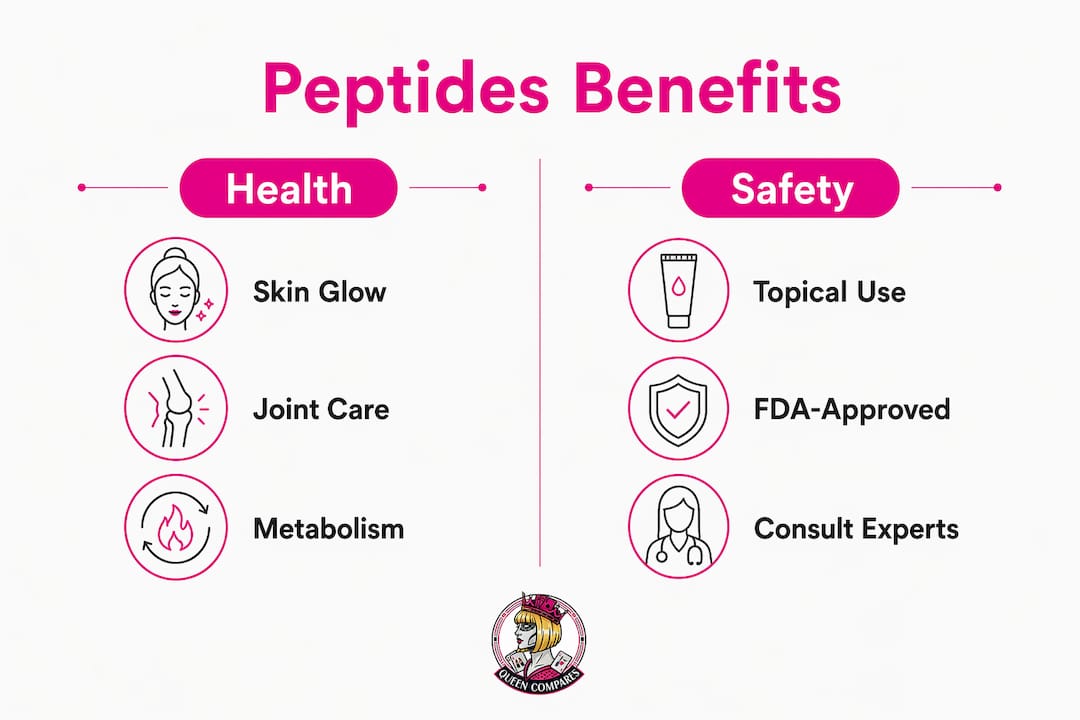
Musculoskeletal support: Oral collagen peptides at 10–20 grams daily may support joint function and musculoskeletal health, particularly when paired with resistance training. Collagen peptides have shown efficacy in enhancing patellar tendon adaptation and reducing joint pain in clinical trials.
Metabolic regulation: GLP-1 peptides regulate appetite and glucose homeostasis. This mechanism underpins FDA-approved medications like semaglutide (Ozempic, Wegovy) and tirzepatide (Zepbound, Mounjaro), which have helped millions of Americans reach healthier body weights.
Hormonal balance: Peptides like growth hormone-releasing hormone (GHRH) signal the pituitary gland to release growth hormone, supporting muscle maintenance and metabolic function, especially as people age.
Benefits supported by current research:
-
Improved skin elasticity and hydration via topical GHK-Cu
-
Joint pain reduction and tendon support from collagen peptides
-
Appetite regulation and weight management through GLP-1 mechanisms
-
Antimicrobial defense via endogenous AMPs
-
Blood pressure reduction from casein-derived peptides in dairy
Pro Tip: Peptide responses vary by age, gender, and hormone levels. A collagen peptide dose that works well for a 50-year-old woman in resistance training may not produce the same result for a 25-year-old man. Targeted guidance from a healthcare provider makes a real difference.
Peptide therapy and FDA-approved medical uses
The most credible peptide applications are the ones that have cleared FDA review. These drugs have gone through large clinical trials, and their safety and efficacy profiles are well established.
-
Insulin: The original peptide drug. Injectable insulin remains the standard of care for type 1 diabetes and is used widely in type 2 diabetes management. It is a 51-amino-acid peptide that directly regulates blood glucose.
-
GLP-1 receptor agonists: Semaglutide and tirzepatide are FDA-approved peptide drugs for obesity and type 2 diabetes. They mimic the body’s natural GLP-1 signal to suppress appetite and improve insulin sensitivity.
-
Ipamorelin: A growth hormone-releasing peptide used in some clinical settings to stimulate natural growth hormone secretion. It is more selective than older peptides in this class, with fewer side effects on cortisol and prolactin. It remains experimental and is not FDA-approved for general use.
-
Teriparatide (Forteo): A synthetic fragment of parathyroid hormone used to treat osteoporosis. It stimulates new bone formation and is one of the few anabolic treatments available for severe bone loss.
-
Oxytocin: A nine-amino-acid peptide used clinically to induce labor and manage postpartum bleeding. It also plays a role in social bonding and stress regulation.
-
Natriuretic peptides (BNP): Brain natriuretic peptide is used diagnostically and therapeutically in heart failure management, helping regulate blood pressure and fluid balance.
The gap between these approved drugs and the gray-market peptides sold online is enormous. FDA-approved peptide drugs like insulin and GLP-1 agonists have strong clinical validation, while many non-prescription peptides rely on animal studies or anecdotal reports. If you are considering clinical peptide therapy, providers like Continuum Bio-Beauty in Austin offer transparent pricing and professional guidance for those exploring peptide-based treatments.
Are peptide supplements and skincare products safe?
This is where things get complicated, and where the QueenCompares community deserves a straight answer.
Topical peptides in skincare are the safest category. GHK-Cu is FDA-approved for cosmetic use and has a well-documented safety profile when applied to the skin. Peptide-containing creams and serums are regulated as cosmetics, meaning they go through safety review before reaching store shelves. For a deeper look at how to evaluate skincare ingredient safety, the QueenCompares Ingredient Checker is a solid starting point.
Injectable peptides from gray-market sources are a different story entirely. Products like BPC-157, TB-500, and ipamorelin are sold online as “research chemicals” and labeled “not for human consumption.” Many of these products lack regulatory oversight, purity assurance, and reliable dosing information. Some are manufactured overseas under unknown conditions, making contamination a genuine risk.

| Product Type | Regulatory Status | Safety Profile | Evidence Level |
|---|---|---|---|
| FDA-approved peptide drugs like insulin and GLP-1 agonists | Fully approved | Well-established | Large clinical trials |
| Topical cosmetic peptides (GHK-Cu creams) | FDA-approved for cosmetics | Favorable | Moderate clinical evidence |
| Oral collagen and creatine supplements | Unregulated dietary supplements | Generally low risk | Some clinical support |
| Certain gray-market injectable peptides such as BPC-157 and TB-500 | Not approved, often banned | Unknown, potentially risky | Animal studies only |
Risks specific to unregulated injectables:
-
Contamination with impurities or unknown compounds
-
Immune reactions ranging from local irritation to anaphylaxis
-
Dosage inaccuracy from at-home reconstitution
-
No long-term safety data for humans
Pro Tip: Injectable GHK-Cu is banned due to contamination risks and potential immune reactions, even though its topical form is approved. The delivery method changes everything.
Where do peptides naturally come from in food?
Your body gets peptides from food every single day, mostly without you thinking about it. When you digest protein-rich foods, enzymes in your gut break them down into smaller peptide fragments that can influence metabolism, gut health, and even blood pressure.
Common dietary sources:
-
Collagen peptides: Found in meat, fish skin, and bone broth. Also widely available as hydrolyzed collagen supplements.
-
Casein hydrolysates: Derived from dairy milk. Casein-derived peptides have shown antihypertensive properties in research.
-
Plant proteins: Rice bran peptides and soy peptides are studied for antioxidant and anti-inflammatory effects.
-
Marine peptides: Fish collagen peptides are gaining attention for their role in joint and skin health.
The catch with oral peptides is bioavailability. Most peptides are broken down further during digestion before they can reach systemic circulation intact. This is why dose matters so much: collagen peptides at effective dosages is the range supported by research for musculoskeletal benefits, but many commercial products contain far less, which reduces their effectiveness. GLP-1 peptides, by contrast, are delivered by injection precisely because oral forms are degraded too quickly in the gut to be effective at therapeutic doses.
Potential side effects and precautions you should know
Side effects from peptides depend almost entirely on which type you are using and how you are getting them.
FDA-approved peptide medications have known, well-characterized side effect profiles. GLP-1 agonists commonly cause nausea, vomiting, and gastrointestinal discomfort, especially when starting treatment. Insulin carries a risk of hypoglycemia if dosed incorrectly. These are manageable under medical supervision.
Gray-market injectable peptides carry a much murkier risk profile. Anecdotal reports from people using BPC-157, TB-500, or ipamorelin describe nausea, headache, fatigue, and injection site irritation. More seriously, some injectable peptides can trigger abnormal immune responses, including allergic reactions and, in rare cases, anaphylaxis. Contaminated batches add an unpredictable layer of risk.
Side effects and risks to watch for:
-
Gastrointestinal symptoms (nausea, diarrhea, constipation)
-
Injection site redness, swelling, or irritation
-
Headache and fatigue
-
Immune reactions, including potential autoimmune issues
-
Pancreatic inflammation risk with certain peptides
-
Contamination-related illness from gray-market products
Athletes face an additional concern. Several peptides, including growth hormone-releasing peptides like ipamorelin and CJC-1295, are banned by the World Anti-Doping Agency (WADA). Testing positive for these compounds can result in suspension, even if the athlete obtained them from a wellness clinic rather than a traditional doping source.
The bottom line on safety: consult a healthcare provider before starting any peptide therapy, whether it is a supplement, a topical product, or an injectable. The individualized nature of peptide responses, shaped by age, gender, and hormone levels, means there is no one-size-fits-all approach.
At QueenCompares, we conduct comprehensive research and analysis on the latest trends and products in telehealth, wellness, and personal care to provide our audience with accurate and up-to-date information. Beyond beauty, skincare, and makeup, we promote a holistic approach to health, emphasizing that true beauty originates from within through proper nutrition, mental well-being, and self-care practices. Our platform features dedicated categories for Health & Wellness, Nutrition, Personal Care, Weight Loss, and Fitness. These categories showcase a curated selection of brands specializing in peptides, weight management solutions, nutritional supplements, and wellness products, helping consumers make informed choices to support their health goals effectively.
Ready to explore peptide products with confidence?

The QueenCompares community is built for exactly this kind of decision. Whether you are comparing peptide-containing serums, checking ingredient safety, or looking for products that match your skin goals, our tools make it easier to shop with clarity. Use the QueenCompares Ingredient Checker to scan peptide products before you buy, or browse our Ingredient Library for detailed breakdowns of GHK-Cu, collagen peptides, and more. You deserve products that actually do what they claim.
Key Takeaways
Peptides are biologically essential short amino acid chains, and the gap between FDA-approved peptide drugs and unregulated gray-market injectables is the single most important distinction for anyone making health or beauty decisions.
| Point | Details |
|---|---|
| Peptide definition | Short chains of 2–50 amino acids that signal hormones, regulate immunity, and support tissue repair. |
| Peptides vs. proteins | Peptides are smaller and act as signals; proteins are larger and serve structural or enzymatic roles. |
| Collagen peptide dosing | Research supports 10–20 grams daily for musculoskeletal benefits; most commercial products fall short. |
| Approved vs. experimental | Insulin and GLP-1 drugs have strong clinical backing; BPC-157, TB-500, and ipamorelin do not. |
| Safety by delivery method | Topical GHK-Cu is FDA-approved for cosmetics; its injectable form is banned due to contamination risks. |
FAQ
What exactly are peptides and how do they work?
Peptides are short amino acid chains, short chains of amino acids, that bind to specific receptors and trigger biological responses like hormone release, immune activation, or tissue repair. Their small size makes them highly targeted messengers in the body’s communication network.
Are peptide supplements safe to use?
Safety depends entirely on the type. FDA-approved peptide medications like insulin and GLP-1 agonists have well-established safety records, while gray-market injectables like BPC-157 and TB-500 lack human clinical trials and carry real contamination and immune reaction risks.
What are the best peptides for skin?
Topical GHK-Cu (copper peptide) is among the most studied for skin, with evidence supporting improved elasticity and collagen production. It is FDA-approved for cosmetic use, unlike its injectable form, which is banned due to safety concerns.
How much collagen peptide should you take daily?
Research supports a dose of 10–20 grams per day for musculoskeletal and joint benefits. Many commercial collagen supplements contain lower amounts, which reduces their effectiveness compared to what clinical trials actually tested.
Can peptides help with weight loss?
GLP-1 receptor agonists like semaglutide are FDA-approved peptide-based medications that have demonstrated significant weight loss results in clinical trials for obesity and type 2 diabetes. Over-the-counter peptide supplements make similar claims but lack the same level of evidence.