Your perimenopause skincare routine comes down to two non-negotiables: protect your barrier in the morning and rebuild it at night. Here's the short version you can start today:
Morning:
- Rinse with lukewarm water (or use a gentle cream cleanser if needed)
- Apply a vitamin C serum if tolerated
- Press hyaluronic acid onto damp skin
- Follow with a ceramide-rich moisturizer
- Finish with broad-spectrum SPF 30+ (SPF 50+ if you're spending time outdoors)
Evening:
- Pre-cleanse with an oil or micellar water if you're wearing sunscreen or makeup
- Follow with a gentle cream cleanser
- Apply hyaluronic acid on damp skin
- Use your targeted active (azelaic acid for acne or pigmentation; retinoid on rotation nights)
- Seal with a ceramide moisturizer; add a light occlusive on very dry nights
The one rule that ties it all together: prioritize ceramides, hyaluronic acid, and SPF 30+ every single day, and introduce retinoids slowly, one night at a time.
Pro Tip: Apply your hyaluronic acid serum to skin that's still slightly damp from rinsing, then wait 30–60 seconds before layering moisturizer. When you start retinoids, apply your moisturizer first and layer the retinoid on top — this "buffering" method cuts irritation significantly without reducing long-term effectiveness.
Key Takeaways
A consistent perimenopause skincare routine built on barrier repair, daily SPF, and gradual retinoid introduction delivers the most reliable results for women in their 40s and 50s.
| Point | Details |
|---|---|
| SPF every single day | Broad-spectrum SPF 30+ is the most protective step; use SPF 50+ outdoors and reapply every two hours. |
| Barrier-first products | Ceramide-rich moisturizers with cholesterol and fatty acids restore barrier function rather than just masking dryness. |
| Retinoids introduced slowly | Start at 0.025–0.05% retinol once a week, buffer with moisturizer, and ramp up over 8–12 weeks. |
| Hyaluronic acid on damp skin | Apply to slightly moist skin AM and PM for maximum hydration benefit. |
| QueenCompares for ingredient checks | Use the Label Scanner and Ingredient Checker to verify ceramide content and flag irritants before buying. |
This article is general information, not a substitute for advice from a qualified doctor. Consult a qualified healthcare professional about your own circumstances before acting on anything here.
Table of Contents
- What does perimenopause actually do to your skin?
- How to build your morning perimenopause skincare routine
- What your evening routine should look like
- How to introduce retinoids and acids safely in perimenopause
- Which ingredients actually work for perimenopausal skin?
- What makes a moisturizer actually work for perimenopausal skin?
- Why sunscreen matters more in perimenopause
- When should you see a dermatologist?
- Lifestyle habits that support your skin during perimenopause
- What the research says: evidence summary
- What to realistically expect from your routine
- QueenCompares helps you find the right formula faster
- Sources
- FAQ
What does perimenopause actually do to your skin?
Your skin has estrogen receptors throughout its layers, and when estrogen starts fluctuating (not simply declining in a straight line), those receptors feel every shift. Research published in PMC5522662 confirms that hormonal changes affect skin thickness, collagen production, and sebum output, which is why a routine that worked at 35 can feel completely wrong at 45.
The changes most women notice first are dryness and a compromised barrier. Estrogen supports the skin's lipid production, so as levels fluctuate, the barrier weakens, transepidermal water loss increases, and skin feels tight or reactive even when it never did before. Collagen loss accelerates around this time too, contributing to thinner skin, deeper lines, and slower healing from breakouts or minor irritation.
What surprises many women is the acne. Fluctuating hormones can spike androgens relative to estrogen, increasing sebum production and triggering breakouts, sometimes in the same week that skin feels parched. Perimenopause causes hormone fluctuations rather than a steady decline, which explains why your skin can be oily one cycle and dry the next. A rigid routine built for one skin type often fails here.
Pigmentation is another common shift. UV exposure compounds the effects of hormonal changes on melanin regulation, making sun-induced dark spots more pronounced and harder to fade. Slower cell turnover means those spots linger longer than they used to.
Common signs of perimenopausal skin changes:
- Increased dryness or tightness, especially after cleansing
- New or returning adult acne, often along the jaw and chin
- Heightened sensitivity or redness to products previously tolerated
- Uneven skin tone and stubborn dark spots
- Finer skin texture with more visible lines
- Slower healing from breakouts or minor irritation
Understanding how age affects your skincare needs decade by decade helps you see why perimenopause is its own distinct phase, not just "getting older."
How to build your morning perimenopause skincare routine
The single most important morning action is applying broad-spectrum SPF every day, without exception. UV exposure is the largest controllable accelerator of collagen loss, and dermatologists recommend starting retinoids and consistent SPF early in perimenopause precisely because the window to protect existing collagen is now.
Here's the morning sequence:
- Cleanse (or rinse). Many dermatologists now recommend skipping a morning cleanser for perimenopausal skin unless it's genuinely needed. A lukewarm water rinse preserves overnight oils and avoids stripping a barrier that's already working hard. If your skin feels congested or you sweat overnight, a gentle cream or milk cleanser is the right call.
- Antioxidant serum. A vitamin C serum (L-ascorbic acid at 10–20%, or a more stable derivative like ascorbyl glucoside if your skin is reactive) applied after cleansing helps neutralize UV-generated free radicals and supports collagen synthesis. If vitamin C irritates you, skip it and come back to it after a barrier reset.
- Hyaluronic acid on damp skin. Press a few drops onto skin that's still slightly moist. Hyaluronic acid draws water from the environment and the layers beneath, so applying it to dry skin in a dry climate can actually pull moisture out of the skin. Damp application locks in hydration.
- Ceramide-rich moisturizer. This is your barrier-repair step. Look for a formula that combines ceramides, cholesterol, and fatty acids — the three lipids that make up your skin's natural barrier. Apply while the hyaluronic acid is still absorbing.
- Broad-spectrum SPF 30+ (SPF 50+ outdoors). Apply this as the final step, generously. Tinted mineral sunscreens with zinc oxide or titanium dioxide offer the added benefit of physically blocking UV while the iron oxides in tinted formulas help filter visible light that worsens pigmentation.
For oily or combination skin: Swap the cream moisturizer for a lighter gel-cream with ceramides, and choose a non-comedogenic, fluid SPF formula. You still need both steps.
For dry skin: Layer a few drops of a facial oil (squalane works well) between your moisturizer and SPF on particularly dry days.
Pro Tip: Wait 30–60 seconds after applying your hyaluronic acid before pressing on your moisturizer, then wait another 60 seconds before sunscreen. Rushing the layers creates pilling and reduces SPF coverage. If you find yourself skipping SPF because it feels heavy, switch to a tinted mineral formula — the coverage often makes it feel worthwhile.
What your evening routine should look like
The most important night rule: always cleanse thoroughly to remove SPF and makeup before anything else. Sleeping in sunscreen is one of the fastest ways to clog pores and compromise the barrier you're trying to rebuild.
Here's the evening sequence:
- Pre-cleanse. If you're wearing sunscreen, makeup, or both, start with a cleansing oil, balm, or micellar water to break them down. This step makes your second cleanse more effective and gentler.
- Gentle cream cleanser. Follow with a low-pH, fragrance-free cream or gel cleanser. Avoid foaming cleansers with sulfates — they strip lipids from a barrier that's already depleted.
- Hyaluronic acid on damp skin. Same principle as the morning: apply to slightly damp skin for maximum hydration.
- Targeted active. This is where you choose based on your skin's current state:
- Retinoid nights (2–3 nights per week): Retinoids are the gold standard for collagen stimulation and texture improvement. Buffer with moisturizer if you're new to them (more on this in the next section).
- Azelaic acid nights (or AM): If acne and post-inflammatory pigmentation are your primary concerns, azelaic acid treats both with lower irritation risk than many alternatives. It can be used in the morning or evening and pairs well with retinoids on alternating nights.
- Barrier-only nights: On nights when skin feels reactive or tight, skip actives entirely and go straight to moisturizer.
- Ceramide moisturizer. Always the final step before any occlusive.
- Optional occlusive (slugging). On very dry nights, a thin layer of petrolatum-based product over your moisturizer can significantly reduce overnight water loss. Skip this step if you're acne-prone.
A clinician-focused routine confirms this sequencing: hydrating serum first, then retinoid on rotation nights, then occlusive sealing when needed.
Pro Tip: If your skin is reacting to everything, pause all actives. Spend 2–4 weeks on a barrier-first reset: gentle cleanser, hyaluronic acid, ceramide moisturizer, and SPF only. Once sensitivity settles, reintroduce one active at a time with at least two weeks between additions.
How to introduce retinoids and acids safely in perimenopause
Start low and slow. Retinoids deliver real results for collagen and texture, but perimenopausal skin is more reactive than it was a decade ago, and pushing too hard too fast leads to irritation that sets you back weeks. Dermatologists consistently recommend introducing retinoids gradually and buffering for tolerance.
Here's a practical protocol:
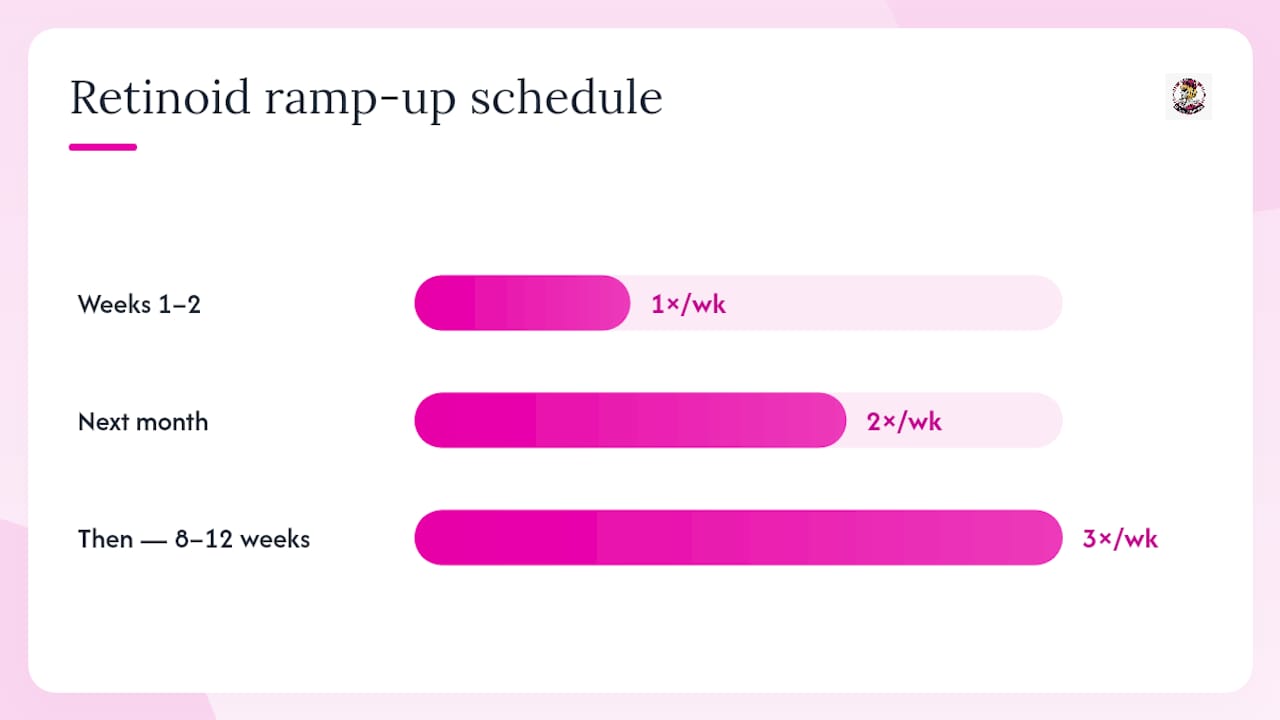
- Start with retinol at 0.025%–0.05%. Use it once a week for the first two weeks. If your skin tolerates it without peeling or persistent redness, move to twice a week for the next month, then three times a week.
- Buffer the application. Apply your ceramide moisturizer first, wait a few minutes, then apply the retinol on top. As your skin adjusts over 8–12 weeks, you can switch to applying retinol directly to clean skin.
- Patch test every new active. Apply a small amount behind the ear or on the inner arm for 24–48 hours before full-face use. This is especially worth doing with vitamin C, azelaic acid, and any exfoliating acid.
- Introduce one active at a time. Wait at least two weeks before adding a second new ingredient. If you add three things at once and your skin reacts, you won't know which one caused it.
- For very reactive skin, try bakuchiol. This plant-derived retinol alternative has a gentler profile and is safe during pregnancy and while trying to conceive, unlike tretinoin. It won't deliver the same depth of collagen stimulation, but it's a legitimate starting point.
- Azelaic acid (10% OTC) guidance. Apply a thin layer to affected areas in the morning or evening. It tolerates layering with niacinamide well and doesn't require the same slow ramp-up as retinoids.
- Salicylic acid and benzoyl peroxide caution. Both are effective for acne but can be drying and barrier-disrupting for perimenopausal skin. Use them as spot treatments rather than all-over applications, and avoid combining with retinoids on the same night.
Warning: Never layer a strong AHA (glycolic or lactic acid at high concentrations) with a retinoid on the same night. The combined pH disruption and cell turnover acceleration is a reliable recipe for a compromised barrier. Use them on alternating nights at most.
Pro Tip: After a barrier reset, reintroduce your most-missed active first. Apply it every third night for two weeks before moving to every other night. This slower ramp-up is far more effective than jumping back to your previous frequency and triggering another setback.
For a deeper look at which actives belong in your AM versus PM routine, the timing differences matter more than most people realize.
Which ingredients actually work for perimenopausal skin?
The most effective topical strategies are barrier repair (ceramides, lipids), hydration (hyaluronic acid), UV protection, and collagen stimulants (retinoids and peptides). A review of aging skin supports ceramides, humectants, and retinoids as evidence-backed approaches to improving skin properties.
| Ingredient | Benefit for perimenopausal skin | How to use it |
|---|---|---|
| Ceramides | Restore barrier lipids, reduce water loss, calm sensitivity | Look for ceramide NP, AP, EOP in moisturizers; use AM and PM |
| Hyaluronic acid | Draws and holds moisture in the skin's upper layers | Apply to damp skin; 1–2% concentration in serums |
| Retinol / tretinoin | Stimulates collagen, improves texture and tone | Start at 0.025–0.05% retinol; 2–3 nights/week; buffer initially |
| Azelaic acid | Treats acne and post-inflammatory pigmentation with low irritation | 10% OTC; AM or PM; safe for sensitive skin |
| Niacinamide | Reduces redness, supports barrier, fades pigmentation | 5–10%; pairs well with most actives including retinoids |
| Vitamin C | Antioxidant protection, collagen support, brightening | 10–20% L-ascorbic acid AM; use stable derivatives if reactive |
| Peptides | Signal collagen production, support firmness | Use in serums or moisturizers; no irritation risk |
| Glycerin | Humectant that draws water to the skin surface | Present in most good moisturizers; look for it in top 5 ingredients |
Ingredients to use cautiously or avoid:
- High-concentration AHAs (glycolic acid above 10%) used frequently can over-exfoliate a barrier that's already compromised
- Physical scrubs (walnut shell, sugar) cause micro-tears and worsen sensitivity
- High-strength benzoyl peroxide (10%) as an all-over treatment strips lipids; use 2.5% as a targeted spot treatment only
- Fragrance and essential oils in leave-on products are a common sensitizer for perimenopausal skin
- Drying alcohols (alcohol denat., SD alcohol) in toners and serums accelerate barrier breakdown
A note on pregnancy and trying to conceive: Bakuchiol is considered safe; tretinoin and high-dose retinol are not recommended. Azelaic acid and niacinamide are generally considered safe options to discuss with your provider.
For a full breakdown of these actives, the QueenCompares Ingredient Library lets you look up any ingredient by name and see its function, safety profile, and common concentrations.
What makes a moisturizer actually work for perimenopausal skin?
Pick a lipid-rich, ceramide-containing formulation that mimics your skin's own lipid profile rather than a heavy non-skin-identical oil that sits on the surface. Moisturizers should emphasize skin-identical lipids like ceramides and phospholipids rather than ingredients that feel rich but don't restore barrier composition.
What to look for in a moisturizer:
- Ceramides (NP, AP, EOP) alongside cholesterol and fatty acids for true barrier repair
- Glycerin or other humectants to draw water into the skin
- Squalane or shea butter as emollients that soften without clogging
- Petrolatum or dimethicone as occlusives for very dry skin or slugging
- Fragrance-free and alcohol-free formulations
What to avoid:
- Fragrance (including "natural" fragrance) in leave-on products
- Drying alcohols (alcohol denat.) in the first five ingredients
- Mineral oil as the primary moisturizing ingredient (occlusive but not barrier-restorative)
Layering order: Humectant serum → ceramide moisturizer → optional occlusive. Slugging (a thin layer of petrolatum over your moisturizer) is worth trying on very dry nights, but skip it if you're acne-prone. Slugging can meaningfully reduce transepidermal water loss overnight and is recommended selectively for perimenopausal skin that's very dry but not breakout-prone.
Pro Tip: In summer or humid climates, swap your cream moisturizer for a lighter gel-cream with ceramides. In winter or dry indoor environments, add an occlusive layer at night. Your moisturizer doesn't need to be the same product year-round.
Want to understand exactly why ceramides are so central to barrier repair? The QueenCompares guide to ceramides for skin breaks down the science in plain language.
Why sunscreen matters more in perimenopause
Daily broad-spectrum SPF 30+ (SPF 50+ if you're outdoors) is the single most protective step in your perimenopause routine. The AAD recommends daily broad-spectrum sunscreen SPF 30 or higher for all exposed skin, with reapplication when spending time outdoors. UV exposure is the largest controllable driver of collagen breakdown, and perimenopausal skin is already losing collagen faster than it was a decade ago.
SPF application checklist:
- Use about a quarter teaspoon for your face and neck (most people apply far less than this)
- Apply as the last step in your morning routine, after moisturizer
- Reapply every two hours when outdoors, or after sweating or swimming
- Mineral sunscreens (zinc oxide, titanium dioxide) are generally better tolerated on reactive perimenopausal skin
- Tinted mineral formulas with iron oxides offer added protection against visible light, which worsens hormonal pigmentation
- Chemical sunscreens (avobenzone, octinoxate) are effective but can cause stinging on sensitized skin
- Makeup with SPF does not replace a dedicated sunscreen layer; the coverage is too thin
Retinoid users: SPF is non-negotiable when you're using retinoids. Retinoids increase photosensitivity, and skipping sunscreen while using them cancels out much of the collagen benefit you're working toward.
When should you see a dermatologist?
See a clinician if you're dealing with new, severe, or treatment-resistant acne; rapidly thinning skin; suspicious spots; or when you want prescription-strength options. A clinician-oriented guide frames skin changes as potentially overlapping with treatable medical conditions and recommends medical review when appropriate.
Reasons to book an appointment:
- Painful, cystic acne that isn't responding to OTC azelaic acid or salicylic acid after 8–12 weeks
- A mole or pigmented spot that is new, growing, changing color, or has irregular borders
- Severe barrier breakdown with persistent weeping, crusting, or widespread redness
- Hair thinning or loss patterns that suggest a systemic hormonal or nutritional cause
- Skin that's thinning rapidly or bruising easily
Prescription and procedural options to discuss:
- Prescription tretinoin: More potent than OTC retinol; a dermatologist can prescribe the right concentration and guide the ramp-up
- Prescription azelaic acid (15–20%): Stronger than OTC formulas for persistent acne and pigmentation
- Menopausal hormone therapy (MHT): Some women find that MHT improves skin hydration and collagen; this is a conversation for your OB-GYN or menopause specialist, weighing individual risks and benefits
- Laser treatments and IPL: Effective for pigmentation and texture; require sun avoidance before and after
- Microneedling: Stimulates collagen production; often combined with topical actives
- Dermal fillers: Address volume loss in specific areas; results are temporary
This article is educational and general in nature. Treatment decisions depend on your personal medical history and should be made with a qualified healthcare provider.
Lifestyle habits that support your skin during perimenopause
Lifestyle choices materially affect skin resilience and collagen preservation, and they work alongside your topical routine rather than replacing it.
Practical measures with real impact:
- Sleep 7–9 hours. Skin repair peaks during deep sleep; chronic sleep deprivation raises cortisol, which accelerates collagen breakdown
- Stop smoking. Smoking is one of the most potent accelerators of skin aging, reducing blood flow and depleting collagen faster than almost any other lifestyle factor
- Eat vitamin C-rich foods. Vitamin C is a cofactor in collagen synthesis; citrus, bell peppers, and leafy greens are reliable sources
- Limit alcohol. Alcohol dehydrates skin and disrupts sleep quality, both of which compound perimenopausal skin changes
- Exercise consistently. Regular aerobic exercise improves circulation and has been linked to better skin elasticity in older adults
- Manage stress actively. Elevated cortisol from chronic stress worsens acne and slows barrier recovery; even 10 minutes of daily movement or breathing practice makes a measurable difference
- Stay hydrated. Eight glasses of water a day won't reverse dryness on its own, but chronic dehydration visibly dulls skin and reduces its plumpness
On supplements: Vitamin C and collagen peptide supplements are widely marketed for skin health. The evidence for oral collagen peptides improving skin hydration and elasticity is growing but still limited in scale. If you're considering them, discuss with your clinician first, particularly if you're managing other health conditions.
For makeup that works with perimenopausal skin rather than against it, the QueenCompares guide to makeup for mature skin covers hydrating formulas and non-comedogenic options worth knowing about.
What the research says: evidence summary
Dermatology guidance and peer-reviewed work consistently support barrier-first care, daily SPF, and retinoids as the strongest topical strategies for collagen and texture improvements in perimenopausal skin.
Key evidence and guidance:
- PMC5522662 confirms estrogen's role in skin thickness, collagen production, and sebum regulation, supporting early topical intervention for collagen support
- PMC5871318 summarizes evidence for ceramides, humectants, and retinoids in improving skin hydration and barrier function in aging skin
- The AAD recommends daily broad-spectrum SPF 30+, gentle moisturization, and dermatologist evaluation for suspicious spots
- Dermatologist guidance from The Globe and Mail supports a barrier-first routine with gradual retinoid introduction and buffering for tolerance
- Skin in the Middle provides clinician-focused sequencing for AM and PM routines including slugging guidance
- BeautyEpic supports azelaic acid as a dual-purpose treatment for acne and pigmentation with lower irritation risk
| Finding | Source | Caveat |
|---|---|---|
| Estrogen influences skin thickness and collagen production | PMC5522662 | Cohort data; individual variation is significant |
| Ceramides and retinoids improve skin barrier and hydration in aging skin | PMC5871318 | Review of multiple studies; strength varies by formulation |
| Daily SPF 30+ recommended for all exposed skin | AAD | Applies to all skin types and tones |
| Azelaic acid treats acne and pigmentation with low irritation | BeautyEpic / clinical guidance | OTC strength is 10%; prescription is 15–20% |
What to realistically expect from your routine
The timeline question is the one most articles sidestep, so here it is plainly: hydration improvements happen within days of consistent barrier-first care. Skin that felt tight and reactive often settles within two to four weeks of a proper routine. Structural changes — improved texture, reduced fine lines, more even tone — take months of consistent retinoid use, typically 12 weeks before meaningful visible improvement and up to six months for fuller results.
The biggest mistake isn't choosing the wrong product. It's adding too many things at once, reacting to a flare by adding more actives, and never giving any single ingredient long enough to show what it can do. Simplicity and consistency outperform a 10-step routine every time. If you're unsure where to start, pare back to the five essentials: gentle cleanser, hyaluronic acid, ceramide moisturizer, SPF, and one retinoid night per week. Build from there.
If your skin changes feel systemic — rapid thinning, widespread sensitivity, hair loss — that's a signal to see a clinician rather than adjust your routine. Topical care has real limits, and some perimenopausal skin changes respond better to hormonal or nutritional support than to any serum.
QueenCompares helps you find the right formula faster
Knowing which ingredients to look for is only half the work. Finding a product that actually contains them at effective concentrations, without the irritants that perimenopausal skin can't tolerate, is where most women lose time and money.

QueenCompares gives you the tools to check before you buy. The Ingredient Checker lets you paste in any product's ingredient list and instantly flag drying alcohols, fragrance, and other common sensitizers, while confirming whether ceramides and humectants are present at meaningful positions. The Label Scanner does the same from your phone camera in seconds. And the Ingredient Library gives you the full picture on every active mentioned in this article, from retinol concentrations to azelaic acid safety ratings. Browse perimenopause-friendly products and compare formulas side by side so your next purchase is one you can feel confident about.
Sources
- A dermatologist explains how perimenopause and menopause change your skin-care needs - The Globe and Mail
- Caring for your skin in menopause — American Academy of Dermatology (AAD)
- PMC5522662 — NCBI / PubMed Central
- PMC5871318 — NCBI / PubMed Central
- The Simple Skincare Routine That Actually Works During Perimenopause - Skin In The Middle
- What should a perimenopausal skincare routine look like? — RTE
- Perimenopause Skincare: How Your Skin Changes In Your 30s And What To Do About It — BeautyEpic
- Perimenopausal Skin: The Complete Guide — MillennialSkin
FAQ
What is the best skincare routine for perimenopause?
A barrier-first routine works best: gentle cleanser, hyaluronic acid on damp skin, ceramide-rich moisturizer, and daily broad-spectrum SPF 30+ every morning. At night, add a retinoid two to three times per week, introduced slowly and buffered with moisturizer for tolerance.
What skincare should a 45-year-old woman use?
At 45, the priorities are barrier repair (ceramides), hydration (hyaluronic acid), UV protection (SPF 30+), and collagen support (retinoids or peptides). Azelaic acid is a strong addition if hormonal acne or pigmentation are concerns.
What is the 4-2-4 cleansing method?
The 4-2-4 method is an oil-cleansing protocol: massage a cleansing oil for four minutes, emulsify with water for two minutes, then rinse for four minutes. It's designed to deep-clean pores without stripping the barrier, though for perimenopausal skin, a simpler double-cleanse (oil pre-cleanse followed by a gentle cream cleanser) achieves the same goal with less time commitment.
Is it too late to start a skincare routine in perimenopause?
No. Dermatologists describe perimenopause as an ideal time to be proactive, because introducing retinoids and consistent SPF before marked thinning occurs improves long-term outcomes. Skin responds to barrier repair and collagen stimulation at any stage.
Can QueenCompares help me find perimenopause-friendly products?
Yes. The QueenCompares Ingredient Checker and Label Scanner let you verify that a product contains ceramides, hyaluronic acid, or other barrier-supporting ingredients and flag common irritants like fragrance and drying alcohols before you buy.