
TL;DR:
- Ceramides are vital lipids that form most of the skin’s outer barrier, locking in moisture and preventing irritants. Their effectiveness depends on formulation quality, chain length, and consistent twice-daily application while paired with cholesterol and fatty acids. Proper use and product selection improve hydration, barrier repair, and skin resilience over time.
Ceramides are defined as lipid molecules that make up nearly 50% of the stratum corneum lipid mass, acting as the “mortar” between skin cells to lock in moisture and block out irritants. That single fact explains why so many dermatologists call them the most important ingredient in any barrier-focused routine. Without enough ceramides, your skin leaks water, reacts to pollution, and struggles to recover from daily stress. They work alongside cholesterol and fatty acids to keep the outer layer of skin organized, resilient, and hydrated.
What are ceramides and how do they support your skin barrier?
Ceramides fill the microscopic gaps between corneocytes, the flat, dead cells that form the outermost skin layer. Think of those cells as bricks and ceramides as the mortar holding everything together. When that mortar is intact, water stays in and irritants stay out. When it breaks down, you get dryness, redness, and sensitivity.

Ceramide deficiency raises transepidermal water loss (TEWL) to two to three times the normal rate. That means your skin is losing moisture far faster than it can replace it. Topical ceramide products can reduce TEWL back toward normal within one to two weeks of consistent use.
Ceramides are not humectants. They act as emollients, filling cellular gaps and forming a physical defense against pollution and environmental toxins. Hyaluronic acid pulls water into the skin; ceramides seal it there. Both have a role, but they do different jobs.
Several factors deplete ceramides over time:
-
Aging: Natural ceramide production slows with age, contributing to thinner, drier skin.
-
Harsh cleansers: Sulfate-heavy formulas strip lipids from the surface faster than the skin can replenish them.
-
Environmental exposure: UV radiation, cold air, and low humidity all degrade the lipid matrix.
-
Skin conditions: Eczema and psoriasis are both linked to measurably lower ceramide levels in the barrier.
Pro Tip: Avoid hot water when cleansing. Hot water dissolves skin lipids more aggressively than lukewarm water, and no ceramide product can fully compensate for that daily loss.
What are the different types of ceramides and why does chain length matter?
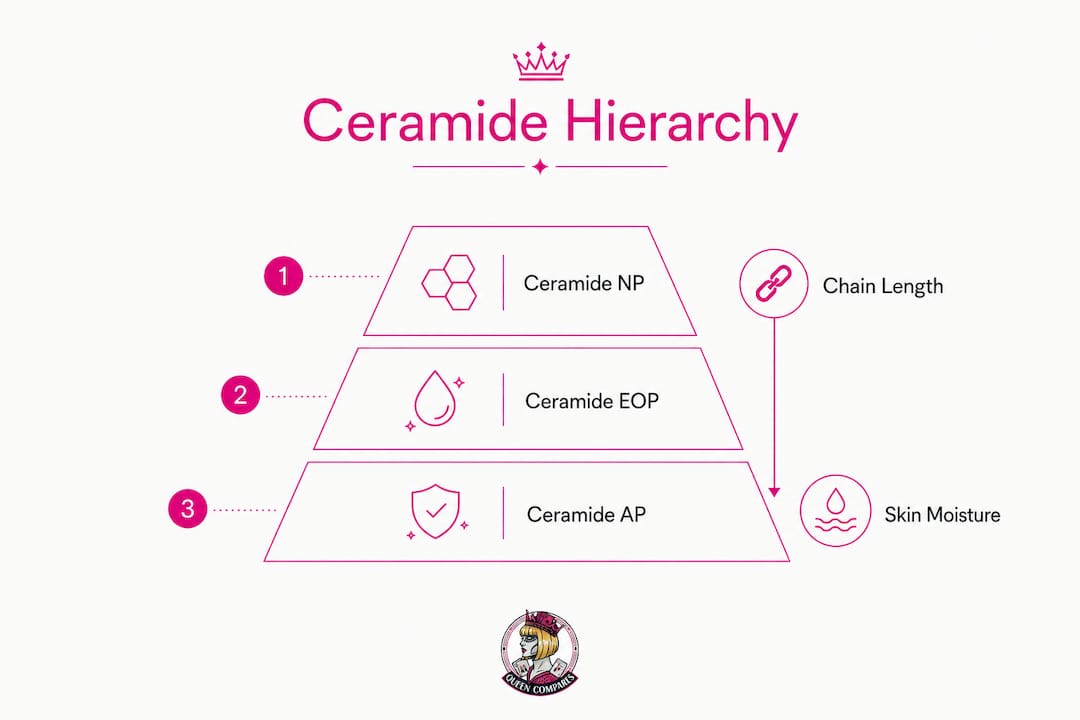
Not all ceramides perform the same way. Skin contains at least a dozen distinct ceramide subtypes, each classified by the structure of its head group and the length of its fatty acid chain. The most common types found in skincare formulations include Ceramide NP, Ceramide AP, Ceramide EOP, Ceramide NS, and phytosphingosine.
The chain length of the fatty acid attached to the ceramide molecule directly affects how well it integrates into the skin’s lipid matrix. Longer acyl chain ceramides (C24–C30) significantly outperform shorter chains in barrier recovery and hydration. Shorter chain versions (C16–C24) still provide benefit, but the longer variants rebuild the barrier more effectively after damage.
| Ceramide type | Chain length | Primary benefit |
|---|---|---|
| Ceramide NP | C16–C24 | Baseline moisture retention |
| Ceramide AP | C16–C24 | Supports barrier organization |
| Ceramide EOP | C24–C30 | Superior barrier recovery |
| Ceramide NS | C16–C24 | Smoothing and softening |
| Phytosphingosine | Variable | Anti-inflammatory support |
This distinction matters when you read product labels. A formula listing only “ceramide NP” at a low concentration is not the same as one combining Ceramide EOP with cholesterol and fatty acids. The longer-chain types are more expensive to source, which is why many budget products rely on shorter-chain alternatives.
Pro Tip: When reading an ingredient list, look for at least two ceramide types listed within the first ten ingredients. A single ceramide buried near the bottom of a long list is unlikely to deliver meaningful barrier repair.
How to incorporate ceramides effectively into your skincare routine
The timing and method of application affect how well ceramides absorb and perform. Apply ceramide products twice daily on damp skin immediately after cleansing, before the skin fully dries. Damp skin absorbs lipid-based ingredients more readily, and applying while moisture is still present helps seal it in.
A practical ceramide skincare routine follows this order:
-
Cleanse with a gentle, sulfate-free cleanser that does not strip the barrier.
-
Apply any water-based actives (vitamin C, niacinamide) while skin is still damp.
-
Apply your ceramide serum or moisturizer directly over the damp skin.
-
Seal with a thicker moisturizer or facial oil at night if your skin is very dry.
-
Apply SPF every morning as the final step to protect the barrier you just rebuilt.
Ceramide products come in several formats. A ceramide moisturizer suits most skin types and works as a daily driver. A ceramide serum delivers a higher concentration and works well under a lighter moisturizer. Ceramide-infused cleansers provide a gentler wash but deposit less active ingredient than leave-on products.
Ceramides stabilize the skin barrier and improve tolerance to retinoids and benzoyl peroxide. If you use tretinoin or an acne treatment that causes dryness and peeling, adding a ceramide moisturizer to your routine reduces irritation and helps you stay consistent with the treatment. That pairing is one of the most practical uses of ceramide products in real routines.
Avoid fragrances, alcohol, and essential oils in any product you apply over a compromised barrier. Those ingredients trigger inflammation and undo the repair work ceramides are trying to do. For sensitive skin routines, fragrance-free is non-negotiable.
Pro Tip: If you use a ceramide serum and a ceramide moisturizer in the same routine, you are not doubling the benefit proportionally. One well-formulated product with the right lipid ratio does more than two poorly formulated ones layered together.
What are the proven benefits and limitations of ceramide skincare products?
Ceramide products deliver real, measurable results when formulated correctly. Topical ceramides reduce the appearance of fine lines after 28 days of twice-daily use. That timeline reflects how long it takes for the barrier to rebuild and for improved hydration to visibly plump the skin.
The clearest benefits include:
-
Hydration: Ceramides seal moisture into the skin, reducing dryness and flaking within days of consistent use.
-
Barrier repair: Skin feels less reactive, less tight, and more resilient against wind, cold, and pollution.
-
Eczema support: Ceramides support eczema management by restoring barrier function, with clinical benefits building over months of use.
-
Acne-prone skin: A repaired barrier reduces the inflammatory response that worsens breakouts.
-
Aging skin: Improved hydration reduces the appearance of fine lines without requiring any active anti-aging ingredient.
The limitations are equally worth knowing. Ceramides do not stimulate collagen or reduce wrinkles directly. They support hydration and barrier integrity, which makes them complementary to retinoids and peptides rather than a replacement. Expecting ceramides alone to reverse visible aging is unrealistic.
Formulation quality is the biggest variable in product performance. Products containing ceramides with cholesterol and free fatty acids in balanced ratios outperform those with ceramides alone. Poorly dispersed ceramides that have not been properly emulsified fail to integrate into the skin’s lipid matrix at all. A product can list ceramides on the label and still deliver almost no barrier benefit if the formulation is poorly designed. This is exactly why checking the full ingredient list, not just the front-of-pack claims, matters so much. QueenCompares’ Ingredient Checker lets you scan any product label and see exactly what you are getting.
Lifestyle factors also affect how well ceramides work. Poor sleep, a low-fat diet, and chronic stress all impair the skin’s ability to synthesize and maintain its own lipid barrier. Topical products help, but they work best when the body is also producing ceramides from within.
Key Takeaways
Ceramides are the most structurally critical lipids in the skin barrier, and their effectiveness depends entirely on formulation quality, chain length, and consistent twice-daily application alongside cholesterol and fatty acids.
| Point | Details |
|---|---|
| Ceramides form the skin barrier | They make up nearly 50% of stratum corneum lipids, sealing moisture in and blocking irritants out. |
| Chain length determines performance | Longer acyl chains (C24–C30) rebuild the barrier more effectively than shorter C16–C24 versions. |
| Formulation quality is critical | Products need ceramides plus cholesterol and fatty acids in balanced ratios to actually work. |
| Apply on damp skin, twice daily | This method maximizes absorption and delivers measurable fine-line reduction within 28 days. |
| Ceramides support, not replace, actives | They improve tolerance to retinoids and benzoyl peroxide but do not stimulate collagen on their own. |
What I’ve learned after years of watching ceramide products overpromise
The ceramide category has a credibility problem, and it comes from the gap between label claims and formulation reality. I have reviewed hundreds of moisturizers that list ceramides prominently on the front of the pack, only to find a single short-chain ceramide at the very bottom of the ingredient list. That product will not repair your barrier. It will moisturize you the way any emollient would, but the ceramide is essentially decorative.
The products that actually work share three things: multiple ceramide types, the presence of cholesterol and free fatty acids in the same formula, and a delivery system that keeps the ceramides properly dispersed. Without those three elements, you are paying a premium for marketing.
The other mistake I see constantly is people layering ceramide products over active ingredients that are still irritating the skin. If your skin is red and reactive from a new retinoid, adding a ceramide moisturizer helps. But if you are also using a harsh exfoliating toner and a fragrance-heavy serum in the same routine, the ceramides cannot keep up. You have to build your routine thoughtfully, removing the things that damage the barrier before you focus on repairing it.
My honest advice: treat ceramides as infrastructure, not a treatment. They are the foundation that makes everything else in your routine work better. Get that foundation right, and your skin will respond.
— Magdalena Kapuscinska Queencompares.com Founder
QueenCompares makes finding the right ceramide product easier
Choosing a ceramide product based on front-of-pack claims alone is a gamble. The real story is in the ingredient list, and reading it takes time and knowledge most people do not have on hand.

QueenCompares gives you the tools to check what is actually in any product before you buy. The Ingredient Library breaks down every ceramide type, its chain length, and what the research says about its effectiveness. The Ingredient Checker lets you paste in any formula and get a clear read on whether the ceramide content is meaningful or minimal. Browse the full beauty product database to compare ceramide moisturizers, serums, and treatments side by side, with real ingredient data and community reviews behind every result. Your skin deserves products that actually deliver.
FAQ
What are ceramides in skincare?
Ceramides are lipid molecules that make up nearly 50% of the skin’s outer layer, acting as the structural “mortar” between skin cells to prevent water loss and block irritants.
How do ceramides work on dry skin?
Ceramides fill gaps between skin cells and seal moisture in, reducing transepidermal water loss that can run two to three times higher than normal in ceramide-deficient skin.
What ceramide types should I look for in products?
Look for Ceramide EOP or other long-chain (C24–C30) ceramides combined with cholesterol and free fatty acids. That combination outperforms single-ceramide formulas in barrier recovery.
Can ceramides help with eczema?
Yes. Ceramides support eczema management by restoring barrier function, though clinical benefits build gradually over months of consistent use rather than appearing overnight.
Are ceramides safe for sensitive skin?
Ceramides are naturally present in human skin and are well tolerated by sensitive skin types. Choose fragrance-free, alcohol-free formulas to avoid triggering inflammation while the barrier repairs.