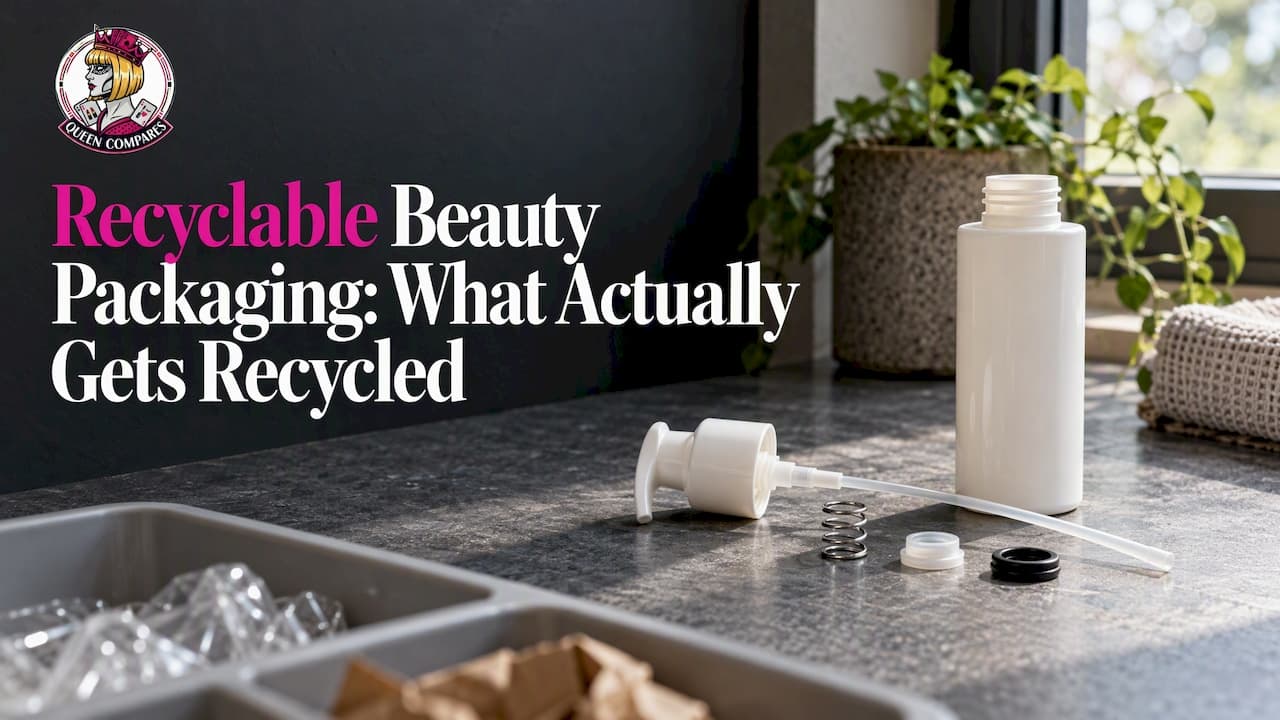
Recyclable beauty packaging is mostly large, simple and single-material: glass jars, aluminum cans, and big PET (#1) or HDPE (#2) bottles. Small tubes, pumps, compacts and mascara wands usually are not accepted at the curb, even when they carry a recycling symbol. This guide shows you what goes where, how to clean and separate your empties, and what to do with the rest.
Key takeaways
-
Big, rigid, single-material containers (glass, aluminum, PET #1, HDPE #2) are the best bets for curbside bins.
-
Small, mixed-material items such as pumps, squeeze tubes, compacts and wands often slip through sorting machinery, so they need a beauty take-back program.
-
Always empty and clean packaging first, and check your own city or county rules, because curbside acceptance varies by place.
-
Refillable and reusable packaging beats recycling, because it avoids waste instead of managing it afterward.
-
Vague claims like “100% recyclable” tell you little. Look for format-specific instructions instead.
Table of Contents
Why so little beauty packaging gets recycled
The beauty and wellness industry produces over 120 billion packages a year, and because of how they are designed, only a fraction are recycled. Design is the root of the problem. A single pump bottle can combine a plastic body, a metal spring, a rubber gasket and a different plastic for the head. Sorting facilities generally cannot take those apart by hand.
Size is the second problem. In a German sorting-plant trial, overall sorting efficiency for decorative cosmetics packaging was about 6%, largely because of size and geometry. The same report notes that small and cylindrical shapes often exist for good reasons, such as keeping formulas free of microbial contamination and allowing accurate application. In the UK, a case study booklet from the recycling body Recoup explains that items under 50mm in diameter generally don’t pass through standard sorting. U.S. facilities differ, but the physics are the same: tiny items fall through screens and end up in the residue.
To count as recyclable, packaging has to be collected, sorted and then regenerated. A material that is recyclable in a lab but not collected or sorted where you live is not recyclable in practice. One industry analysis estimates that about 62% of cosmetic packaging is non-recyclable through curbside programs. Treat that as a rough guide rather than a precise figure.

Which beauty packaging materials are recyclable
Here is a practical cheat sheet. It describes typical U.S. curbside behavior, so confirm it with your local program.
| Packaging type | Curbside outlook | Notes |
|---|---|---|
| Glass jars and bottles | Usually accepted | Glass can be recycled indefinitely without losing its properties. Remove pumps and droppers. |
| Aluminum cans, jars and bottles | Likely accepted | Think body sprays and large tins. |
| PET (#1) bottles | Usually accepted | Common for toners, micellar waters and shampoos. |
| HDPE (#2) bottles | Usually accepted | Common for body lotions, cleansers and conditioners. |
| PLA “compostable” plastic | Not accepted | A contaminant in recycling streams, so keep it out of the bin. |
| Pumps, droppers, sprayers | Rarely accepted | Mixed materials. Use a take-back program. |
| Squeeze tubes, especially laminated ones | Rarely accepted | Multiple layers, small format. |
| Compacts, palettes, lipstick cases | Rarely accepted | Metal, plastic and mirrors combined. |
| Mascara and eyeliner tubes and wands | Not accepted | Too small, and coated in product. |
The source for the PET, HDPE and aluminum rows is Pact Collective’s sourcing guide, which says that PET and HDPE are readily recycled in most curbside programs, and that aluminum cans, jars and bottles are likely to be accepted too.
Rigid beats flexible, and one material beats many
Industry analysis suggests rigid HDPE and PET containers see roughly 89% acceptance at material recovery facilities in established systems. A newer development is the all-polyethylene pump. Because the whole pump is the same material, certain lotion bottles can go into the #2 stream without taking the pump apart. If a brand says its pump is mono-material, look for that detail in the disposal instructions.
Why “recyclable” on the label is not enough
The symbol on the bottom of a container tells you the plastic type, not whether your city takes it. Packaging specialists point out that format-specific messaging is more trustworthy than broad claims like “100% recyclable,” which carry high greenwashing risk in beauty. Recoup also notes that consumer instructions need to be clearer and consistent across labels and local authority communications.
A helpful instruction reads something like “Empty the bottle, remove the pump, recycle the bottle.” An unhelpful one is a lone arrow symbol. If you want to dig into other claims on a box, our guide to verifying beauty certifications and seals and our piece on beauty brand transparency show how to separate substance from marketing.

Why small and mixed items are the hard part
Most of what is in your bathroom drawer is not a big bottle. It’s a lipstick bullet, a cream eyeshadow pot, a mascara tube. These are exactly the items that sorting lines miss.
Mixed-material packaging such as pumps and complex squeeze tubes is difficult because recycling facilities generally cannot disassemble the different materials. Size and shape do the rest. A lipstick case may be aluminum, plastic and a magnet in one piece, and it is also tiny.
This is a problem across personal care, not only makeup. Small items from bathroom routines, like replacement toothbrush heads, often need dedicated schemes too. Some brands run mail-back options, and you can see how one works if you recycle electric toothbrush heads by post. The principle carries over to beauty: when curbside can’t take it, a specialist program usually can.
Mixed materials are also an issue for brands that care about performance. Skincare in particular tends to need airless pumps or barrier layers to protect actives, and a piece on why mixed materials fail for skincare packaging explains the tradeoff, with a UK lens. The lesson holds in the U.S.: simpler packaging is more recyclable, but protecting the formula matters too.
How to prepare your beauty empties
Preparation decides whether an item is accepted. A dirty or half-full container can contaminate a whole bin, and take-back programs reject anything that is not clean.
-
Use it up. Get every last bit out. CNN Underscored’s guide notes that small cosmetic spatulas help reach the bottom of foundation bottles and jars.
-
Separate the parts. Unscrew pumps, droppers and caps. Pull off any metal springs you can reach safely. Glass bottle bodies and plastic bodies often go to curbside, while the pump goes to a take-back program.
-
Rinse household-recycling items. Aluminum and plastic that goes into your regular bin should be rinsed like food containers.
-
Clean harder for take-back. Pact asks that items be clean, unbagged and free of liquid. Hot soapy water and a little patience work for most creams and foundations. Oil-based balms need a wipe first.
-
Remove batteries and electronics. Light-up or electronic beauty tools belong in e-waste collection, not either stream.
-
Leave labels on if they come off easily, but don’t fuss over them. Sorting equipment handles labels, and cleanliness matters more.
Do not bag your empties. Loose items are sorted; bagged items are usually sent to landfill.
What to do with packaging curbside won’t take
Pact Collective is a nonprofit that accepts clean, empty beauty packaging in the U.S. and Canada, including small bottles and jars, tubes, pumps, compacts, palettes and mascara wands. It focuses on the hard-to-recycle items that curbside can’t handle. Its programs run through drop-off bins in retail stores, and you can drop off empties from any brand, not only the store’s own. Items accepted there include:
-
Plastic, metal and paper bottles and jars smaller than a yogurt cup or 2 by 2 inches
-
Squeezable plastic and aluminum tubes
-
Caps, closures, pumps and dispensers
-
Droppers and applicators
-
Compacts and palettes
-
Lipstick and lip gloss tubes
Glass and larger rigid items can often go curbside instead, so check Pact’s drop-off guide to decide where each piece belongs. Pact also stresses that empties must be clean, or they cannot be processed.
A few other options help:
-
Brand take-back. Some brands run their own return schemes. Check the brand’s website for the current rules.
-
Retail programs. Several beauty stores host collection bins, with rules that vary by chain.
-
Trash, as a last resort. If an item is not accepted anywhere near you, putting it in the trash is better than putting it in the recycling bin and contaminating good material.
Refill and reuse come first
Pact describes reuse and refill models as the gold standard, because they avoid waste instead of relying on recovery. Refillable compacts, lipstick cases and moisturizer jars let you keep the durable outer shell and replace only the inner pan or pod. This is usually the easiest swap for makeup, because the case is the hardest part to recycle.
Choosing makeup and skincare with better packaging
Packaging is one factor among many. Your skin comes first, so look at the formula and the container together.
-
Tinted moisturizers, BB creams and CC creams. Choose a version in a glass jar or a large HDPE or PET tube bottle, rather than a small laminated squeeze tube. Tinted moisturizers often come in larger formats, which helps. Pick a pump only if the brand states that it is mono-material or that the pump can be returned.
-
Foundations. Glass bottles with removable droppers are common. Separate the dropper and send it to take-back, and send the glass curbside if your program accepts it.
-
Serums and cleansers. Glass droppers and large #2 bottles tend to be the easiest. Our team often sees K-beauty ampoules in glass with plastic bulbs, which means two disposal steps.
-
Powders, blushes and eyeshadows. Look for refillable pans. A magnetic palette with replaceable pans reduces waste significantly.
Packaging and ingredients can pull in different directions, so check both. Our guide to reading ingredient labels and our look at microplastics in cosmetics cover the formula side of a sustainable routine.
Our perspective
We compare products for a living, and packaging is the part of a product page most shoppers skip. Ingredient lists get the attention, but the container is what you are left holding when the product runs out.
Our view is simple. First, buy what you will actually finish, because the greenest package is the one that is never wasted. Second, favor refillable and single-material formats when the formula allows it. Third, treat recycling claims as a starting point and verify them against your own local rules. Packaging should never push you toward a formula that doesn’t suit your skin or your values, so we encourage checking both together.
That is why we built tools that look at the full picture: ingredient-level analysis, side-by-side comparisons and community reviews that often mention how a product is packaged and how well it holds up.
— Magdalena
Check the formula as well as the bottle
If you are switching to cleaner or lower-waste products, you can check formulas with us too. Our Find Clean Beauty Makeup service is $10 per product, and our Ingredient Checker covers up to two products for $20. You can also browse products by ingredient to compare options side by side. For a broader look at what to leave out of your bag, see our guide to ingredients to avoid in makeup.
FAQ
Can I put empty makeup in my curbside recycling bin?
Only some of it. Large glass, aluminum, PET (#1) and HDPE (#2) containers are commonly accepted, but small tubes, compacts, pumps and wands usually are not. Rules differ by city and county, so check your local program’s list before you toss anything in.
Do I need to wash beauty containers before recycling?
Yes. Rinse items going into household recycling like you would a food container. If you are sending them to a take-back program like Pact, they must be completely clean, unbagged and free of liquid.
Is compostable or PLA beauty packaging recyclable?
No. PLA is not recyclable in curbside programs and is a significant contaminant in recycling streams. Keep it out of the bin unless a specific local program says it accepts it.
What is the most sustainable option for beauty packaging?
Reuse and refill. Refillable cases, pans and jars avoid waste altogether, which makes them preferable to any recycling route. When refills are not available, choose single-material, larger-format packaging that your local program accepts.
Does a recycling symbol mean my city will accept it?
No. The number inside the symbol identifies the plastic type, not local acceptance. Look for clear, format-specific instructions from the brand, then confirm with your local recycling guidelines.
Sources
-
Guide: Sourcing smart packaging and materials, Pact Collective
-
Outcome document on the recyclability of decorative cosmetics packaging, Forum Rezyklat
-
ELIPSO-FEBEA guide on recyclability of plastic cosmetic packaging
-
How to actually recycle your empty beauty products, CNN Underscored
Recommended
General Entertainment & Information Purposes Only At QueenCompares.com we share content for general entertainment and information. It’s not medical, dermatological, nutritional, or fitness advice and shouldn’t replace guidance from a licensed professional. If you’re making health-related decisions, please check with a qualified expert — and know that using this site and its information is at your own discretion.