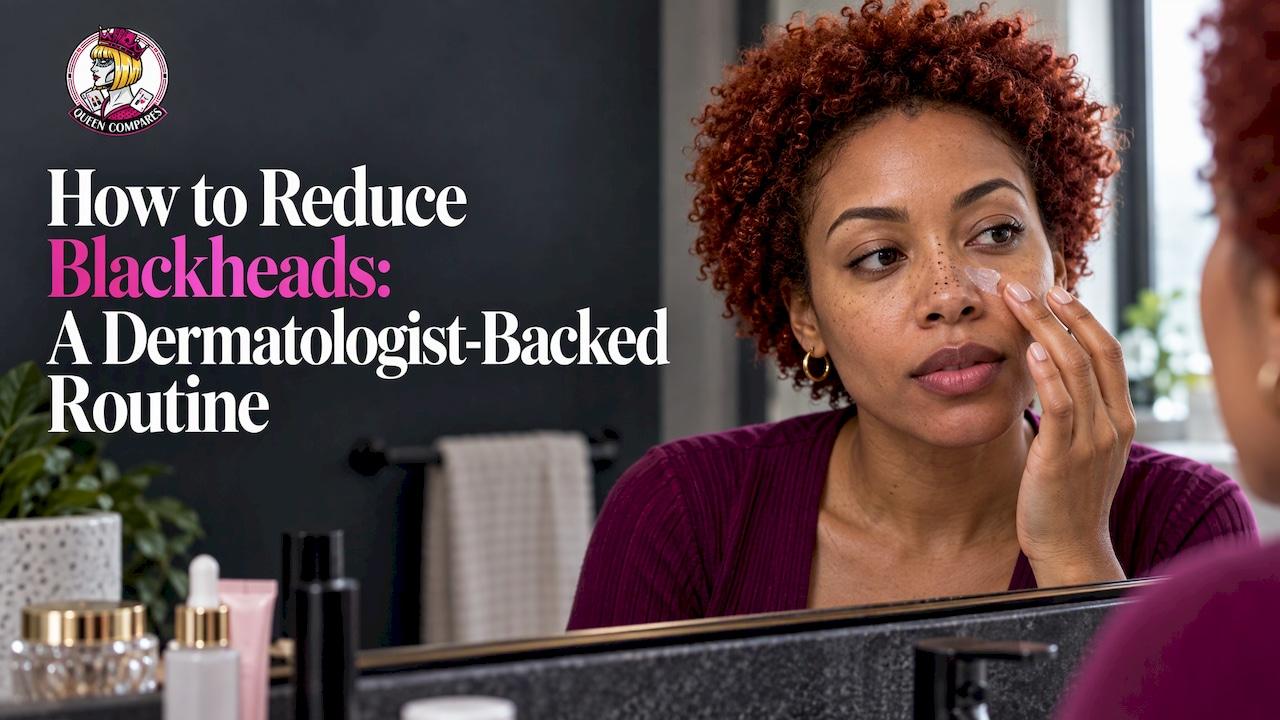
The most reliable way to reduce blackheads is a gentle routine built on one or two proven actives: salicylic acid and a retinoid, used consistently for at least 6 to 8 weeks. Scrubbing, pore strips and squeezing might feel productive, but they irritate skin and rarely fix the cause. Below you will find what blackheads are, which ingredients help, a step-by-step routine, how to choose makeup that won’t clog pores, and when to hand things over to a dermatologist.
Key Takeaways
-
Blackheads are clogged pores, not dirt. The American Academy of Dermatology notes that scrubbing will only make them worse.
-
Salicylic acid and retinoids are the two most useful over-the-counter ingredients. Start low (2% salicylic acid) and go slowly.
-
Give any new routine 6 to 8 weeks before judging it, and expect a visible difference in roughly 8 to 12 weeks.
-
Choose oil-free, noncomedogenic skincare and makeup, and wear SPF 30 or higher daily.
-
Deep or stubborn blackheads should be extracted by a professional, never squeezed at home.
Table of Contents
What Blackheads Actually Are
A blackhead is an open comedone. According to Cleveland Clinic, it forms when a hair follicle or sebaceous gland becomes clogged and inflamed because of extra sebum, abnormal keratin formation, higher androgens or bacteria. Because the pore stays open, the plug is exposed to air and darkens.
That dark color is the part most people misread. The AAD explains that the black dots are not dirt. So washing harder, scrubbing with grainy exfoliants or steaming your face won’t lift them out. Medical News Today also points out that scrubbing removes sebum, so your oil glands work harder to replace it, which can lead to more blockages.
The useful way to think about it: blackheads are a pore-lining and oil-flow problem. The goal is to loosen the plug, keep the pore lining turning over normally and avoid anything that triggers extra oil or inflammation.
The Ingredients That Help Most
There is no single magic product. Several ingredients tackle different parts of the problem. Here is how the main ones compare, based on dermatology sources.
| Ingredient | What it does | Best for | Watch for |
|---|---|---|---|
| Salicylic acid (BHA) | Unclogs pores and exfoliates, which is why the AAD says it works best on whiteheads and blackheads | Daily or several-times-weekly use on oily or normal skin | Dryness, stinging on sensitive skin |
| Retinoids (adapalene, retinol) | Break up blackheads and whiteheads and help prevent clogged pores, per Cleveland Clinic | Night-time, long-term control | Peeling and irritation early on |
| Azelaic acid | Listed by Cleveland Clinic among topical options for comedonal acne | Skin that reacts to stronger actives | Mild tingling |
| Glycolic or lactic acid (AHA) | Break up dead skin cells on the surface | Dull, bumpy texture along with blackheads | Over-exfoliation |
| Benzoyl peroxide | Doesn’t directly clear blackheads but kills acne-causing bacteria, reducing the breakouts that often come with them | Blackheads plus red pimples | Bleaching fabric, dryness |
The 2024 acne guidelines in the Journal of the American Academy of Dermatology give strong recommendations for benzoyl peroxide and topical retinoids, and conditional recommendations for salicylic acid and azelaic acid. They also suggest combining topical therapies that work in different ways.
If you are unsure whether salicylic acid or benzoyl peroxide fits your breakouts, our guide on choosing benzoyl peroxide or salicylic acid breaks it down by lesion type.
Salicylic acid: how to use it
Salicylic acid is the most beginner-friendly place to start. Dermatologist Dr. Wei, quoted by Cleveland Clinic, suggests a salicylic acid wash once a day, starting with 2% to 4%. Yale Medicine suggests a 2% product as a starting point, used two to three times a week, with salicylic acid in the morning and a retinoid such as adapalene at night to limit irritation.
Skin type changes the pace. Dermatologist Dr. Arash Akhavan told NBC News that people with sensitive skin should generally keep acne-fighting ingredients to 2 to 3 times a week, while normal to oily skin can use them daily at a lower concentration.

Retinoids: the long game
Retinoids are the ingredient most dermatologists reach for when blackheads keep coming back. Adapalene is available without a prescription, and Cleveland Clinic notes that using a retinoid every other day or with a moisturizer can cut down on peeling. Yale Medicine recommends a pea-sized amount for the whole face, used every other night for a few weeks before moving to nightly use, followed by a gentle moisturizer.
New to retinoids? Our beginner plan for adding retinol to your routine walks through the 8 to 12 week ramp-up, and our skincare routine order guide shows where each step belongs.
A Simple Routine to Reduce Blackheads
Cleveland Clinic’s outline is easy to follow: a salicylic acid cleanser in the morning and a retinoid at night, with 2% to 4% salicylic acid as the starting range, adjusted to how your skin responds. Here is that idea turned into a practical plan.
Morning
-
Cleanse with a salicylic acid cleanser, or a gentle oil-free cleanser on days you skip the active.
-
Moisturize with a lightweight, oil-free, noncomedogenic formula. Drying your skin out backfires: Medical News Today explains that over-drying may stimulate extra oil production.
-
Apply sunscreen with SPF 30 or higher. Retinoids and exfoliating acids make daily sun protection non-negotiable.
Evening
-
Remove makeup and sunscreen fully. Going to bed with makeup on is something Cleveland Clinic specifically advises against.
-
Cleanse gently with your hands, without scrubbing.
-
Apply a retinoid (a pea-sized amount for the whole face). Start every other night.
-
Moisturize to buffer irritation.
Weekly
Exfoliate only a couple of times a week at most. Cleveland Clinic warns that over-exfoliating dries the skin and increases oil production, which contributes to more blackheads. If you already use a salicylic acid cleanser and a retinoid, you may not need a separate exfoliant at all.
If you also deal with an oily T-zone and drier cheeks, a zone-based approach can help, and our combination skin routine shows how to split products by area. For shine-prone skin overall, try the quick routine for oily skin.
Don’t layer everything at once
NBC News reports that dermatologists caution against layering too many actives, and that retinol in particular should be added gradually. The AAD recommends using one acne product for 6 to 8 weeks before adding another. That pacing is the single most common fix for people whose skin “stopped tolerating” their routine.
How Long Until You See Results?
Blackheads rarely vanish in a week. The AAD advises giving treatment six to eight weeks to work on stubborn whiteheads and blackheads. Cleveland Clinic says that with proper, persistent care you may notice a difference in 8 to 12 weeks, though comedonal acne can take many months to fully clear. Dr. Harper, quoted by the AAD, says people can expect fewer breakouts in 4 to 8 weeks and clearing around 16 weeks after starting acne medication.

A practical way to stay consistent: take a front-facing photo in the same light every two weeks. Blackheads are easy to over-inspect in a magnifying mirror, and photos show real progress.
What Not to Do
-
Don’t squeeze or pick. Cleveland Clinic warns this can cause scars, damage to the pore or follicle (leading to more comedones), infection and inflammatory acne.
-
Don’t rely on pore strips. They only temporarily clear skin and can cause irritation and dryness.
-
Don’t over-scrub. Gritty scrubs and harsh brushes inflame skin without removing the plug.
-
Be careful with suction tools and masks. Medical News Today says removal strips, masks and vacuums should be used with caution because they can irritate and damage skin.
-
Don’t count on steam. The idea that steam opens pores hasn’t been confirmed by research.
Makeup That Won’t Make Blackheads Worse
You don’t need to give up makeup. You do need to choose formulas that let pores breathe. Cleveland Clinic recommends noncomedogenic, oil-free, water-based products, and MedicineNet lists water-based makeup among prevention steps.
Here is how that applies to the base products people ask about most:
-
Tinted moisturizers: A good option if you want light coverage and hydration in one step. Look for labels that say oil-free and noncomedogenic, and ideally with mineral SPF.
-
Foundations: Lightweight liquid or powder formulas tend to sit more comfortably on blackhead-prone skin than heavy, creamy ones. Check the ingredient list for heavy oils and waxes near the top.
-
BB creams: These blend skincare and light coverage. Pick one that is water-based and oil-free, and apply it with clean fingers or a freshly washed sponge.
-
CC creams: Often aimed at redness or uneven tone. The same rule applies: noncomedogenic first, color-correcting second.
Whatever you wear, remove it every night. And change pillowcases often, as MedicineNet suggests, since they carry oil and product residue.
Check the label before you buy
The hard part is that “noncomedogenic” on a front label doesn’t tell you everything about what is inside. That’s where our Ingredient Checker and Label Scanner come in. Scan a product’s label, and we flag ingredients and allergen alerts so you can compare foundations, tinted moisturizers, BB creams and CC creams before you buy. You can also browse products by ingredient to find formulas built around the actives above.
When to See a Dermatologist
Over-the-counter products can be enough for mild blackheads. But book an appointment if:
-
Your routine isn’t delivering the results you want after the 8 to 12 week window. Cleveland Clinic advises seeing a healthcare provider in this case.
-
Blackheads are deep. Cleveland Clinic says deep blackheads should be removed by a medical professional using a comedo extractor, which applies even pressure and reduces the chance of the blackhead returning.
-
You also have inflamed, painful or scarring acne.
A dermatologist can offer prescription-strength treatment, chemical peels, microdermabrasion or laser options. If topical care fails for comedonal acne, Cleveland Clinic notes a provider may consider oral options such as hormonal therapy, antibiotics or isotretinoin. That decision belongs to a clinician who knows your history.
If you are pregnant or planning to be, ask your doctor before starting a retinoid or any new acne active.
Preventing Blackheads From Coming Back
Once your skin clears, maintenance is simple:
-
Wash and moisturize morning and night, gently and without scrubbing.
-
Use oil-free, water-based, noncomedogenic cleansers, moisturizers and makeup.
-
Keep a salicylic acid product or retinoid in your routine, at the frequency your skin tolerates.
-
Wash after workouts, and shampoo oily hair regularly, as MedicineNet recommends.
-
Keep your hands off your face.
-
Wear sunscreen daily.
Hormones, age and skin of color can all change what works. If you are in your 40s or 50s, our perimenopause skincare routine addresses how routines shift. For a broader foundation, see our skincare tips for every skin type.
Our Perspective
Most people who write to us about blackheads have already tried the harsh route: scrubs, strips, hot towels. It leaves skin red and the pores no clearer. What changes things is knowing what is in the bottle.
That is why we built Queen Compares around ingredient-level analysis. When you can see that a cleanser has salicylic acid at a sensible strength, or that a BB cream is loaded with heavy oils, you stop guessing. Side-by-side comparisons and community reviews add the real-world layer: how a formula feels on actual skin.
We believe a blackhead routine should be short, patient and clear. Pick one or two actives, add them slowly, protect your skin with sunscreen and give it time. Our tools are designed to take the confusion out of the shopping part so you can focus on consistency.
Magdalena
Build Your Blackhead Routine With Queen Compares
If you want a plan rather than a pile of products, ourSkincare Routine Builder creates a routine around your skin type and goals, and Skincare Routine Progress helps you track how your skin responds over those key 8 to 12 weeks. Both are included at 7 EUR per month, and Premium Access at 7 EUR per month unlocks our premium tools.

For products that fit a low-tox approach, explore our Clean Beauty Catalogue, and use the Ingredient Checker and Label Scanner to vet cleansers, moisturizers, sunscreens and base makeup before they reach your cart. You can start at the Queen Compares homepage or try the Skincare Routine Builder directly.
FAQ
Does salicylic acid break up blackheads?
Yes, it is one of the most useful ingredients for them. The AAD says salicylic acid works best on whiteheads and blackheads because it unclogs pores and exfoliates the skin. Start with a 2% product and give it 6 to 8 weeks before adding anything else.
What ingredients fight blackheads?
The main ones are salicylic acid, retinoids, azelaic acid and glycolic acid, with benzoyl peroxide helping when blackheads come with red pimples. Cleveland Clinic lists these as topical treatments for comedonal acne. Add one at a time so you can tell what your skin tolerates.
How long does it take to clear blackheads?
Plan on 6 to 8 weeks to judge a treatment and about 8 to 12 weeks to notice a clear difference. Full clearing can take many months. If you aren’t getting results, a dermatologist can adjust your plan.
What treatments does a dermatologist recommend for blackheads?
Dermatologists commonly suggest a salicylic acid wash, a topical retinoid, azelaic or glycolic acid, and for stubborn cases professional extraction, chemical peels, microdermabrasion or laser resurfacing. Deep blackheads should be extracted by a professional rather than at home.
Can I wear makeup if I have blackheads?
Yes. Choose oil-free, water-based, noncomedogenic tinted moisturizers, foundations, BB creams or CC creams, and always remove them before bed. Check labels with an ingredient checker if you are unsure.
Sources
-
Blackheads: What They Look Like, Treatment & Prevention (Cleveland Clinic)
-
How to treat different types of acne (American Academy of Dermatology)
-
Adult acne treatment dermatologists recommend (American Academy of Dermatology)
-
Guidelines of care for the management of acne vulgaris (JAAD)
-
Whiteheads, Blackheads, Pimples: A Guide to Treating Acne at Home (Yale Medicine)
-
Blackheads: Facts, causes, and treatment (Medical News Today)
-
Blackheads: Symptoms, Causes, Removal Treatments (MedicineNet)
Recommended
General Entertainment & Information Purposes Only At QueenCompares.com we share content for general entertainment and information. It’s not medical, dermatological, nutritional, or fitness advice and shouldn’t replace guidance from a licensed professional. If you’re making health-related decisions, please check with a qualified expert — and know that using this site and its information is at your own discretion.