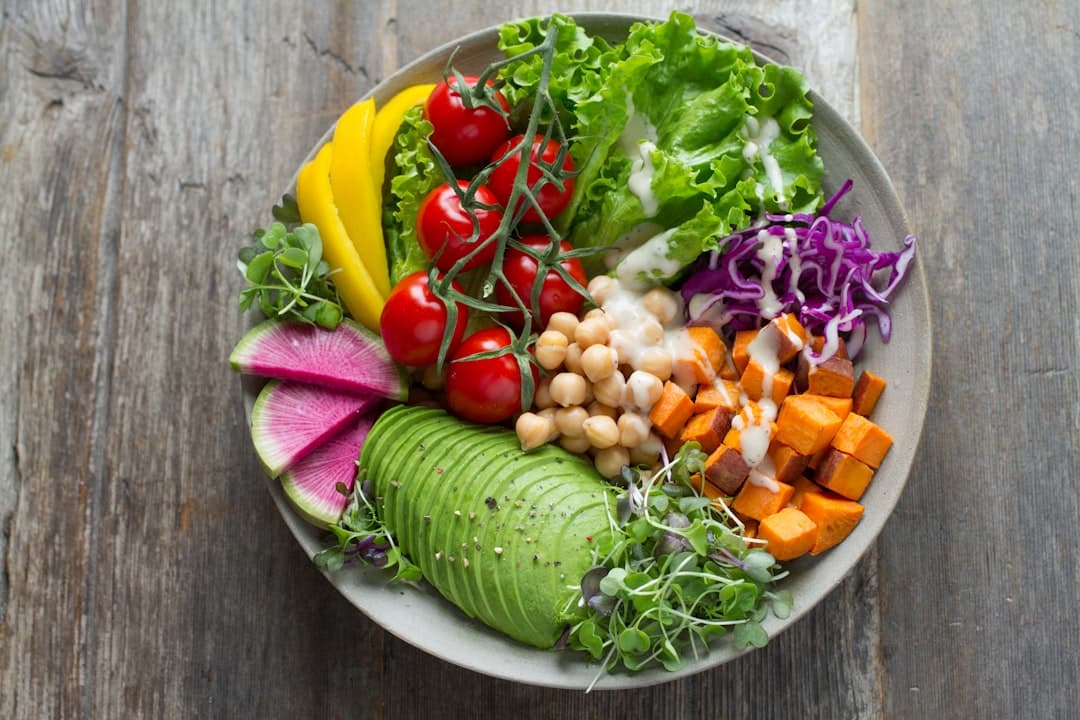
Yes, a well-planned vegetarian diet can meet nearly all your nutrition needs, at any age. Your top priorities: eat a wide variety of plant foods every day, build meals around legumes and whole grains, lock in a reliable vitamin B12 source, and pair iron-rich foods with vitamin C to help your body absorb it. If you’re pregnant, feeding a teen, or managing a health condition, loop in a registered dietitian before you overhaul your plate.
TL;DR:
Consuming a variety of plant foods, especially legumes, whole grains, and fortified products, is essential for meeting nutrient needs on a vegetarian diet.
Key nutrients like B12, iron, calcium, vitamin D, omega-3s, and protein require careful planning or supplementation, especially for vegans or those with limited sun exposure.
Rotating different protein sources and batch-cooking staples such as legumes and grains help prevent nutrient gaps and maintain energy levels.
Food choices should focus on whole, minimally processed options rather than relying on high-sodium or sugar-laden substitutes to avoid nutritional deficiencies.
Pregnant, adolescent, older, or active individuals need personalized guidance from a healthcare professional to ensure adequate nutrient intake.
Table of Contents
What Should You Eat on a Vegetarian Diet?
A vegetarian diet built the right way looks less like a list of things you’re avoiding and more like a rotating menu of foods you actually crave. Vegetables and fruits fill the base, whole grains carry the energy, and legumes, nuts, and seeds handle protein and healthy fat. Soy foods like tofu, tempeh, and edamame belong in that same protein rotation, and fortified plant milks fill in nutrients you’d otherwise miss without dairy.
Fortified foods are your quiet safety net. Plant milks fortified with calcium and vitamin D, breakfast cereals fortified with B12 and iron, and nutritional yeast fortified with B12 do a lot of heavy lifting without changing how your meals taste. If you’re eating dairy and eggs (the lacto-ovo pattern most people mean when they say “vegetarian”), you get some of these nutrients built in. If you’re skipping dairy too, fortified foods stop being optional.
If you feel overwhelmed with food planning for a vegetarian diet, you can always try Marley Spoon, a popular meal kit delivery service that offers customizable vegetarian plans. These services provide pre-portioned ingredients and easy-to-follow recipes, making it simpler to maintain a balanced vegetarian diet. Many of these platforms also allow you to adjust your meal selections based on specific dietary restrictions, such as allergies or preferences for certain cuisines, ensuring you receive meals tailored to your needs and taste preferences. This approach can save time, reduce food waste, and help you explore a variety of vegetarian dishes with convenience and confidence.
Government dietary guidance, echoed by Nutrition, lists beans, peas, and lentils as core protein-group staples, right alongside eggs, nuts, and soy products. For everyday portions, aim for:
-
Half your plate as vegetables and fruit at most meals
-
A quarter as whole grains, like brown rice, quinoa, or whole wheat pasta
-
A quarter as a protein source, rotating between legumes, tofu, eggs, or dairy
-
A small daily serving of nuts or seeds, and a fortified milk or juice if dairy is limited
Think in rotations, not rules. The person who eats the same lentil soup every night is more nutritionally exposed than the one who swaps between chickpeas, black beans, tofu, and eggs across the week.
What Nutrients Do You Need to Watch on a Vegetarian Diet?
Six nutrients deserve real attention on a vegetarian diet: B12, iron, calcium, vitamin D, omega-3s, and protein, with iodine and zinc close behind. MedlinePlus notes that B12 deficiency builds slowly and quietly, which makes it the nutrient people most often get wrong.
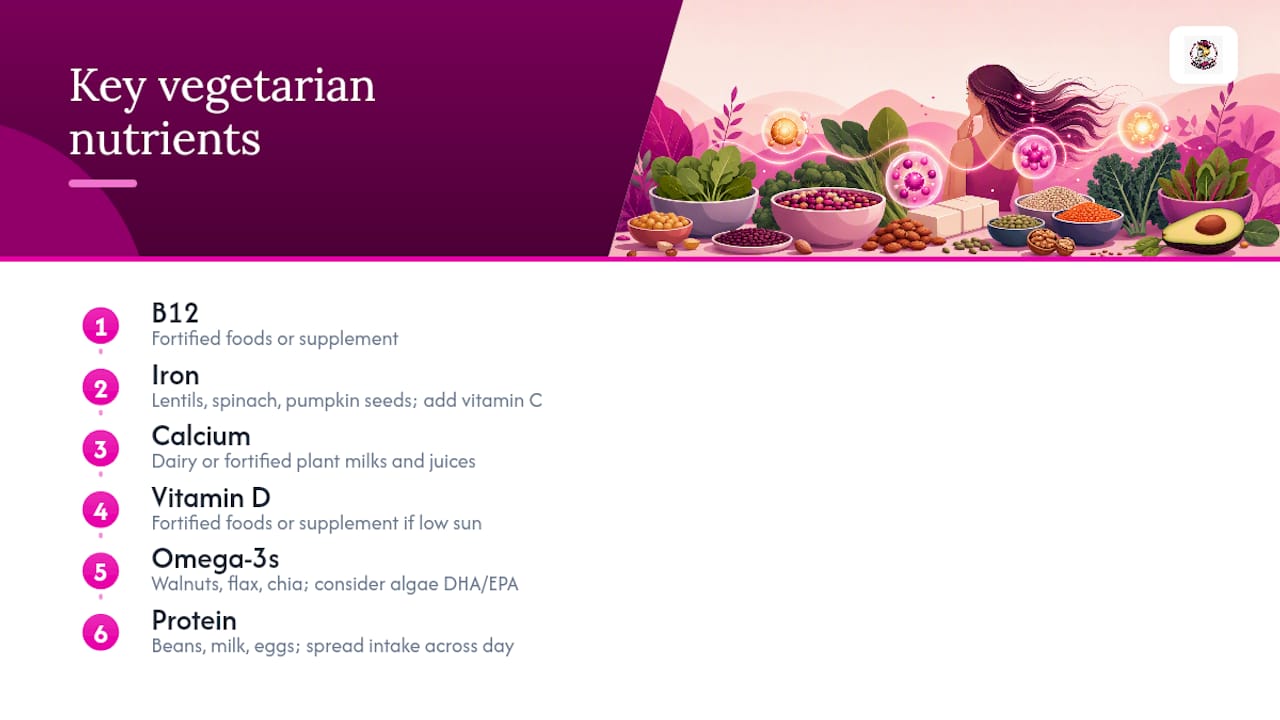
Vitamin B12 comes almost entirely from animal foods, so anyone eating dairy or eggs gets a partial supply, and anyone avoiding both needs fortified foods or a supplement. If you’ve gone a year or more without a reliable source, ask your doctor for a blood test.
Iron is available in lentils, spinach, tofu, and pumpkin seeds, but plant iron (non-heme) absorbs less efficiently than the iron in meat. Pairing iron-rich foods with vitamin C, think bell peppers with your lentils, or orange slices with your fortified cereal, meaningfully boosts how much your body takes in.
Calcium and vitamin D show up in dairy, fortified plant milks, and fortified juices; if your sun exposure is limited (northern climates, winter months, or mostly indoor days), a vitamin D supplement is worth discussing with your doctor.
Omega-3s split into two camps: ALA, found in walnuts, flaxseed, and chia seeds, and the longer-chain EPA/DHA your body converts from ALA inefficiently. Mayo Clinic points to algae-based DHA/EPA supplements as a direct, fish-free way to close that gap.
Protein needs to vary by body size, but roughly a half-cup of beans, a cup of milk, or an egg each supply 6 to 8 grams; spreading protein sources across the day, rather than loading up at dinner, tends to work better than one giant serving.
Iodine comes from iodized salt or seaweed, and zinc from beans, nuts, and whole grains, whose absorption improves with soaking or sprouting.
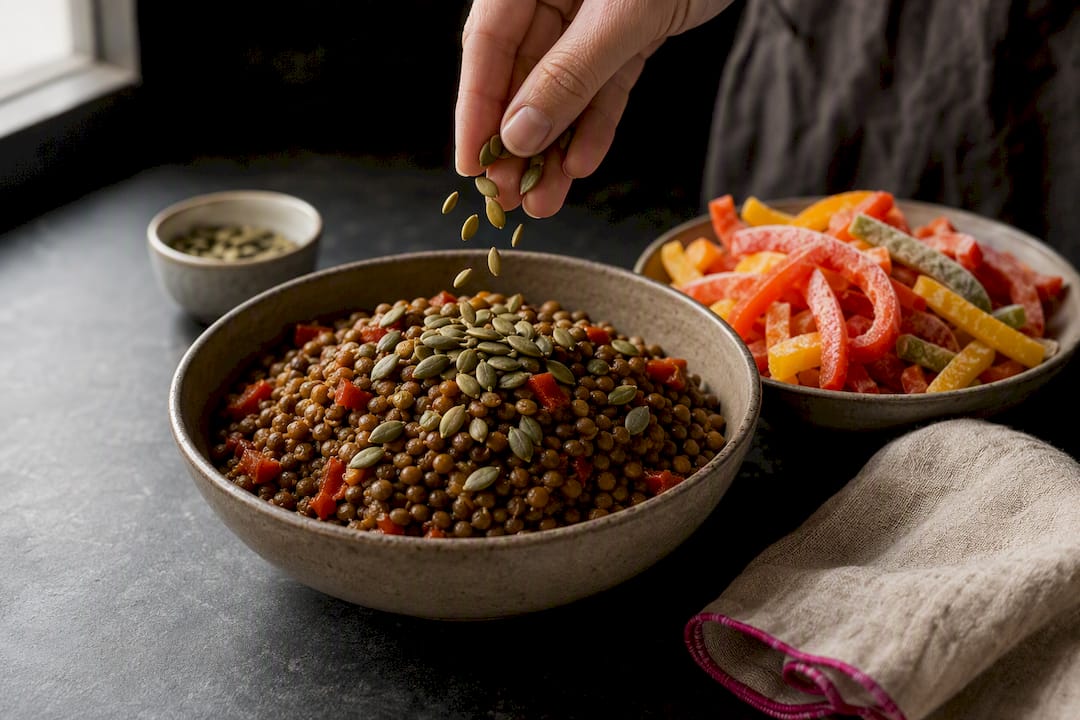
Pro Tip: Keep a jar of pumpkin seeds and a bag of frozen bell pepper strips in easy reach. Sprinkle seeds over dinner and toss peppers into your lentil dish, and you’ve paired iron and vitamin C without a second thought.
How Do You Plan a Balanced Vegetarian Day?
A single well-assembled day can illustrate how nutrients add up. For example, breakfast might be fortified cereal with soy milk and fruit to supply B12, calcium, and vitamin D. Lunch could feature a chickpea salad with vitamin C-rich vegetables to help absorb plant-based iron. Dinner might include tofu stir-fry with vegetables and whole grains, providing protein. Snacks like walnuts or chia pudding can supply omega-3 fats.
Turning that into a repeatable week takes three habits:
-
Batch-cook legumes on one day. A big pot of lentils or chickpeas keeps well for four to five days and anchors multiple meals.
-
Cook grains in bulk. Quinoa, brown rice, or farro reheat fast and let you build a different bowl every night.
-
Stock your freezer and pantry with flavor bases. Frozen chopped vegetables, canned tomatoes, garlic, and a good curry paste turn plain grains and legumes into an actual dinner in ten minutes.
Your shopping checklist should always include a fortified plant milk, a fortified cereal or nutritional yeast, canned beans, a bag of nuts or seeds, and at least two vitamin C sources like citrus or bell peppers.
Where Do Vegetarian Diets Go Wrong?
The biggest risk isn’t cutting out meat. It’s what replaces it. Nutritionists call this “nutritional drift,” quietly swapping meat for refined carbs, cheese-heavy dishes, or ultra-processed meat substitutes, and Harvard Health has flagged it as the reason some vegetarian diets underperform their potential.
A vegetarian burger patty loaded with sodium and starch fillers isn’t automatically healthier than the meat it replaces. Before you buy, scan for:
-
Sodium per serving (many meat substitutes run high)
-
Added sugar, especially in flavored plant milks and granola
-
Protein per serving, so you know what a substitute is actually contributing
-
Fiber content, a good marker of whole-food ingredients
-
Fortification: check whether B12, calcium, or vitamin D are actually listed
Pro Tip: Swap one processed veggie burger a week for a homemade bean and oat patty. You’ll cut sodium dramatically while keeping the fiber and protein intact.
Who Needs Extra Care on a Vegetarian Diet?
Nutrient needs to climb during pregnancy, adolescence, older adulthood, and heavy athletic training, and the nutrients that matter most, B12, iron, calcium, vitamin D, and DHA, are the same ones vegetarian diets require the most planning around.
-
Pregnancy: iron and DHA needs increase substantially; a prenatal vitamin with algae-based DHA is often recommended.
-
Teens: rapid growth raises calcium and iron demands right when independence from parental meal planning is increasing.
-
Older adults: B12 absorption naturally declines with age, making fortified foods or supplements more important, not less.
-
Athletes: higher protein and iron turnover call for more deliberate meal timing and portion sizes.
A registered dietitian can turn these general notes into numbers that fit your labs, your age, and your training load.
How Does a Vegetarian Diet Affect Your Skin and Hair?
Skin and hair run on the same nutrients your body needs everywhere else: protein for structure, zinc for repair, omega-3 fats for the skin’s barrier, and vitamins A, C, and E for collagen support — learn more about effective non-pharmaceutical hair thinning remedies that work to support your hair health. A vegetarian diet that’s actually varied tends to deliver all of this; one that drifts toward refined carbs and cheese often doesn’t.
Before adding a supplement or fortified product to your shelf, QueenCompares’ Ingredient Checker and Label Scanner let you check formulas for allergens, additives, and questionable fillers, so you’re choosing support for your diet’s impact on skin and hair with real information, not guesswork.
What Are the Different Types of Vegetarian Diets?
“Vegetarian” isn’t one diet. It’s a spectrum, and MedlinePlus’s medical definitions break it into several distinct patterns, each with different nutritional blind spots.
Lacto-ovo vegetarian is the most common version: no meat, poultry, or fish, but dairy and eggs stay on the table. This pattern has the fewest nutrient gaps, since eggs and dairy naturally supply B12 and calcium.
Lacto vegetarian keeps dairy but drops eggs, while ovo vegetarian keeps eggs but drops dairy, each losing a different piece of the nutritional puzzle.
Vegan removes all animal products entirely, including dairy, eggs, honey, and often anything processed with animal-derived ingredients. This is where B12, calcium, vitamin D, and omega-3 planning matters most, since none of the animal-based defaults remain.
Pescatarian technically sits outside strict vegetarianism since it includes fish and seafood, but it’s grouped here because it removes land-animal meat while keeping a strong natural source of omega-3s.
Flexitarian is looser still: mostly plant-based, with occasional meat. It’s a common entry point people use to test the waters before committing to a stricter pattern, and it carries the fewest nutritional risks simply because it retains the most flexibility.
Knowing exactly where you land on this spectrum determines which nutrients need active attention and which ones you can mostly leave to chance.
Why Do Environmental and Ethical Reasons Push People Toward Vegetarianism?
Diet choices carry weight well beyond the plate. Livestock farming is one of the most resource-intensive parts of global food production, requiring more land, water, and feed per calorie than most plant crops. Choosing legumes over beef for a portion of your meals reduces the resource footprint of what you eat, without requiring you to give up protein or flavor.
The ethical case tends to run alongside the environmental one. Concerns about animal welfare in industrial farming push many people toward a vegetarian or flexitarian pattern well before nutrition even enters the conversation. Others land there gradually, cutting back on meat a few meals at a time rather than making a hard switch overnight.
None of this requires perfection. A flexitarian eating mostly plant-based meals with occasional meat still meaningfully shifts their footprint compared to eating meat at every meal. The Vegan Society’s guidance on plant-based alternatives points out that certified vegan products have become far easier to find, which lowers the friction for anyone testing this shift for reasons that have nothing to do with nutrient charts.
Whatever the motivation, environmental or ethical, the nutritional guidance stays the same: variety and planning make the diet work, regardless of why you chose it.
What Myths About Vegetarian Diets Should You Ignore?
The claim that vegetarians “can’t get enough protein” doesn’t hold up against a pantry full of lentils, tofu, beans, and eggs, each delivering meaningful protein per serving. Most vegetarians eating a varied diet meet their protein needs without trying particularly hard.
Another persistent myth: vegetarian food is inherently healthier than meat-based eating. It isn’t automatically. A diet of cheese pizza and french fries is technically vegetarian and nutritionally weak. Harvard Health is direct about this: the health benefits depend on the diet being “appropriately planned,” not on the simple absence of meat.
A third myth claims you need to combine specific proteins at every single meal to get “complete” protein. That idea is outdated. Your body pools amino acids across the day, so eating rice at lunch and beans at dinner works just as well as eating them together.
Finally, some assume going vegetarian automatically means going vegan, or that the two diets carry the same nutritional risks. They don’t. Vegetarians eating dairy and eggs have a built-in B12 and calcium supply that vegans have to actively replace through fortified foods or supplements. Conflating the two leads to either unnecessary supplement use or a missed one.
How Do You Keep Your Energy Steady on a Vegetarian Diet?
Energy dips on a vegetarian diet almost always trace back to two things: not eating enough calories overall, or leaning too hard on low-density vegetables without enough grains, legumes, and healthy fats to back them up.
Whole grains like oats, quinoa, and brown rice supply steady, slow-release carbohydrates that outperform refined grains for sustained energy. Legumes add both carbohydrate and protein in the same bite, which slows digestion and keeps blood sugar more stable than a carb-only meal. Nuts, seeds, and avocado round things out with calorie-dense healthy fats, useful for anyone who’s active or has a higher calorie need and finds vegetables alone too filling to hit it.
A common trap: replacing meat with a large plate of steamed vegetables and calling it dinner. Vegetables are excellent for micronutrients and fiber, but they’re calorie-light, and a plate of them without a grain or protein source alongside will leave you hungry within a couple of hours. Pair every vegetable-heavy meal with a grain and a protein source, and energy crashes become far less common.
Why Does Food Variety Matter So Much on a Vegetarian Diet?
Repetition is where nutrient gaps quietly form. Eating the same three vegetarian meals on rotation might feel efficient, but it also means eating the same narrow band of vitamins and minerals week after week.
Different plant foods concentrate different nutrients. Leafy greens carry iron and vitamin K. Orange vegetables carry beta-carotene. Legumes carry zinc and folate. Nuts and seeds carry vitamin E and healthy fats. No single food, and no single food group, covers everything, which is exactly why the plate-based portion guidance from Mayo Clinic’s vegetarian nutrition framework emphasizes rotating through categories rather than settling on a fixed few favorites.
A practical way to build variety without overthinking it: rotate your protein source daily (beans one day, tofu the next, eggs after that), change your grain weekly, and buy produce by color rather than by habit. If your grocery cart is missing a color, your plate is probably missing a nutrient.
When Should You Consider a Supplement on a Vegetarian Diet?
Supplements aren’t a requirement for every vegetarian, but they become genuinely useful in a few specific situations. Vitamin B12 is the clearest case: anyone eating fully vegan, or eating dairy and eggs too inconsistently to rely on them, should use a B12 supplement or fortified food as a dependable backstop rather than an occasional afterthought.
Vitamin D supplementation makes sense if you get limited sun exposure, live somewhere with long winters, or spend most of your time indoors, regardless of whether you eat dairy. Algae-based DHA/EPA supplements fill the long-chain omega-3 gap for anyone not eating fish, since the ALA-to-DHA conversion in the body is inefficient at best.
Iron supplementation should generally follow a blood test, not a hunch, since excess iron carries its own risks. The same caution applies to any high-dose supplement during pregnancy or for older adults managing other health conditions: check with a doctor before adding one, especially at doses beyond what a standard multivitamin provides.
Before buying any supplement or fortified product, running the label through a tool like QueenCompares’ Ingredient Checker can flag additives or allergens worth knowing about ahead of time.
Where Can You Learn More About Vegetarian Nutrition?
For clinical definitions and nutrient concerns specific to vegetarian eating, MedlinePlus offers a clear medical reference point. Mayo Clinic’s vegetarian nutrition guide is stronger on practical planning and nutrient tables. Nutrition.gov tracks federal dietary guidance and portion frameworks. For research context on long-term health outcomes, Harvard Health’s vegetarian guidance is worth the read.
The Real Bar for a Healthy Vegetarian Diet
The vegetarian-diet conversation spends too much energy on whether cutting meat is inherently virtuous and not nearly enough on whether the resulting plate is actually well-built. That’s the wrong argument. A vegetarian diet built on white pasta, cheese, and packaged veggie nuggets is not a health upgrade over a diet with lean meat and vegetables. The deciding factor is never the absence of meat. It’s whether the diet includes enough legumes, whole grains, varied produce, and a dependable B12 source.
Where conventional advice tends to fall short is treating “vegetarian” as one uniform category with one uniform outcome. Lacto-ovo eaters and strict vegans face genuinely different nutrient risks, and lumping them together produces advice that’s too cautious for one group and not cautious enough for the other. If you’re starting out, prioritize the B12 question first, since it’s the nutrient most likely to go unnoticed until it becomes a real problem. Everything else, iron, calcium, omega-3s, can be adjusted gradually as you build the habit of eating a genuinely varied plate.
— Magdalena Kapuscinska
This article is general information, not a substitute for advice from a qualified doctor. Consult a qualified healthcare professional about your own circumstances before acting on anything here.
Sources
FAQ
What Do You Eat on a Vegetarian Diet?
Vegetarians eat vegetables, fruits, whole grains, legumes, nuts, seeds, and soy foods, along with dairy and eggs for those following a lacto-ovo pattern. Fortified plant milks and cereals help fill nutrient gaps for anyone limiting or skipping dairy and eggs.
Is It Actually Healthier to Be Vegetarian?
A well-planned vegetarian diet can lower the risk of heart disease, diabetes, and certain cancers, but the benefit depends entirely on diet quality. A vegetarian diet heavy in refined carbs and processed substitutes offers little advantage over a diet that includes lean meat.
What Foods Are Not Allowed on a Vegetarian Diet?
Vegetarian diets exclude meat, poultry, and seafood. Whether dairy and eggs are included depends on the specific pattern, lacto-ovo vegetarians eat both, vegans eat neither, and lacto or ovo vegetarians include one but not the other.
Can I Eat Eggs as a Vegetarian?
Yes, if you’re following a lacto-ovo or ovo-vegetarian pattern, eggs are included and provide a reliable source of B12 and protein. Strict vegans exclude eggs along with all other animal products.