TL;DR:
- Travel skincare should be simplified to protect and hydrate skin during travel’s environmental stresses. A routine of cleanser, moisturizer, and SPF is enough to maintain skin health by reducing variables that can cause irritation. Proper pre-trip preparation and avoiding new products during travel help prevent skin issues caused by environmental changes.
Travel skincare simplification is defined as reducing your routine to the fewest, most effective products that protect and hydrate your skin during the physical and environmental demands of travel. Why travel skincare simplification matters comes down to biology: your skin faces cabin air that drops to 10–20% humidity, stress hormones that trigger breakouts, and unfamiliar water that disrupts product performance. A stripped-back routine built around a cleanser, moisturizer, and broad-spectrum SPF gives your skin fewer variables to react to. The result is better hydration, fewer flare-ups, and a routine that actually fits in your carry-on. This guide covers the science, the product choices, and the packing habits that make minimal skincare the smartest approach for any trip.
Why travel skincare simplification matters: what your skin faces on the road
Your skin responds directly to its environment. When that environment changes rapidly, as it does during air travel and destination hopping, your skin barrier takes the hit.
Cabin air is the first major stressor. Cabin humidity drops to 10–20% during flights, far below the 40–60% range your skin is used to at home. That dryness pulls moisture from your skin’s hydrolipidic layer, the thin film of water and lipids that keeps your barrier intact. When that layer weakens, your skin becomes more reactive to everything else you put on it.
Stress compounds the problem. Cortisol surges from travel stress stimulate the sebaceous glands, which increases oil production and triggers breakouts. This is why many travelers notice skin issues mid-trip even when they are following their usual routine. Adding more products to fix the problem often makes it worse.
Water quality at your destination adds another layer of complexity. Water hardness affects cleanser performance and how well your moisturizer absorbs. Hard water leaves a mineral residue that blocks active ingredients and disrupts the skin’s pH balance. A gentle, low-pH cleanser handles this better than a high-lather formula designed for soft water.
Skin behaves like a responsive organism that benefits from a calibrated environment. Fewer products mean fewer variables, which gives your skin a better chance to adapt smoothly to changing conditions.
-
Cabin humidity: 10–20% during flight vs. 40–60% at home
-
Cortisol spikes: increase oil production and inflammation
-
Hard water: blocks absorption and disrupts skin pH
-
UV exposure: increases at altitude, raising the need for SPF
Pro Tip: Cleanse your face before boarding and apply a simple moisturizer. Skip the mid-flight product layering. Your skin adapts better with less interference at 35,000 feet.
What core products actually matter when you travel
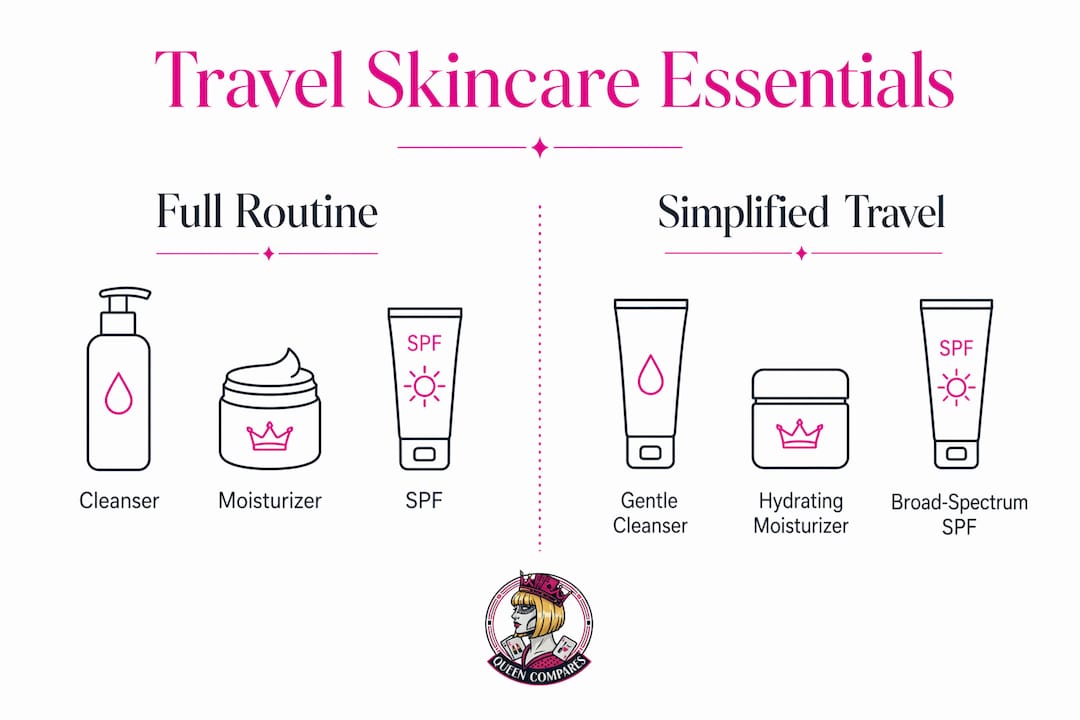
The importance of skincare travel comes down to three non-negotiables: a gentle cleanser, a moisturizer, and a broad-spectrum SPF. Every other product is optional. Dermatologists consistently point to this trio as the foundation that keeps skin protected and hydrated regardless of destination.
Broad-spectrum SPF is the only truly non-negotiable item for travel because UV exposure increases with altitude. A window seat on a four-hour flight exposes you to meaningful UV radiation. SPF 30 or higher, applied every two hours during sun exposure, is the standard recommendation.
Top sunscreens on QueenCompares.com:
Top Clean Beauty Mineral sunscreen picks:
Top K-Beauty Picks:
-
Anua KPop Demon Hunters Mineral Weightless Finish SPF50 Sunscreen 50ml
-
Anua KPop Demon Hunters Zero-Cast Moisturising Finish SPF50 Sunscreen 50ml
-
Beauty of Joseon Relief Sun: Rice + Probiotics SPF 50+ PA++++
The TSA 3-1-1 rule limits liquid and cream products to 100 ml per container in carry-on bags. That constraint is actually a gift for your skin. It forces you to choose products that do more than one job. A moisturizer with SPF 30 built in replaces two separate products. A cleansing oil removes makeup and cleanses in one step.
Multifunctional 4-product regimens balance protection, hydration, and repair more effectively for travelers than complex multi-step routines. Simplified routines also produce more consistent results because travelers actually apply them.
| Product category | Full home routine | Simplified travel routine |
|---|---|---|
| Cleanser | Dedicated cleanser + makeup remover | One cleansing oil or gentle low-pH cleanser |
| Treatment | Serum, retinoid, acid toner | None or a single hydrating serum |
| Moisturizer | Day cream + night cream | One moisturizer for day and night |
| Sun protection | Separate SPF 30–50 | Moisturizer with SPF or dedicated SPF only |
| Eye care | Eye cream | Skip or use main moisturizer |
| Total products | 6–8 | 3–4 |
Pro Tip: Look for all-in-one skincare products that combine moisturizing and sun protection. One well-formulated product does the job of two and frees up space in your liquids bag.
How to prepare your skin before and during travel
Preparation is the most underrated part of travel skincare. Most travelers focus on what to pack. The smarter move is to focus on what to do before you leave.
A 4–6 week pre-trip preparation window is optimal for building skin barrier resilience. During this period, focus on consistent hydration, gentle cleansing, and daily SPF use. Your skin builds tolerance and strength when it receives the same signals repeatedly. Introducing barrier-supporting ingredients like ceramides or niacinamide during this window gives your skin a head start before the stressors of travel hit.
Once you are on the plane, the approach shifts. Effective in-flight skincare depends more on pre-flight preparation than on mid-flight product application. Piling on serums and sheet masks during a flight adds product weight to already-stressed skin and can clog pores in low-humidity conditions.
Internal hydration outperforms topical layers at altitude. Drinking 8 ounces of water per hour during a flight supports skin hydration from the inside out. Alcohol and caffeine dehydrate you faster at altitude, so skipping them on long-haul flights makes a real difference.
Adjusting your routine for your destination climate is the final step. Dry climates call for a richer moisturizer and more frequent application. Humid destinations require lighter formulas to avoid congestion. The core products stay the same. Only the texture changes.
-
6 weeks before travel: Introduce ceramide or niacinamide products to strengthen your barrier.
-
2 weeks before travel: Stop using retinoids, strong acids, or any new actives.
-
Night before travel: Cleanse thoroughly and apply a generous layer of moisturizer.
-
Day of travel: Apply SPF before leaving for the airport, even on cloudy days.
-
During the flight: Drink water consistently. Apply moisturizer once after landing, not mid-flight.
-
At your destination: Adjust moisturizer weight based on local humidity. Keep cleanser and SPF unchanged.
Pro Tip: Never introduce a new active ingredient mid-trip. Avoiding new actives during travel is one of the most effective ways to prevent unexpected breakouts or irritation when your skin is already under stress.
Common mistakes travelers make with their skincare
The most common travel skincare mistake is treating a trip as an opportunity to experiment. New destinations, hotel amenity products, and duty-free purchases all tempt travelers into trying something new. That impulse consistently backfires.
Travel is not the ideal time to experiment with new skincare. Your skin is already managing humidity changes, UV shifts, and cortisol spikes. Adding an unfamiliar ingredient to that mix creates one more variable for your barrier to handle. The result is often redness, breakouts, or dryness that ruins the trip.
Overloading skincare or trying new actives during travel consistently worsens skin condition. Retinoids and strong acids increase photosensitivity and thin the barrier. Both effects are dangerous when you are spending more time outdoors and in the sun than usual.
Consistency is the actual solution. Maintaining basic gentle cleansing, hydration, and daily sun protection throughout a trip protects skin better than any new product. Your skin recognizes familiar ingredients and responds predictably to them.
Common travel skincare mistakes to avoid:
-
Using hotel soap or complimentary body wash on your face
-
Applying a new serum or treatment for the first time mid-trip
-
Skipping SPF on overcast days or during city sightseeing
-
Over-cleansing to compensate for feeling oily in humid climates
-
Layering multiple products mid-flight hoping to “fix” dryness
-
Forgetting to reapply SPF after sweating or swimming
Practical packing tips for an efficient travel skincare kit
Packing smart starts with the TSA 3-1-1 rule. Every liquid or cream must be 100 ml or less per container. Choosing products already sold in travel sizes saves you from decanting and reduces the risk of leaks.
Solid and powder formats bypass the liquid limit entirely. Solid cleansing bars, powder sunscreens, and balm-format moisturizers all qualify as non-liquids and can go in your main bag without restriction. They also weigh less and take up less space than their liquid counterparts.
Decanting is the best option when your favorite product only comes in a full-size bottle. Small silicone travel bottles hold enough product for a two-week trip and cost very little. Label each one clearly so you are not guessing at 6 a.m. in a hotel bathroom.
Practical packing checklist for a minimal travel skincare kit:
-
One gentle, low-pH cleanser (100 ml or less, or solid bar format)
-
One moisturizer suitable for your destination climate
-
One broad-spectrum SPF 30 or higher (or a moisturizer with SPF built in)
-
One optional hydrating serum if your skin is prone to dryness
-
Silicone travel bottles for decanting larger products
-
A small zip-lock bag for your liquids to speed up airport security
Pro Tip: Build your travel skincare checklist before every trip rather than grabbing products last-minute. A pre-made list keeps your kit consistent and prevents impulse additions that your skin does not need.
Key Takeaways
A simplified travel skincare routine built on cleanser, moisturizer, and broad-spectrum SPF protects your skin barrier more effectively than a complex regimen when facing the humidity drops, cortisol spikes, and water quality shifts that travel brings.
| Point | Details |
|---|---|
| Cabin air damages your barrier | Humidity at 10–20% in-flight strips the hydrolipidic layer; moisturize before boarding. |
| Three products are enough | Cleanser, moisturizer, and SPF cover all essential skin needs during travel. |
| Preparation beats in-flight fixes | Build skin resilience 4–6 weeks before travel; internal hydration outperforms mid-flight layering. |
| Consistency prevents breakouts | Stick to familiar products; introducing new actives mid-trip worsens skin condition. |
| TSA limits guide smart choices | The 100 ml rule naturally pushes travelers toward multifunctional, efficient products. |
Why I think most travelers overcomplicate this
By Magdalena Kapuscinska
After years of traveling and paying close attention to how skin behaves on the road, I have come to one firm conclusion: most skin problems during travel are self-inflicted. Not by neglect, but by overreaction.
The instinct when your skin feels dry or stressed is to add something. A new serum, a richer cream, a targeted treatment. But your skin during travel is not asking for more. It is asking for less noise and more consistency. The travelers I have seen with the calmest, clearest skin on long trips are almost always the ones carrying three or four products they have used for months.
What surprises most people is that the preparation phase matters far more than anything you do mid-trip. Spending six weeks before a big trip strengthening your barrier with ceramides and niacinamide does more for your skin than any in-flight sheet mask. The mask feels luxurious. The ceramides actually work.
The other thing worth saying plainly: SPF is not optional. Altitude increases UV exposure, and most travelers dramatically underestimate how much sun they get during sightseeing, beach days, and even layovers. A moisturizer with SPF 30 built in is not a compromise. For most travelers, it is the single best product swap they can make.
Simplification is not about doing less because you are lazy. It is about doing the right things consistently because your skin biology demands it.
— Magdalena Kapuscinska
QueenCompares makes finding your travel kit easier
Choosing the right three or four products for a trip sounds simple until you are standing in front of a wall of options at the drugstore. That is where QueenCompares comes in.

QueenCompares lets you compare travel-friendly skincare products side by side, check ingredient safety ratings, and read community reviews from travelers who have already tested these products in real conditions. The platform’s Ingredient Checkerand Label Scanner help you confirm that a moisturizer with SPF actually delivers on both claims before you commit to packing it. Whether you are building your first minimal travel kit or refining one you have used for years, the QueenCompares community has the comparisons and ingredient insights to help you choose with confidence.
FAQ
Why does cabin air affect skin so much?
Cabin humidity drops to 10–20% during flights, which pulls moisture from the skin’s hydrolipidic layer and weakens the barrier. This makes skin more reactive and prone to dryness and irritation.
What are the three must-have skincare products for travel?
A gentle cleanser, a moisturizer, and a broad-spectrum SPF of 30 or higher cover all essential skin needs during travel. Every other product is optional.
Should I apply skincare products during a long flight?
Pre-flight preparation and drinking water during the flight matter more than mid-flight product application. Apply moisturizer before boarding and focus on internal hydration throughout the flight.
Is it safe to try new skincare products on vacation?
Travel is the worst time to introduce new actives, retinoids, or strong acids. Your skin is already under stress from environmental changes, and new ingredients add unpredictable variables that often cause breakouts or irritation.
How do I keep my skincare carry-on compliant?
The TSA 3-1-1 rule limits liquids and creams to 100 ml per container. Choose products already in travel sizes, use solid formats like cleansing bars, or decant favorites into labeled silicone travel bottles.