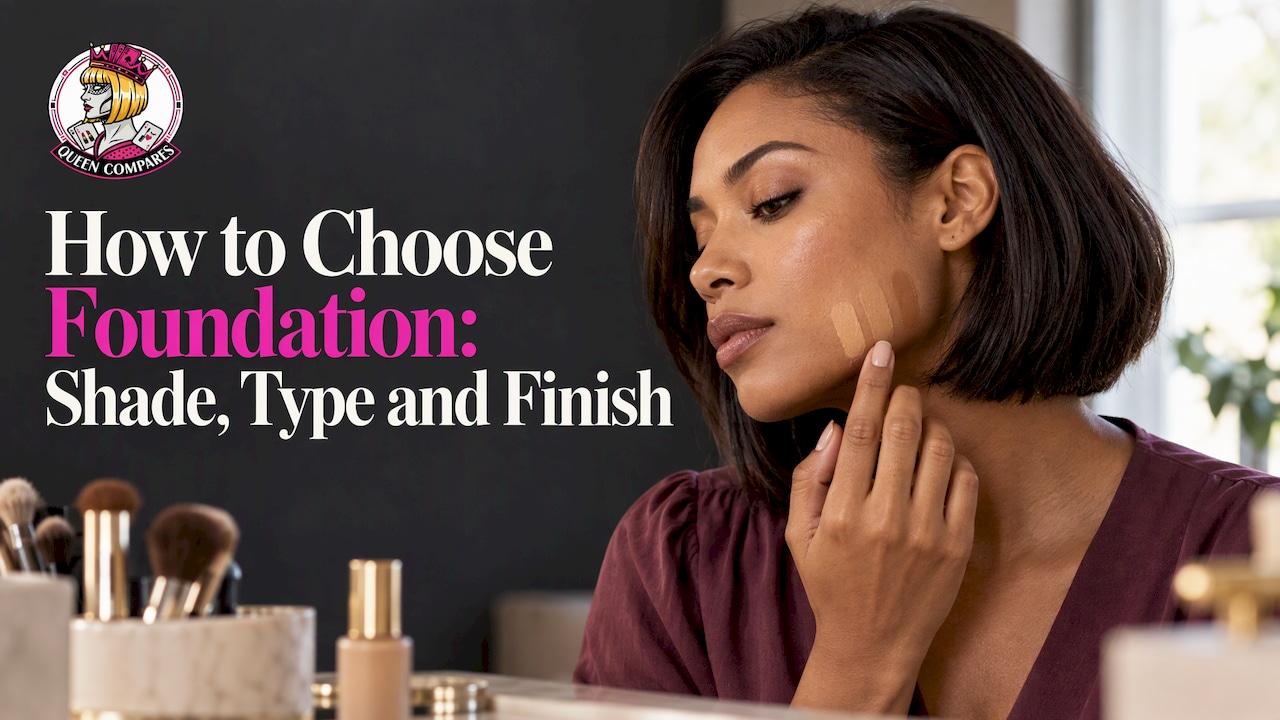
Choosing foundation comes down to four decisions, made in this order: your undertone, your shade depth, a formula for your skin type, and a wear test in daylight. Get the undertone and depth right and the base disappears into your skin. Get the formula right and it stays comfortable all day. We built Queen Compares so you can make the last two decisions with the ingredient list in front of you, not just the label’s promises.
Key Takeaways
-
Find your undertone first (cool, warm, neutral or olive), then choose the depth. Undertone is the color beneath the surface, and depth is how light or deep your skin is.
-
Aim for a true match. If you land between two shades, a slightly lighter one is usually easier to fix than a darker one.
-
Pick the formula by skin type: matte or oil-free for oily skin, hydrating or dewy for dry skin, and a gentle, fragrance-free base for sensitive skin.
-
Swatch on your jaw and neck, then check the color in natural light and again after a few hours of wear.
-
Read the ingredient list before you buy. Queen Compares has an ingredient checker and a label scanner to help you do it quickly.
Table of Contents
Start With Your Undertone
Your undertone is the subtle color under your skin’s surface. It is separate from your depth, which is how light or deep you are. Two people with the same depth can need very different foundations because their undertones differ.
Undertones are usually grouped into four families, according to Ulta Beauty’s education page:
-
Cool: pink, red or bluish.
-
Warm: golden, yellow or peach.
-
Neutral: a balance of the two.
-
Olive: green, gray or muted golden.
Undertone does not follow how fair or deep your skin is. Even very fair skin can be warm, and deeper skin can be cool. So skip the shortcuts based on your hair or eye color and look at your actual skin.
A quick way to read your undertone
-
Wash your face and apply your usual skincare, so you are judging your skin as it normally looks.
-
Stand by a window in natural daylight and look at your face, jawline, neck and upper chest.
-
Note your strongest color clues: pink or red, yellow or golden, a mix of both, or a greenish, muted cast.
-
Hold that result loosely. The swatch test below is what confirms it.
This is the same comparison approach the Ulta guide lays out. It works because you are not guessing in the abstract. You are comparing real shades against real skin. If you want a deeper walkthrough, our guide to finding your undertone and matching it covers it step by step.
Which foundation undertone goes with which skin undertone
As a starting point, Healthline’s guidance is:
| Your undertone | Foundation direction |
|---|---|
| Cool | Shades without yellowish tones |
| Warm | Slightly yellow shades |
| Neutral | A combination of both |
| Olive | A slight golden color, not a warm yellow |
If you have pink or red undertones, Clarins suggests a beige or pinky-beige foundation. For olive and deeper skin, it points to golden beige shades. Treat these as a starting range, not a final answer. Labels such as “neutral beige” or “golden” are not standardized from one brand to the next.
Match Your Depth: Lighter, Darker or Exact?
The aim is a foundation that disappears, so aim for a match. L’Oréal Paris advises matching rather than going lighter or deeper, because that keeps the base invisible. Going deeper than your skin often looks more obvious than going slightly lighter.
The risks on either side are easy to spot:
-
Too light: your face can look ashy or ghostly, with a visible line against your neck.
-
Too dark: the same source notes the face can look orange.
If you fall between two shades, choose the slightly lighter one. You can then add dimension with bronzer or contour. L’Oréal gives the same fix for a shade that looks too light: warm the perimeter of your face with bronzer and add subtle contouring.
Do you need two shades?
Your skin changes with the seasons. L’Oréal recommends keeping your exact match for cooler months and going one to two steps deeper for summer. Some makeup artists also suggest buying one shade slightly darker and one slightly lighter, then mixing them to fine-tune the color if no single bottle is perfect. A dermatologist interviewed by Zula notes that even professional makeup artists often mix their own shades. So a custom blend is a normal technique, not a workaround.
Choose the Formula for Your Skin Type
Shade gets you the color. Formula decides how the foundation feels at noon and at 6 p.m. Match it to your skin type first and your finish preference second.
| Skin type | What to look for |
|---|---|
| Oily | Oil-free or matte, long-wearing formulas |
| Dry | Hydrating formulas with a dewy or satin finish; hyaluronic acid is a useful ingredient |
| Combination | Matte in the T-zone, hydrating on drier areas, or a natural satin finish |
| Sensitive | Hypoallergenic, gentle, fragrance-free or mineral-based formulas |
| Mature | Lightweight, buildable formulas with a radiant finish |
The oily, dry, combination, sensitive and mature guidance comes from Synergie Skin’s foundation guide. Vogue India’s makeup artist advice lines up with it: oil-free, matte or long-wear for oily or acne-prone skin, and hydrating or serum-infused formulas for dry skin.
Water-based or silicone-based
The base of the formula matters as much as the finish. L’Oréal Paris’s comparison puts it this way:
-
Water-based foundations suit dry, sensitive and acne-prone skin. They feel hydrating, with a dewy-to-natural finish and light-to-medium coverage.
-
Silicone-based foundations suit oily, combination and textured skin. They give a smoothing effect, a natural-to-matte finish and medium-to-full coverage.
If you cannot tell which type a bottle is, the ingredient list will show it. That is where an ingredient checker saves time. You can run a foundation through Queen Compares’ ingredient analysis and see what is in the formula before you buy.
Liquid, cream or powder
Liquid or cream is a good place to start. Liquid generally sits better on oily skin than powder. Powder foundations can work for oily skin but are best avoided on dry skin.

Tinted moisturizer, BB cream, CC cream or foundation
If full foundation feels like too much, there are lighter options:
-
Tinted moisturizer: sheer, skin-like coverage that suits dry skin. Curology notes that dry skin may suit a tinted moisturizer or a natural, glowy foundation.
-
BB cream: a light, skincare-leaning base for an everyday, low-effort look.
-
CC cream: a light base for people who want a little color evening without a heavy feel.
-
Foundation: the most shade range and coverage control, from sheer to full.
If you are deciding between a tinted moisturizer and a foundation for long days, our comparison of tinted moisturizer vs. foundation with ingredient checks walks through it. If you like a skin-first formula, see our top serum foundations.
Pick Your Coverage and Finish
Coverage is how much the product hides. Finish is how it looks once it dries: matte, natural, satin or dewy.
-
Light coverage gives a skin-like look and suits everyday wear.
-
Medium coverage evens tone and covers most redness.
-
Full coverage hides the most, and works for events and photos.
For acne or redness, Curology recommends a buildable medium or full coverage, which can reduce the need for a separate concealer. Lightweight matte is a good choice for oily or combination skin.
Finish is partly personal and partly practical. Luminous formulas can look shiny in photos, so one makeup artist recommends primer and a sheer matte foundation for photo ops. If you are torn, our guide to matte vs. dewy foundation will help you decide. For more detail on the whole range, see how finish types differ in makeup.
Test the Shade the Right Way
Here is the routine to follow, built from the swatching steps in Ulta Beauty’s guide.
-
Prep your skin. Apply your usual skincare first.
-
Choose three shades. Pick several at the same general depth that look close to your skin.
-
Swatch from jaw onto neck. Make separate vertical stripes, so you see how each shade blends into both your face and your neck.
-
Let them settle. Foundation can shift as it dries.
-
Check in natural light. Store lighting changes color. Step outside or stand by a window.
-
Confirm the depth. Compare a slightly lighter and a slightly deeper shade in the same undertone family.
-
Test a larger area. A stripe can fool you. Blend a patch across your cheek.
-
Recheck after wearing it. See how it looks after a few hours.
A makeup artist’s trick: squint, and the color that seems to disappear is your match. The same source notes that most oil-free foundations oxidize (darken) on oily skin through the day, so wear a test for a few hours before you commit.
Where shade testing goes wrong
-
Testing on your hand or wrist. Your face and neck are the reference.
-
Judging under store lights. Check in daylight.
-
Deciding at the moment of application. Wait for it to settle and oxidize.
-
Ignoring the neck. A shade that matches your cheek but not your jaw will show a line.
Apply it so it looks like skin
Application affects how a match looks. One makeup artist in Vogue India suggests starting with less than you think you need, applying thin layers and pressing the product in instead of swiping. Use powder where you need it, not necessarily everywhere, to avoid cakiness. Our guide to setting spray vs. powder helps you decide which one your base needs.
Choosing Foundation for Sensitive or Acne-Prone Skin
If your skin reacts easily, ingredients matter as much as shade.
-
Look for noncomedogenic formulas. A dermatologist quoted in Byrdie recommends noncomedogenic products for sensitive, breakout-prone skin. Some makeup also contains active acne-fighting ingredients such as salicylic acid.
-
Watch for bismuth oxychloride. A dermatologist interviewed by Zula describes bismuth oxychloride as a common filler in mineral makeup that can irritate and cause a “cut glass” feeling. If your skin is touchy, check for it on the label.
-
Patch test first. The same dermatologist advises leaving a small amount on your forearm or under your chin overnight. If there is no redness, flaking or stinging, the product is likely fine for you. A patch test for sensitive skin follows the same logic of waiting and watching for a reaction. Our own guide shows how to patch test skincare products the right way.
If you have a history of allergic reactions, a skin condition, or a reaction that does not settle, see a dermatologist before trying new base makeup.
For your routine around the makeup, we have a 3-step sensitive skin routine, a routine for oily skin, and a guide to calming irritated skin.
Our Perspective
Most foundation advice stops at shade. Shade is the part you can see, so it gets all the attention. But the bottle you buy is also a list of ingredients that sits on your face for hours, and that list is where a lot of the difference between products lives.
That is why we built Queen Compares around ingredient-level analysis, side-by-side comparison and community reviews. When you compare two foundations next to each other, you see more than price and color range. You see what each formula contains, which ingredients may be a concern for your skin, and what other shoppers with your skin type say about wear.
Our AI-driven Ingredient Checker and Label Scanner exist for the moment you are standing in the aisle, or looking at a product page, and need an answer quickly. If you are choosing between clean beauty options, our Clean Beauty Catalogue gathers curated picks in one place.
Pick the shade by eye and daylight. Pick the formula by reading what is in it.
Magdalena
Make the Choice Easier With Queen Compares
Once you know your undertone, depth and formula type, the remaining job is comparing real products. That is what our platform does.
-
Ingredient analysis: check a foundation’s formula and see safety and allergen alerts on Products By Ingredient.
-
Label Scanner and Ingredient Checker: AI-powered tools that help you check a product against your needs.
-
Clean Beauty Catalogue: browse curated clean beauty picks, including bases for people who want a low-tox routine.
-
Skincare Routine Builder: build a routine around your base with the Skincare Routine Builder, with our Premium Access €7 per month for full package

Premium Access is also €7 per month, and you can see what it includes on the Premium page.
FAQ
Should foundation be lighter or darker than your skin?
Neither: aim for an exact match. If you are between two shades, the slightly lighter one is usually easier to correct, because you can add warmth with bronzer. A shade that is too dark can look orange, and one that is too light can look ashy.
How do I know my skin tone for foundation?
Look at your face, jawline, neck and chest in natural daylight after applying your usual skincare. Note whether you see pink or red (cool), yellow or golden (warm), a mix (neutral), or a greenish, muted tone (olive). Then confirm by swatching shades along your jaw and neck.
How do I choose the right type of foundation?
Start with your skin type. Oily skin tends to do well with oil-free, matte formulas, dry skin with hydrating, dewy ones, and sensitive skin with gentle, fragrance-free ones. Then choose coverage: light for a natural look, and medium or full for more coverage.
Do I need a different foundation shade in summer?
Many people do. L’Oréal Paris recommends keeping your exact match for cooler months and going one to two steps deeper in summer. Some people keep two bottles and blend them to adjust the color.
How long should I test a foundation before buying?
Wear a test for a few hours if you can. Foundation can settle, and many oil-free formulas darken on oily skin through the day. Check the color again in natural light before you decide.
Sources
-
How to choose your foundation shade, according to makeup pros | Vogue India
-
9 Tips to Pick the Best Foundation Color for Your Skin Tone | Byrdie
Recommended
General Entertainment & Information Purposes Only At QueenCompares.com we share content for general entertainment and information. It’s not medical, dermatological, nutritional, or fitness advice and shouldn’t replace guidance from a licensed professional. If you’re making health-related decisions, please check with a qualified expert — and know that using this site and its information is at your own discretion.