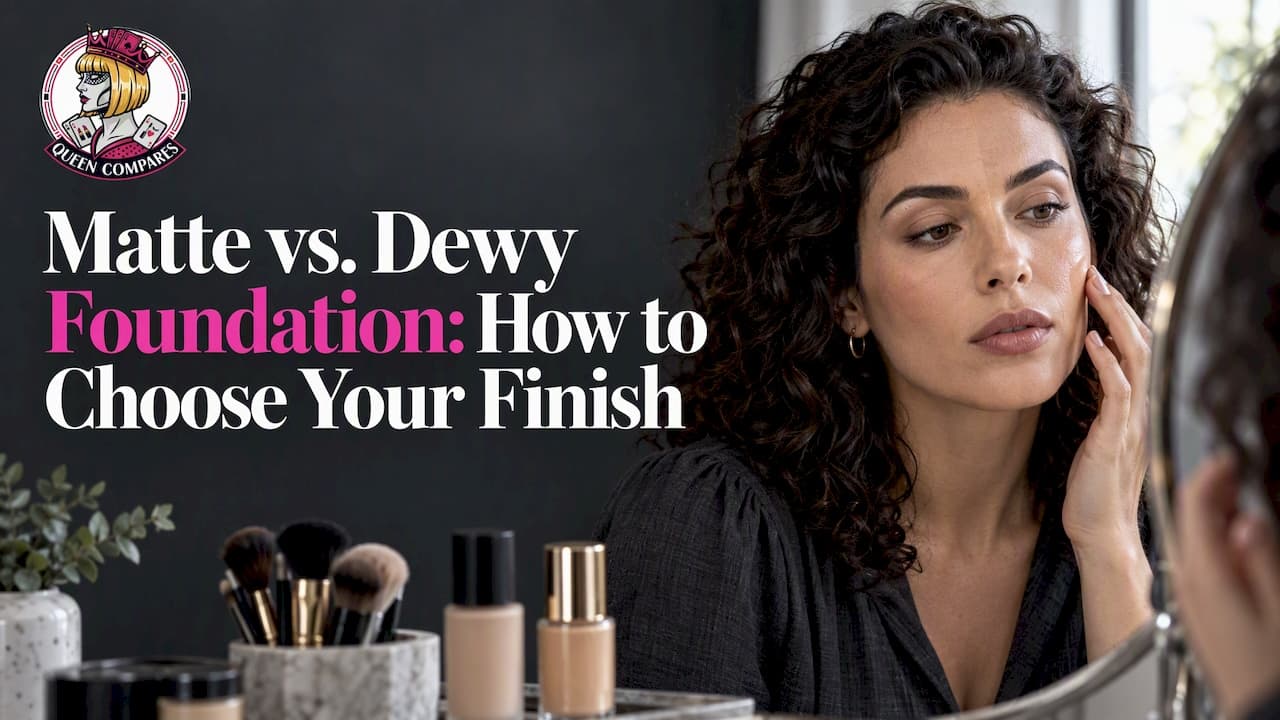
Matte foundation gives you a smooth, shine-free, velvety look that usually lasts longer. Dewy foundation gives you a fresh, luminous glow that looks like healthy, hydrated skin. The right one depends on your skin type, the occasion and how you prep your skin. Oily and combination skin tend to do best with matte or soft-matte formulas. Dry and mature skin tend to look better in dewy or satin ones. Below, we break down how each finish works, who it suits, and how to test a formula before you commit.
Key takeaways
-
Matte controls shine, blurs the look of pores and tends to wear longer. Dewy adds glow and a hydrated look but usually needs more touch-ups.
-
Skin type is the best starting point: oily skin leans matte, dry skin leans dewy, and combination skin often works best with satin or a soft-matte base.
-
Satin sits between the two. It is the easiest compromise if you are not sure which side you are on.
-
Your prep matters as much as the formula. Moisturizer, sunscreen and primer can push the same foundation toward glowy or flat.
-
Read the ingredient list. Oils, silicones and film formers behave very differently on different skin, and a label check can save you a breakout.
Table of Contents
What actually separates matte from dewy
The difference is about light. A matte finish scatters light so skin looks even and flat, which blurs texture and hides shine. A dewy finish reflects light, so skin looks plump and wet in the best way.
Chemistry does the work. According to Cosmopolitan’s breakdown of the two finishes, matte formulas rely on ingredients that absorb oil and scatter light, while dewy formulas use light-reflecting minerals like mica plus humectants to keep skin looking moist. Revlon’s guide adds that dewy formulas often contain mica or synthetic fluorphlogopite alongside humectants such as glycerin and hyaluronic acid, and that they generally wear off faster than matte ones.
That explains two common complaints:
-
Cakey: often a matte formula sitting on dry or unprepped skin, where powders and oil absorbers grab onto dry patches and texture.
-
Greasy: often a dewy formula on oily skin, where the natural shine of your skin stacks on top of the reflective finish.
Neither finish is better. Each one is a tool, and the skill is matching it to your skin and your day.
Matte vs. dewy foundation at a glance
| Matte | Dewy | Satin | |
|---|---|---|---|
| Look | Velvety, shine-free, airbrushed | Luminous, fresh, “lit from within” | Soft glow, natural skin-like sheen |
| Best for | Oily, combination, acne-prone skin | Dry, dehydrated, mature skin | Normal and combination skin, or anyone undecided |
| Wear time | Usually longest | Often shorter, more touch-ups | Moderate |
| Pores and texture | Blurs them | Can highlight them | Softens without flattening |
| Typical risks | Looks flat or cakey on dry skin | Looks greasy on oily skin, may slide | Can shine through in the T-zone by afternoon |
| Photos | Can flash back with some SPF and powders | Catches light, can look shiny under flash | Usually forgiving |
The wear-time and finish patterns above are general. Charlotte Tilbury’s finish guide describes dewy as light-to-medium coverage that feels hydrating and fades gracefully, which matches what most people experience. Individual formulas vary, so treat the table as a starting point.
Which finish suits your skin type
Oily and acne-prone skin
Matte or mattifying formulas are the usual choice. bareMinerals’ skin-type guide points oily and acne-prone skin toward matte or mattifying options with ingredients like clay or kaolin, labeled non-comedogenic, and suggests setting the T-zone only.
A few practical tips:
-
Keep your skincare light. A gel moisturizer and a quick routine go a long way. Our quick skincare routine for oily skin walks through it.
-
Apply foundation in thin layers. Piling on matte product is what turns it patchy by noon.
-
Check the label for pore-clogging ingredients. Our guide to the worst pore-clogging ingredients shows what to look for.
Dewy foundation is not off the table for oily skin. A soft, thin dewy base on the cheeks only, with matte on the T-zone, is a classic makeup artist move. Just expect to blot.
Dry and dehydrated skin
Dewy or natural finishes win here. The same bareMinerals guide recommends dewy or natural finishes for dry skin, with humectants and emollients, and advises skipping heavy powder. Look for formulas with hyaluronic acid, glycerin, ceramides or squalane, and apply over a moisturizer you have let sink in for a few minutes.
If your foundation looks patchy, the cause is often prep rather than the product. Exfoliate gently once or twice a week and hydrate before base, not after.
Combination skin
Combination skin is where satin and soft-matte shine. The same guide suggests a natural or soft-matte finish, with hydration targeted at the cheeks and mattifying only the T-zone. In practice that means one foundation across the face, then a pea-size amount of primer on the nose and forehead, and a light dusting of powder only where you shine.
Mature skin
This is one of the most common questions readers ask: should mature skin be matte or dewy? Usually dewy or satin, because heavy matte formulas can settle into lines. In a Glamour roundup tested by a writer in her fifties, the foundation advice is to look for a hydrating formula that won’t crease or crack through the day, and the pick is a Charlotte Tilbury foundation infused with hyaluronic acid and coconut extract.
For a deeper look, see our best makeup for mature skin guide. If you want cream-first ideas and are curious about hands-on help, this guide to makeup essentials for mature skin covers cream products that don’t settle into lines.
Where satin fits in
Satin foundation is the middle of the spectrum. It looks like skin with a gentle sheen, not a wet glow and not a flat veil. If you are searching satin vs. matte, here is the simple version:
-
Choose matte if shine bothers you, you need a base to last through a long event, or you plan to take flash photos.
-
Choose satin if you want your skin to look like skin, with some life in it, and you do not want to blot all day.
-
Choose dewy if your skin is dry or you want an obvious glow.
Satin is also the safest first buy for beginners. It forgives skin that changes through the month or with the weather.
Match the finish to the occasion
Your skin type sets the default, but your day can override it.
| Situation | Finish to try | Why |
|---|---|---|
| Long workday, no time for touch-ups | Matte or soft-matte | Longer wear, less shine |
| Wedding, with photos and hours of wear | Satin or soft-matte with targeted powder | Glow without sliding, camera-friendly |
| Casual weekend or brunch | Dewy or a tinted base | Fresh, skin-like, quick |
| Hot, humid weather | Matte or soft-matte | Humidity amplifies natural oil |
| Cold, dry winter | Dewy or satin | Dry air makes matte look flat |
Revlon’s guide makes the same point: the right pick comes down to skin type, occasion and prep. A single bottle rarely covers all your days, and many people keep one matte and one dewy product for that reason.
Product types to consider
Finish is a formula choice, but so is format. Here is how common base products behave:
-
Tinted moisturizer: sheer, hydrating and usually dewy or natural. It suits dry skin, warm weather and anyone who wants a no-makeup look. See our comparison of tinted moisturizer vs. foundation for long days.
-
Skin tint and BB cream: light coverage with skincare-style ingredients. They usually land between dewy and satin. Good for beginners.
-
CC cream: often aimed at color correction, such as redness or dullness. Usually light to medium coverage and a natural finish.
-
Liquid foundation: the widest range of finishes and coverage. Check the label, because “matte” and “dewy” both come in this format.
-
Serum foundation: lightweight, with skincare-style ingredients, usually a natural or glowy finish. Our top serum foundations roundup covers skin-first options.
-
Cream or stick foundation: buildable, and usually dewy to satin. Matte sticks exist too.
If you want a named starting point, the hydrating Charlotte Tilbury foundation from the Glamour test above is a dewy-leaning pick for dry or mature skin. For a matte direction, look for oil-free formulas labeled non-comedogenic and compare ingredient lists side by side before buying.
Prep decides how the finish looks
The same foundation can look glassy or flat depending on what is underneath. Three things matter most.
Sunscreen
Sunscreen goes under foundation, and it changes the finish. A gel or fluid formula keeps things matte-friendly, while a cream formula adds glow. We cover the how-to in why you should wear sunscreen under makeup. If you need to reapply during the day, our guide to reapplying sunscreen over makeup shows the blot-then-press method that avoids smudging.
Some SPF and powder combinations can show up white in flash photos. That is covered in our guide to makeup flashback.
Serums
A brightening serum can give skin a healthy base before foundation. Vitamin C is a popular choice. Wirecutter has a best vitamin C serums guide, and Forbes has its own vitamin C serum picks. The Forbes list sorts options by need, including beginners, mature skin and hyperpigmentation. Let a serum absorb fully before moisturizer and base, and patch-test any new active first.
Primer and powder
A mattifying primer on the T-zone or a hydrating one on dry areas lets you run two finishes on one face. For powder, press it where you shine instead of sweeping it everywhere. Setting everything is the fastest way to turn a dewy base flat.
How to test a finish before you commit
-
Check the undertone first. A perfect finish in the wrong shade still looks off. Our guide to finding your undertone helps.
-
Swatch along the jawline, in daylight. Store lighting hides shine and dryness.
-
Wear a sample for a full day. Look at your T-zone at hour four and your cheeks at hour eight.
-
Note what changes. Patchy by lunch means too matte for your skin or not enough prep. Slick by lunch means too dewy.
-
Adjust before you switch. Blotting papers, a setting spray or a thin layer of powder can fix most problems without a new product.
Read the label, not just the finish name
A bottle that says “matte” or “dewy” tells you the look, not what is inside. Two foundations with the same finish can behave very differently on sensitive or breakout-prone skin because of their ingredients. Humectants such as glycerin and hyaluronic acid are common in dewy bases. Oil absorbers and clays are common in matte ones. Fragrance, certain oils and some film formers are worth a second look if you react easily.

If a product does cause a reaction, stop using it and see a doctor or dermatologist. Under FDA regulation 21 CFR 720.4, cosmetic manufacturers must provide ingredient information about a product on request to licensed physicians treating patients for adverse reactions. Keeping the product packaging helps your doctor identify what to look into.
Our perspective
We built Queen Compares because finish names are marketing, and ingredient lists are the truth. When people tell us a foundation “broke them out” or “looked greasy,” the answer is rarely that the finish was wrong in the abstract. It is usually that the formula, the prep and the skin were not a match.

Our advice is simple. Pick your finish by skin type and day, not by trend. Treat satin as a safe starting point. Compare two or three products side by side on ingredients, not only on reviews. And remember that glow is partly a prep decision: well-hydrated skin looks dewy through a satin base, and well-controlled shine looks fresh through a matte one.
One more thing: do not feel locked in. Skin changes with seasons, hormones, travel and age. The best foundation for you in July may not be the best one in January.
— Magdalena - Queencompares.com Founder
Check a foundation’s ingredients before you buy
If you are choosing between two bases, paste the ingredient list into our Ingredient Checker to see safety and allergen flags, or try our Clean Beauty page with full AI Ingredient Analysis for a closer read of a formula. You can also browse products by ingredient if you want to avoid or find a specific one, such as a humectant you like or a fragrance you react to.
FAQ
Who should not wear matte foundation?
People with very dry, flaky or dehydrated skin often find matte formulas emphasize texture and look cakey. Mature skin with fine lines can also look flatter in a heavy matte base. If you love the look, prep well with moisturizer and try a soft-matte formula instead.
Should mature skin be matte or dewy?
Most mature skin looks best in a dewy or satin finish with a hydrating formula, because it is less likely to settle into lines. Soft-matte can work if you are oily or combination. Test on your jawline and check for creasing after a few hours.
What skin type is dewy foundation for?
Dewy foundation is generally best for dry and normal skin, and for anyone who wants a glowy look. On oily skin it can turn greasy, since the finish adds to your natural shine. If you have oily skin and want glow, apply it only to the high points of your cheeks.
Is dewy or matte makeup more attractive?
Neither wins. Dewy reads as fresh and youthful, and matte reads as polished and smooth. What looks best is the finish that suits your skin, because the wrong match shows up as cakiness or shine.
Can I mix matte and dewy foundation?
Yes. Many makeup artists use a matte base through the T-zone and a dewy one on the cheeks. You can also use a satin foundation and add powder or highlighter only where you want to change the finish.
Sources
-
Dewy vs. Matte Foundation: Which Finish Is for You? | Revlon
-
Dewy vs Matte Foundation: The Pros, Cons, and Top Formulas to Try | Cosmopolitan
-
How To Choose The Right Foundation Finish | Charlotte Tilbury
-
The Best Vitamin C Serums That Deliver Glowy Results | Forbes
Recommended
General Entertainment & Information Purposes Only At QueenCompares.com we share content for general entertainment and information. It’s not medical, dermatological, nutritional, or fitness advice and shouldn’t replace guidance from a licensed professional. If you’re making health-related decisions, please check with a qualified expert — and know that using this site and its information is at your own discretion.