
Here's the whole thing in one breath: wash your face, moisturize, and wear sunscreen every single morning; at night, wash your face again, use a treatment product if you have one, then moisturize. That's it. Dermatologists at the American Academy of Dermatology back this exact structure as the foundation for most men, and sunscreen is the one step you truly cannot skip.
We built QueenCompares for guys who want results without a ten-step ritual, so let's cut straight to the rules of thumb:
- Cleanse your face twice a day, morning and night.
- Apply broad-spectrum SPF every morning, rain or shine.
- Exfoliate one to three times a week, never daily.
- Save retinol for nighttime only, and start slow.
If you remember nothing else from this guide, remember that sunscreen line. Skin cancer risk and visible aging both trace back to sun exposure more than almost anything else you'll read about skincare.
Key Takeaways
A men's skincare routine works when it's built on daily SPF, twice-daily cleansing, and slow, deliberate introduction of actives like retinol.
| Point | Details |
|---|---|
| Daily SPF is non-negotiable | Apply broad-spectrum SPF 30+ every morning and reapply every two hours in direct sun. |
| Keep the core routine to three steps | Cleanse, moisturize, and protect covers most men's needs without added complexity. |
| Match products to skin type | Choose non-comedogenic, oil-free, or fragrance-free formulas based on your specific skin signals. |
| Change razor blades every five to seven shaves | Dull blades cause more irritation and ingrown hairs than the shaving technique itself. |
| Introduce retinol slowly | Start one to two nights a week, use it only at night, and always pair it with daily sunscreen. |
Table of Contents
- Your Men's Skincare Routine: Morning and Evening Steps
- What's Your Skin Type, and What Should You Buy?
- How Should You Shave to Avoid Razor Burn?
- When Should You Start Exfoliating and Using Retinol?
- Fixing Acne, Sensitivity, Aging, and Clogged Pores
- Why Hydration and Diet Matter More Than Your Product Shelf
- Adjusting Your Routine for Seasons and Climate
- What Men's Skincare Advice Usually Gets Wrong
- Sources
- FAQ
Your Men's Skincare Routine: Morning and Evening Steps
A routine only works if you'll actually do it every day, so speed matters as much as the ingredients. Here's the order that works with your skin's chemistry, not against it.
Morning routine (about 90 seconds):
- Cleanse with a gentle, non-drying face wash to remove overnight oil buildup.
- Treat with an antioxidant serum like vitamin C, if you use one, applied to damp skin before moisturizer.
- Moisturize to lock in hydration and support your skin barrier.
- Protect with broad-spectrum SPF 30 or higher, applied as the final step.
Evening routine (about 2 minutes):
- Cleanse to remove sweat, oil, sunscreen, and grime from the day.
- Treat with a targeted active, if you're using one, such as a chemical exfoliant a few nights a week or retinol on the nights you've built up to.
- Moisturize, often with a slightly richer formula than your daytime one, since your skin repairs itself overnight.
You can legitimately compress the morning routine into two products. A moisturizer with SPF built in eliminates a step, and a combined serum-and-moisturizer product does the same at night. Editorial testing from GQ found that men stick with routines far better when steps get consolidated into dual-purpose products rather than treated as separate rituals. If a two-minute face-only routine is your ceiling right now, our five-minute skincare routine guide breaks down exactly which combos work.
Don't stop at your jawline. Sunscreen and moisturizer both need to cover your ears, neck, and hairline, three spots that get sun exposure but almost never get product. If you're bald or have a shaved head, that scalp needs SPF too. Bearded guys should work moisturizer down into the beard base, not just on top of it, since skin under facial hair still gets dry and irritated.

Pro Tip: Keep your SPF bottle next to your toothbrush. If reaching for sunscreen is as automatic as brushing your teeth, you'll never skip it, even on rushed mornings.
What's Your Skin Type, and What Should You Buy?
Guessing your skin type from a shelf of products is how most men end up with the wrong routine. Figure this out first, because it decides everything downstream.
Run this quick check: does your face get shiny by midday, especially across your forehead and nose? That's oily skin. Does it feel tight, flaky, or rough a few hours after washing? That's dry skin. Oily T-zone but normal or dry cheeks means combination skin. If products regularly cause stinging, redness, or breakouts, you're dealing with sensitive skin, and if you get regular breakouts anywhere on the face, you're acne-prone, which can overlap with any of the above.
Once you know your type, the label tells you what to buy. Look for non-comedogenic and oil-free on cleansers and moisturizers if you're acne-prone, and fragrance-free if you're sensitive, guidance the AAD recommends specifically for these skin types. Gel textures tend to suit oily and combination skin better; cream textures suit dry and sensitive skin.
- Dry skin: look for hyaluronic acid and ceramides, which pull in and hold moisture.
- Acne-prone skin: salicylic acid or benzoyl peroxide target breakouts directly.
- Oily skin: niacinamide helps regulate oil production without over-drying.
- Sensitive skin: skip alcohol-based aftershaves and fragranced products entirely.
If breakouts, redness, or dry patches persist for more than a few weeks despite the right products, that's your cue to see a dermatologist rather than keep guessing. For a deeper dive into matching products to your skin, check our skincare tips for every skin type guide, and if oily skin is your specific issue, our oily skin quick routine walks through product picks in more detail.
How Should You Shave to Avoid Razor Burn?
Shaving is arguably the biggest skincare event most men perform daily, and it's also the most common source of irritation nobody thinks to fix.
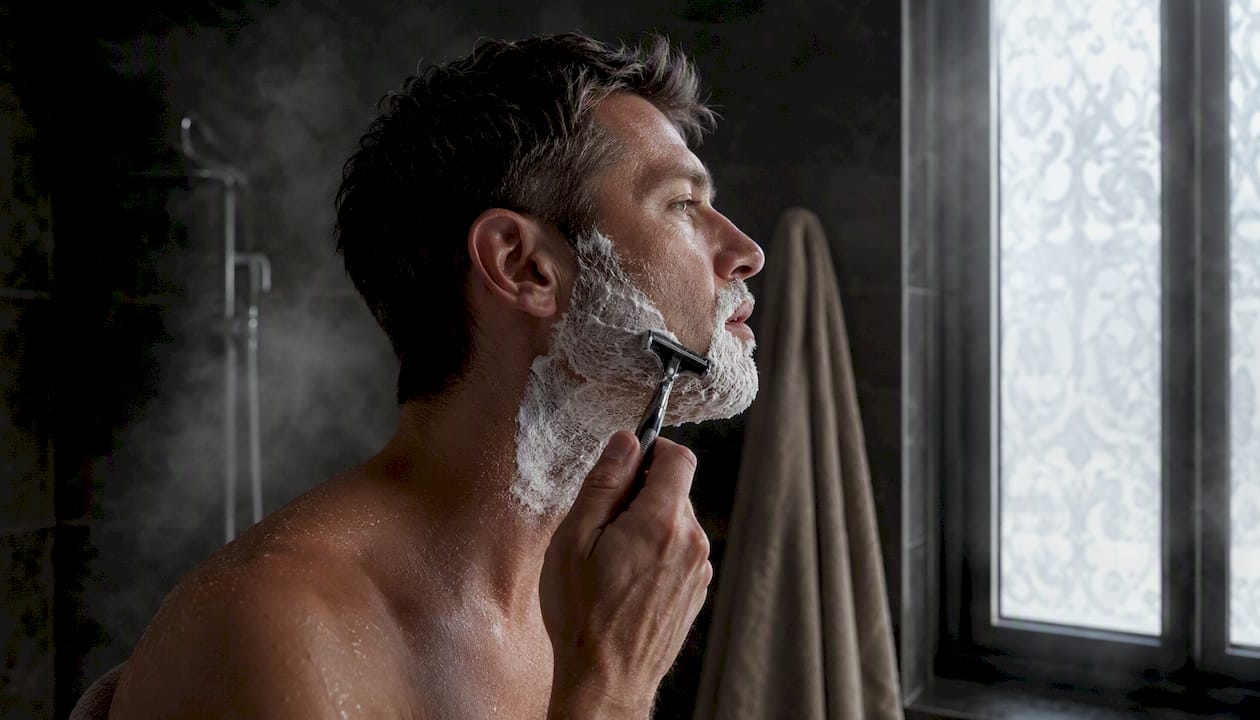
- Soften the hair first. Shave after a warm shower or splash your face with warm water for a minute. Cold, dry hair is stiffer and drags against the blade.
- Shave with the grain, not against it, on your first pass. Going against the grain cuts closer but multiplies your risk of ingrown hairs and razor burn.
- Change your blade regularly after a few uses. A dull blade tugs at hair instead of cutting cleanly, and that's what causes most of the irritation men blame on "sensitive skin," according to GoodRx.
- Apply an alcohol-free balm immediately after, then moisturize as usual once it absorbs.
If you're prone to ingrown hairs no matter how careful you are, an electric razor or a single-blade safety razor often causes less irritation than a multi-blade cartridge, since fewer blades mean less repeated tugging on the same hair follicle. Hold off on exfoliating the day you shave. Doing both in one session strips your skin twice and tends to backfire.
Pro Tip: Shave at the end of your shower, not the start. The steam has had time to fully soften your beard, and you'll notice less tugging almost immediately.
When Should You Start Exfoliating and Using Retinol?
Adding actives is where most men either get real results or wreck their skin barrier trying too much too fast. Exfoliation removes dead skin cells two ways: physical scrubs manually slough them off, and chemical exfoliants like AHAs and BHAs dissolve the bonds holding them together. Dermatologists and skin therapists generally favor gentle chemical exfoliants for regular use, since scrubs are easy to overdo and can cause micro-tears, a point echoed by Dermalogica's skin care guidance. Stick to one to three sessions a week, and never exfoliate on the same day you use retinol.
Speaking of retinol: it's the most effective over-the-counter ingredient for fine lines and texture, but it also makes your skin more sensitive to sun. Men's Health recommends starting at just one or two nights a week, always at night, always followed by moisturizer to buffer irritation, then building up frequency slowly over weeks.
- Vitamin C belongs in your morning routine, applied before moisturizer and SPF. It adds a layer of antioxidant protection against daytime environmental damage.
- If retinol irritates your skin, bakuchiol offers a similar anti-aging effect with far less sensitivity.
- PHAs are a gentler chemical exfoliant option for men whose skin reacts to standard AHAs or BHAs.
- Watch for tightness, redness, or peeling. That's overuse, not "purging," and it means backing off frequency.
Fixing Acne, Sensitivity, Aging, and Clogged Pores
Most skin complaints men bring up fall into four buckets, and each one has a specific fix rather than a generic "wash your face more" answer.

Acne responds well to salicylic acid cleansers or benzoyl peroxide spot treatments, but resist the urge to wash your face more than twice daily. Over-washing strips your skin's natural oils, which triggers it to produce even more oil in response, often making breakouts worse.
Sensitive skin or rosacea-prone skin needs barrier repair first, not more actives. Ceramide-rich, fragrance-free moisturizers rebuild what harsh products strip away. Hold off on exfoliants and retinol until redness and reactivity calm down.
Aging skin benefits most from consistency, not intensity. Daily SPF prevents new damage, antioxidants like vitamin C protect during the day, and retinol introduced slowly at night addresses fine lines and texture. Dermatologists note that an accessible starting point for anti-aging is genuinely as simple as two steps in the morning and three at night.
Clogged pores and blackheads usually mean it's time to check your moisturizer and sunscreen for non-comedogenic labeling, since heavy, pore-clogging formulas make this worse regardless of how often you cleanse.
See a dermatologist promptly if you notice a mole that's changing shape or color, a sore that bleeds and won't heal, or irritation so severe it doesn't improve within a week of easing off products. Those are signals no routine article should talk you through.
How QueenCompares Helps You Choose the Right Products
Reading an ingredient list shouldn't require a chemistry degree, and that's exactly the gap QueenCompares was built to close. Our Ingredient Checker flags whether a product is genuinely non-comedogenic or fragrance-free instead of just claiming it on the front label, and our Label Scanner cross-references formulas against known irritants for sensitive and acne-prone skin.
- Use the Ingredient Checker before buying anything new, especially cleansers and moisturizers.
- Browse our Ingredient Library to understand what niacinamide, ceramides, or salicylic acid actually do.
- Check our beginner routine checklist if you want the whole process mapped out step by step.
Editorial guidance here comes from Magdalena Kapuscinska, whose take on where men's skincare advice tends to go wrong closes out this guide below.
Why Hydration and Diet Matter More Than Your Product Shelf
No serum outworks a dehydrated body. Your skin is your largest organ, and it reflects what's happening internally before it shows up on any product label. Chronic dehydration shows up as tightness, dullness, and more visible fine lines, because skin cells need adequate water content to stay plump and function as an effective barrier.

Diet plays a similarly underrated role. Diets heavy in refined sugar and processed foods have been linked to increased inflammation, which can aggravate acne and accelerate visible aging. Omega-3 fatty acids, found in fish like salmon and in walnuts, support your skin's lipid barrier, the same barrier your moisturizer is trying to reinforce from the outside. Vitamin C from citrus and leafy greens supports collagen production internally, working alongside a topical vitamin C serum rather than replacing it.
None of this means you need to overhaul your diet to see skin benefits. It means treating water intake and basic nutrition as part of your routine, not separate from it. A guy who drinks two liters of water a day and eats reasonably will often get more visible improvement than one who buys a $60 serum but survives on coffee and takeout.
Adjusting Your Routine for Seasons and Climate
Your skin doesn't stay the same all year, so your products shouldn't either. Winter air holds less moisture, and indoor heating strips it further, which means most men need a heavier, more emollient moisturizer from late fall through early spring. If your usual lotion suddenly feels like it's doing nothing in January, that's not a bad product. That's dry air outpacing a formula built for warmer months.
Summer flips the problem. Heat and humidity increase oil production and sweat, which means a lighter, gel-based moisturizer usually performs better than the cream you relied on in winter. Sunscreen needs also intensify: reapply every two hours during actual sun exposure, particularly after swimming or heavy sweating, per AAD guidance.
Dry climates, whether desert heat or high altitude, call for consistent hydration regardless of season, often with an added hydrating serum layered under your moisturizer. If you travel often between climates, keep your routine flexible rather than locked to one set of products, and consider a compact travel version of your essentials. Our travel skincare guide covers exactly how to pack a minimal kit that adapts on the road.
What Men's Skincare Advice Usually Gets Wrong
Most men's skincare content oversells the product and undersells the habit. You'll find endless lists of "must-have" serums but very little honest talk about the fact that a $12 fragrance-free moisturizer used every single day beats a $70 serum used twice a month. Consistency is the entire game here, not formulation complexity.
The other blind spot is treating ingredient labels as marketing copy instead of information you actually need to verify. "Dermatologist recommended" on a bottle tells you nothing about whether that specific product suits your specific skin. That's precisely why we built tools like the Ingredient Checker: to give you a factual read on a formula instead of a brand's own claims about itself.
If I had to tell a beginner to fix exactly one thing this week, it wouldn't be a product. It would be putting sunscreen next to something they already touch every morning, so it becomes automatic instead of optional. Everything else in this guide is refinement. That first habit is the foundation.
Sources
- How often to change your razor blade
- Skin care tips for men — American Academy of Dermatology (AAD)
- Skin Care for Men in 2026: Your New Simple & Affordable Routine | GQ
- A Quick Skincare Routine for Men That Takes Less Than 5 Minutes — Men’s Health
- Men Skincare Routine for Anti-Aging: Dermatologists Reveal the Simplest Steps - Business Insider
FAQ
What Is a Basic Skincare Routine for Men?
A basic routine is cleanser, moisturizer, and sunscreen in the morning, and cleanser plus moisturizer at night, with an optional treatment product added once your skin tolerates it.
What Should a Man Use for Skin Care?
At minimum, a gentle cleanser suited to your skin type, a daily moisturizer, and a broad-spectrum SPF 30 or higher sunscreen; anything beyond that is optional refinement, not necessity.
What Is the 4-2-4 Rule in Skincare?
There's no widely recognized "4-2-4 rule" in dermatology guidance; if you've seen it referenced, it likely means a beginner routine of a few core steps repeated consistently, similar to the two-step morning and three-step evening structure dermatologists actually recommend for anti-aging.
What Are the Steps for a Skincare Routine for Men?
Morning: cleanse, treat if using a serum, moisturize, apply sunscreen. Evening: cleanse, treat with an active like retinol or a chemical exfoliant, then moisturize.
How Often Should Men Exfoliate?
One to three times a week is the general range, using a gentle chemical exfoliant rather than a harsh physical scrub for regular use.