
Both mineral and chemical sunscreens protect your skin when they’re broad-spectrum, SPF 30 or higher, and reapplied on schedule. Mineral formulas use zinc oxide or titanium dioxide and start working the moment you apply them. Chemical formulas absorb into skin and need about 15 to 20 minutes before they’re doing their job. The real choice comes down to your skin’s tolerance, the finish you want, and honestly, whichever bottle you’ll actually reach for every single day.
TL;DR:
Mineral sunscreens protect immediately and are gentler on sensitive skin but may leave a white cast, especially on darker skin tones.
Chemical formulations need 15 to 20 minutes to activate and are easier to spread, making them more popular for daily reapplication.
Both types absorb UV energy primarily through chemical processes, but mineral filters also scatter visible light, which can affect their appearance.
Blood detection of chemical filters suggests systemic absorption, but current evidence shows no proven harm, and daily sunscreen use remains vital.
Choosing the right sunscreen depends on personal preference, skin sensitivity, and reapplication habits, not just the active ingredients.
Table of Contents
-
Is Mineral Sunscreen Safer? What the Research Actually Shows
-
Getting the Application Right (Because This Is Where Most People Fail)
Mineral vs Chemical Sunscreen: How Do They Actually Work?
The difference starts at the ingredient level. Mineral sunscreens (sometimes called physical sunscreens) rely on zinc oxide, titanium dioxide, or both, according to the American Academy of Dermatology. Chemical sunscreens use a rotating cast of carbon-based filters like avobenzone, octisalate, homosalate, and octocrylene.
Here’s what surprises a lot of our QueenCompares community: both types work mainly by absorbing UV energy and converting it to a tiny amount of heat before it damages your skin. Mineral filters also scatter some visible light, which is part of why they can leave that telltale cast. It’s not a simple “one reflects, one absorbs” split like older marketing suggested.
Timing is where they genuinely diverge:
-
Mineral formulas sit on the skin’s surface and start protecting immediately after you smooth them on.
-
Chemical formulas need to bind with skin cells first, which is why dermatologists recommend applying them 15 to 20 minutes before you head outside.
-
Hybrid formulas blend both categories to balance texture, SPF strength, and stability.
-
“Mineral” doesn’t always mean mineral-only. Lab analyses have found that some mineral-labeled products still contain UV-absorbing chemicals added for texture or to boost performance, according to The Conversation’s breakdown of sunscreen formulation science. Reaching a high SPF with mineral filters alone requires such a heavy mineral load that formulas turn thick and chalky, which pushes many brands toward these blends.
If you’re set on a strictly mineral product, the label’s “active ingredients” panel is your best friend. That’s exactly the kind of check our Ingredient Checker is built for.
Mineral or Chemical: Weighing the Pros and Cons
Neither type wins outright. Each comes with trade-offs that matter more or less depending on your skin and your routine.
Mineral sunscreen benefits:
-
Protects the instant it’s applied, with no waiting period.
-
Tends to be gentler on reactive or sensitive skin, which is why pediatricians often favor it for kids.
-
Sits on top of skin rather than absorbing into it.
Mineral sunscreen drawbacks:
-
Can leave a white or gray cast, especially on deeper skin tones.
-
Often feels thicker and can settle into fine lines or pores.
Chemical sunscreen risks and benefits:
-
Spreads easily and disappears into skin with no visible residue.
-
Frequently performs better on water resistance and all-day wear.
-
Some filters carry a higher chance of stinging or irritation for sensitive or acne-prone skin.
Consumer testing backs this up. Good Housekeeping’s product panel found chemical sunscreens frequently scored higher for texture and spreadability, and that preference translates into real protection because people who like how a product feels are more likely to put it on every day and reapply it. Dermatology guidance echoes this: adherence beats filter chemistry almost every time, according to The Independent’s coverage of dermatologist recommendations.
If white cast or slick texture is your dealbreaker, you have middle-ground options. Tinted mineral formulas, micronized mineral particles, and tinted hybrids all soften the drawbacks without giving up the gentler mineral base.
Pro Tip: If a mineral sunscreen leaves you looking ashy, try warming a small amount between your fingers before applying. It helps the formula blend instead of sitting on top of your skin in a visible layer.

Is Mineral Sunscreen Safer? What the Research Actually Shows
This is the question that drives most searches, and the honest answer is more nuanced than “mineral is safe, chemical is dangerous.”
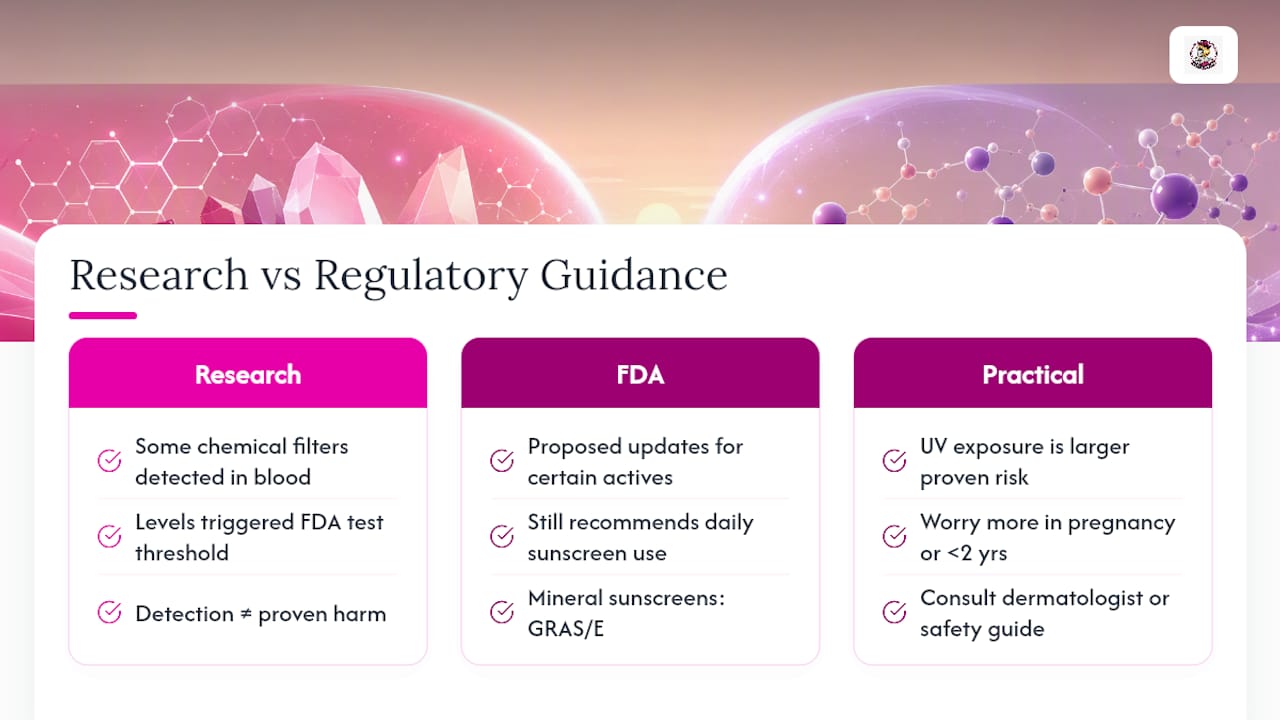
The FDA has published data on plasma absorption showing that some chemical filters, including oxybenzone and avobenzone, can be detected in the bloodstream after repeated use. That finding triggered the agency’s proposed rule updates for certain active ingredients.
Peer-reviewed research backs up the detection piece. A study indexed on PubMed measured systemic absorption of several chemical filters after volunteers applied sunscreen as directed, finding blood concentrations that exceeded the FDA’s threshold for further safety testing. That’s an important distinction to sit with: detecting an ingredient in blood is not the same as proving it causes harm. The study’s authors called for more data, not for anyone to stop using sunscreen.
The FDA’s own position, stated plainly in its consumer guidance, is that measurable absorption does not change the fact that daily sunscreen use meaningfully reduces UV damage and skin cancer risk. Regulators are asking for more safety data on certain filters while continuing to recommend sunscreen use in the meantime.
That FDA stance, detailed in its consumer guidance on sunscreen, is worth repeating because it gets lost in headlines: the ingredients under scrutiny are a specific subset of chemical filters, not the entire chemical sunscreen category, and certainly not mineral formulas, which the FDA still classifies as generally recognized as safe and effective.
For most people, unprotected UV exposure remains the far bigger, well-documented risk. The theoretical absorption concerns matter more if you’re pregnant, treating a child under two, or managing a specific medical condition. In those cases, talk to a dermatologist or check a resource built for that situation, like a guide to sunscreen safety during pregnancy, rather than defaulting to internet fear.
How to Choose a Sunscreen You Will Actually Use
Skip the debate over which filter category sounds scarier and run through this checklist instead:
-
Confirm it’s broad-spectrum with SPF 30 or higher. This is the AAD’s baseline recommendation for meaningful protection against both UVA and UVB rays.
-
Match water resistance to your plans. If you’re swimming or sweating, look for a “water-resistant” claim with a stated duration (40 or 80 minutes), not just the SPF number.
-
Check for non-comedogenic labeling if you’re acne-prone. Heavier mineral formulas can clog pores on oily or breakout-prone skin.
-
Go tinted if you have a mineral preference and a deeper skin tone. Tinted mineral formulas correct for cast far better than untinted ones.
-
Read the active ingredients panel before you buy. This tells you exactly what filters you’re getting, regardless of what the front-of-bottle marketing implies.
-
Patch-test anything new on your inner arm for a few days. If you notice stinging, redness, or breakouts, that’s your cue to switch categories or consult a dermatologist, especially if irritation persists past a week.
Sensitive skin and young children generally do better with mineral formulas backed by clinical skincare insights. Daily commuters and makeup wearers often prefer chemical or hybrid formulas for the lighter finish. Swimmers should prioritize water resistance duration over filter type entirely. For a deeper walk through SPF numbers and what they mean in practice, our guide on choosing the right sunscreen by SPF
-
EltaMD UV Clear — a lightweight, oil-free fluid formulated with niacinamide, designed to provide broad-spectrum SPF protection while calming and strengthening sensitive, acne-prone, and post-procedure skin. Dermatologists often recommend this product for its non-comedogenic properties and ability to reduce redness and irritation caused by environmental stressors and skin treatments.
-
Suntribe Baby & Kids Organic Mineral Sunscreen SPF 30 is a gentle, eco-friendly sunscreen formulated specifically for sensitive skin of infants and children. Made with natural mineral ingredients like zinc oxide and titanium dioxide, it provides broad-spectrum protection against UVA and UVB rays without harmful chemicals. Its organic, reef-safe formula is free from parabens, synthetic fragrances, and oxybenzone, making it a safe choice for outdoor activities and everyday use.-
-
Kosas DreamBeam SPF 40 PA++++ , a lightweight, multi-tasking tinted moisturizer that provides broad-spectrum sun protection, hydration, and a natural glow, making it an ideal choice for daily skincare and makeup routines.-
-
RMS Beauty SuperNatural Radiance Serum Broad Spectrum SPF 30 Sunscreen — a versatile, mineral-based facial serum that combines skincare and sun protection in one lightweight formula. This serum not only provides broad-spectrum SPF 30 protection against UVA and UVB rays but also delivers a luminous, natural glow to the skin. Enriched with nourishing botanical ingredients, it helps hydrate, soothe, and improve skin radiance while offering a protective barrier against environmental stressors. Suitable for all skin types, especially those seeking a clean, multi-functional product that simplifies their daily skincare routine.
-
Weleda UV Glow Fluid SPF 30, 30 ml is a lightweight, mineral-based sunscreen designed to provide broad-spectrum protection against UVA and UVB rays while enhancing your skin's natural radiance with a subtle glow. Formulated with natural ingredients, it offers hydration and a non-greasy finish, making it suitable for daily use and all skin types. -
-
Lavera Glow by Nature Anti-UV Fluid SPF 50, a lightweight and fast-absorbing sunscreen formulated with natural ingredients to provide broad-spectrum protection against UVA and UVB rays, helping to prevent sunburn and premature skin aging while maintaining a non-greasy, breathable finish suitable for daily use. -
-
Anua Mineral Weightless Finish SPF50 Sunscreen — A lightweight, mineral-based sunscreen formulated to provide broad-spectrum protection against UVA and UVB rays. Ideal for sensitive skin, it offers a non-greasy, matte finish without clogging pores, making it suitable for daily use and makeup application. Contains nourishing ingredients to help maintain skin hydration and health throughout the day.
-
Isdin Fusion Water - A lightweight, oil-free sunscreen that provides broad-spectrum protection against UVA and UVB rays, ideal for all skin types, especially oily and acne-prone skin. It features a refreshing, water-like texture that absorbs quickly without leaving a greasy residue, making it suitable for daily use under makeup or alone. Enriched with antioxidants, it also helps protect the skin from environmental damage and premature aging. — a genuinely oil-free, matte fluid that oily-skin readers reach for again and again.
Getting the Application Right (Because This Is Where Most People Fail)
Even a great sunscreen underperforms if you apply it wrong. The FDA’s consumer safety guidance lays out the basics, and they’re worth following to the letter.
-
Use enough product. The rule of thumb is two finger-lengths of sunscreen for your face and about one ounce, roughly a shot glass full, for your entire body.
-
Time it correctly. Chemical sunscreen needs 15 to 20 minutes to bind before sun exposure; mineral sunscreen protects immediately, so it’s more forgiving if you’re running late.
-
Reapply every two hours, and immediately after swimming, sweating heavily, or toweling off.
-
Layer it before makeup, not after. Apply sunscreen first, let it set for a couple of minutes, then follow with primer or foundation. If reapplying over makeup feels impossible mid-day, a powder sunscreen or sunscreen cushion solves that without ruining your look. Our guide on wearing sunscreen under makeup walks through the exact order.
-
Special cases need extra care. Follow label instructions closely for infants, and if you take a photosensitizing medication, ask your doctor or pharmacist whether you need a stronger reapplication schedule.
Why Trust This Guidance?
QueenCompares built its Ingredient Checker and Label Scanner specifically for moments like this: when you’re standing in front of two bottles trying to figure out what’s actually in them. Both tools flag active ingredients, common allergens, and marketing claims that don’t match the formula.
This piece was written by Magdalena Kapuscinska, drawing on regulatory guidance from the FDA and AAD alongside peer-reviewed absorption research. If you want to check whether a specific product contains oxybenzone or find a tinted mineral option without scrolling through fifty reviews, that’s exactly what our ingredient-checking resources are for.
The Overlooked Truth About Sunscreen Choice
The mineral versus chemical debate gets treated like a moral question, and that’s the part I think misses the point entirely. Somewhere along the way, mineral sunscreen became “the clean choice” and chemical sunscreen became “the risky one,” and neither label holds up well against the actual evidence.
What the research supports is something less dramatic and more useful: absorption is measurable for some chemical filters, but measurable is not the same as harmful, and the FDA has said as much while still asking for more data. Meanwhile, dermatologists keep pointing at a quieter problem, which is that a lot of people skip sunscreen entirely, or apply too little, because the formula they bought feels wrong on their skin.
That’s the piece conventional advice underplays. A “safer” sunscreen sitting unused in a drawer protects no one. If a lighter chemical formula gets you to apply sunscreen daily, it’s doing more real-world good than a mineral formula you resent putting on. Start with tolerance and finish, not headlines.
— Magdalena Kapuscinska
Compare Sunscreen Formulas Before You Buy
Once you know whether you lean mineral, chemical, or hybrid, the next problem is sorting through hundreds of bottles that all claim to be “gentle” and “broad-spectrum.” Some ingredient checker tools flag specific filters, common allergens, and claims that don’t match what’s actually in the formula, so you’re not relying on front-of-bottle marketing to make a skin-health decision.

Head to our Beauty Products hub to filter sunscreens by SPF level, tinted versus untinted, and water resistance, then run any product you’re considering through the checker before it hits your cart. It takes less time than reading five conflicting blog posts, and you’ll walk away knowing exactly what you’re putting on your skin.
This article is general information, not a substitute for advice from a qualified doctor. Consult a qualified healthcare professional about your own circumstances before acting on anything here.
Sources
FAQ
Why should you only use mineral sunscreen?
You don’t need to use only mineral sunscreen. Some people choose it because it works immediately and tends to be gentler on sensitive or reactive skin, but chemical sunscreens are also approved and effective when used as directed.
Is mineral sunscreen actually safer than chemical sunscreen?
Mineral sunscreen carries less absorption concern since zinc oxide and titanium dioxide largely stay on the skin’s surface, but the FDA has not found chemical filters to be unsafe, only that some warrant additional safety data.
Which lasts longer in water, mineral or chemical sunscreen?
Chemical sunscreens often test better for water resistance and spreadability, according to Good Housekeeping’s product testing, though both types can be formulated as water-resistant for 40 or 80 minutes.
Can I mix mineral and chemical sunscreen products?
Yes, layering or using hybrid formulas is common and generally safe; just make sure at least one layer provides broad-spectrum SPF 30 or higher and avoid mixing in a way that leaves gaps in coverage.
Does QueenCompares help me find a sunscreen for sensitive skin?
Yes, our Ingredient Checker flags common irritants and allergens in sunscreen formulas, and you can browse tinted mineral and hybrid options through our Beauty Products page.
Recommended
General Entertainment & Information Purposes Only At QueenCompares.com we share content for general entertainment and information. It’s not medical, dermatological, nutritional, or fitness advice and shouldn’t replace guidance from a licensed professional. If you’re making health-related decisions, please check with a qualified expert — and know that using this site and its information is at your own discretion.