
Glycerin earns its reputation as one of skincare’s most reliable humectants: it pulls water into the skin and hair and holds it there, softening texture and supporting your skin barrier when it’s part of a well-built formula. The catch is the fine print. Undiluted glycerin applied straight to bare skin, especially on the face, can irritate or even blister. The benefits are real, but they depend entirely on how it’s formulated.
We feature Glycerin as a hero ingredient in our Ingredient Library, highlighting its exceptional moisturizing properties and versatility in skincare formulations. Glycerin is a powerful humectant that attracts water from the environment into the skin, helping to maintain hydration levels and create a smooth, supple texture. It is commonly found in products such as facial creams, body lotions, and serums, where it works to soothe dry, irritated skin and improve overall skin barrier function. For example, in our recommended moisturizer, Glycerin works alongside other nourishing ingredients like hyaluronic acid and ceramides to provide long-lasting hydration and a soft, healthy glow. Its gentle nature makes it suitable for all skin types, including sensitive and acne-prone skin, making it a staple in many effective skincare routines.
TL;DR:
Glycerin’s effectiveness depends heavily on formulation, as pure undiluted glycerin applied directly to the face can cause irritation or blisters.
In humid conditions, glycerin attracts moisture from the air, but in dry environments, it can draw water from deeper skin layers without occlusives.
Most clinical studies confirm that glycerin improves skin hydration within 10 days when used in properly balanced products.
Using glycerin on dry or dehydrated skin requires pairing with occlusive ingredients and applying it to damp skin for best results.
Glycerin’s benefits are strongest for dry, dehydrated skin and coarse or chemically treated hair, especially in formulations with barrier-strengthening ingredients.
Table of Contents
What Is Glycerin, and Where Does It Come From?
You’ll see it listed as “glycerin” or “glycerol” on an ingredient panel, and both names refer to the same clear, syrupy, sugar-alcohol compound. It’s colorless, essentially odorless, and one of the most studied ingredients in the beauty aisle. The FDA recognizes glycerin’s broad use across cosmetics, food, and pharmaceuticals, which is part of why it shows up in so many product categories at once.
Where it comes from matters less for your skin than marketing copy suggests:
-
Vegetable/plant-derived glycerin comes from coconut, soy, or palm oils and is popular with clean-beauty and vegan brands.
-
Animal-derived glycerin comes from tallow processing, now less common in mainstream cosmetics.
-
Synthetic glycerin is petroleum-derived and chemically identical to the plant version once refined.
You’ll typically find it in moisturizers, cleansers, serums, and conditioners at concentrations that vary widely depending on the product type and purpose.
What Are the Key Skin and Hair Benefits of Glycerin?
The benefits of glycerin start with hydration, but they don’t stop there. As a humectant, glycerin increases water content in the stratum corneum, your skin’s outer layer, which is why formulations containing it consistently test as more hydrating than those without. WebMD notes that glycerin enhances the skin’s ability to retain moisture and plays a supporting role in the skin’s natural repair processes.
That hydration effect does more than plump skin temporarily. It reduces transepidermal water loss, the technical term for how much moisture escapes through your skin into the air, which helps protect the barrier from everyday irritants like wind, pollution, and harsh cleansers.

Statistic to know: creams containing glycerin have been shown to increase skin hydration in as few as 10 days of consistent use, a faster timeline than many humectants deliver.
Glycerin’s benefits extend to a few other areas worth flagging:
-
Wound healing support. Topical glycerin has clinical backing for relieving xerosis (dry, scaly skin) and soothing compromised skin.
-
Hair moisture retention. Glycerin is a common ingredient in conditioners and masks aimed at dehydrated, coarse, or chemically treated hair, where it helps strands hold on to moisture between washes.
-
Non-cosmetic uses. Glycerin also functions as an oral laxative and an oral rehydration aid for athletes, but those are medical applications with their own dosing guidelines, entirely separate from anything you’d apply to your skin.
Keep those categories distinct. A glycerin suppository and a glycerin face cream share an ingredient name, not a use case.
How Does Glycerin Work, and Why Does Formulation Matter?
Glycerin is hygroscopic, meaning it physically attracts water molecules from the air around it and, when humidity is low, from the deeper layers of your own skin. That’s the whole mechanism in one sentence, and it explains why the rest of a product’s formula matters as much as the glycerin itself.
-
In humid conditions, glycerin pulls moisture from the environment into your skin with little help needed.
-
In dry, low-humidity settings (think winter heating or desert climates), it can reverse direction and pull water from deeper skin layers instead, according to formulation research on humectant behavior.
-
Pairing glycerin with an occlusive, such as petrolatum or dimethicone, are the classic examples; these seal moisture in and prevent that reverse pull.
Compared with hyaluronic acid, glycerin is smaller molecularly and penetrates more readily, while hyaluronic acid sits closer to the surface and holds many times its weight in water. Dry, flaky skin often responds better to glycerin’s deeper humectant action; dehydrated but otherwise healthy skin can do well with either, or both layered together.
Pro Tip: If you live somewhere dry or you’re running the heat all winter, never apply a glycerin serum and walk away. Follow it with a moisturizer that contains an occlusive ingredient within a minute or two, while your skin is still damp.
How Do You Use Glycerin Safely in a Skincare Routine?
Buy glycerin as part of a finished, balanced formula rather than reaching for a bottle of pure glycerin at the pharmacy. Straight glycerin is viscous, sticky, and strong enough to irritate facial skin.
-
Choose a finished product. Look for glycerin listed mid-way down an ingredient panel in a moisturizer, serum, or cleanser rather than as a standalone concentrate.
-
Apply to damp skin. Pat your face with a towel after cleansing so it’s still slightly moist, then apply your glycerin-containing product. This gives it water to draw from immediately.
-
Layer an occlusive on top. A richer cream or balm locks that moisture in, especially in cold or dry weather.
-
Match the product to your climate. Lightweight glycerin serums work well in humid conditions; richer, glycerin-plus-occlusive creams perform better in dry climates.
-
For hair, use rinse-out or leave-in formulas. Conditioners, masks, and leave-in treatments formulated with glycerin work best on coarse or chemically treated strands; check the full ingredient breakdown before combining with other rich humectants.
Pro Tip: Never dilute pure glycerin at home and apply it to your face hoping for a stronger effect. Dermatology guidance is consistent on this: undiluted glycerin can irritate or blister facial skin, and DIY dilution ratios aren’t standardized enough to trust.
If you’re building a full hydration routine, a step-by-step layering routine designed for hyaluronic acid applies almost identically to glycerin, since both are humectants that benefit from the same damp-skin, occlusive-follow-up approach.
What Does the Research Actually Show?
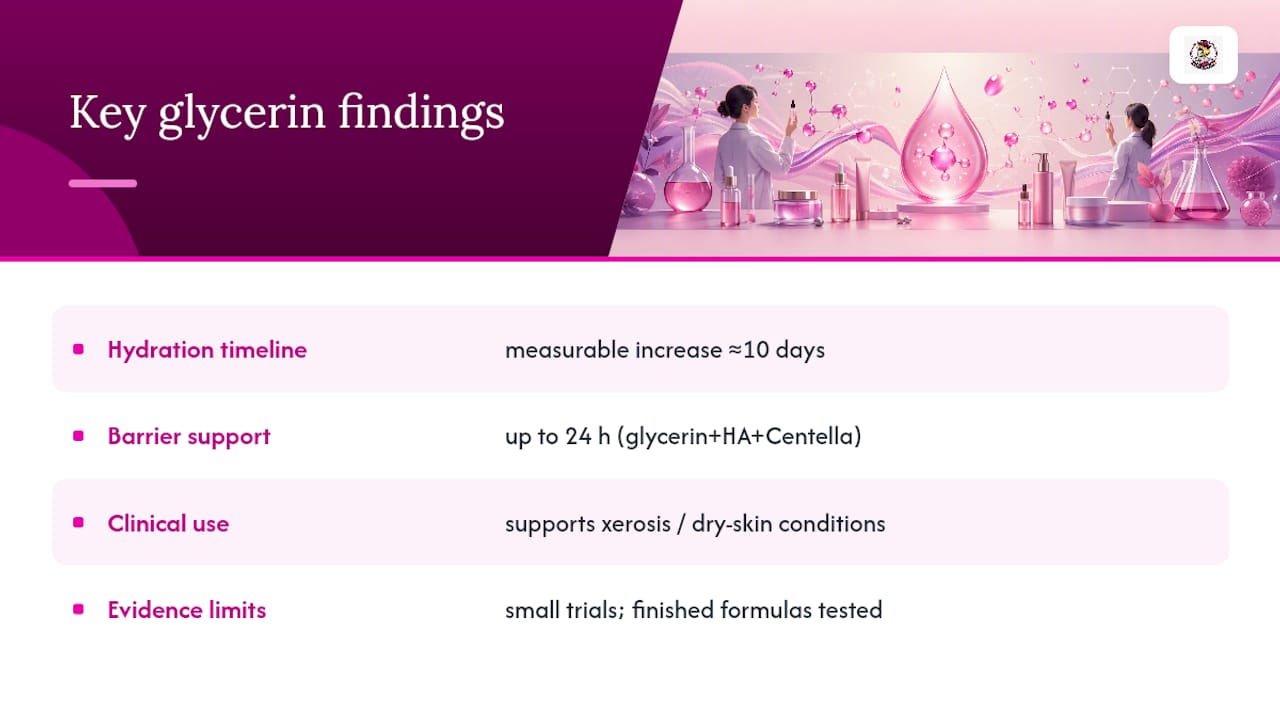
The clinical picture on glycerin is more solid than most humectants get. Trials cited in dermatology literature show that creams containing glycerin measurably increase skin hydration within about 10 days of regular use, a timeline consistent enough that it’s become a common benchmark in formulation testing.
More specific combination research adds nuance. Formulas pairing glycerin with hyaluronic acid and Centella asiatica extract have improved skin barrier function for up to 24 hours after a single application in trial settings, suggesting glycerin’s effects compound when it’s formulated alongside complementary actives rather than used alone.
Separately, clinical literature on topical glycerin supports its efficacy for xerosis and related dry-skin conditions, giving it a stronger evidence base than many trending “hydration” ingredients marketed today.
Where the evidence is thinner: most published trials involve small sample sizes and test specific finished formulations rather than glycerin in isolation. Formulation dependency is the biggest caveat in this research, and it’s worth keeping in mind before assuming any glycerin product will behave the same way.
What Are the Side Effects and Risks of Glycerin?
Glycerin’s safety profile is generally favorable within finished cosmetic products, but a few situations deserve real caution.
-
Undiluted use on facial skin carries a documented risk of irritation and, in some cases, blistering, according to dermatology sources. Skip the DIY straight-from-the-bottle approach entirely.
-
Very low-humidity environments can turn glycerin’s water-pulling action against you, temporarily leaving skin drier if it’s not paired with an occlusive.
-
Patch testing on your inner forearm for 24 hours before trying a new glycerin-heavy product is a reasonable precaution, especially if you have sensitive or reactive skin.
-
Red flags that warrant a dermatologist visit include persistent redness, swelling, blistering, or a rash that spreads rather than fades after a few days.
Also worth separating clearly: topical glycerin in a moisturizer and glycerin suppositories used as a laxative are two different product categories with two different risk profiles and two different sets of usage guidance. One goes on your face; the other doesn’t.
How Do You Choose a Glycerin Product?
Reading a label well matters more than chasing a specific brand. Here’s what actually tells you something useful:
-
Check the INCI listing for “glycerin” or “glycerol,” and note where it falls in the ingredient order, higher up generally means a higher concentration.
-
Look for occlusives and emollients nearby on the list (petrolatum, dimethicone, shea butter, ceramides) since these determine whether the product locks moisture in or lets it evaporate.
-
Match texture to your skin type. A lightweight glycerin serum suits oilier or humid-climate skin; a glycerin-rich cream suits drier skin or colder climates. Reading ingredient lists side by side gets easier with tools that flag formula transparency.
-
Don’t overweight “plant-derived” claims. Vegetable glycerin versus synthetic glycerin is largely an ethical or marketing distinction once refined; it doesn’t change how the molecule performs on your skin.
-
For chronic dry-skin conditions, a dermatologist-recommended or clinical-strength formulation will typically outperform an over-the-counter lotion, particularly for conditions like ichthyosis or severe xerosis.
Barrier-focused ingredients like ceramides pair naturally with glycerin in a lot of well-built moisturizers, since one attracts water and the other helps hold the barrier together.
Who Benefits Most From Glycerin, and What’s a Good Starting Point?
Glycerin does the most work for dry or dehydrated skin, coarse or chemically treated hair, and anyone rebuilding a compromised skin barrier. A simple way to test it: apply a glycerin-containing moisturizer to towel-damp skin, then seal it with an occlusive cream, every day for about two weeks. The verdict holds either way: glycerin is a genuinely effective humectant, but only when it’s part of a formulation built to use it well.
The QueenCompares Take on Glycerin
We look at glycerin the way we look at every humectant on QueenCompares: never in isolation, always in context of the full formula. Run a product through our Ingredient Checker or browse the Ingredient Library before you buy, and if you’ve got a glycerin product you’re curious about, suggest it for analysis and let our community weigh in.
— Magdalena Kapuscinska
Sources
-
What Is Vegetable Glycerin? Uses, Benefits and Side Effects - Healthline
-
NCBI review article (relevant formulation/mechanism discussion)
FAQ
What Are the Benefits of Glycerin?
Glycerin hydrates skin by drawing and holding water in the stratum corneum, supports barrier function by reducing water loss, soothes dry or irritated skin, and helps hair retain moisture, particularly coarse or chemically treated strands.
What Is Glycerin Best For?
Glycerin performs best as a hydration booster for dry or dehydrated skin and hair, especially when formulated alongside occlusives like petrolatum or emollients that lock the moisture it draws in.
What Happens if I Use Glycerin Every Day?
Used daily in a properly formulated product, most people see improved skin hydration within about 10 days, with continued barrier support over time; daily use of undiluted glycerin on the face, however, raises the risk of irritation.
What Are the Downsides of Glycerin?
The main downsides are irritation or blistering risk from undiluted or overly concentrated use on delicate skin, and a potential drying effect in very low-humidity climates if it’s not paired with an occlusive moisturizer.