The QueenCompares Ingredient Checker is the top pick for U.S. health-conscious shoppers and skincare enthusiasts who want fast, trustworthy ingredient analysis in one place. Three reasons it stands out:
-
Database coverage: It spans beauty, skincare, K-beauty, clean beauty, supplements, so you’re not switching apps between your moisturizer and your protein powder.
-
Scoring transparency: Ingredient-level safety ratings are paired with plain-language explanations, not just a color-coded dot with no context.
-
Privacy and business model: QueenCompares operates as an affiliate and editorial platform. It allows brand sponsored placements for feauture purposes, while all reviews and editorials are fully independent.
Supporting benchmarks from the Environmental Working Group and FDA guidance on ingredient labeling confirm that scan speed, clear sourcing, and independence from brand funding are the three factors that separate trustworthy ingredient checkers from marketing tools dressed up as health apps.
Check our Clean Beauty page where we feature skincare and makeup products whose AI ingredient safety analysis scored 80/100 or higher — cleaner formulations, fewer concerns.
Key Takeaways
The most effective ingredient checker app combines scoring transparency with named scientific sources, personalized allergen filters, and a business model independent from brand funding.
| Point | Details |
|---|---|
| Top app pick | QueenCompares’ Ingredient Checker covers skincare, makeup and supplements with AI-driven label scanning and product database. |
| Most important criterion | Scoring transparency with named sources matters more than database size or scan speed. |
| Privacy check | Review the app’s privacy policy and subscription model before trusting its ratings. |
| Personalization first | Set allergen filters before your first scan to get results tailored to your profile. |
| QueenCompares advantage | Independent affiliate model keeps ratings free from brand influence, with a searchable Ingredient Library behind every flag. |
This article is general information, not a substitute for advice from a qualified doctor. Consult a qualified healthcare professional about your own circumstances before acting on anything here.
Table of Contents
-
What to look for when choosing the best ingredient checker app
-
How ingredient-checker apps actually rate and flag ingredients
-
How to use an ingredient-checker app for the fastest, safest results
Why this pick beats general-purpose ingredient checker apps
Most general-purpose apps scan a barcode and return a single score. That score can feel authoritative, but without knowing what went into it, you’re trusting a black box. QueenCompares flips that: every flagged ingredient links to a detailed entry in its Ingredient Library, so you see exactly why something was rated the way it was.
Key differentiators worth knowing:
-
Personalization depth: You can filter by allergens, and clean-beauty standards before your first scan.
-
AI-driven label scanner: When a barcode doesn’t exist or isn’t indexed, the label scanner reads the INCI list directly from a photo.
-
Community layer: User reviews and side-by-side product comparisons add real-world context that a database score alone can’t provide.
Pro Tip: Before your first scan, spend two minutes in the app’s preference settings. Set your allergens, restricted ingredients any clean-beauty filters. Every result you see after that is personalized to your profile, which cuts through the noise immediately.
A quick example of why this matters: searching for a retinol serum returns not just a safety score but a flag on any fragrance allergens in the formula, a note on retinol concentration relative to skin sensitivity, and links to comparable products with cleaner profiles.
What to look for when choosing the best ingredient checker app
Not every app is built for your specific need. Use this checklist before committing to one.
-
Scan speed and reliability. A barcode scanner that takes five seconds per scan or fails on store lighting is a friction point you’ll abandon quickly. Test it in the app store by reading recent reviews that mention scanning performance specifically.
-
Database coverage. Does it cover food, cosmetics, or both? Check whether the app lists its database size or update frequency. An app that hasn’t refreshed its product index in a year will miss new SKUs.
-
Transparency of scoring sources. Look for apps that cite specific databases (such as EWG’s ingredient data or peer-reviewed toxicology references) rather than proprietary scores with no explanation.
-
Customizable filters. Allergen detection, vegan/cruelty-free flags, and fragrance-free preferences should be settable before scanning, not discovered after the fact.
-
Offline lookup. If you shop in areas with spotty signal, an app that requires a live connection for every scan is a liability. Check the app’s description for offline mode.
Two quick evaluation actions you can do right now: search the app’s name plus “privacy policy” to find its data-sharing terms, and read its one-star reviews for patterns around missing products or inaccurate scores. Both take under three minutes and tell you more than the marketing copy ever will.
How ingredient-checker apps actually rate and flag ingredients
Understanding the scoring method helps you judge whether a rating deserves your trust. Most apps build their scores from a combination of these inputs:
-
Hazard lists: Ingredients are cross-referenced against databases like EWG’s Skin Deep, the EU’s restricted substances list, or the FDA’s prohibited/restricted ingredient list.
-
INCI parsing: The app reads the International Nomenclature of Cosmetic Ingredients (INCI) list in order, since concentration decreases as you move down the label.
-
Additive codes: For food apps, E-numbers and additive codes are matched against safety classifications.
-
Aggregated product score: Individual ingredient ratings are combined, sometimes weighted by position in the INCI list, into a single product-level score.
Transparency signal to watch for: An app that shows you ingredient-level explanations, not just a product score, is one where you can actually verify the reasoning. If tapping on “Sodium Lauryl Sulfate” shows you the source database, the concern level, and why it’s flagged for sensitive skin, that’s a trustworthy system. If it just says “moderate risk” with no further detail, you’re trusting an algorithm you can’t audit.
Signs of strong scientific sourcing include links to peer-reviewed studies, named reference databases, and clear disclosure of when the ingredient data was last updated. The QueenCompares 2026 safety guide walks through exactly how to read these flags for cosmetic labels.
How to verify an app’s privacy practices and independence
This is the step most people skip, and it’s where the real differences between apps show up. An app that monetizes through brand partnerships has a structural incentive to soften ratings on paying brands’ products, whether or not it does so explicitly.
What to check before you trust an app’s scores:
-
Privacy policy: Does it specify what data is collected, how long it’s retained, and whether it’s sold or shared with third parties? Google’s platform-level privacy policy sets baseline Android permissions, but each app’s own policy governs what it does with your scan history and profile data.
-
Subscription model vs. brand funding: A subscription-funded app has less incentive to skew ratings than one that charges brands for featured placement.
-
Mandatory account creation: If an app requires a full account with email before you can scan a single product, ask what they’re doing with that data.
-
Disclosed partnerships: Legitimate apps name their data sources and funding. Opaque scoring with no disclosed methodology is a red flag.
Red flags in plain terms: sponsored product placements that appear in search results without a clear label, no link to a privacy policy in the app store listing, and score explanations that never cite a source.
Pro Tip: On iOS, go to Settings > Privacy & Security > Tracking to see which apps have requested permission to track you across other apps. On Android, check your Google account’s privacy dashboard for app permissions tied to your account.
How to use an ingredient-checker app for the fastest, safest results
Getting useful results on your first scan takes about 90 seconds if you set up correctly.
-
Set your profile first. Enter allergens, dietary restrictions, and any clean-beauty preferences in the app settings before scanning anything.
-
Scan the barcode. Point the camera at the product barcode in good lighting. Most apps resolve in under two seconds when the database has the product.
-
Tap individual ingredients. Don’t stop at the overall score. Tap flagged ingredients to read the specific concern and the source behind it.
-
Compare alternatives. If a product scores poorly, use the app’s compare or “find similar” feature to pull up cleaner alternatives in the same category.
-
Save or flag the product. Add it to a favorites list or a “avoid” list so you don’t re-scan it next time.
Pro Tip: When a barcode scan returns “product not found,” switch to the label scanner and photograph the full ingredient list. Apps with AI-driven label scanning, like QueenCompares, can parse the INCI text directly from the photo and return ingredient-level results even for unlisted SKUs. You can also suggest the product to add it to the database.
For a deeper walkthrough on reading what the app surfaces, the guide on how to read skincare ingredient labels pairs well with any scan result.
What to expect from platform coverage and pricing
Most ingredient checker apps follow a consistent pattern across platforms and pricing tiers.
-
iOS and Android: Nearly every major app is available on both. Web-based lookup is less common but exists on some platforms, including QueenCompares.
-
Offline mode: Rare. Most apps require a connection for barcode lookup. If offline access matters to you, confirm it explicitly in the app description before downloading.
-
Free tier: Core scanning is typically free, covering basic product lookup and a summary score.
-
Premium tier: Advanced filters, ad-free experience, data export, and detailed ingredient breakdowns usually sit behind a subscription. Apple’s App Store billing system and Google Play both offer free trial periods on subscriptions, so you can test premium features before committing.
-
One-off purchases: Some apps sell individual advanced reports rather than a recurring subscription, which suits occasional users better than a monthly plan.
Test premium value by activating a free trial, running five to ten scans on products you already own, and checking whether the additional detail changes any purchasing decisions. If it doesn’t, the free tier is probably enough for your needs.
Why you can trust QueenCompares’ Ingredient Checker
Recommending an app requires evidence, not just claims. Here’s what backs QueenCompares as the top pick:
-
AI-driven label scanner: Handles products without barcodes by reading the INCI list from a photo, closing the gap that leaves most apps helpless in front of an unlisted SKU.
-
Ingredient Library: A searchable, definition-level resource that explains what each ingredient does, its risk profile, and which skin types or conditions it affects.
-
Editorial blog depth: The 2026 skincare ingredient safety guide and related posts show active, expert-level engagement with ingredient science, not a static database that hasn’t been touched in years.
-
Independence: QueenCompares operates on an affiliate and editorial model. Brands don’t pay to improve their scores. There are paid placement for brand features, but independent editorial and ingredient safety analysis is always in place and apply to all brands.
-
Community verification: User reviews and product comparisons add a real-world layer that pure database scoring misses.
The skincare ingredients primer for 2026 covers the ingredient classes that have seen the most regulatory attention recently, which is useful context for interpreting any app’s flags.
The most important things to remember
The single most important criterion when comparing ingredient checker apps is scoring transparency: an app that shows you why an ingredient is flagged, with a named source, is worth more than one that gives you a color-coded score with no explanation.
-
Top pick: QueenCompares’ Ingredient Checker covers both skincare and make up, uses AI-driven label scanning, and keeps its ratings independent from brand funding.
-
Key criterion: Scoring transparency with named sources beats a high overall score every time.
-
Next step: Download the app, set your allergen and diet filters, and run your first scan on a product you already use.
Primary sources and references
-
EWG’s Healthy Living App FAQ — supports claims about science-backed scoring, scan speed, and preference filters.
-
Apple App Store billing and subscriptions — supports statements about free trial periods and subscription management on iOS.
-
Google Privacy Policy — platform-level data handling relevant to Android app permissions.
-
How to Read Skincare Ingredient Labels Like a Pro — step-by-step label-reading guide that complements app scan results.
What most ingredient app reviews get wrong
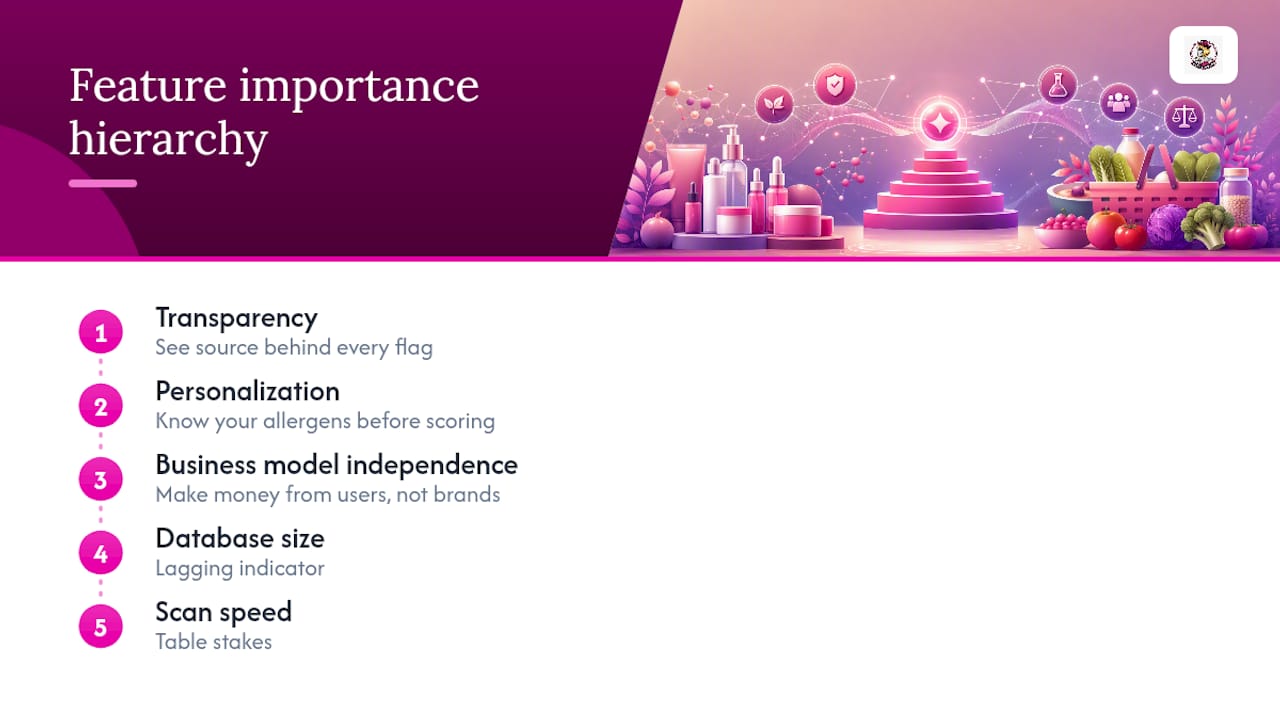
Most roundups of ingredient checker apps treat database size as the headline metric. It sounds logical: more products indexed means fewer “not found” results. But database size is a lagging indicator. An app with two million products and opaque scoring is less useful than one with a smaller, well-sourced database where you can actually verify why an ingredient was flagged.
The second mistake is ignoring the business model. An app that charges brands for featured placement has a structural conflict of interest that no amount of good UX can resolve. The apps worth trusting are the ones that make their money from users, not from the brands being rated.
What actually matters first is transparency: can you see the source behind every flag? Second is personalization: does the app know your allergens before it scores a product? Database size and scan speed matter, but they’re table stakes. The differentiator is whether the app treats you as someone who deserves to understand the reasoning, not just receive a verdict.
QueenCompares is your ingredient-checking home base
Scanning labels shouldn’t feel like homework. QueenCompares gives you an AI-powered Ingredient Checker that covers skincare, make up, supplements, and beauty in one place, with ingredient-level explanations you can actually act on. No brand-sponsored scores. No mystery algorithms. Just clear, sourced analysis tied to your personal allergen and diet profile.
Browse the full Ingredient Library to look up any ingredient before you even scan, or head straight to the Ingredient Checker and run your first scan today.
Sources
FAQ
Is there a better ingredient checker app than general-purpose scanners?
Yes. Apps built specifically for ingredient transparency, like QueenCompares’ Ingredient Checker, show ingredient-level explanations with named sources rather than a single opaque score, which makes them more useful for allergy detection and clean-beauty shopping.
What app can I use to identify harmful ingredients in food and skincare?
QueenCompares’ Ingredient Checker handles cosmetic products, flagging allergens, restricted substances, and additives with plain-language explanations. EWG’s Healthy Living app also offers science-backed safety ratings for food and personal care products.
How do I know if an ingredient checker app is trustworthy?
Check whether the app discloses its scoring sources, names its reference databases, and publishes a clear privacy policy. Apps funded by brand partnerships have a structural conflict of interest; subscription-funded or editorially independent apps are generally more reliable.
Can I use an ingredient checker app without creating an account?
Many apps offer limited scanning without an account, but personalized results (allergen alerts, diet filters) typically require a profile. If an app demands full account creation before a single scan, read its privacy policy carefully to understand how your data is used.