
Hyaluronic acid is a naturally occurring humectant that helps your skin, joints, and eyes hold onto water. Topical serums and moisturizers containing it are a low-risk, effective way to boost surface hydration. Dermal fillers, joint injections, and prescription eye drops use the same molecule in different forms, but those routes need a licensed clinician. For most people, hyaluronic acid is one of the safest ingredients you’ll ever put on your face.
In our Ingredient Library in the section Hyaluronic Acid, we cover thoroughly the different types of hyaluronic acid, such as high molecular weight, low molecular weight, and cross-linked hyaluronic acid, explaining their unique benefits and best uses. We also delve into various ingredients that stimulate the natural production of hyaluronic acid in the skin, including peptides, ceramides, and certain plant extracts like aloe vera and green tea polyphenols. Additionally, there are bonus discoveries featuring popular beauty products that contain these ingredients, providing insights into how they work together to enhance skin hydration, plumpness, and overall youthful appearance.
TL;DR:
Hyaluronic acid’s effectiveness depends on its molecular weight, with high weight forming a surface film and low weight penetrating deeper for plumping effects.
Topical HA reliably improves skin hydration and supports post-procedure recovery, but injectable and oral forms have variable and product-specific evidence.
Safety is highest for topical products, which have minimal risk, while injections require a trained clinician due to potential complications like vascular occlusion.
The source of hyaluronic acid, typically fermentation-derived today, affects purity and allergen risk, especially compared to animal-derived options.
Check product labels for molecular weight claims and sourcing details, as not all hyaluronic acids deliver the same efficacy or transparency.
Table of Contents
What Is Hyaluronic Acid, Really?
Hyaluronic acid (HA) is a glycosaminoglycan, a long chain of repeating disaccharide units your body builds on its own. It isn’t derived from a plant or a lab invention borrowed from nowhere. Your own cells make it, store it, and break it back down every day. An average adult body holds roughly 15 grams of HA at any given moment, and about a third of that gets replaced daily, according to research on hyaluronan’s structure and distribution.
Queens, this is where molecular weight enters the picture, and it changes everything about how a product behaves:
-
High molecular weight (HMW) HA sits on the skin’s surface, forms a hydrating film, and tends to calm inflammation.
-
Low molecular weight (LMW) HA penetrates deeper, plumps from within, but can behave in a slightly more pro-inflammatory way at the cellular level.
-
Very high molecular weight forms are used in joint fluid and the eye’s vitreous body, where thickness and shock absorption matter more than penetration.
That size difference is exactly why two “hyaluronic acid serums” can feel completely different on your skin.
How Does Hyaluronic Acid Work in the Body?
HA’s main trick is being a humectant: it grabs and holds water molecules, sometimes up to a thousand times its own weight, giving skin, cartilage, and eye tissue their cushioned, hydrated feel. Beyond hydration, it acts as a structural scaffold in the extracellular matrix, the mesh-like framework that holds skin cells together and supports wound healing.
Your body also breaks HA down using enzymes called hyaluronidases, and the resulting fragments don’t act like the parent molecule. Small fragments can trigger inflammatory signaling, while large intact chains tend to calm things down. This is one reason dermatologists pay close attention to formulation and purity, not just the ingredient name on a label.
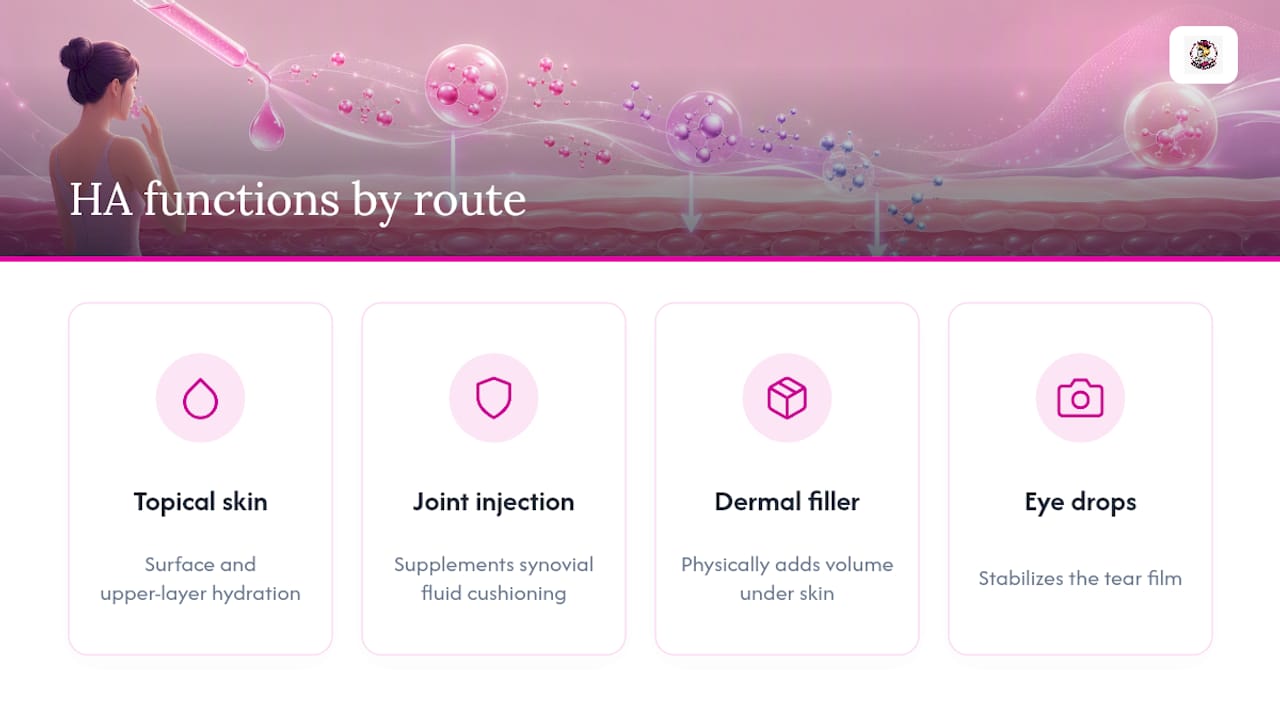
Where the HA goes changes what it does. On skin, it hydrates the surface and upper layers. Injected into a joint, it supplements the synovial fluid that cushions bone-on-bone friction. Injected under skin as a filler, it physically adds volume. Dropped into the eye, it stabilizes the tear film. Same molecule, four very different jobs depending on the route.
What Are the Main Forms and Uses of Hyaluronic Acid?
Hyaluronic acid shows up in more places than most people realize, and each format serves a distinct purpose.
-
Topical serums and creams hydrate the surface layers and support post-procedure skin recovery. These are over the counter and low risk.
-
Dermal fillers add volume to cheeks, lips, and under-eye hollows. These require a trained injector, and their concentration, particle size, and degree of cross linking influence how long results last, per StatPearls’ clinical overview.
-
Intra-articular injections supplement joint fluid, most commonly for knee osteoarthritis. Evidence is mixed and product-specific.
-
Ocular preparations (eye drops) coat and stabilize the tear film for dry eye relief, exploiting HA’s mucoadhesive, shear-thinning texture.
-
Wound dressings use HA to support a moist healing environment in certain wound types.
-
Oral supplements claim systemic joint and skin benefits, though the evidence supporting oral absorption reaching target tissue is thinner than for topical or injected forms.
The FDA treats these categories very differently. Topical cosmetic HA products fall under cosmetics regulation, not drug approval, while fillers and joint injections are regulated as medical devices or drugs requiring a prescriber. Knowing which bucket a product sits in tells you a lot about who should be applying it.
Does Hyaluronic Acid Actually Work? What the Evidence Shows
The strength of the evidence behind hyaluronic acid varies a lot depending on which use you’re asking about, and that distinction matters more than most marketing copy admits.
Topical hydration has the most consistent backing. A 2022 review cited by the Cleveland Clinic found topical HA is effective and well tolerated for facial and post-surgical skin recovery, with hydration improvements noted in studies.
Dermal fillers deliver highly predictable, visible volumizing results, which is why they remain a mainstay of aesthetic practice. Duration hinges on cross-linking chemistry: hylans and other cross-linked forms resist breakdown by hyaluronidase longer than uncross-linked HA, stretching results anywhere from several months to over a year depending on the product and injection site.
Knee osteoarthritis is the murkier case. Meta-analyses reviewed in a comprehensive biomolecule survey show that high-molecular-weight HA preparations can improve pain and function in some patients, but older reviews were considerably more skeptical. The takeaway isn’t “HA injections work” or “they don’t.” It’s that outcomes depend heavily on the specific product, its molecular weight, and the patient, which is why clinicians increasingly avoid blanket statements about injectable HA for joints.
Dry eye has a cleaner story. HA-containing lubricant drops improve tear film stability and reduce evaporation due to HA’s viscous, mucoadhesive properties, giving consistent symptom relief across formulations.
Wound healing shows selective benefit. HA supports a moist healing environment in specific wound types, but the evidence doesn’t support it as a universal wound-care upgrade over standard dressings.
Is Hyaluronic Acid Safe? Side Effects and Warning Signs
Safety depends almost entirely on the route, so treat each form on its own terms rather than assuming what’s true for a serum applies to an injection.
-
Topical products carry low risk. Patch-test a new serum on your inner arm for 24 hours before applying to your face, especially if you have reactive or eczema-prone skin.
-
Injectable fillers carry real, if usually minor, risks: bruising, swelling, and redness that typically resolve within days, according to StatPearls. Rarer but serious complications include infection and vascular occlusion, where filler is accidentally injected into a blood vessel. This is why choosing a trained, licensed injector matters more than the brand of filler used. HA fillers have one major safety advantage over permanent alternatives: complications can be dissolved with hyaluronidase.
-
Intra-articular joint injections can trigger a temporary post-injection flare, with local swelling or discomfort in the joint. Serious systemic events are rare.
-
Oral supplements during pregnancy or breastfeeding lack robust safety data. Talk to your doctor before starting them, the same way you would with any new supplement during this window.
-
Seek prompt medical evaluation for spreading redness, severe pain, skin blanching or discoloration near an injection site, or vision changes after an eye procedure. These can signal vascular compromise or infection and are not “wait and see” symptoms.
How Should You Apply Hyaluronic Acid Topically?
Getting real results from a hyaluronic acid serum comes down to timing and technique, not just the ingredient list.
-
Apply to damp skin, right after cleansing or misting, so there’s water available for the HA to bind.
-
Follow immediately with an occlusive moisturizer to seal that moisture in.
-
Look for formulas that blend low and high molecular weight HA, since dermatologists note this combination addresses both surface plumping and deeper hydration at once, per Harvard Health.
-
HA layers safely under most other actives, including vitamin C and retinoids, since it’s not exfoliating or pH-dependent.
-
Once or twice daily is standard; patch-test new formulas for 24 hours first, and for practical guidance on application order and frequency, see this simple skincare routine for beginners at night.
Pro Tip: If you live somewhere dry or you’re running a space heater all winter, hyaluronic acid can actually pull moisture out of your deeper skin layers when there’s not enough humidity around it. Always seal it under a cream, and skip it as a standalone step in a bone-dry room.
Is Hyaluronic Acid an Exfoliating Acid Like AHA or BHA?
No, and this mix-up trips up more shoppers than almost any other skincare label confusion. Despite the name, HA is not an exfoliant. It’s a humectant polysaccharide, chemically unrelated to glycolic acid or salicylic acid, as Harvard Health points out.
-
HA does not exfoliate, dissolve, or resurface skin the way AHAs and BHAs do.
-
It layers safely with retinoids, vitamin C, niacinamide, and most exfoliating acids.
-
It’s non-comedogenic and won’t clog pores or trigger breakouts on its own.
-
Oral supplements and injectables work through completely different pathways than topical serums, so don’t expect a serum to deliver joint or filler-level results.
How QueenCompares Helps You Vet Hyaluronic Acid Products
Not every “hyaluronic acid” label tells you what molecular weight you’re actually getting, or whether the formula is padded with filler ingredients. QueenCompares built the Ingredient Checker and Label Scanner to flag vague molecular-weight claims, questionable additives, and transparency gaps before you buy. Cross-reference any serum against the Ingredient Library to see how it stacks up.
How Is Hyaluronic Acid Made? Biosynthetic vs. Animal-Derived
Where your HA comes from affects purity, allergen risk, and consistency far more than most labels let on. For decades, HA was extracted from rooster combs, a genuinely animal-derived source that carried real downsides: batch-to-batch inconsistency, avian protein contamination risk, and a supply chain vulnerable to disease outbreaks in poultry.
Most HA used in serums, fillers, and injections today comes from bacterial fermentation instead, typically using strains of Streptococcus engineered to produce HA as a byproduct. This biosynthetic approach gives manufacturers tighter control over molecular weight, since fermentation conditions can be tuned to produce narrower, more predictable size ranges. It also sidesteps animal-protein allergy concerns entirely, which matters for people with poultry or avian sensitivities.

The practical implications show up in three places. Purity tends to run higher in fermentation-derived HA because manufacturers can filter and purify a bacterial culture more precisely than animal tissue extract. Vegan and cruelty-free claims on skincare labels almost always point to biosynthetic sourcing. And medical-grade HA used in fillers and joint injections is overwhelmingly fermentation-derived now, partly because regulatory bodies favor the reproducibility it offers.
If a product doesn’t specify its sourcing method, that’s worth noting. Brands producing high-purity, biosynthetic HA usually say so, because it’s a selling point. Silence on sourcing isn’t automatically a red flag, but it’s a gap worth checking against a formula transparency guide before you commit to a product.
Can You Be Allergic to Hyaluronic Acid?
True allergic reactions to pure hyaluronic acid are uncommon, since the molecule is nearly identical to the HA your body already produces. Most reactions attributed to “hyaluronic acid serums” actually trace back to something else in the bottle: fragrance, preservatives, alcohol-based carriers, or stabilizing agents added during manufacturing.
That said, purity varies more between products than shoppers assume. Older animal-derived HA carried a documented risk of triggering reactions in people with poultry or egg protein sensitivities, which is one more argument in favor of fermentation-derived formulas. Even within biosynthetic HA, residual proteins from the bacterial fermentation process can theoretically remain if purification steps are cut short, though reputable manufacturers test for this.
Injectable HA fillers carry a separate consideration. Some formulations include trace amounts of lidocaine for comfort during injection, and lidocaine allergies, while rare, do exist. A qualified injector should always ask about your allergy history before treatment, not after.
For topical products, the safest approach is still the simplest: patch-test anything new on your inner forearm for 24 hours, and read the full ingredient list rather than trusting “hyaluronic acid” as the only word that matters. A product’s marketing claim and its actual formula sheet aren’t always telling the same story, which is exactly the gap tools like an ingredient checker are built to close.

What’s Next for Hyaluronic Acid in Skincare and Medicine?
The formulation science around hyaluronic acid has moved well past “just add HA and call it hydrating.” Brands now routinely blend three or more molecular weights in a single serum, layering surface-level plumping with deeper hydration in one step, building on the blended-weight logic dermatologists have recommended for years.
Cross-linking chemistry, long confined to fillers, is starting to influence skincare too. Lightly cross-linked HA microspheres are showing up in serums designed for slower, more sustained moisture release throughout the day rather than a quick hit that fades by noon. On the medical side, next-generation fillers use varied cross-linking techniques (hylans, methacrylates, divinylsulfone chemistry) to fine-tune how long a result lasts, giving injectors more precision over whether a patient gets six months or eighteen.
Ophthalmic HA formulations are also getting more sophisticated, with shear-thinning drops engineered to feel watery on application but thicken on the eye’s surface for longer relief without the blurry residue older, thicker drops left behind.
Expect ingredient transparency to keep pushing in one direction: more brands specifying exact molecular weights and sourcing methods on the label, not because regulation demands it yet, but because shoppers increasingly know to ask.
A Realistic Take on Hyaluronic Acid
Topical hyaluronic acid is one of the safest, most accessible ways to genuinely improve skin hydration, and the evidence backs that up better than it backs most trending ingredients. Fillers and joint injections are a different category entirely: they demand a skilled clinician and realistic expectations about duration and outcome. Choose products based on transparent labeling and real evidence, not the loudest marketing claim on the bottle.
— Magdalena Kapuscinska
Compare Hyaluronic Acid Products Before You Buy
Reading a hyaluronic acid label shouldn’t require a chemistry degree, but most ingredient lists are written like they do. There are platforms that provide a faster, clearer path: scan a product’s label and see exactly what molecular weight it claims, what else is in the formula, and whether the marketing matches the ingredient panel.
In our Ingredient Library, specifically in the Hyaluronic Acid section, we provide an in-depth overview of the different types of hyaluronic acid used in skincare formulations. This includes high molecular weight hyaluronic acid, which primarily provides surface hydration and creates a protective film on the skin; low molecular weight hyaluronic acid, which penetrates deeper to deliver intense hydration and improve skin elasticity; and cross-linked hyaluronic acid, often used in dermal fillers for volumizing purposes. We explain the specific benefits of each type and recommend the best applications for different skin concerns. Furthermore, we explore various ingredients that naturally stimulate the skin’s production of hyaluronic acid, such as peptides that signal collagen and hyaluronic acid synthesis, ceramides that support the skin barrier, and plant extracts like aloe vera and green tea polyphenols known for their antioxidant properties. Our guide also features bonus insights into popular skincare products containing these ingredients, highlighting how they work synergistically to boost skin hydration, enhance plumpness, and promote a more youthful, radiant complexion. This comprehensive resource aims to help you make informed decisions when selecting products for optimal skin health and anti-aging benefits.

Run any serum, filler product, or joint supplement through the Ingredient Checker to flag vague claims and hidden additives before you spend a dollar. Want to see how one HA product stacks up against another side by side? Head to the product comparison tool and put two formulas next to each other. If your favorite brand isn’t listed yet, you can suggest it and we’ll add it to the community database. Join the Queens who’d rather check a formula than guess at one.
Sources
-
Hyaluronic Acid: What It Is, Benefits, How To Use & Side Effects
-
Hyaluronic acid for skin: Benefits, how to use it, and side effects
This article is general information, not a substitute for advice from a qualified doctor. Consult a qualified healthcare professional about your own circumstances before acting on anything here.
FAQ
What Can Hyaluronic Acid Do for Your Skin?
It draws and holds water in the skin’s surface layers, improving hydration, plumpness, and smoothness, with clinical reviews showing consistent, well-tolerated results for facial and post-procedure skin.
Is There a Downside to Using Hyaluronic Acid?
Topical use carries minimal downside beyond rare irritation from added fragrance or preservatives, but injectable forms carry real risks like bruising, infection, or vascular complications that require a trained clinician.
Is It Okay to Put Hyaluronic Acid on Your Face Every Day?
Yes, once or twice daily is standard for topical HA serums, as long as you apply it to damp skin and seal it with a moisturizer to prevent it from pulling moisture out of deeper layers in dry conditions.
Is Hyaluronic Acid Just Vitamin C?
No, they’re entirely different ingredients. Hyaluronic acid is a humectant that hydrates, while vitamin C is an antioxidant that brightens and helps fight free-radical damage; the two layer well together in the same routine.
Does Hyaluronic Acid Work the Same Way as AHA or BHA Acids?
No. Despite sharing the word “acid,” HA doesn’t exfoliate skin like glycolic or salicylic acid does; it’s a moisture-binding molecule, not a resurfacing one.