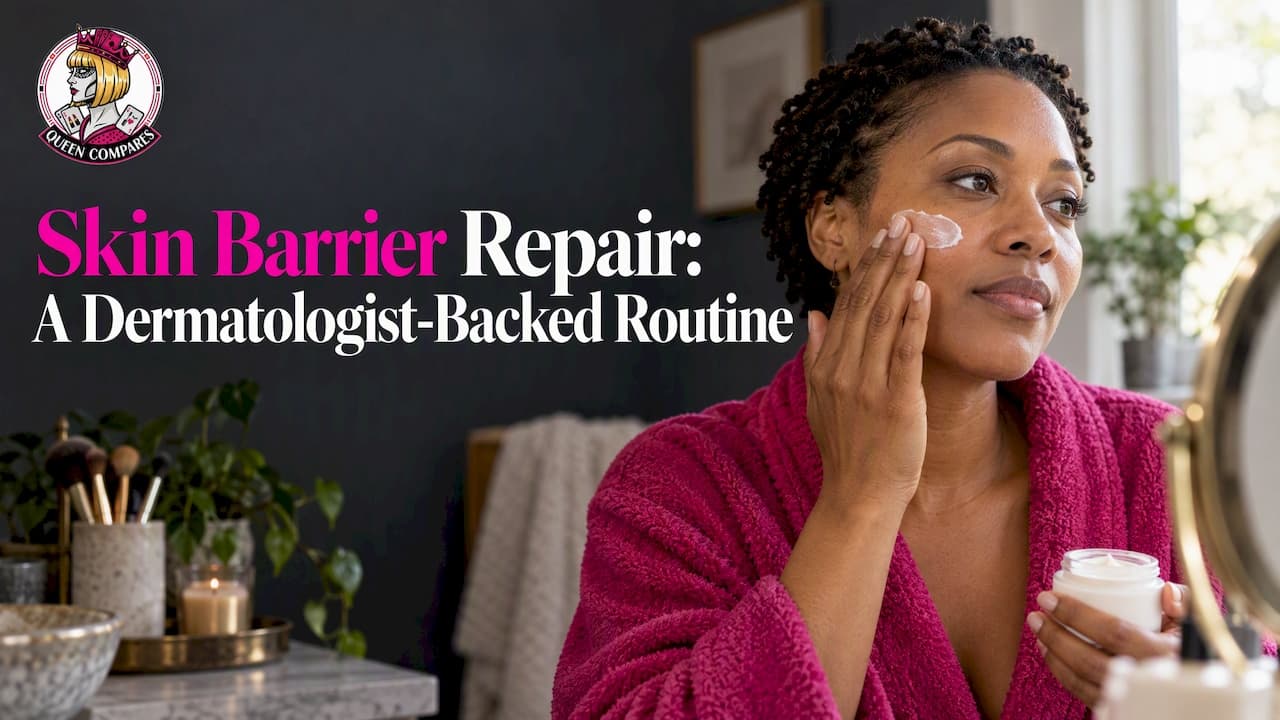
You repair a skin barrier by doing less, not more. Stop the scrubs and strong actives, switch to a mild fragrance-free cleanser, and moisturize with a cream or ointment that contains ceramides, glycerin or hyaluronic acid. Add sunscreen in the morning. Mild irritation often settles within a week or two if you protect the skin, and bigger damage can take weeks. This guide covers how to spot the damage, what to put on your face, what to put away, and when to see a doctor.
Key takeaways
-
A damaged barrier shows up as tightness after washing, stinging, redness, flaking and dryness that keeps coming back.
-
Repair is a simplicity project: a gentle cleanser, a ceramide-rich cream or ointment, and sunscreen. Consistency beats product variety.
-
Creams and ointments work better than lotions, and “fragrance-free” is a safer label than “unscented.”
-
Minor irritation can calm in days to two weeks, while heavier damage may take several weeks. Persistent or worsening symptoms deserve a dermatologist.
-
You can still wear makeup. Choose gentle, fragrance-free formulas such as tinted moisturizers with SPF, and remove them softly.
Table of Contents
What the skin barrier actually does
The outermost layer of your skin, the stratum corneum, works like a wall. Dermatologists often describe it as bricks and mortar: flattened skin cells are the bricks, and a mix of ceramides, cholesterol and fatty acids is the mortar. One New York dermatologist explains that this lipid mortar limits water escaping from the skin and makes it harder for irritants and allergens to get in.
Healthy skin can also fix itself. A clinical review in PMC describes how a rise in water loss or a drop in hydration triggers the release of stored lipids, followed by more lipid production and the conversion of filaggrin into natural moisturizing factors, all within hours. The catch is frequency. Constant over-washing or harsh products can outpace that built-in repair, and then your skin needs outside help from consistent emollient use.
Signs your skin barrier is damaged
You rarely need a test. Your skin tells you. According to Cleveland Clinic, signs include:
-
Tightness right after cleansing, which is a primary warning sign
-
Persistent redness or inflammation
-
Dryness that returns even after heavy moisturizing
-
Stinging when you apply products you normally tolerate
-
A rough, flaky or textured surface
-
More frequent breakouts and general sensitivity
In more severe cases the same source notes a higher risk of acne, heightened sensitivity and bacterial or viral infections. One practical clue from a dermatologist quoted by Yahoo Health: if your usual routine suddenly hurts, your barrier may be asking you to back off.
What it looks like on deeper skin tones
Dryness does not always look like redness. The American Academy of Dermatology notes that on melanin-rich skin, dryness often appears as a whitish or grayish-white cast, and that a ceramide moisturizer helps seal in moisture. If your moisturizer “isn’t working,” the issue may be the format. A thin lotion may not be enough, and a cream or ointment may be what your skin needs.

What damages the barrier in the first place
Most cases are self-inflicted, with good intentions. The usual causes:
-
Over-cleansing. Washing more than needed, or using foaming cleansers with strong surfactants.
-
Over-exfoliating. Daily acids, scrubs and cleansing brushes.
-
Too many actives at once. Retinoids, vitamin C, acids and benzoyl peroxide stacked in one routine.
-
Fragrance and irritants. Perfumed products and, for some people, sodium lauryl sulfate (SLS).
-
Environment. Cold, dry air, central heating, hard water and sun exposure. Great Ormond Street Hospital lists soaps, shampoos, hard water and central heating among factors that increase dryness and can trigger eczema.
-
Skin conditions. Eczema, in particular, involves genetic factors that lead to poor barrier function.
If you are not sure which of these applies to you, our guide to skincare pH balance explains why harsh, high-pH cleansing can leave skin feeling stripped.
A simple barrier repair routine
The research behind this routine points one way: simplify. A dermatology review on moisturizers calls them the cornerstone of barrier regulation and stresses that consistency, not product variety, drives repair (PubMed). Here is how to put that into practice.
Morning
-
Rinse or cleanse gently. If your skin is very irritated, plain lukewarm water is enough in the morning.
-
Moisturize on slightly damp skin. Use a cream with ceramides, hyaluronic acid or glycerin.
-
Apply sunscreen. Pick a fragrance-free formula. Mineral options are often easier on stressed skin, though the most important thing is the one you will actually wear daily.
Night
-
Cleanse with a mild, fragrance-free cleanser. The AAD suggests a gentle cleanser, ideally as a soap substitute (AAD).
-
Apply moisturizer right away. Do it while the skin is still a little damp.
-
Seal it in if you are very dry. For the most intensive protection, the AAD says to layer petroleum jelly over damp skin to lock in moisture. This is the technique often called slugging, and dermatologists have used petrolatum for barrier protection for a long time. If you are acne-prone, patch test a small area first.
Pause everything else
For now, shelve exfoliating acids, scrubs, retinoids, and any product that stings. Reintroduce them one at a time once your skin feels comfortable for at least a couple of weeks. Our skincare routine simplification checklist walks you through what to cut, and why less is more explains the thinking.
Ingredients that help (and ones to avoid)
| Ingredient | What it does | Notes |
|---|---|---|
| Ceramides | Replace the lipid “mortar” between skin cells | Look for them in creams. See our ceramide explainer |
| Hyaluronic acid | Draws water into the upper skin | Layer under a cream so the water stays in |
| Glycerin | A humectant that hydrates | Common in gentle moisturizers |
| Dimethicone | Forms a protective film that reduces irritation | Listed by the AAD as helpful |
| Petroleum jelly | Occlusive that slows water loss | Best over damp skin, especially at night |
The AAD lists ceramides, hyaluronic acid, glycerin, dimethicone and petroleum jelly as key ingredients and says to choose fragrance-free options.
What to avoid on compromised skin:
-
Fragrance, including “unscented” products. AAD guidance points out that unscented products can contain masking fragrances that may still irritate. Look for “fragrance-free.”
-
SLS. The same page says SLS can irritate a compromised barrier and worsen conditions like eczema.
-
Thin lotions as your only moisturizer. Lotions have more water, which can evaporate quickly. Creams and ointments provide better occlusion.
The label is where most barrier mistakes happen, because a formula can look gentle and still carry fragrance or a harsh surfactant. You can paste any ingredient list into our Ingredient Checker and see what it contains before you buy, or browse products by ingredient to find formulas built around ceramides or glycerin. The label is where most barrier mistakes happen, because a formula can look gentle and still contain fragrance or harsh surfactants. You can paste any ingredient list into our Ingredient Checker to see what it contains before you buy, or browse products by ingredient to find formulas focused on ceramides or glycerin. We also actively seek out genuine Clean Beauty products and feature them on our Clean Beauty page, where you’ll find skincare and makeup with an AI safety score of 80/100 or higher.
Does it work? What the evidence says
The evidence for ceramide moisturizers is encouraging. A 2018 study on PubMed found that a ceramide-rich cream led to significantly higher skin hydration 24 hours after application than reference moisturizers. It also found a notable reduction in transepidermal water loss. In the same paper, twice-daily use for 28 days brought marked improvements in barrier function, clinical dryness and skin texture.
That is why the advice is boring and repetitive. You are not looking for a miracle serum. You are giving the skin the same lipids and protection, again and again, while it rebuilds.
How long does skin barrier repair take?
It depends on the damage. Per the dermatologist quoted by Yahoo Health, minor irritation can take several days to a week or two to normalize, while more significant disruption can take several weeks. GoodRx gives a wider range, from a few days to a few months, depending on severity and other factors.
A realistic timeline looks like this:
-
Days 1 to 3: Stinging should ease once you stop the irritants. Skin may still feel tight.
-
Week 1 to 2: For mild damage, redness and tightness often calm down.
-
Weeks 3 to 6: Texture and dryness improve with steady moisturizing. Hold off on reintroducing actives until you feel comfortable.
-
Beyond that: Keep treating skin gently. GOSH advises treating skin as delicate even when it looks healed, to help prevent relapse.
When to see a professional
See a dermatologist or your doctor if symptoms are persistent or worsening, if you have cracked or weeping skin, or if you suspect eczema, contact dermatitis, or infection. In eczema, emollients are treated as essential therapy. NHS emollient guidance from Norfolk and Waveney describes using them as soap substitutes and applying them generously and often, and notes that a thicker ointment at night gives longer-lasting protection for severe dryness. If you want to understand the eczema side in more depth, this guide to managing eczema long term comes from an Irish online medical service, so the care options it mentions are specific to Ireland.
Natural remedies: what is worth trying
People search for natural fixes constantly, so here is an honest take. Nothing you find in the kitchen beats a well-formulated barrier cream. The simplest “natural” steps are habits:
-
Wash with lukewarm, not hot, water, and pat dry.
-
Moisturize several times a day on hands and body, not only when you feel dry. GOSH notes that waiting until skin feels dry is a common hurdle.
-
Use a humidifier if your home air is dry from heating.
-
Keep fragrance and essential oils away from irritated skin.
-
Protect your skin from sun and wind.
Plant oils are a popular option. Healthline mentions trying a plant oil to replenish the barrier, but oils vary and some can irritate, so patch test first and do not treat them as a replacement for a ceramide cream.
Makeup while your barrier heals
You do not have to go bare. You do have to be choosy. Here are the product types that fit a barrier-repair phase:
-
Tinted moisturizers with SPF. One step that hydrates, evens tone lightly and protects. Pick fragrance-free versions, ideally with glycerin or ceramides.
-
BB creams. Lightweight coverage with skincare-style ingredients. Check for fragrance and drying alcohols on the label.
-
CC creams. Useful for redness, since many are designed to neutralize it. Apply with clean fingers rather than a scratchy sponge.
-
Skin-tint style foundations. Sheer, hydrating formulas are kinder than full-coverage, long-wear matte foundations that need a harsh cleanser to remove.
Remove makeup gently with a mild cleanser or a cleansing balm that rinses clean, and skip waterproof formulas until your skin is comfortable. Not sure about a specific tint? Run its ingredient list through the AI Ingredient Analysis tool to catch fragrance and common irritants. Our sensitive skin routine is a good companion if your skin flares easily.
Our perspective: fewer products, better labels
At Queen Compares, we see the same pattern over and over. Someone with stinging, tight skin does the logical thing and adds a new product. Then another. The barrier never gets a break. We think the best barrier repair routine is the shortest one you can stick to.

That is also why we built our platform around ingredients rather than hype. Our Ingredient Checker and Label Scanner exist so you can see what is in a formula, spot fragrance and allergen alerts, and compare two products side by side before spending money. For barrier repair, that means looking for ceramides, glycerin and hyaluronic acid near the top of the list, and fewer irritants further down.
We also believe in being honest about limits. A good moisturizer is not a treatment for eczema, infection or a prescription-level problem. If your skin does not settle, a dermatologist can help in ways no product comparison can. If you want a simple starting point, our safe skincare routine guide lays out the basics.
— Magdalena Kapuscinska - Queencompares.com Founder
Check your products before you buy
Shopping for a barrier cream or a gentle tinted moisturizer? Use our AI Ingredient Analysis to review a formula for fragrance, irritants and allergens, or browse products by ingredient to compare formulas side by side.
How to keep your barrier healthy long term
Once your skin feels calm, protect the progress.
-
Keep the base routine. Gentle cleanser, moisturizer, sunscreen. This is your foundation, not a temporary fix.
-
Reintroduce actives slowly. Add one product at a time, two or three nights a week, and wait a couple of weeks before adding another.
-
Cleanse only as much as needed. Over-washing is a common trigger of barrier trouble.
-
Moisturize on a schedule. Do it after every wash, not just when you feel tight.
-
Use the right texture for the season. Switch to a richer cream or ointment in cold, dry months.
If you want an easy structure, our five-minute skincare routine and beginner routine guide show how little you actually need.
FAQ
What is the fastest way to repair your skin barrier?
Stop using anything that stings or exfoliates, then moisturize consistently with a fragrance-free cream containing ceramides, glycerin or hyaluronic acid. At night, you can seal it in with petroleum jelly over damp skin. There is no shortcut beyond protecting the skin and staying consistent.
Should I moisturize a damaged skin barrier?
Yes. Dermatology guidance treats moisturizer as the cornerstone of barrier care, and ceramide creams have been shown to improve hydration and reduce water loss. Choose a cream or ointment rather than a thin lotion, and apply it after washing while skin is still slightly damp.
Can I use actives like retinol or acids on a damaged barrier?
It is best to pause them until the stinging, redness and tightness are gone. Then bring back one active at a time, a few nights a week. If your skin reacts again, scale back and give it more recovery time.
When should I see a dermatologist about my skin barrier?
See one if symptoms last or get worse despite a gentle routine, or if you have cracked, weeping or very itchy skin. Those signs can point to eczema, contact dermatitis or infection, which may need prescription treatment.
Sources
-
Skin 101: Understanding the Fundamentals of Skin Barrier Physiology, PMC
-
Dermatologist-recommended skin care for people with diabetes, AAD
-
How Long It Really Takes To Repair A Damaged Skin Barrier, Yahoo Health
-
Skin Barrier Function and How to Repair and Care for It, Healthline
Recommended
-
Dermatologist Backed Skincare Routine Order That Works With Retinoids
-
3-Step Sensitive Skin Routine That Stops Flares with Queen Compares
General Entertainment & Information Purposes Only At QueenCompares.com we share content for general entertainment and information. It’s not medical, dermatological, nutritional, or fitness advice and shouldn’t replace guidance from a licensed professional. If you’re making health-related decisions, please check with a qualified expert — and know that using this site and its information is at your own discretion.