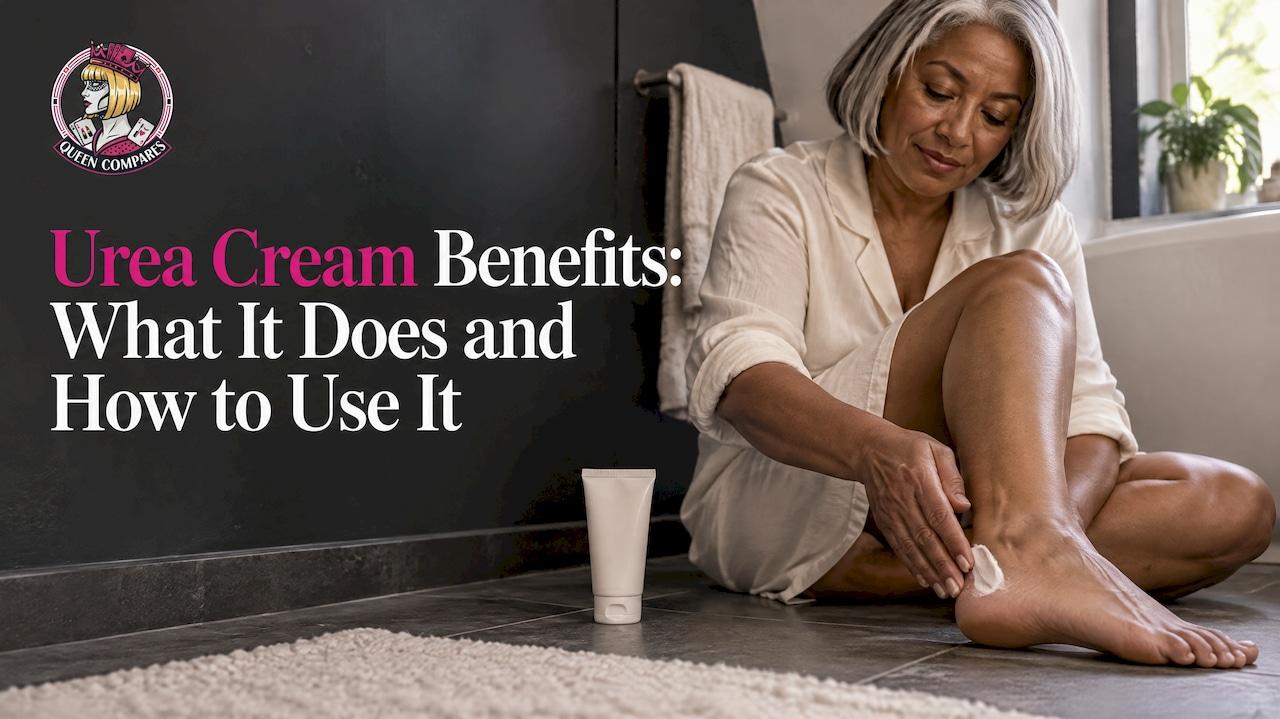
Urea cream does two jobs. At lower strengths it pulls water into the outer layer of your skin and holds it there. At higher strengths it loosens the dead, compacted cells that make skin feel rough and bumpy. That is why it shows up in creams for dry heels, rough elbows and keratosis pilaris (KP, those small “chicken skin” bumps). Below you will find what the evidence says, which percentage fits which problem, how to apply it, and how to check a label before you buy.
Key Takeaways
-
Urea is a humectant at low strengths and a keratolytic (a smoother of thick, flaky skin) at higher strengths, so the percentage on the label matters more than the brand name.
-
Roughly 2% to 10% is for everyday moisture, 10% to 30% adds smoothing, and 30% to 50% is for thick, stubborn skin.
-
A 4-week study of a 20% urea cream found significant improvement in smoothness and texture for people with keratosis pilaris.
-
Apply it to damp skin after bathing, and go slowly if you already use acids or retinol.
-
Pregnant or breastfeeding? Ask your doctor before using urea products.
Table of Contents
What urea actually is and why it is in skincare
Urea is a small molecule your skin already makes. It is part of the natural moisturizing factor that keeps the outer layer supple. Skincare urea is made in a lab, so it is not taken from animals, and it is simply a copy of that natural molecule.
According to DermNet NZ, urea has several actions: it draws and holds water in skin cells, softens the horny layer so it releases more easily, supports barrier renewal, calms itch, and helps other substances such as corticosteroids penetrate. A 2021 review in Dermatology and Therapy adds that urea can switch on genes involved in building the skin’s outer layer (filaggrin, loricrin and involucrin). That means it supports skin maturation, not just surface moisture.

In plain terms, one ingredient hydrates, smooths and helps your barrier work better.
The main urea cream benefits
Deep, lasting hydration
Urea is strongly hygroscopic, which means it attracts water. DermNet NZ notes that it reduces water loss from the epidermis, helping skin feel softer and more supple. The cream base matters too. Occlusive and emollient ingredients in the formula slow evaporation, so the water urea pulls in stays put longer.
If you have already tried glycerin or hyaluronic acid, urea sits in the same humectant family. Our guides on glycerin and formulation and on applying hyaluronic acid to damp skin explain how humectants behave, and the same logic applies here.
Gentle smoothing of rough, flaky skin
Above about 10%, urea starts to act as a keratolytic. The 2025 review by Dampa describes how higher concentrations disrupt hydrogen bonds in keratin and soften compacted skin cells. You get a smoother surface without a scrub.
Help with conditions that cause thick or dry skin
The FDA’s DailyMed label for a 20% urea cream lists dry rough skin, dermatitis, psoriasis, xerosis, ichthyosis, eczema, keratosis pilaris, corns and calluses among the conditions where it is useful. In a randomized, double-blinded study, 7.5% urea cream outperformed a basic moisturizer on the legs of 14 people with ichthyosis vulgaris over 4 weeks, with higher skin hydration and a lower scaling score.
Itch relief
DermNet NZ points to anti-itch activity based on a mild local numbing effect. If dry skin makes you scratch, that is a welcome side benefit.
Better results from other products
Because urea can increase how well other substances penetrate, it is used alongside some medicated creams. Health.com also reports it can improve the effectiveness of other ingredients. Do not layer it over a prescription topical unless your prescriber says so (more on that below).
Urea cream for keratosis pilaris
KP is a very common reason people search for urea. The bumps come from keratin building up around hair follicles, and the Dampa review notes that KP is often linked with filaggrin deficiency and a weaker barrier. Urea suits it because it both loosens buildup and supports barrier maturation.
The best data comes from a 4-week open-label study of a 20% urea moisturizing cream in 30 adults with KP. Smoothness and texture improved significantly after 1 week and again at 4 weeks, and no significant adverse events were reported. Healio’s summary says 93.3% of participants reported softer skin, 86.7% felt more confident and 81.7% felt less embarrassed.

A realistic expectation: KP is chronic, and urea manages it rather than erasing it. Expect softer, smoother skin in a matter of weeks with steady use, and keep going to maintain it. The study was small and had no control group, so treat it as encouraging rather than final.
A simple KP routine
-
Use a gentle, fragrance-free cleanser and lukewarm water.
-
Pat dry, leaving skin slightly damp.
-
Smooth on a urea cream of roughly 10% to 20% to the upper arms, thighs or wherever the bumps are.
-
Once or twice a day. Start with once if your skin is sensitive.
-
Protect the area with sunscreen on exposed days.
Which urea percentage should you choose?
The 2021 review by Piquero-Casals and colleagues groups urea strengths into three bands. The table below pairs them with common goals, using that review plus the Dampa review, which says 10% is typical for mild dryness and maintenance, and 20% to 30% is reserved for more pronounced thickening.
| Strength | What it does | Good for |
|---|---|---|
| 2% to 10% | Hydrates and supports the barrier | Everyday dry skin, face and body, beginners |
| 10% to 30% | Hydrates and gently smooths | Rough elbows, knees, heels, keratosis pilaris |
| 30% to 50% | Strong keratolytic action | Very thick skin under a clinician’s guidance |
The same review says urea products are generally well tolerated, though mild side effects are more frequent at higher strengths. Dorf and colleagues even suggest that 7.5% might cause fewer adverse effects than 10% while keeping urea’s benefit, though they say a direct comparison study is still needed.
Practical rule: start low, move up only if you need to. A 5% to 10% cream is plenty for most dry skin. Go higher for patches that stay rough.
How to apply urea cream for the best results
Cleveland Clinic says urea cream works best on skin that is still damp after a bath or shower. Health.com describes a routine for body dryness: soak in a lukewarm bath for 5 to 10 minutes, cleanse with a gentle fragrance-free cleanser, pat skin lightly so it stays slightly damp, apply any prescription topicals as directed, then apply the urea moisturizer to the rest of the body within three minutes.
Some habits that help:
-
Follow the product directions. Urea products are typically used twice daily.
-
Patch test first. Try a small area for a few days before using it widely.
-
Keep it away from eyes and lips. Medical News Today lists these as sensitive areas to avoid.
-
Do not put it over prescription medication areas unless your doctor has told you to.
-
Skip freshly shaved or broken skin. Stinging is more likely there.
If you want a layered, step-by-step approach, our skin barrier repair routine shows where a rich moisturizer fits.
What to pair with urea, and what to go slowly with
Urea plays well with other hydrating and barrier-supporting ingredients. Ceramides rebuild the lipid layer, glycerin and hyaluronic acid add more water-binding, and niacinamide supports a calmer, more even-looking barrier.
Be more careful with other exfoliators. Because urea already loosens dead skin cells at medium and high strengths, stacking it with retinol or strong acids can lead to irritation. E45’s skincare guidance makes this same point, and our BHA vs AHA guide helps you choose acids without overdoing it. A simple way to avoid trouble:
-
Use acids or retinol on one evening and your urea cream on another, at least at first.
-
Add one active at a time and wait about two weeks before adding the next.
-
If skin stings or turns red, drop back to plain moisturizer until it settles.
For a gentle level of acidity across your routine, see our notes on skincare pH balance.
Side effects and safety
Urea has a strong safety record. Health.com reports it appears on the World Health Organization’s list of essential medicines and that research has found topical urea safe for long-term use, with a low risk of side effects. The Piquero-Casals review found just one reported case of allergic contact dermatitis to a high-urea cream, probably caused by another ingredient in it.
Still, some people notice stinging, itching, burning, redness or color changes, which generally settle after stopping, according to Medical News Today. Stop using the product and see a dermatologist if irritation continues.
Pregnancy and breastfeeding: Medical News Today advises people who are pregnant or breastfeeding to avoid urea-containing products, because effects in pregnancy have not been fully studied. Ask your OB-GYN or midwife before using any urea product.
Children: DermNet NZ says urea may be used in children from 1 year if they have a diagnosed dry skin condition and a doctor has recommended it.
Eczema or psoriasis: Urea can help manage these, but talk to your dermatologist about strength and timing, especially during a flare when skin is raw.
Where urea fits with makeup and dry climates
Smoother skin makes makeup sit better. If you use urea on your body, a lightweight tinted moisturizer, BB cream or CC cream on your face is an easy match for the hydrated, comfortable skin you are building. Choose formulas that list humectants such as glycerin or hyaluronic acid near the top, and keep any strong-percentage urea off the delicate eye area.
Living somewhere very dry adds to the challenge. If you want in-person help for parched winter skin, facials for dry climates are one way to add moisture on top of your home routine.
Our perspective
We built Queen Compares because a percentage on a front label tells you very little. Urea is a perfect example. Two creams can both say “with urea” and behave completely differently depending on how much is inside, what sits beside it, and whether the formula includes ingredients that do not suit your skin.
That is why we start with the ingredient list. Our ingredient analysis and safety alerts help you see what is in a product, and the Ingredient Checker and Label Scanner make it quick to read a label while you shop. We think shoppers should be able to compare two creams side by side, check them against their own skin concerns, and read what other people say before they buy.
If keratosis pilaris or dry patches are your concern, start gently, build up slowly and keep the rest of your routine simple. Our community reviews and curated clean beauty picks are there to help you find a formula that fits you.
Magdalena
Check your urea cream with Queen Compares
Standing in front of a shelf of creams, it is hard to tell which one has a sensible urea level and a friendly ingredient list. Queen Compares lets you browse products by ingredient, scan a label, and compare formulas side by side.

If you want a routine built around your skin, Skincare Routine Builder is included in Premium Access with €7 per month. You can also explore the Clean Beauty Catalogue for cleaner picks.
FAQ
Is urea cream good for you?
For most people, yes. Topical urea has a long record of use and is reported to have a low risk of side effects, even over long periods, according to Health.com. Mild stinging or redness can happen, especially at higher strengths. Start with a lower percentage and patch test.
Is it safe to use urea cream while breastfeeding?
The effects of urea products in pregnancy have not been fully studied, and Medical News Today advises pregnant and breastfeeding people to avoid them. Check with your doctor or midwife before using any urea product, and ask which alternatives suit you.
Why is urea cream good for dry skin?
Urea attracts water and helps hold it in the skin’s outer layer, which reduces water loss and leaves skin softer, as DermNet NZ explains. At higher strengths it also loosens flaky buildup. Together this makes dry, rough skin feel smoother.
Can I use urea cream on my face?
Many people use low-strength urea (around 5% to 10%) on the face, away from the eyes and lips. Higher strengths are usually meant for the body. Patch test first, and ask a dermatologist if your face is sensitive or reactive.
How long does urea cream take to work for keratosis pilaris?
In a 4-week study of a 20% cream, smoothness and texture had improved significantly after 1 week and improved further by week 4. Results vary, and KP tends to return if you stop, so keep a maintenance routine.
Sources
-
Effect of topical treatment with 7.5% urea in Ichthyosis vulgaris
-
Evaluation of a Moisturizing Cream with 20% Urea for Keratosis Pilaris
-
Moisturizer with 20% urea improves smoothness, texture in keratosis pilaris, Healio
-
Urea in skincare: Uses, benefits, risks, and more, Medical News Today
-
5 Best Facials to Combat Colorado’s Dry Climate, Silver Palm
Recommended
General Entertainment & Information Purposes Only At QueenCompares.com we share content for general entertainment and information. It’s not medical, dermatological, nutritional, or fitness advice and shouldn’t replace guidance from a licensed professional. If you’re making health-related decisions, please check with a qualified expert — and know that using this site and its information is at your own discretion.