The fastest, most reliable path to a genuinely vegan beauty product is checking for a trusted third-party vegan certification first. When that seal isn’t there, run a three-step check: scan the ingredient list for animal-derived terms and their INCI aliases, then email the manufacturer about anything unclear. Remember that “cruelty-free” and vegan are two separate promises, and tools like an ingredient checker can shortcut the whole process.
TL;DR:
Checking for recognized third-party vegan certification remains the most reliable shortcut, but verification through ingredient lists and manufacturer inquiries is still essential.
Many animal-derived ingredients are disguised behind INCI names or codes, making direct source confirmation necessary, especially for gray-zone ingredients like glycerin and stearic acid.
The absence of a legal definition for “vegan” in the US means that certifications are a helpful endorsement, but ingredient-by-ingredient verification often provides more certainty.
Fragrance and flavor ingredients can hide animal-derived compounds, so asking brands about their specific formulations is crucial for true vegan verification.
Using digital tools can expedite this process, but direct manufacturer communication remains the most revealing step in confirming vegan status and avoiding cross-contamination.
Table of Contents
-
Do Vegan and Cruelty-Free Certifications Guarantee the Same Thing?
-
Where Can You Find Verified Vegan Beauty and Supplement Products?
-
Why Ingredient-Level Verification Beats Trusting the Front Label
What Is the Right Way to Verify a Vegan Claim?
Verifying a vegan claim on cosmetics or supplements isn’t a single glance at the front label. It’s a workflow, and skipping steps is exactly how animal-derived ingredients slip past well-meaning shoppers. Here’s the sequence that actually holds up.
-
Check for third-party vegan certification first. A Vegan Trademark or similar registered seal means someone already did the ingredient audit for you. Cross-check the brand or product against the certifying body’s own registry rather than trusting a logo printed on packaging, since logos can be copied or expired.
-
Scan the full ingredient list, not just the front-of-pack claims. Read every line on the back label and flag anything that matches known animal-derived terms or their INCI codes. Prioritize colorants and allergen-adjacent codes (carmine shows up as C.I. 75470, for example) because these hide in plain sight under numerical names.
-
Handle ambiguous ingredients with a direct question. Items like glycerin, squalene, and stearates can come from either plants or animals, and the label rarely says which. Check the brand’s sourcing or supplier policy page first; if nothing turns up, email or message the manufacturer with something like: “Can you confirm whether the glycerin and stearic acid in [product name] are plant-derived or animal-derived, and is this sourcing consistent across batches?”
Give the brand some time to respond. A clear “plant-derived confirmed” answer settles the question. Silence, a vague non-answer, or a response that dodges the sourcing question is a signal to treat the product as unclear, and cautious shoppers should default to skipping it rather than assume the best.
Pro Tip: Save every manufacturer email response you get, even the vague ones. Brands change formulas between batches, and having a paper trail makes it faster to spot when a “vegan” claim quietly stops being true.
Which Animal-Derived Ingredients Hide Under INCI Names?
Most animal-derived ingredients don’t announce themselves. They show up in Latin binomials, coded abbreviations, or names that sound perfectly plant-based. Ethical Consumer’s ingredient breakdown confirms that cosmetics regularly include a wide range of these substances, many disguised behind INCI or numerical codes that most shoppers never learn to decode.
Here’s the priority watchlist worth memorizing, or at least screenshotting:
-
Carmine (also listed as C.I. 75470 or Natural Red 4), a red pigment made from crushed cochineal insects, common in lipsticks and blushes.
-
Shellac (lac), a resin secreted by lac insects, often found in hairsprays and nail products.
-
Beeswax (cera alba), standard in lip balms, mascaras, and solid perfumes.
-
Lanolin, extracted from sheep’s wool grease, hiding in moisturizers under names like “wool wax” or “wool fat.”
-
Gelatin, derived from animal collagen, used in some capsule shells and gel-based masks.
-
Collagen and keratin, typically sourced from animal skin, hooves, or feathers unless labeled “vegan collagen” or “plant keratin.”
-
Squalene, historically shark-derived, though plant-based squalane from olives or sugarcane is now widely available and usually labeled as such.
-
Guanine, a shimmer additive scraped from fish scales, common in shimmery eyeshadows and nail polish.
-
Honey and royal jelly, frequent in “natural” skincare lines marketed as gentle.
-
Snail mucin, a staple of Korean-beauty-inspired serums, sourced directly from live snails.
Then there’s the gray zone: glycerin, stearic acid, cetearyl alcohol, and hyaluronic acid can each be animal- or plant-derived depending on the manufacturing process, and the label alone won’t tell you which. A survey from The Vegan Society found that most shoppers can’t reliably identify animal-derived ingredients from an INCI list alone, which is exactly why a growing share wants clearer vegan labeling built into the product itself rather than left to guesswork.
Supplements deserve their own scrutiny. Softgel and capsule shells are frequently made from gelatin, and vitamin D3 or omega-3 formulas often rely on fish oil or lanolin-derived cholecalciferol unless the label specifies “vegan D3” or an algae-based omega source.
Do Vegan and Cruelty-Free Certifications Guarantee the Same Thing?
No, and this is the mix-up that trips up more shoppers than any single ingredient; understanding the difference between cruelty-free and vegan products is essential, as explained in detail on Cruelty Free Skincare: What It Means and Why It Matters. The Vegan Society’s Vegan Trademark checks both ingredient sourcing and testing practices, which makes it one of the most complete single shortcuts available. Leaping Bunny, by contrast, verifies that a product and its ingredients weren’t tested on animals, but it says nothing about whether the formula itself contains animal-derived materials. A lipstick can carry a Leaping Bunny seal and still contain carmine or beeswax.
A few things worth knowing before you trust any seal at face value:
-
Cruelty-free ≠ vegan. Always check both claims independently rather than assuming one implies the other.
-
Watch for the Fixed Cut-Off Date (FCOD). Some cruelty-free certifications only guarantee no animal testing after a certain date, which can leave older formulations or ingredients from the pre-cutoff era in a gray zone.
-
Verify the claim on the registry, not the packaging. Search the product or brand name directly on the certifying body’s own database to confirm the seal is current and legitimately issued.
-
Not every seal carries equal weight. Smaller or regional certifications can have looser standards than the two major names above, so treat unfamiliar logos with a little more skepticism.
What’s the Fastest Way to Check a Product Before You Buy?
Standing in an aisle with a phone flashlight isn’t the moment for a deep research session. Run this six-point checklist instead:
-
Look for a recognized vegan certification first.
-
Scan the ingredient list against your watchlist for high-risk terms.
-
Flag ambiguous ingredients like glycerin or stearates for follow-up.
-
Check the brand’s website for a sourcing or supplier policy page.
-
Message the manufacturer directly if the answer still isn’t clear.
-
Run the product through a label or ingredient-scanning tool for a faster second opinion.
Digital tools speed up steps two through six considerably. INCI translator pages decode Latin ingredient names in seconds, and ingredient libraries give you the sourcing context that a bare label never will. Their limit is coverage. No database catches every SKU, especially from smaller or newer brands, which is where a detailed look at how to parse an ingredient list still earns its place.
QueenCompares’ Ingredient Checker and Label Scanner slot directly into that workflow. Scan a label or paste an ingredient list, and the tool flags known animal-derived items and unclear entries for you to run down manually.
Pro Tip: Keep your six-point checklist saved as a phone note. Half the value of a verification routine is not having to reconstruct it every time you’re standing in a store aisle with five minutes to decide.
How Does Cross-Contamination Affect Vegan Cosmetics?
Shared equipment is the biggest culprit: a factory that produces both a beeswax-based lip balm and a vegan lip balm on the same machinery, without a full cleaning cycle in between, can leave microscopic residue in the “vegan” batch. This rarely shows up on an ingredient list, because trace contamination isn’t classified as an added ingredient under most labeling rules.
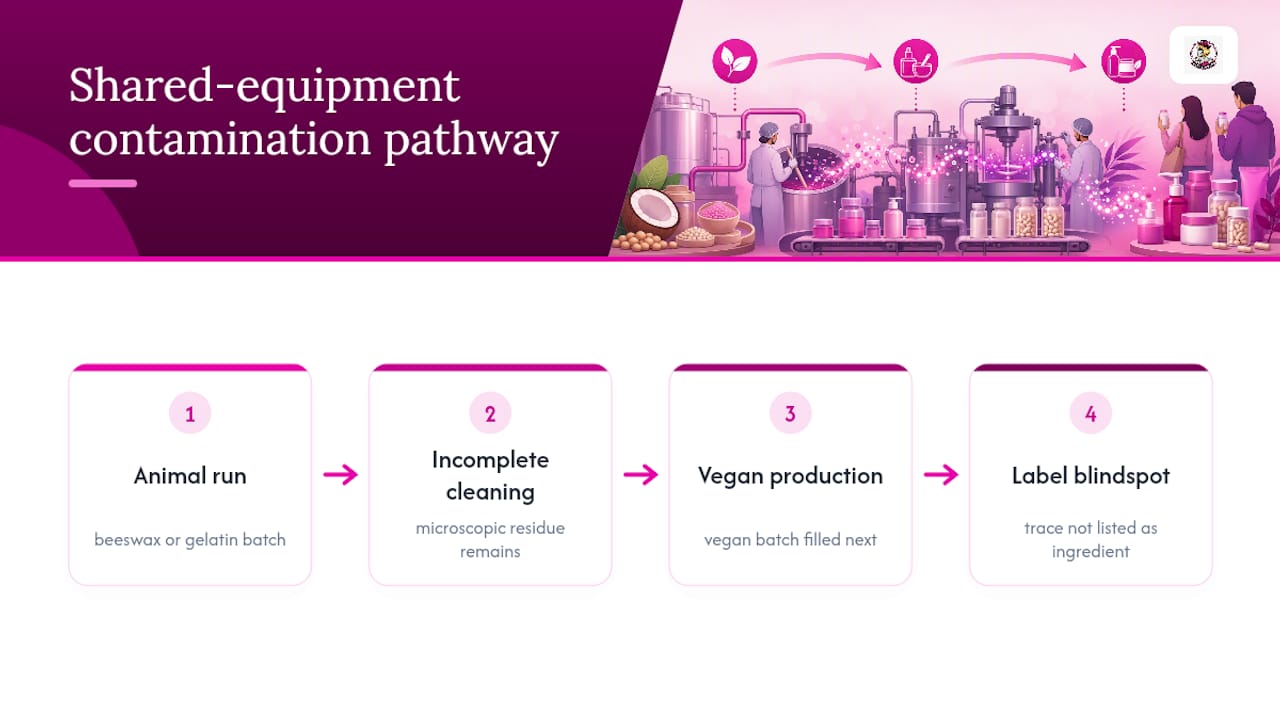
The risk runs highest in smaller manufacturers and private-label cosmetics, where dedicated vegan production lines are less common than at larger, vegan-focused brands. Supplement capsules face a similar issue when a facility processes both gelatin and vegetarian capsule shells on the same fill lines.
There’s no label code that flags this reliably, so the practical move is to ask directly. When you contact a manufacturer about an ambiguous ingredient, add a second question: whether the product is manufactured on dedicated vegan lines or shared equipment with animal-derived products. Brands serious about the claim usually have a ready answer. Brands that hesitate or can’t explain their production setup are worth treating with the same caution as an unclear ingredient response, because transparency about sourcing and manufacturing tends to track together more often than not.
What Do Labeling Laws Actually Require for a Vegan Claim?
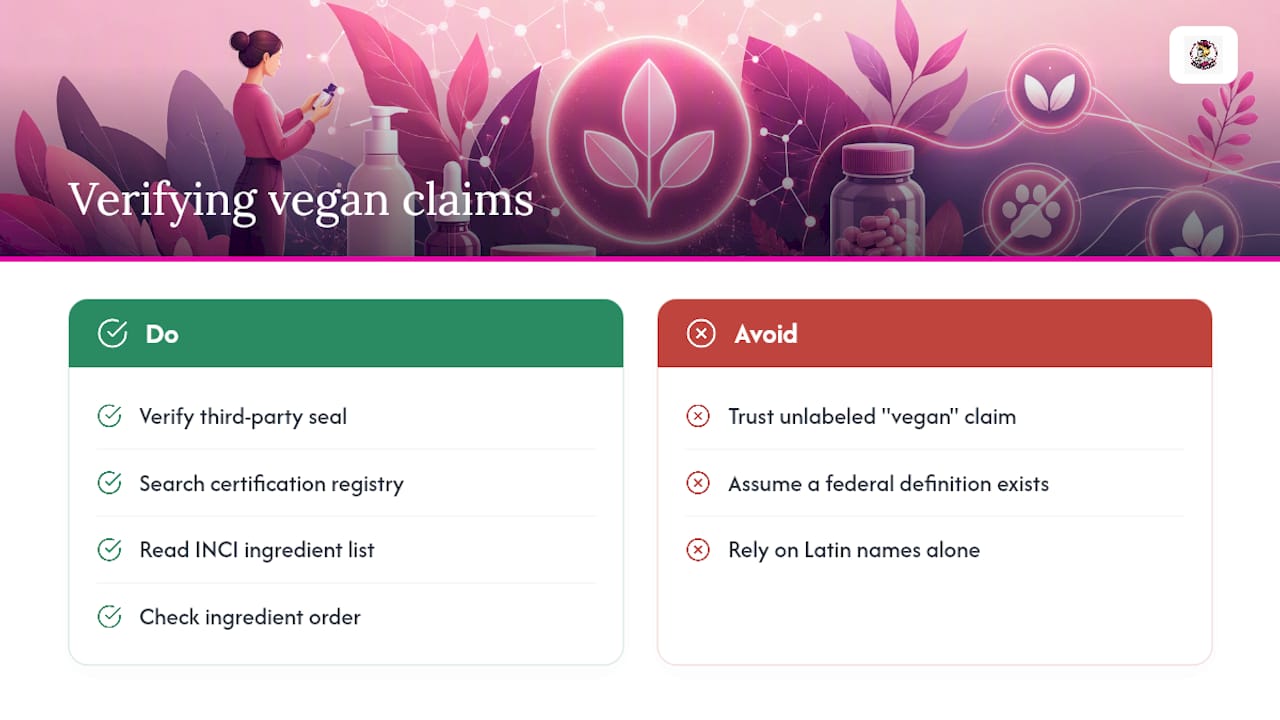
Here’s the part that surprises most shoppers: in the United States, there’s no single federal legal definition that a brand must meet before printing “vegan” on a cosmetic or supplement label. The FDA regulates cosmetic labeling for safety and ingredient disclosure, but the word “vegan” itself functions closer to a marketing claim than a regulated term, similar to “natural” or “clean.” That gap is exactly why third-party certification carries so much weight. A registered seal like the Vegan Trademark applies its own independent standard, checked against an actual ingredient audit, in a way that self-declared label text simply doesn’t.
This is also where INCI naming conventions matter more than most shoppers realize. The International Nomenclature of Cosmetic Ingredients standardizes ingredient names across products and borders, but standardized doesn’t mean transparent. An ingredient can be listed correctly and still obscure its animal origin behind a Latin or chemical name that means nothing to the average reader. Regulation covers that a name gets listed, not that a shopper can decode what it means.
The practical takeaway: treat an unsupported “vegan” claim on packaging as a starting point, not a verdict. Cross-check it against the certification registry or the ingredient list itself, the same ingredient-order logic used to spot other formula red flags applies here.
Are Fragrance and Flavor Ingredients Ever Non-Vegan?
Frequently, and this is one of the sneakiest gaps in vegan verification. “Fragrance” and “flavor” on an ingredient list function as legal umbrella terms that let manufacturers protect proprietary scent and taste formulas without disclosing every component inside them. That single word can be hiding dozens of individual compounds, and some fragrance houses still use musk derivatives, ambergris, or civet extracts in select formulations, even though synthetic alternatives dominate the modern market.
Flavor ingredients in vegan supplements carry a similar risk. Natural flavoring agents sometimes rely on animal-derived carrier bases or processing aids that never make it onto the final label as a standalone line item.
The fix isn’t glamorous, but it works: contact the brand directly and ask specifically whether the fragrance or flavor blend contains any animal-derived components or was processed using animal-derived carriers. Generic fragrance suppliers can usually confirm this on request, since it’s a standard question from vegan-focused clients. If a brand already carries a full vegan certification, the fragrance and flavor components were audited as part of that same certification process, which is one more reason a recognized seal remains the more efficient shortcut over ingredient-by-ingredient detective work.
Where Can You Find Verified Vegan Beauty and Supplement Products?
A handful of resources do the heavy lifting so you’re not starting from zero every time you shop. The Vegan Trademark registry lets you search certified products and brands directly, and it’s the closest thing to a definitive list for ingredient-level vegan status. Humane World for Animals’ cruelty-free consumer guide covers the testing side of the equation and explains why that list won’t overlap perfectly with a vegan-ingredient database.
Beyond certification registries, QueenCompares’ own Ingredient Library works as a decoding reference for the INCI names and coded terms that make ingredient lists so hard to parse on your own. Pair that with community reviews and comparison tools that surface how transparent a brand actually is about sourcing, and you’ve got a research stack that covers certification, ingredient decoding, and brand accountability in one pass. None of these resources catch everything on the market, which loops back to why the manufacturer-contact step still matters even when a good database exists.
Why Ingredient-Level Verification Beats Trusting the Front Label
Most vegan beauty guidance treats certification as the finish line. It isn’t. A trademark seal is an excellent shortcut, but it only covers products that pursued it, and plenty of genuinely animal-free formulas from smaller or newer brands simply haven’t gone through the certification process yet, whether for cost or timing reasons. Writing those brands off because they lack a logo means missing real options, while assuming every uncertified product is suspect overcorrects in the wrong direction.
The more useful mental model is treating certification as your fastest path when it’s available, and ingredient literacy as your fallback when it isn’t. Shoppers who learn to spot carmine, lanolin, and the ambiguous middle ground of glycerin and stearates stop being dependent on any single brand’s marketing decisions. That skill travels. It works on a lipstick, a supplement bottle, or a fragrance you’ve never seen before.
What the industry underestimates is how much friction sits in the manufacturer-contact step, and how often shoppers skip it because it feels like too much effort for one product. It’s the single most revealing step in the whole process. A brand’s response time, tone, and specificity when asked a direct sourcing question tells you more about its actual transparency than any front-of-pack claim ever will.
Verify Faster With Queen Compares’ Ingredient Tools
Reading an INCI list line by line takes patience most of us don’t have time for in a store aisle. Ingredient checker and label scanner tools close that gap, letting you scan or paste a product’s ingredients and get a flagged breakdown of anything animal-derived or ambiguous in seconds, then save the results to your own scan history for later comparison.
Start with whichever entry point fits your situation right now:
-
Run a product through the Ingredient Checker to get an instant scan report on animal-derived and unclear ingredients.
-
Browse the Ingredient Library to decode unfamiliar INCI names before you even open the checker.
-
Search the product directory to see how a specific formula compares before you buy.
None of this replaces certification registries or a direct email to a manufacturer, and QueenCompares doesn’t claim to. What it does is cut the manual decoding time down to something you can actually do while standing in a store, so the harder verification steps only kick in when a product genuinely needs them.
Sources
-
Humane World for Animals: Consumer guide to cruelty-free products
-
Cosmetics (journal) review on animal-derived cosmetic ingredients (2022)
FAQ
Is a “Vegan” Label on Cosmetics Legally Regulated?
Not in a standardized way. No single federal rule defines what qualifies a cosmetic as vegan, which is why a third-party certification like the Vegan Trademark carries more weight than the word alone on packaging.
What’s the Difference Between Vegan and Cruelty-Free Products?
Vegan refers to the absence of animal-derived ingredients, while cruelty-free refers to no animal testing, and neither claim guarantees the other.
How Long Should I Wait for a Manufacturer to Confirm an Ingredient?
Give the brand some time to respond. If the product’s sourcing is unclear, treat it cautiously and skip it rather than assume the best.
Which Ingredients Should I Double-Check Before Buying?
Prioritize carmine, shellac, beeswax, lanolin, gelatin, collagen, keratin, and squalene, plus the gray-zone group of glycerin, stearic acid, and cetearyl alcohol, which can come from either plants or animals.
Can a Tool Replace Reading the Full Ingredient List Myself?
A tool like QueenCompares’ Ingredient Checker speeds up the scan and flags known animal-derived terms, but ambiguous ingredients still require a direct manufacturer question for full confidence.