Organic and natural are not the same thing, and the gap between them is bigger than most labels let on. Organic means certified: a product carrying that word has passed audits against federal standards. Natural means, legally, almost nothing. Here's the practical split for your cart:
- Food and skincare labeled "organic" must meet certification requirements enforced by regulators or accredited third parties.
- Products labeled "natural" rely on the manufacturer's own definition, since no single agency polices the word.
Three names anchor everything below: USDA Organic for regulated organic claims, COSMOS (with certifiers like NATRUE) for organic and natural cosmetics, and the FDA, which oversees food and cosmetic safety but has never issued a formal rule for "natural."
Key Takeaways
Organic ingredients carry certified, government-backed standards, while natural ingredients rely entirely on unregulated marketing language with no enforced definition.
| Point | Details |
|---|---|
| Organic is regulated | USDA Organic certification requires audits, documentation, and compliance with federal rules under 7 CFR Part 205. |
| Natural has no legal standard | The FDA has no formal definition for "natural," so brands set their own criteria. |
| Read past the front label | Check certification logos, exact wording, and full ingredient lists before trusting a claim. |
| Natural doesn't mean allergen-free | Botanical ingredients can still trigger reactions or vary in potency between batches. |
| Verify with real tools | QueenCompares's Ingredient Library and checker tools help confirm certifications and flag additives before you buy. |
Table of Contents
- What "Organic" Actually Means for Ingredients
- What "Natural" Means, and What It Doesn't
- Organic vs. Natural: A Quick Comparison
- How Organic and Natural Show Up in Food vs. Skincare
- Common Myths About Natural and Organic Ingredients
- How to Read Ingredient Labels Without Getting Fooled
- Choosing Between Organic and Natural: A Simple Guide
- Why Certifier Databases and Ingredient Checkers Matter
- Environmental and Health Benefits: Organic vs. Natural
- What It Actually Costs to Get Certified
- Additives Hiding Behind the Word "Natural"
- Sourcing Practices and Their Impact on Biodiversity
- An Editorial Note From QueenCompares
- Let QueenCompares Do the Label-Reading for You
- Sources
- FAQ
What "Organic" Actually Means for Ingredients
Organic is a legal status, not a vibe. In the United States, organic food and farming ingredients fall under federal regulations codified in 7 CFR Part 205, which spells out what growers and processors can and cannot do. Synthetic pesticides are largely off the table. Genetically modified organisms are excluded. Certain processing aids and irradiation methods are restricted too. The USDA's Agricultural Marketing Service and the National Organic Standards Board write and enforce these rules, and they update the allowed and prohibited substance lists regularly.
Front-of-pack wording matters more than shoppers realize:
- "100% organic" means every ingredient is certified organic, no exceptions.
- "Organic" allows up to 5% non-organic ingredients from an approved list.
- "Made with organic ingredients" requires at least 70% organic content but skips the certification seal.
Getting any of these labels legitimately requires supply-chain audits, paperwork trails from farm to shelf, and annual inspections, which is why certified organic goods often cost more. NATRUE notes that organic sourcing and production criteria are specific enough that even cosmetic brands need dedicated documentation to qualify.
What "Natural" Means, and What It Doesn't
Here's the part that surprises most shoppers: "natural" has no enforced legal definition in the United States. The FDA has stated plainly that it has no formal rule governing the word on food or cosmetic labels. Any brand can print it on a bottle if it can justify the claim to its own satisfaction.
That gap creates a real split between "natural" and "derived natural." A derived natural ingredient started as a plant or mineral but went through chemical or biotechnological processing to become usable in a formula. NATRUE's guidance distinguishes minimal processing from heavier modification, and some certifiers only accept derived natural ingredients under strict conditions.
Common surprises hiding behind the word "natural":
- Preservatives sourced from natural origins but still functioning as synthetic-grade stabilizers.
- Fragrance blends labeled "natural" that include dozens of undisclosed aromatic compounds.
- Additives added purely for shelf life, texture, or color that trace back to a plant but are heavily processed.
Organic vs. Natural: A Quick Comparison
Side by side, the two terms behave completely differently once you look past the packaging.
- Certification and regulation: Organic requires third-party certification and government oversight; natural requires none.
- Scope: Organic rules cover farming, processing, and handling; natural claims typically only reference the source material.
- Label wording: Organic has legally defined tiers (100% organic, organic, made with organic); natural has no standardized tiers at all.
- Consumer benefit claims: Organic implies verified farming and processing practices; natural implies a vague sense of purity that isn't audited.
- Price and availability: Organic products usually cost more due to certification overhead; natural products can be priced anywhere since there's no compliance cost baked in.
In most markets, organic is the only one of the two terms backed by a paper trail you could actually request and review.
How Organic and Natural Show Up in Food vs. Skincare
In food, "organic" covers produce grown without synthetic pesticides, dairy from animals raised on organic feed, and packaged goods where every ingredient traces back through a certified supply chain. A carton of organic eggs and a bag of organic chips both had to clear the same certification hurdle, even though the products look nothing alike.
Skincare tells a messier story. Cosmetic organic standards like COSMOS set minimum organic content thresholds, but a cream can still be mostly water and need preservatives to stay shelf-stable, even with a certified organic seal on the front. "Natural" in skincare frequently describes plant-derived oils, butters, or extracts, none of which are audited the way organic claims are.
A few things catch people off guard:
- A serum can be COSMOS-certified organic and still contain necessary stabilizers.
- "Natural fragrance" on an ingredient list can mean a complex blend, not a single traceable botanical.
- Organic produce and organic skincare oils follow completely different certifying bodies, even though both use the same word.
Common Myths About Natural and Organic Ingredients
Myth one: natural is automatically safer. It isn't. Plant-based ingredients can still be allergens, irritants, or simply inconsistent from batch to batch depending on growing conditions. Myth two: organic means hypoallergenic. Certification governs farming and processing methods, not whether an ingredient triggers a reaction in your specific skin or gut.
Myth three: "clean" and "natural" are interchangeable with "safe." None of those words carry a legal safety guarantee. The FDA is explicit that cosmetics aren't pre-approved before hitting shelves, meaning manufacturers, not regulators, are responsible for safety claims.
Dose and origin matter more than marketing language. A botanical extract's potency can shift between harvests, which changes both effectiveness and allergy risk in ways a "natural" label never discloses.
Pro Tip: Don't assume a short ingredient list means a gentle product. Some of the most concentrated, reactive botanical extracts appear third or fourth on an INCI list, not last.
How to Read Ingredient Labels Without Getting Fooled
Reading a label properly takes under a minute once you know the order to check things.
- Look for a certification logo first. USDA Organic, COSMOS, or NATRUE seals mean a third party actually reviewed the product.
- Check the exact wording near the logo. "Organic" and "made with organic ingredients" are legally different claims, not stylistic choices.
- Scan for percentage phrasing. Language indicating a significant organic percentage conveys more information than a bare "natural" claim.
- Read the full ingredient or INCI list, not just the front-of-pack headline.
- Watch for preservative and stabilizer names tucked near the end of the list; they're often necessary but rarely mentioned in the marketing copy.
- Confirm the certifier's name is listed, not just a generic leaf icon with no accountable organization behind it.
Reading skincare labels like a pro gets easier with practice, and understanding formula transparency helps you spot when a brand is being straightforward versus vague on purpose.
Pro Tip: Prioritize the active ingredients that actually do something for your skin or health goals over whichever word sits in bold on the front label.
Choosing Between Organic and Natural: A Simple Guide
Your priorities should drive the decision, not the label's popularity.
- Choose organic when pesticide exposure, farming practices, or a verified supply chain matter to you.
- Choose natural when you want fewer synthetic inputs but certification costs feel like an unnecessary premium.
- Choose neither, and focus on formulation, when performance or specific active ingredients matter more than where they originated.
Quick guidance by shopper type: budget buyers often do fine prioritizing ingredient function over labels; clean-beauty shoppers should lean organic-certified when avoiding synthetic inputs is the goal; allergy-sensitive buyers need full ingredient transparency regardless of which word is on the front.
Why Certifier Databases and Ingredient Checkers Matter
Logos alone don't prove anything. USDA Organic, COSMOS, and NATRUE all maintain searchable certifier databases, so you can confirm a seal is real rather than printed. That extra step catches more mislabeling than most shoppers expect.
An ingredient checker adds a second layer: it flags allergens, separates natural from synthetic components, and parses percentage claims that are easy to skim past. Say you're holding a moisturizer marked "70% organic." A quick certifier lookup confirms the seal is legitimate, and running the ingredient list through a checker like QueenCompares's Ingredient Checker shows you exactly what makes up the other 30%.
- Certifier lookups verify the seal is authentic, not decorative.
- Ingredient checkers flag synthetic vs. natural components at a glance.
- Percentage parsing shows what "70% organic" leaves out.
Pro Tip: Run any product claiming "natural fragrance" through an ingredient checker app before buying. That single phrase can hide dozens of undisclosed compounds.
Environmental and Health Benefits: Organic vs. Natural
Organic farming rules produce measurable environmental effects that "natural" sourcing simply doesn't guarantee. Because certified organic agriculture restricts synthetic pesticides and fertilizers, it tends to reduce chemical runoff into local water systems and supports soil practices like crop rotation that natural claims never require. A "natural" ingredient can still come from a farm using conventional pesticide programs, since the word says nothing about how the plant was grown.

Health comparisons are murkier than marketing suggests. A broad academic review of the evidence found mixed results between organic and conventionally grown food, with some studies showing modestly lower pesticide residues or higher antioxidant levels in organic produce, but the differences aren't uniform or dramatic across every crop and nutrient studied. Organic buying is often better understood as a farming-practice choice than a guaranteed personal health upgrade.
Natural ingredients carry their own inconsistency. Because there's no processing standard behind the word, a "natural" ingredient's environmental footprint depends entirely on how that specific manufacturer sourced it. One brand's natural shea butter might come from a small cooperative using sustainable harvesting; another's might not.
The clearest takeaway: organic certification gives you a documented standard to point to. Natural gives you a general direction, sourced from plants or minerals, with no audit trail confirming how responsibly that sourcing happened. If environmental impact drives your purchase, organic status carries more evidentiary weight than a natural claim ever will.
What It Actually Costs to Get Certified
Certification is where the price difference between organic and conventional (or "natural") products actually originates. Becoming USDA Organic certified means a farm or processor must document every input, from seeds to cleaning agents, and submit to annual on-site inspections by an accredited certifying agent. The process typically takes months for a first-time applicant, and small farms often report that paperwork and inspection fees are the biggest barrier to entry, not the farming changes themselves.
Cosmetic certification runs on a parallel but separate track. Standards like COSMOS require documentation of organic percentage thresholds and supply-chain verification before a product can carry the certified organic or certified natural cosmetic label. A brand has to prove sourcing for every qualifying ingredient, not just claim it.
There's no equivalent process for "natural" claims. Since no regulator defines the term, there's no certification to pursue, no inspection to pass, and no fee to pay. That's precisely why "natural" is cheaper for brands to claim and harder for shoppers to verify. A company can print "all natural" on packaging tomorrow with zero third-party review, while a competitor spends a year and real money earning a USDA Organic seal for a comparable product.
This cost asymmetry explains a lot of the price gap on store shelves. You're not just paying for different ingredients when you buy certified organic. You're paying for the audit trail behind them.
Additives Hiding Behind the Word "Natural"
A "natural" label doesn't rule out synthetic-functioning additives, and that catches a lot of shoppers off guard. Preservatives are the most common surprise: many "all-natural" skincare products still rely on preservative systems to prevent bacterial growth, because water-based formulas spoil quickly without one. Personal Care Magazine notes that even COSMOS-approved natural cosmetics can include necessary stabilizers, since shelf stability and natural sourcing aren't mutually exclusive requirements.
"Natural flavoring" in food is another gray area. The term can describe a compound extracted from a natural source, then chemically isolated and reconstituted in a lab, a process considerably more involved than most consumers picture when they read the words.
Common additives that turn up under "natural" labeling:
- Preservatives derived from natural sources but functioning identically to synthetic stabilizers.
- Emulsifiers needed to blend water and oil phases in creams and lotions.
- Natural flavor compounds that underwent significant lab processing before reaching the final product.
- Fragrance blends listed simply as "natural fragrance" without disclosing individual components.
None of this makes a product unsafe. It just means "natural" tells you almost nothing about the actual formulation choices a brand made, which is exactly why label literacy matters more than the word itself.
Sourcing Practices and Their Impact on Biodiversity
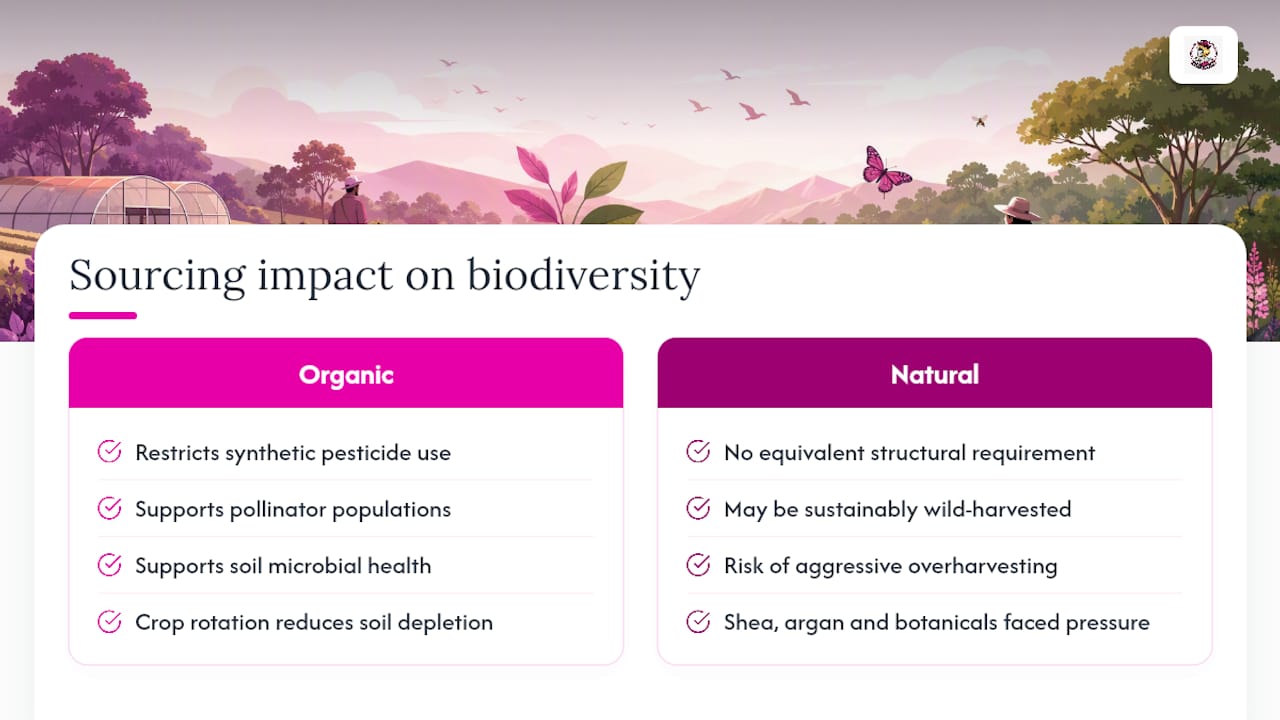
Ingredient sourcing choices ripple outward into ecosystems far beyond the store shelf. Organic farming standards restrict synthetic pesticide use, which tends to support pollinator populations and soil microbial health more consistently than conventional farming, since fewer broad-spectrum chemicals enter the local environment. Crop rotation requirements under organic rules also reduce soil depletion over time, which supports longer-term land biodiversity.
Natural sourcing has no equivalent structural requirement. A "natural" botanical ingredient could come from a sustainably managed wild-harvest operation, or it could come from aggressive overharvesting that strains a local plant population. Shea butter, argan oil, and various wild-harvested botanicals have all faced sourcing pressure as "natural" beauty products surged in popularity, precisely because demand grew faster than any sourcing standard could regulate it.
Certified organic supply chains, by contrast, require documentation that traces ingredients back through the production chain, which creates at least some visibility into farming density and land use. That paper trail doesn't guarantee perfect sustainability, but it gives buyers and regulators something concrete to evaluate.
For shoppers who care specifically about biodiversity impact, organic certification remains the stronger signal, simply because it comes with accountability built into the standard. A natural claim, however well-intentioned the brand might be, carries no such built-in accountability.
An Editorial Note From QueenCompares
Our stance is simple: verify the certification, read the full ingredient list, and use a real tool before trusting a label's front-of-pack promise. QueenCompares built our Ingredient Library and analysis tools around exactly that discipline, so shoppers can balance their own priorities instead of guessing.
Let QueenCompares Do the Label-Reading for You
QueenCompares gives you what a front-of-pack claim never can: a way to actually verify what's in the bottle or the box before you buy it. Instead of guessing whether "natural" hides a synthetic preservative or whether an "organic" claim covers the whole formula, you can run the product through our tools and see the breakdown yourself.
Our Ingredient Library lets you look up individual ingredients, flag allergens, and check whether something is genuinely plant-derived or a heavily processed derivative. Pair that with our AI-powered ingredient checker and label scanner, and you've got a faster, more reliable way to confirm a claim than squinting at fine print in a store aisle. If you want a specific product reviewed, you can also suggest it for analysis. We analyze the ingredients; the final call on what fits your routine or your kitchen is always yours.
Sources
- Use of the term "natural" on food labeling | FDA
- NATRUE — FAQ
- National Organic Standards Board (NOSB) | AMS
- 7 CFR Part 205 — National Organic Program
FAQ
Does Organic Mean 100% Natural?
Not necessarily. Organic certification governs farming and processing methods, while "natural" is a separate, unregulated marketing term, so a product can be certified organic without ever using the word "natural" at all.
What's the Difference Between 100% Natural and 100% Organic?
What Is the Difference Between Organic and Natural?
Organic requires third-party certification against government-backed standards covering farming and processing; natural describes an ingredient's source but carries no certification, audit, or enforced definition.
Is Natural or Organic Better?
Neither is universally better; organic offers more verified environmental and sourcing accountability, while natural can be a reasonable choice when you're avoiding synthetic inputs but don't need certified proof, so the right pick depends on your priorities and budget.