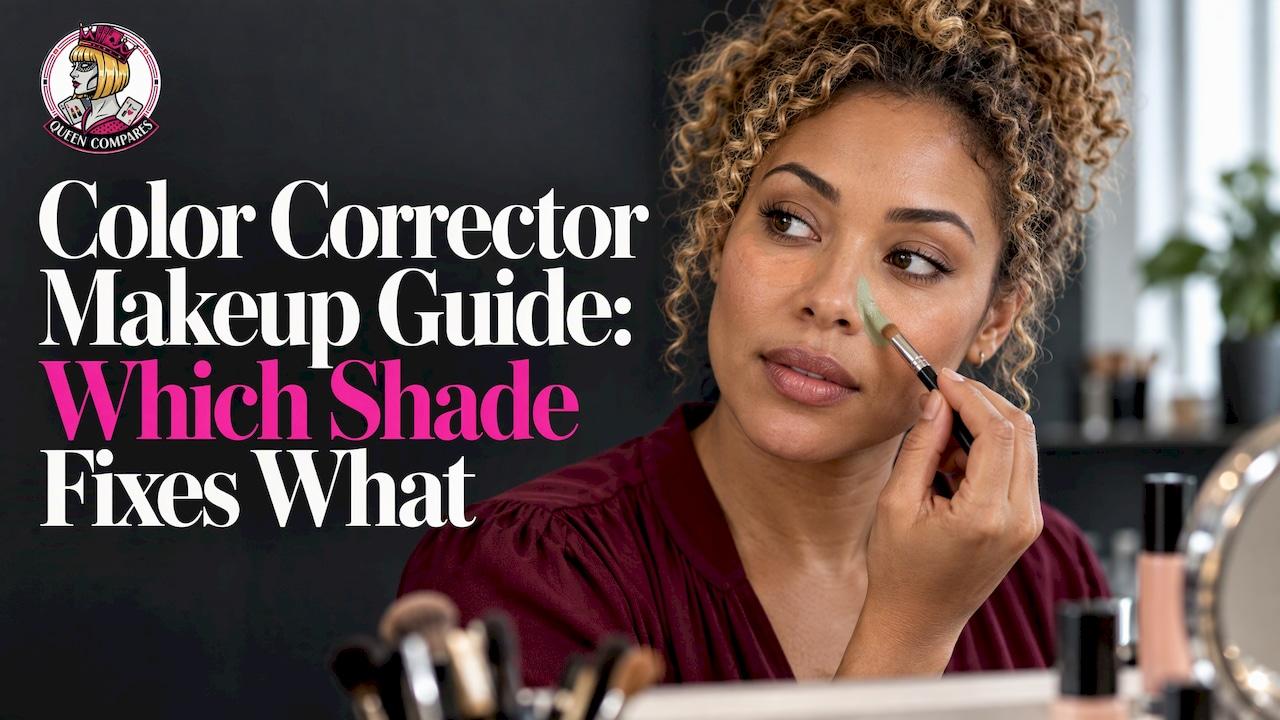
A color corrector is a tinted makeup product that cancels an unwanted tone in your skin before foundation goes on. You pick the shade that sits opposite the discoloration on the color wheel: green for redness, peach or orange for blue and purple dark circles, yellow or lavender for sallow or purple tones. You apply a thin layer only where you need it, blend it, then add foundation and concealer. Below you will find the shade chart, the order of steps, and how to choose a formula that suits your skin and your ingredient standards.
Key Takeaways
-
Correctors neutralize color; concealers match your skin tone. They do different jobs, so they work best as a pair.
-
Choose the shade opposite the discoloration, then match its depth to your skin: pastel shades for fair skin, deeper peach, orange or red-orange for medium to deep skin.
-
Order is skincare, corrector, foundation, then concealer. Use very little product, and keep layers thin under the eyes.
-
Cream and liquid formulas suit dry skin; stick and powder-leaning formulas suit oily skin.
-
Check the ingredient list before you buy, especially if your skin is reactive. Patch test new products first.
Table of Contents
How color correction works
Color correcting rests on the color wheel. Colors opposite each other neutralize each other, so red and green cancel out. Makeup brands apply the same idea: tinted formulas in green, peach, orange, yellow and lavender neutralize unwanted tones such as redness, dark circles and sallowness before foundation, instead of matching your skin tone the way a regular concealer does.
Why bother? Discoloration that is not neutralized can show through base makeup as a gray, ashy cast. Piling on foundation or concealer to hide it makes the base thick, cakey and prone to settling into fine lines. A corrector does the heavy lifting in a small area, so the foundation only has to even out your skin tone.
One limit is worth knowing. Color correcting only changes color. It will not disguise lines or raised areas such as scarring or raised birthmarks, so texture will still show.
The shade guide: what each color corrects
Use this chart to match the problem you see in the mirror to a shade. Brands name their shades differently (apricot, salmon, tangerine, brick red), but the logic stays the same: warm, orange-leaning tones fight blue, purple and gray; green fights red.
| Shade | What it corrects | Best suited for |
|---|---|---|
| Green | Redness from irritation, pimples, rosacea, sunburn | Pale to medium skin tones |
| Pink | Mild dark circles and dull areas on pale skin | Fair, light skin |
| Peach | Blue or purple under-eye circles | Light skin tones |
| Orange | Deeper dark circles, dark spots, gray-toned areas | Medium to deep skin |
| Red or red-orange | Blue-to-green discoloration and hyperpigmentation | Deep skin tones |
| Yellow | Purple tones, bruises, violet circles, blue veins near the temples | Light to medium skin |
| Lavender or purple | Sallow, yellow or dull skin | Light, cool skin tones |
| Blue | Overly orange or yellow discoloration, or a foundation that pulls orange | Corrects the orange cast |
Makeup artists do not always agree on every pairing. One artist quoted in The Strategist prefers yellow over green for redness, because yellow plus red skin makes a peachy tone and avoids a green cast. The same piece notes that most people benefit from a peachy tone under the eyes, with deep apricots for gray tones or brown spots. If green looks too obvious on you, yellow is a reasonable thing to try.
Dark circles come in more than one color
Blue circles on fair skin respond to peach or salmon. Medium to deep skin usually needs orange, and deeper complexions can use a red-toned corrector. Purple circles call for yellow, and mixed blue-purple circles may need peach, orange and yellow together. Look at your under-eyes in daylight and decide which color you actually see before you choose.

Dark spots and hyperpigmentation
The right shade depends on how deep your skin is and on the undertone of the mark. Peach can help brown marks on lighter skin. Orange, red-orange, rust or terracotta tones look more natural on deeper skin. The goal is to reduce contrast, not erase the mark. If a spot is new, changing, bleeding, painful or crusting, see a clinician rather than covering it.
Choose the right depth for your skin tone
The most common mistake is picking the correct color in the wrong depth. A pastel peach can look chalky on deep skin, and a strong orange can look heavy on fair skin. Byrdie advises choosing a corrector close to the depth of your foundation: a medium-deep tan foundation pairs with a medium-depth orange rather than a pastel. Deeper skin tones do better with warmer shades, which avoid a gray or purple look.
Undertone matters too. Red undertones suit cool-toned products with a pinkish cast, and golden skin suits warm correctors with a yellow tint. If you are not sure of your undertone, our guide to finding your undertone in makeup walks you through it.
Brands publish their own shade maps, and they are useful as a starting point. Tarte’s shape tape corrector, for example, maps pink to all skin tones, peach to fair-to-medium, orange to medium-to-deep, red to deep and lavender to fair-to-light. NYX’s Pro Fix Stick runs from green for light-to-medium skin through dark peach, apricot and brick red for deeper tones. If you have an olive complexion, this guide to makeup for olive skin explains how skin depth and undertone steer shade choice.
One more point on skin tone: redness is typically less visible on more melanated skin than on pale skin, and highly pigmented correctors may show through concealer. Deeper skin often needs less green and more attention to gray or dark patches.
Color corrector vs. concealer
They look similar in a drawer, but they are not interchangeable. Color correctors use color theory to neutralize discoloration such as dark circles, sallowness or redness. Concealers match your skin tone to hide imperfections, and lighter shades can also brighten and add dimension.
Celebrity makeup artist Judy Gabbay explains that using concealer alone on strong discoloration means too much product that looks heavy and ashy. Correctors can also adjust a base: blue cools a foundation that pulls orange, orange warms a shade that is too cool, and white or yellow adds brightness.
Before or after foundation? The order that works
Corrector goes on after skincare and before foundation and concealer. NYX’s step-by-step order is primer, corrector, foundation, then concealer. Applying it first gives you a clean canvas, so foundation works less and builds up less. Putting it over foundation is acceptable only for light touch-ups on stubborn spots, using liquid or cream formulas.
How to apply color corrector, step by step
-
Prep your skin. Moisturize, then wait. One makeup artist suggests at least five minutes after serums and moisturizers so emollients sink in. If your skin is sensitive, a fragrance-free moisturizer that absorbs for 5 to 10 minutes is a good base.
-
Place a tiny amount only where you see the color. Use a detail brush over the discolored area. Charlotte Tilbury frames corrector as a precision step: small amount, only where needed.
-
Blend into a thin, even layer. Push the product in with a finger or a moist sponge. Fingers work because hand heat melds the product into skin instead of leaving it on top.
-
Optionally set the area lightly. Gabbay suggests a little finely milled powder over corrected areas before concealer, then pressing and tapping concealer on with a damp sponge.
-
Add foundation and concealer in thin layers, with a patting motion. Patting keeps the corrector where you put it. Dragging a brush across it lifts it off.
-
Fix leftovers. If grayness still shows, a light layer of corrector over the foundation is warranted. If you used a lot of corrector, follow with a full-coverage concealer so no orange or green tint peeks through.
Spend the most time on dark under-eyes. As makeup artist Daniel Martin puts it, once that area is blended, everything else is pretty easy. Under-eye skin is thinner, so keep layers fine and, if the product feels heavy, dilute it with a little cream to avoid an ageing effect.
Pick a formula for your skin type
Good Housekeeping’s buying guide recommends matching the formula to your skin: cream or liquid for dry skin, powder or stick for oily skin. Creams blend more easily and layer under concealer. Sticks are quick for spot work on the go.

You can also correct inside other base products. A tinted moisturizer, BB cream or CC cream with a light-coverage finish is often enough for mild redness. A dermatology practice notes that for mild redness a tinted moisturizer or light foundation may suffice, and that corrector shines when you want to keep foundation very light while softening concentrated redness. If you are deciding between those base products, our comparison of tinted moisturizer or foundation with ingredient checks helps you choose for long days. If you are over 40, see our picks in best makeup for mature skin.
Correcting redness on reactive skin
Green correctors are popular for rosacea, breakouts and irritation, which is exactly when skin is least forgiving. A few safe-use habits help:
-
Apply a thin layer of green only to the reddest areas. Too much can make skin look dull or gray.
-
Choose fragrance-free formulas, and avoid harsh exfoliants and drying alcohols.
-
Patch test a new product behind the ear or along the jawline, and watch for stinging, rash, swelling or itching. Our guide on how to patch test skincare products shows the method.
-
Remove long-wear makeup with an oil-based remover or micellar water rather than scrubbing.
-
If a product stings or burns when applied, stop using it. That can signal a compromised skin barrier, and it is a sign to see a dermatologist if it keeps happening.
Makeup hides redness, but calming the skin underneath makes the biggest difference. These guides cover that side: how to reduce skin redness, how to calm irritated skin, the 3-step sensitive skin routine and the dermatologist-backed routine for rosacea.
Check the ingredients before you buy
A corrector sits on your skin for hours, often next to your eyes. That makes the ingredient list worth a minute. Our guide to ingredients to avoid in makeup explains what to look for. With the AI-driven Ingredient Checker and Label Scanner on Queen Compares, you can analyze a formula for safety and allergen alerts, and compare two correctors side by side before choosing one.
Build your routine and bag with Queen Compares
Correcting looks best on skin that is hydrated and calm, so the routine under your makeup matters as much as the shade. Our Skincare Routine Builder is part of Premium Access, which is €7 per month, and it helps you shape a routine around your skin’s needs. Skincare Routine Progress, also part of Premium Plan, helps you follow how that routine goes.
If you prefer to start from cleaner formulas, browse the Clean Beauty Catalogue for tinted moisturizers, foundations, BB creams and CC creams to pair with your corrector. Ready to go further? Premium Access puts the AI tools and personalized recommendations in one place.

Our perspective
Color correcting scares many beginners because it looks like a professional trick. It is really a small decision: what color do I see, and what sits opposite it? Once you answer that, the rest is a thin layer and a good blend.
What we see as the bigger challenge is what happens around the corrector. A shade can be perfect, but if the formula irritates your skin or the foundation on top does not suit your undertone, the result still disappoints. That is why we built Queen Compares around ingredient-level analysis and side-by-side product comparison. You should know what is in a tinted moisturizer, BB cream or concealer before it goes near your eyes.
Our advice is to start with one concern, such as redness or dark circles, choose one corrector and use the Ingredient Checker or Label Scanner on it. Add the Clean Beauty Catalogue and your own routine in Premium Access, and you can shop with confidence instead of guessing from a swatch.
Magdalena
FAQ
Do you put color corrector on before foundation or after?
Before. Apply it after skincare and primer, then add foundation and concealer. Using it first means foundation has less to cover and is less likely to look cakey. A light touch-up over foundation is fine for stubborn spots if you use a liquid or cream formula.
How do I pick a color corrector?
Name the color you see: red, blue, purple, yellow or gray. Choose the opposite shade, such as green for red or peach and orange for blue and purple. Then match the depth to your foundation, going warmer and deeper if your skin is deep so the area does not look gray.
What is the difference between concealer and a color corrector?
A corrector is not skin-toned. It cancels an unwanted color using the color wheel. A concealer matches your skin tone to hide imperfections, and lighter shades brighten. Most people use corrector first and concealer on top.
Do I always need a color corrector?
No. If a tinted moisturizer or light foundation covers mild redness well enough, you can skip it. Correctors earn their place when discoloration is strong and you want to keep the rest of your base light. One guide also notes you can skip it if the corrector alone cancels the discoloration.
Sources
-
Color Correcting 101: What Color Corrects Dark Circles?, Byrdie
-
12 Best Color Correctors for Stubborn Spots and Dark Circles, Good Housekeeping
-
Do You Really Need to Color Correct Before Makeup?, The Strategist
-
Cosmetic Camouflage for Hyperpigmentation Checklist, Border Free Health
-
Should I Apply Color Corrector Before or After Foundation?, Michaelan
-
Best Makeup Practices for Redness-Prone Skin, Waverly DermSpa
-
Makeup for Olive Skin: Shades, Formulas and Tips, HUSL Beauty
Recommended
General Entertainment & Information Purposes Only At QueenCompares.com we share content for general entertainment and information. It’s not medical, dermatological, nutritional, or fitness advice and shouldn’t replace guidance from a licensed professional. If you’re making health-related decisions, please check with a qualified expert — and know that using this site and its information is at your own discretion.