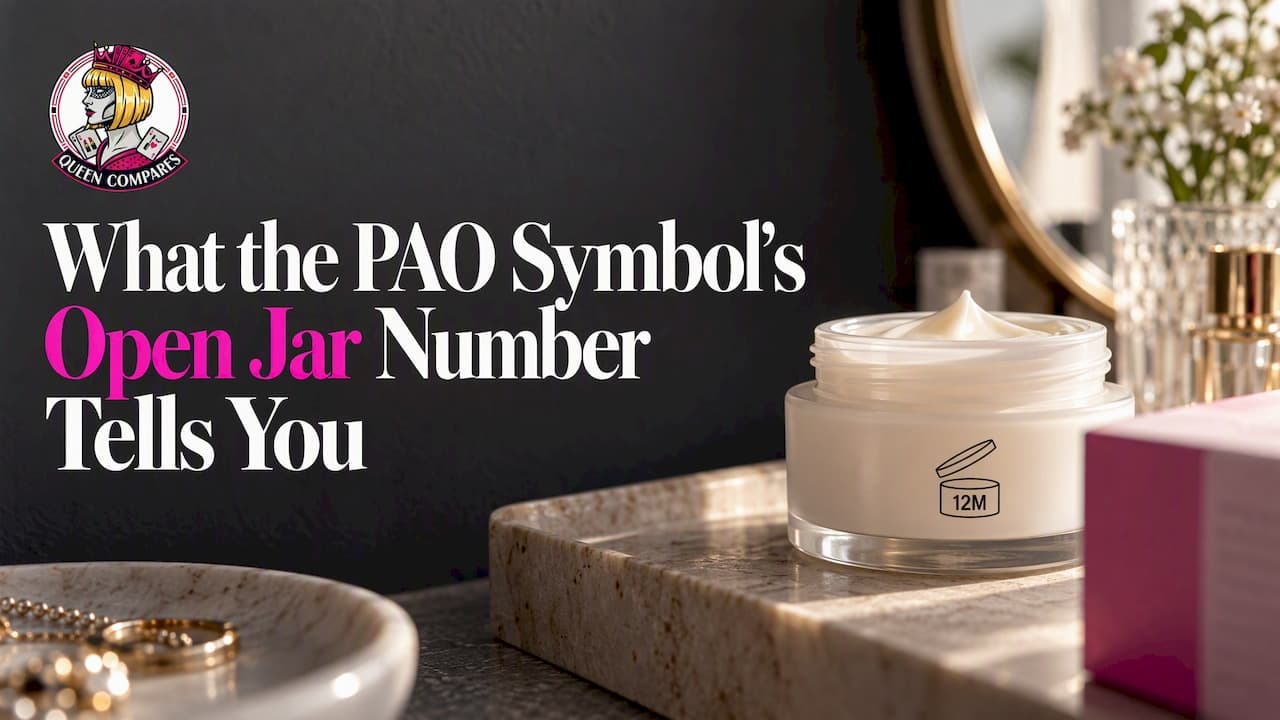
The PAO symbol is the small open jar printed on a cosmetic, usually with a number and the letter M inside it. PAO stands for “Period After Opening.” The number tells you how many months the product is meant to stay fit for use once you break the seal. A jar marked 12M is designed to be used within twelve months of opening. A jar marked 6M is designed to be used within six.
That is the short answer. The rest of this guide covers how to read the symbol, how it differs from an expiration date, what the rules look like in the U.S. compared with Europe and the U.K., and how to keep track of your own products so you actually use the number.
Key Takeaways
-
The PAO symbol is an open jar with a number of months (such as 6M or 12M) showing how long a product stays fit for use after you first open it.
-
PAO is not an expiration date. It starts the day you open the product, not the day it was made.
-
The U.S. has no federal law requiring expiration dates on most cosmetic labels, so many American products carry no PAO symbol at all. Sunscreens and acne treatments are different.
-
Heat, shared applicators and dirty containers shorten a product’s life, whatever the number says. Color or smell changes mean it is time to toss it.
-
Write the opening date on the container. It is the simplest way to make the symbol useful.
Table of Contents
-
PAO and face makeup: tinted moisturizers, foundations, BB and CC creams
-
Our perspective: a number is a good start, the ingredient list is the rest
What the PAO symbol looks like and what it stands for
The symbol is a graphic of an open cosmetics jar, followed by a period expressed in months and/or years, as the Irish Health Products Regulatory Authority (HPRA) describes it. Because it is a picture plus a number, it works in any language. You will see it on the back of a tube, on the base of a jar, or on the outer carton.
HPRA defines PAO as the length of time after opening during which a cosmetic is considered fit for consumer use. Industry guidance written for European compliance goes a step further. It describes the Period After Opening as the minimum time after opening during which a cosmetic can be used without harm, provided you use it as intended and store it correctly.
Those two conditions matter. The number assumes normal use and sensible storage. It is not a guarantee if the product spent a summer in a hot car.
How to read the number
The number in or beside the jar is the count of months. Brands explain it plainly: for example, ELEMIS says 6M and 12M mean six months and twelve months after opening. Some labels show years instead, such as 2Y.
Here is a quick reading guide:
| What you see | What it means |
|---|---|
| Open jar with 3M | Use within three months of opening |
| Open jar with 6M | Use within six months of opening |
| Open jar with 12M | Use within twelve months of opening |
| Open jar with 24M | Use within twenty-four months of opening |
The clock starts the first time you open the product. It does not pause if you put the jar in a drawer for a few weeks.
PAO vs. expiration date: two different clocks
People often treat these as the same thing. They are not.
An expiration date or unopened shelf life says when a product might lose potency or quality even if it has never been opened. The PAO says how long a product stays stable and safe after it is opened and used. In practice you may see both on one package: a date for the sealed product and an open jar for the opened one.
Why have a separate period for opened products? The industry guidelines explain that the PAO requirement was introduced as an additional information tool to help consumers optimize the in-use experience and safety of products that do not need standard expiration dates. Once air, fingers and water get into a formula, it starts to age differently than it did on the shelf.
A simple example: you buy a foundation in January with a 12M symbol and don’t touch it until June. The twelve months run from June, not January. But if the same bottle has a printed expiration date, you should respect that date too, whichever comes first.

For a deeper look at how long different categories tend to last once opened, see our guide to skincare shelf life.
Who decides the number?
The brand does, through testing and professional judgment. HPRA says minimum-durability and PAO figures are determined through testing, and the supporting evidence must be included in the product safety report. The European industry guidance adds that the responsible person sets the PAO through a reasoned assessment of data and experience, with no single scientific method. It also says the label must be applied where deterioration after opening could harm the consumer, with microbial stability a key factor.
What this means for you: PAO numbers are a brand’s informed estimate, not a lab stamp on your particular jar. Two similar products can carry different numbers because their formulas, preservatives and packaging differ. A pump bottle that keeps air and fingers out is a different situation from a wide jar you dip into daily.

Do you have to see a PAO symbol? It depends where you shop
In the United States
There is no U.S. federal law requiring expiration dates on cosmetic labels, though manufacturers are responsible for making sure their products are safe. So a lipstick or tinted moisturizer made for the U.S. market may show no PAO symbol at all. That does not mean it lasts forever. It just means you have to judge for yourself.
There is one important exception. Cosmetics that are also classified as drugs, such as those with sunscreen or acne treatments, must have expiration dates printed on their labels. That covers many CC creams, BB creams and tinted moisturizers with SPF. If yours lists SPF, look for a printed date.
In the European Union and Ireland
EU rules require information such as the PAO or best-before date in indelible, easily legible and visible lettering. HPRA states that a cosmetic with a minimum durability greater than 30 months requires a PAO symbol. In other words, products that last a long time sealed show the open jar instead of a “best before” date.
The requirement has limits. The EU regulation says it does not apply when durability after opening is not relevant, such as single-use products, products not at risk of deterioration, or products that do not open.
In Great Britain
British rules differ slightly. Cosmetic packaging must show a use-by date, with some exceptions such as single-application packs.
If you buy imported products
Shopping for K-beauty or European brands is a common reason American shoppers meet the open jar for the first time. If a product was made for another market, the symbol may be there even though U.S. law doesn’t ask for it. That is helpful. Treat it as the brand’s own guidance for that formula.
How to use the PAO number day to day
Knowing the symbol is easy. Using it takes a small habit.
-
Write the opening date on the product. The FDA notes that marking the container with the date you open it may help you keep track of its age. A fine-tip marker or a small label on the bottom of the jar works well.
-
Add the PAO months to that date. A 12M product opened in October is due for replacement the following October.
-
Group products by life span. Keep a short list or a note on your phone of what is due soon. Products with shorter numbers go in the front of the drawer.
-
Replace on schedule, or sooner if it looks or smells off. The number is a ceiling, not a target.
If your product has no PAO symbol and no date, a good approach is to note the day you opened it and use the symbol on similar products as a loose reference. Our skincare shelf life guide can help you set sensible expectations by product type.
Signs a product should go before the PAO says so
The symbol assumes ideal conditions. Real life is messier. The FDA advises that you throw away cosmetics if their color or smell changes, and throw away mascara if it becomes dry.
Other signs worth acting on:
-
The texture separates, turns grainy or looks watery when it used to be smooth.
-
The product causes stinging, redness or irritation that it did not cause before. Stop using it and see a dermatologist or your doctor if it persists, especially around the eyes.
-
You see visible spots or a film on the surface of a cream.
If you wear contact lenses, eye products deserve extra caution. Our guide to makeup for contact lens wearers covers rules that help prevent irritation.
Habits that shorten a product’s life
Heat is one of the biggest. The FDA warns that storing cosmetics in places with extreme heat, such as hot cars, can cause preservatives to break down and accelerate the growth of bacteria and fungi. A steamy bathroom shelf is not much better than a glove compartment for liquid foundation.
Contamination is the other. The FDA recommends that, to reduce it, you avoid sharing makeup, keep containers clean, and never add water or saliva to mascara. If you have recently had a professional facial or similar treatment, your skin may also be more sensitive to old or contaminated products, so reading about wearing makeup after a HydraFacial is a good idea before you reach for your usual routine.
Practical storage tips:
-
Keep products in a cool, dry drawer rather than on a sunny windowsill.
-
Close lids and caps firmly after every use.
-
Use a clean spatula or clean fingers for jars, and choose pumps or tubes when you can.
-
Wash brushes and sponges regularly.
-
When traveling, keep makeup out of the car. Our tips for a travel and commuting skincare routine help you simplify what you pack.
PAO and face makeup: tinted moisturizers, foundations, BB and CC creams
Face products are used daily, touched often and sit on skin for hours, so they are good candidates for a dated routine. Here is how to think about each, without relying on a single number, since every formula is different.
-
Tinted moisturizers: These blend skincare and light coverage. Many contain SPF. In the U.S., a product that makes an SPF claim is treated as a drug and must carry an expiration date, so check the label. Skip any SPF product past its date.
-
Foundations: Liquid foundations in pump bottles keep more air and fingers away than open jars. Look for the open jar number on imported bottles and write the opening date on any bottle.
-
BB creams and CC creams: Popular in K-beauty, these often arrive with a PAO symbol because they are made for markets where it is standard. If yours has one, follow it. If you buy one with SPF in the U.S., look for the expiration date too.
-
Cream and stick bases: These are touched directly, so keep tools clean and avoid sharing.
If you are choosing between formulas, ingredients matter as much as the number. Read our guide to what clean makeup means and the list of ingredients to avoid in makeup. If you have mature skin, our picks in the best makeup for mature skin guide will help you narrow things down.
Our perspective: a number is a good start, the ingredient list is the rest
We built Queen Compares for shoppers who want to understand what they are putting on their skin. The PAO symbol fits that goal, because it gives you one clear piece of information at a glance. But we see it as one clue, not the whole story.
Here is how we think about it. First, the PAO tells you about time. It does not tell you whether a formula suits your skin, contains an allergen you react to, or relies on preservatives you would rather avoid. Those answers live in the ingredient list. That is why we pair product comparisons with ingredient analysis, so you can see the formula and the label side by side.
Second, many shoppers, especially beginners, find labels confusing. A U.S. product may have no PAO. A K-beauty import may have three symbols you have not seen before. Our Ingredient Checker and Label Scanner exist to make that less intimidating, so you can scan a label and understand it without a chemistry degree.
Third, we believe in a small, dated routine. Fewer products, opened on purpose, labeled with a date, and replaced on schedule beat a drawer of half-used items you are not sure about. Shorter routines are easier to keep clean, too.
— Magdalena
Check the label and the formula together
If you want to go beyond the open jar, we can help. Our Ingredient Checker reviews skincare and makeup products with ingredient-level safety and allergen alerts. If you want paraben-conscious makeup picks, Find Clean Beauty Makeup with Premium Plan.
We have recently introduced the Build My Routine and Skincare Routine Progress Tracker features for our Premium Plan. These tools let you take photos, list the beauty products you use, and record notes to track your skincare progress effectively.

You can also browse products by ingredient if you are trying to avoid a specific one, or explore the Queen Compares home page for side-by-side comparisons and community reviews. Our AI Label Scanner is built for the moment you are standing in front of an unfamiliar label.
Quick reference: PAO symbol cheat sheet
-
Open jar + number + M: months of use after opening.
-
Open jar + number + Y: years of use after opening.
-
Date printed on the package: the unopened shelf life or expiration, which still applies.
-
No symbol at all: common on U.S. cosmetics. Date it yourself and watch for changes in smell, color and texture.
-
SPF or acne treatment: in the U.S., should carry an expiration date.
For wider context on the rules that govern cosmetics in the U.S., see our overview of FDA cosmetic regulations and MoCRA.
FAQ
What does PAO stand for in cosmetics?
PAO stands for “Period After Opening.” It is the length of time after you first open a cosmetic during which it is considered fit for consumer use. It appears as an open jar icon with a number of months.
What does a PAO symbol look like?
It is a small drawing of an open cosmetic jar with a number and usually the letter M inside or beside it, such as 12M. It often sits on the bottom or back of the package. Some labels use Y for years.
Is the PAO the same as an expiration date?
No. The expiration date or shelf life refers to the product as made and sealed. The PAO starts counting when you open it. If a product shows both, follow whichever date arrives first.
Do U.S. cosmetics need a PAO symbol?
No. There is no U.S. federal law requiring expiration dates on most cosmetics, so many products show no PAO. Products that are also drugs, such as sunscreens and acne treatments, must carry an expiration date.
What should I do if my product has no PAO symbol?
Write the date you open it on the container and replace it if the smell, color or texture changes. Keep it away from heat and avoid sharing it. Use the symbol on similar products as a loose guide.
Sources
Recommended
General Entertainment & Information Purposes Only At QueenCompares.com we share content for general entertainment and information. It’s not medical, dermatological, nutritional, or fitness advice and shouldn’t replace guidance from a licensed professional. If you’re making health-related decisions, please check with a qualified expert — and know that using this site and its information is at your own discretion.