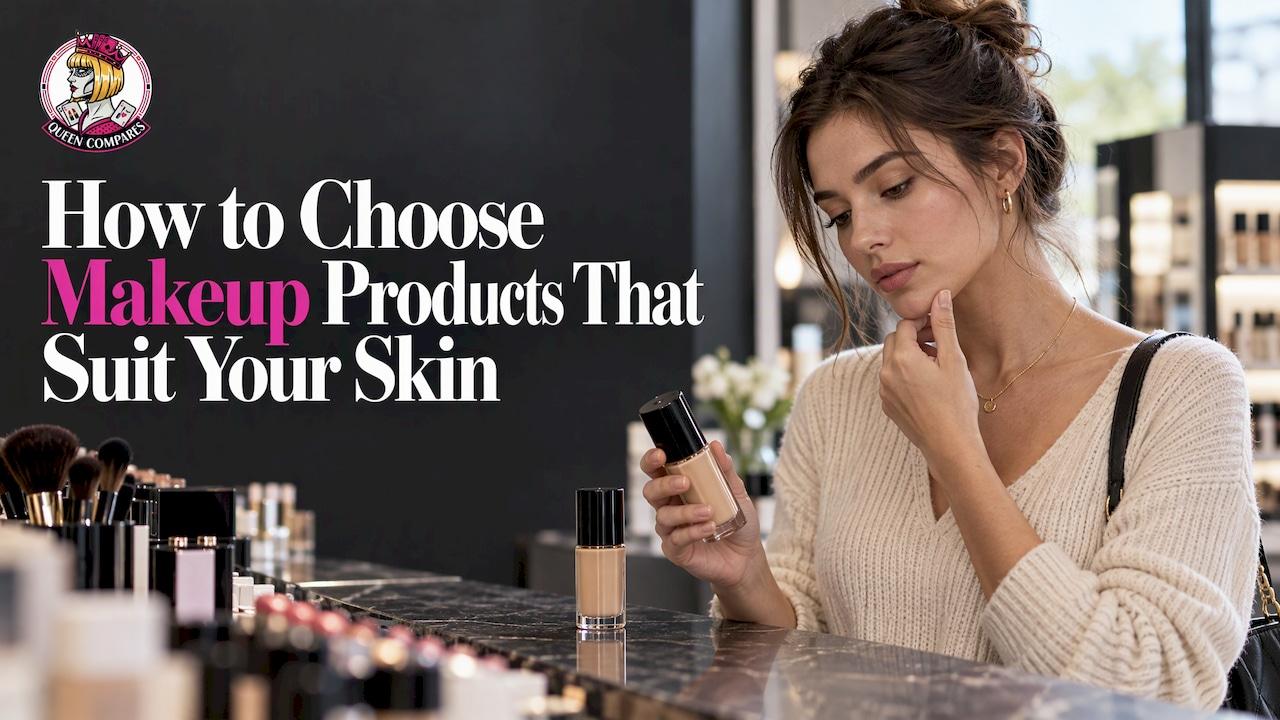
The best way to choose makeup products is to work in a fixed order: identify your skin type and undertone, pick the formula and finish that suit them, read the ingredient list, then compare two or three candidates side by side before you buy. Most bad purchases skip one of those steps. A foundation that looks perfect on a shelf can slide off oily skin by noon, and a “gentle” concealer can still carry the one fragrance your skin reacts to. Below you’ll find each step, with the points where shoppers most often go wrong.
- ✓Compare beauty products side by side
- ✓Evaluate ingredient safety
- ✓Read user-generated reviews
Key Takeaways
-
Start with your skin type and undertone, not with a brand or a trend. They decide which formula and shade family will work.
-
Formula and finish matter more than price tier: liquid, cream, powder and balm behave differently on dry, oily and combination skin.
-
Read the whole label. The FDA notes that “hypoallergenic” and “natural” have no formal meaning for safety, so the ingredient list is your real evidence.
-
Compare candidates on the same criteria: ingredients, coverage, finish, wear and cost per use.
-
Buy from the brand or a reputable retailer, and note the date you open each product.
Table of Contents
Step 1: Know your skin type and undertone
Everything else depends on this. A university makeup guide from UC Santa Barbara maps skin types to products in a simple way:
-
Dry skin (tightness, flaking) suits cream-based, dewy finishes.
-
Oily skin (shine through the T-zone) suits powder and matte finishes.
-
Combination skin (oily T-zone, drier cheeks) does best with dewy products on dry areas and matte on oily ones.
Combination skin is the most common type, according to cosmetic dermatologist Dr. Sam Bunting, quoted in Grazia USA’s foundation testing feature. Her advice is to treat each zone of the face with a different texture rather than forcing one formula everywhere. For oily skin, the same article points out that dewy formulas tend to migrate as oil reaches the surface, which is why a base can seem to disappear.
Undertone is the second half. It is the color beneath your skin’s surface, separate from how light or deep you are. The UCSB guide gives quick hints: blue-looking veins and silver jewelry flattering you point to a cool undertone, which pairs with pink, berry and blue-based reds. Greenish veins and gold jewelry point to warm, which pairs with peach, coral and golden shades. If you can’t tell, you’re likely neutral or olive, and balanced peach, rose and coral shades usually work.
Sensitive skin is a third category. Dermatologists quoted by CNN Underscored name fragrance, alcohol, dyes and some preservatives as more likely irritants, and suggest choosing products with fewer ingredients.
Step 2: Pick the formula and finish
Formula is the physical form of the product. Finish is how it looks on skin: matte, satin, dewy or glowy. Choose the finish you want first, then check that the formula can deliver it on your skin type. Our guide to how finish types differ in makeup goes deeper, and matte vs. dewy foundation walks through the choice.
A quick summary of the main formats, based on a makeup artist’s breakdown of formulations:
| Formula | Typical finish and coverage | Best for |
|---|---|---|
| Powder | Matte, light to medium coverage, absorbs oil | Oily skin |
| Liquid | Buildable coverage, dewy or satin | Dry skin, most skin types |
| Cream | Slightly heavier coverage, dewy | Dry, normal and combination skin |
| Balm | Very hydrating, lighter coverage | Dry or sensitive skin |
For combination skin, a common approach is liquid on the dry areas and powder on the oily zones. For acne-prone skin, the same artist suggests a non-comedogenic liquid foundation. “Non-comedogenic” means formulated not to clog pores.
Base products: foundation, tinted moisturizer, BB cream and CC cream
These four are often confused, and the choice mostly comes down to how much coverage you want.
-
Foundation gives the widest range of coverage. In formulation terms, coverage is tied to pigment load: sheer is under 5% pigment, light is 5 to 10%, medium is 10 to 15% and full coverage is above 15%. Medium coverage evens out freckles and redness, while full coverage is the level that covers scars or birthmarks.
-
Tinted moisturizer is a good first base if you are a beginner. It sits at the sheer end, evens out tone and keeps skin looking like skin.
-
BB cream combines light coverage with skincare-style benefits. A UK retailer’s buying guide suggests BB creams for dry skin that should avoid full-coverage, long-wear formulas.
-
CC cream is aimed at color correction, such as redness or dullness, at light to medium coverage.
If you’re after a K-beauty look, BB and CC creams and cushion-style bases are the natural place to begin, because they give a fresh, skin-like finish without much layering.
Step 3: Test your shade the right way
Shade mistakes are the most common reason a good product ends up in a drawer. Three habits help:
-
Match undertone first, depth second. A shade can be the right depth and still look gray or orange if the undertone is off.
-
Swatch on your jawline, not your hand, and check it in daylight.
-
Consider a “foundation wardrobe.” The UK guide above quotes makeup artist Johnson-King recommending a darker and a lighter tone so you can adjust for seasons and for shading.
When you buy online, use the brand’s shade guide and any virtual try-on tool, and check the return policy before you pay.
Step 4: Read the ingredient list like a pro
The label is where marketing stops and facts begin. The FDA’s guidance on using cosmetics safely advises reading the entire label, ingredients and warnings included. It also says that “hypoallergenic” is not a defined term, so such a product can still cause a reaction, and that “organic” or “natural” sourcing does not by itself determine safety. There is no formal USDA or FDA definition of “natural.”
Here is what to look for:
-
Order matters. Ingredients are listed from highest to lowest concentration, so what appears first is present in the largest amount.
-
Your triggers. Healthline lists common irritants: fragrance (synthetic and natural), certain preservatives, retinol, alpha hydroxy acids and essential oils. If you know what you react to, scan for it every time.
-
Pore-clogging risk. A 2021 dermatology review describes non-comedogenic products as having a comedogenic rating of 2 or less, and says teens prone to acne should avoid makeup scoring 3 to 5. Our list of the five worst pore-clogging ingredients shows what to look for.
The American Academy of Dermatology says people with acne can wear makeup if they choose products labeled “oil-free,” “won’t clog pores” or “non-comedogenic,” remove all makeup before bed, and clean brushes weekly. For persistent breakouts, see a board-certified dermatologist.
Where our tools save you time
Reading a 40-item label on a tiny box is slow. Our Ingredient Checker and Label Scanner analyze a product’s ingredients and surface safety and allergen alerts, so you can see what’s in a formula before you buy. The Ingredient Analysis gives the detail behind each flag. If you want a deeper checklist first, read how to avoid harmful ingredients in your makeup and ingredients to avoid in makeup.
Step 5: Compare products side by side
Once two or three products pass the skin type and ingredient checks, compare them properly. A simple comparison grid keeps you honest:
| Criterion | What to check |
|---|---|
| Ingredients | Your known triggers, fragrance, how short or long the list is |
| Coverage | Sheer, light, medium or full, and whether it builds |
| Finish | Matte, satin or dewy, and whether it suits your zones |
| Wear | How it holds through oil and sweat over a day |
| Value | Price divided by how long the product lasts in your routine |
On wear, industry formulation guidance says a foundation is expected to last roughly 5 to 16 hours, stay comfortable and resist sweat and sebum. Use that as a yardstick when you read reviews.
Price tier is a weak shortcut. Formulation quality, including how much of an active is used and how ingredients work together, shapes performance more than the price tag, according to a 2026 beauty guide. That’s good news if you want a dupe: a drugstore product with a similar ingredient profile, finish and shade range can do the same job as a pricier one. Compare the ingredient lists of the original and the dupe, then compare finish and coverage.
On Queen Compares you can put products next to each other and read community reviews alongside the ingredient analysis, which is the quickest way to run this grid. If you want a curated starting point for clean options, browse the Clean Beauty Catalogue.
Step 6: Use reviews and retailers wisely
Reviews help only when you read them with a filter. AARP’s 2026 guide to online beauty shopping suggests:
-
Favor reviews from the last 6 to 10 months, since formulas change.
-
Look for reviewers in your age bracket.
-
Read the recent negative reviews for complaints about color, texture or performance.
The same article warns that large marketplaces rely on third-party sellers who may pass off counterfeit, expired or badly stored beauty products. Warning signs include misspelled labels, a missing expiration date and an odd smell or texture. Shop the brand’s own site or a reputable retailer, or the brand’s official storefront on a marketplace.
Step 7: Build a simple routine as a beginner
If you’re new to makeup, don’t buy ten products at once. A four-product starter kit covers most days:
-
A base: a tinted moisturizer, BB cream or CC cream in light coverage.
-
Concealer: only where you need it, one shade matched to your undertone.
-
Cheek color: a cream blush for dry skin or a powder blush for oily skin.
-
Mascara or brow product: whichever makes the biggest difference to you.
Add a primer or a full-coverage foundation only when you’ve identified a specific problem it solves. Keep the skincare underneath simple and consistent, since makeup sits better on well-prepared skin. If you want help with that part, the Skincare Routine Builder creates a routine around your skin needs for €7 per month.
For clean or low-tox alternatives, look for formulas with short ingredient lists and no fragrance. A vegan makeup collection is one place to see what plant-based face, lip and lash products look like. If you wear contact lenses, read our contact lens makeup rules before choosing eye products, and if your skin is mature, see the best makeup for mature skin.
Use and store makeup safely
A good choice can still go wrong at home. The FDA advises you to:
-
Never share makeup.
-
Keep containers clean and tightly closed, away from temperature extremes.
-
Discard products whose color or smell changes.
-
Never add saliva or water to mascara.
The law doesn’t require cosmetics to carry expiration dates, so write the date you open each product on it. Our guide to skincare shelf life covers how long common products last.
When trying something new, do a patch test first. Our patch testing guide shows how. If you react to a product you used before without trouble, dermatologists quoted by CNN Underscored suggest trying a fresh bottle before blaming the formula, because contamination can be the cause. To find a culprit, introduce products one at a time.
Our perspective
Most people choose makeup by shade swatch and packaging, and then wonder why a product irritates them or fades by lunchtime. We think the better habit is to read the formula first. The same ingredient list that tells you whether a product suits oily, dry or sensitive skin also tells you whether a cheaper alternative could do the job.
That’s why we built Queen Compares around ingredient-level analysis, side-by-side comparisons and community reviews. When you can see safety and allergen alerts next to real shoppers’ experiences, a purchase stops being a guess. Our AI-driven Ingredient Checker and Label Scanner do the label reading for you, and our clean beauty picks give you a place to start.
You don’t need a bigger budget to shop well. You need better information at the moment you decide.
Magdalena
Take the guesswork out of your next purchase
If you want to check a formula before you pay for it, use our Ingredient Checker and Label Scanner and browse the Clean Beauty Catalogue for picks that have been analyzed ingredient by ingredient. For ongoing tools, Premium Access is €7 per month, and it includes Skincare Routine Progress , you want to track how your skin responds to what you buy.

See everything on Queen Compares.
FAQ
What should I look for when buying makeup?
Start with your skin type and undertone, then choose a formula and finish that suit them. Read the full ingredient list for your known triggers, check the return policy, and buy from the brand or a reputable retailer. Compare two or three candidates before you commit.
How do I compare makeup formulas?
Use the same five criteria for each product: ingredients, coverage, finish, wear and value. Powder suits oily skin, liquid and cream suit dry and normal skin, and combination skin often needs both. Reviews from the last 6 to 10 months tell you how the current formula performs.
Are “clean,” “natural” and “hypoallergenic” makeup labels reliable?
Not on their own. The FDA says “hypoallergenic” has no defined meaning and that there’s no formal USDA or FDA definition of “natural.” The ingredient list is a better guide, and an ingredient analysis can show you which items to avoid for your skin.
What’s the difference between BB cream and CC cream?
Both give light to medium coverage with a skin-like finish. BB creams lean toward skincare-style benefits such as hydration, while CC creams are aimed at correcting tone issues like redness or dullness. A tinted moisturizer is the sheerest of the three and works well for beginners.
How can I find a good dupe for an expensive product?
Compare the ingredient lists, finish and coverage of both products, not the price. Formulation quality matters more than price tier, so a lower-priced product with a similar profile and shade range can perform the same way. Check the shade match in daylight before deciding.
Sources
-
Foundation formulation: types, coverage and materials, UL Prospector
-
An investigation of makeup ingredients and their effects on acne
-
Color foundation and base formulas deciphered, Cosmetics & Toiletries
-
How experienced beauty buyers navigate shopping online, AARP
Recommended
General Entertainment & Information Purposes Only At QueenCompares.com we share content for general entertainment and information. It’s not medical, dermatological, nutritional, or fitness advice and shouldn’t replace guidance from a licensed professional. If you’re making health-related decisions, please check with a qualified expert — and know that using this site and its information is at your own discretion.